

Coordinate geometry of the circle bridges algebra and geometry by turning circular paths into equations on the Cartesian plane. In Leaving Certificate Higher Level Mathematics, Paper 2 routinely tests your ability to move between standard and general circle forms, determine whether lines intersect or touch a circle, construct tangent equations, and analyse circles that touch each other or the coordinate axes.
Standard Form and General Form
A circle is defined as the set of all points that sit at a fixed radius length from a fixed centre point. When the centre is the origin , applying Pythagoras' theorem gives . Learn this equation and understand where it comes from (the distance from the centre is always r). Check your own copy of the Formulae and Tables booklet to see which circle formulas it lists.
When the centre shifts to , the distance formula gives the standard form . Notice how the signs flip inside the brackets: an equation reading has centre and radius .
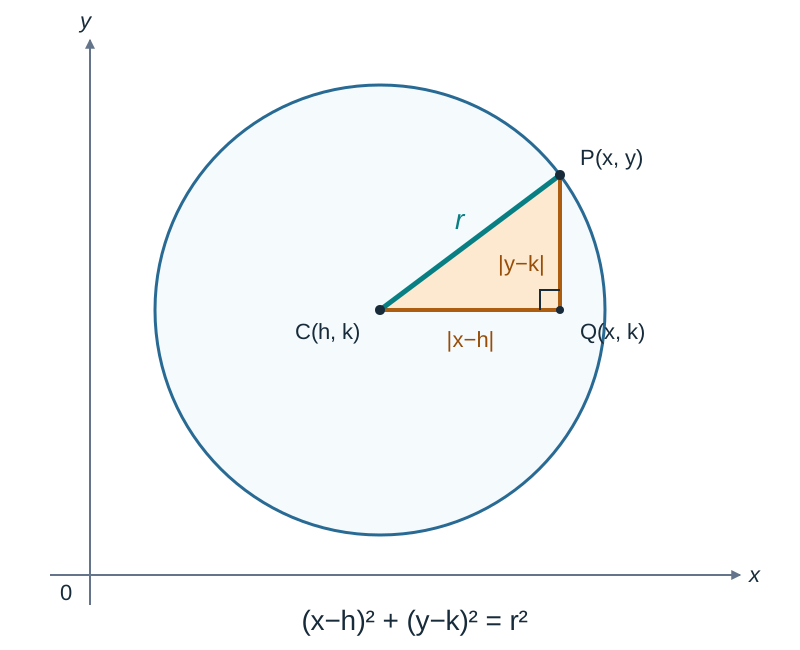
Expanding gives . This expansion is usually written in the general form:
Comparing coefficients shows that and , so the centre is . The constant term is , which rearranges to give the radius . Before extracting , , or , always divide across by any common coefficient attached to and so that both squared terms start with .
Testing Points and Axis Intercepts
To determine whether a point sits inside, outside, or on a circle, you compare its distance from the centre with the radius. When working with the standard form, substitute the point into . If the result is less than , the point is inside; if it equals , it lies on the boundary; if it exceeds , it is outside.
If the circle is given in general form, substitute the point directly into the expression . A negative value means the point is inside, zero means on the circle, and a positive value means outside. For example, testing in gives , confirming that is outside.
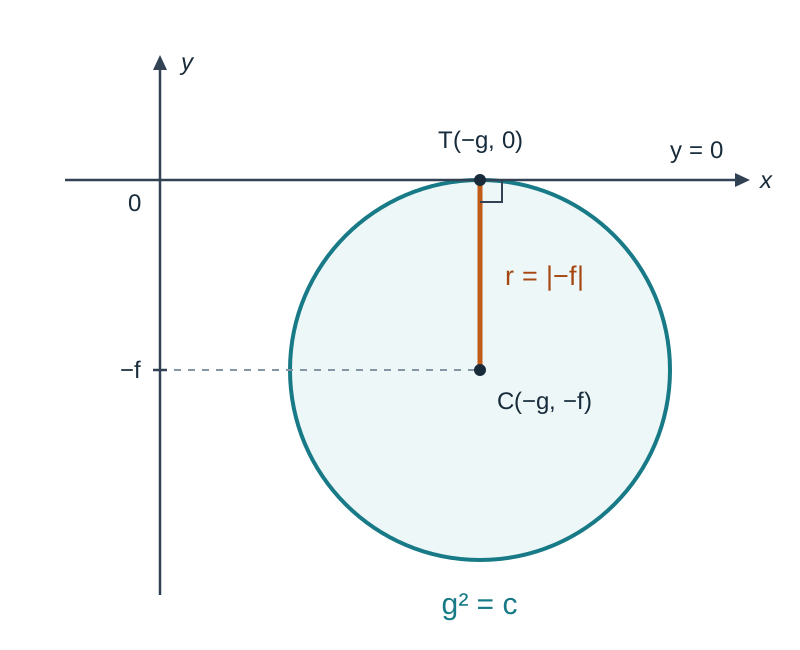
To find where a circle crosses the coordinate axes, set the opposing coordinate to zero. Letting leaves a quadratic in whose solutions are the -intercepts. Similarly, setting yields the -intercepts. When a circle touches the -axis, the radius equals , so , which simplifies to the useful condition .
Lines and Circles: Intersections and Tangency
A line and a circle can cross at two distinct points, touch at one single point of contact as a tangent, or miss each other entirely. You can find exact intersection points by rearranging the linear equation for one variable, substituting that expression into the circle equation, solving the resulting quadratic equation in one variable, and substituting each solution back into the line equation to find the matching co-ordinate.
For example, to find where the line meets the circle :
- From the line, express in terms of : .
- Substitute into the circle equation: , which gives , or .
- Factorise: , so or .
- Substitute back into : , and . The points of intersection are and (check: ).
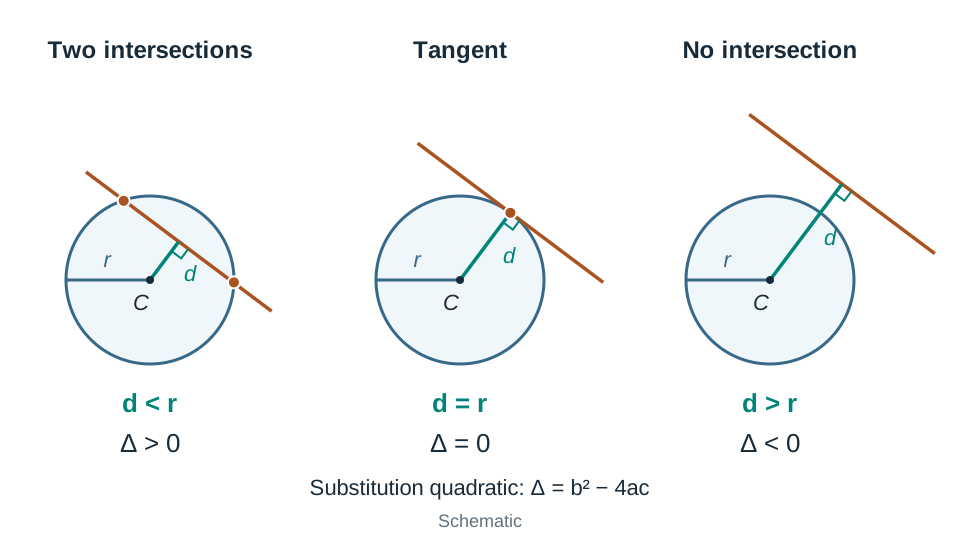
The quadratic discriminant tells you the geometric arrangement without needing to find the coordinates. If , the line crosses the circle twice. If , the line is a tangent touching at one point. If , the line does not meet the circle.
When a problem asks you to prove tangency or find an unknown constant, using the perpendicular distance formula is almost always faster than algebra substitution. A straight line is tangent to a circle if and only if the perpendicular distance from the centre to the line equals the radius :
Constructing Tangent Equations
Finding a tangent depends on whether the given point lies on the circle or outside it. By geometric theorem, every tangent line is perpendicular to the radius drawn to the point of contact.
If the point of contact is on the circle, first find the slope of the radius connecting the centre to that point using . The tangent slope is its negative reciprocal, . Then write the line equation using .
If the point lies outside the circle, write the tangent as an unknown line through that point: , which rearranges to . Apply the perpendicular distance formula from the centre to this line and set it equal to . Squaring both sides produces a quadratic equation in , yielding the two tangent slopes that pass through that external point.
Touching Circles and Tangent Lengths
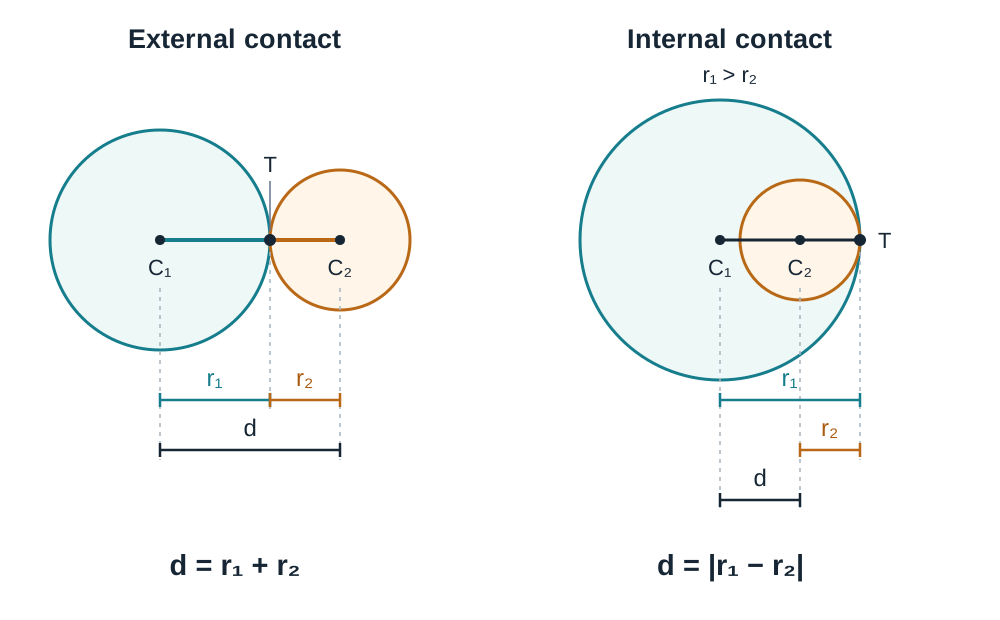
Two circles touch each other when their boundaries meet at exactly one point. You test this by calculating the distance between their centres and comparing it with their radii and .
For external contact, the two circles sit outside each other and touch at a single point between their centres. This occurs when . For internal contact, one circle sits inside the other, which occurs when . In an exam, state both values explicitly and finish with a concluding sentence showing that they match.
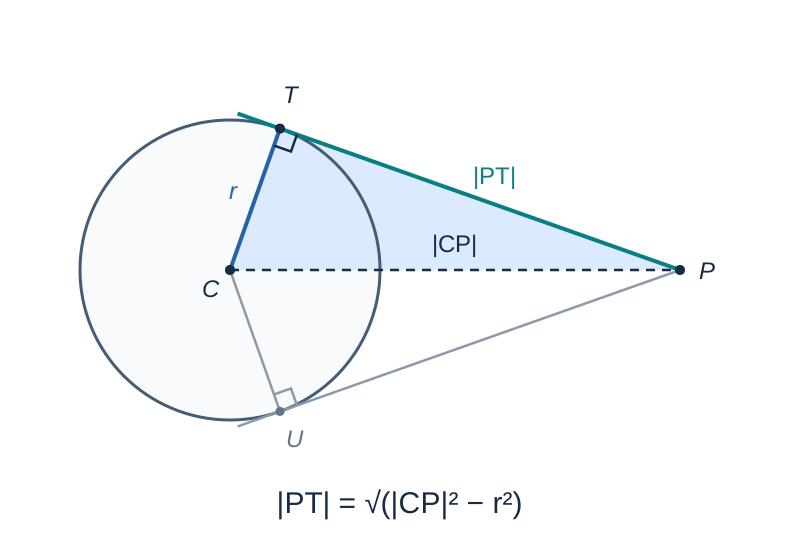
Another classic exam question asks for the length of a tangent drawn from an external point to a circle with centre and radius . Because the radius to the contact point meets the tangent at , triangle is right-angled at . Pythagoras' theorem gives , so the tangent length is .
Key terms
- Standard Form
- The circle equation , where is the centre and is the radius.
- General Form
- The circle equation , with centre and radius .
- Point of Contact
- The single point where a tangent line touches a circle, forming a right angle with the radius drawn to that point.
- Perpendicular Distance
- The shortest distance from a point to a straight line; a line is tangent to a circle if and only if this distance from the centre equals the radius.
- External Contact
- The geometric condition where two separate circles touch at one boundary point, satisfying .
- Internal Contact
- The geometric condition where one circle sits inside another and touches it at one point, satisfying .
Check yourself
What are the centre and radius of the circle ?
Divide by 2 to get . Here , , and . The centre is and the radius is .
Determine whether the point lies inside, outside, or on the circle .
Substitute the point into : . Because the value equals , the point lies exactly on the circle.
Two circles have radii of 8 and 3, and their centres are 5 units apart. Do they touch externally or internally?
They touch internally because the distance between their centres equals the difference between their radii: .
What algebraic condition links and when the circle touches the -axis?
The radius equals the distance to the -axis, meaning . Since , setting this equal to gives .