

Complex numbers extend the real number system to allow for solutions to equations like x² + 1 = 0. A complex number is written as z = a + bi, where 'a' is the real part and 'b' is the imaginary part. We use i to represent the imaginary unit, defined as i² = -1. This topic includes plotting on an Argand diagram, polar form representation, using De Moivre's Theorem for powers, roots, and proofs, and solving polynomials using the Conjugate Root Theorem.
Arithmetic and the Argand Diagram
A complex number is z = a + bi. To add or subtract, combine real and imaginary parts separately. To multiply, expand the brackets and replace i² with -1, e.g. (1 + 2i)(3 - i) = 3 - i + 6i - 2i² = 5 + 5i. The conjugate of z = a + bi is z̄ = a - bi (written "z bar"), which is the reflection of z across the real axis. The conjugate of a sum is the sum of the conjugates, and the conjugate of a product is the product of the conjugates. For example, the conjugate of (1 + 2i)(3 - i) = 5 + 5i is 5 - 5i, and (1 - 2i)(3 + i) = 5 - 5i. To divide, multiply the numerator and denominator by the conjugate of the denominator, expanding (a + bi)(a - bi) = a² + b² to ensure a real denominator. The Argand diagram represents z = a + bi as the point (a, b). The modulus r = |z| = √(a² + b²) is the distance from the origin. The argument (arg z) is the angle measured anticlockwise from the positive real axis. Angles measured clockwise are negative; for example, 1 − i has argument −π/4 (equivalently 7π/4).
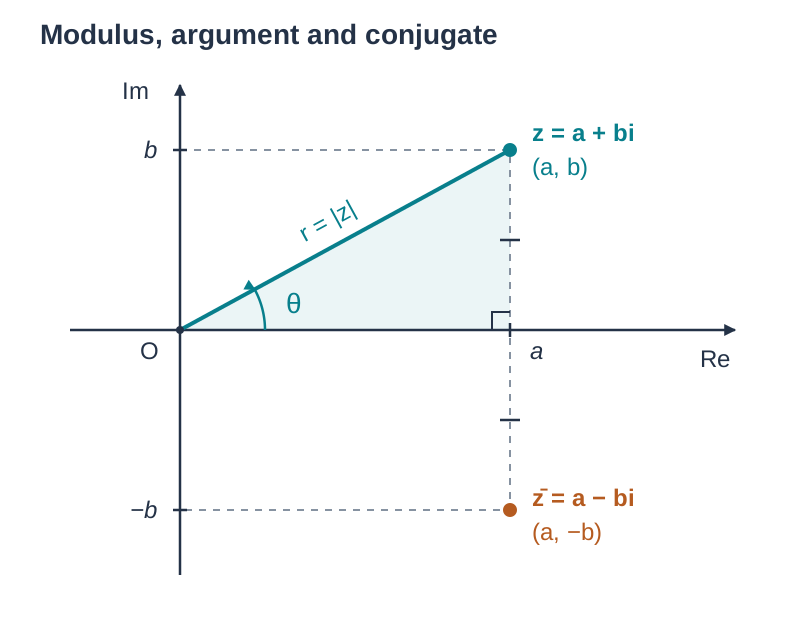
Polar Form
A complex number can be written in polar form as z = r(cos θ + i sin θ). To convert a + bi to polar form: 1. Plot the point to determine the quadrant. 2. Calculate r = √(a² + b²). 3. Find the reference angle α = tan⁻¹|b/a|. 4. Adjust α for the quadrant (Q1: θ=α, Q2: θ=π-α, Q3: θ=π+α, Q4: θ=2π-α (or -α)). Always check the quadrant before setting the argument.
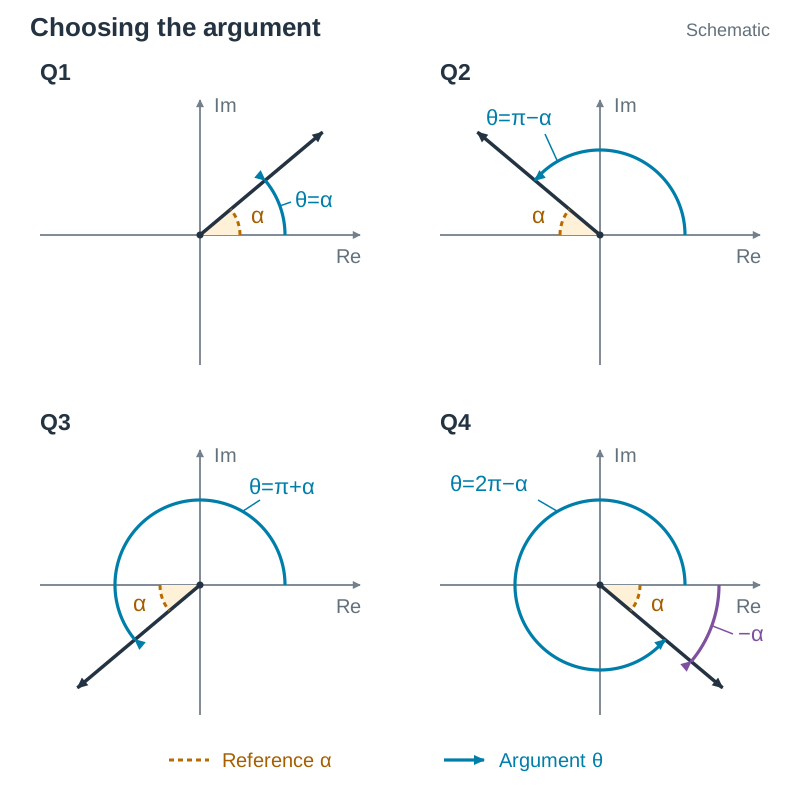
De Moivre's Theorem: Powers and Identities
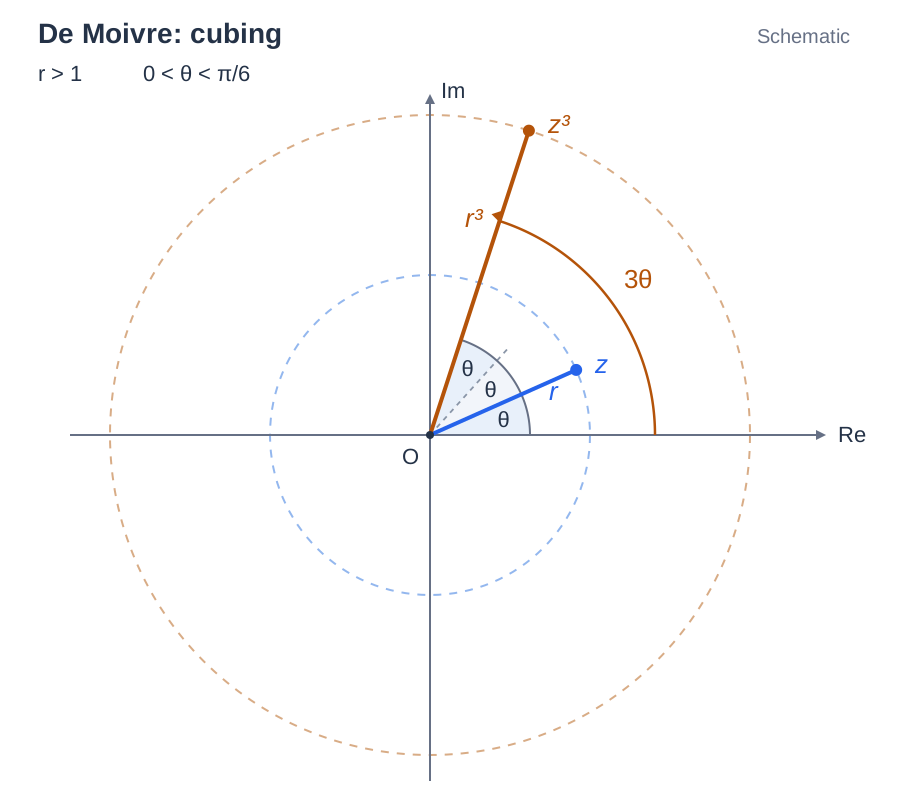
De Moivre's Theorem states [r(cos θ + i sin θ)]ⁿ = rⁿ(cos nθ + i sin nθ). For powers, raise r to the power n and multiply θ by n. For identities (like cos 3θ), expand (cos θ + i sin θ)ⁿ using the Binomial Theorem and equate real/imaginary parts. For example, to find cos 3θ, let c = cos θ and s = sin θ: (c + is)³ = (c³ - 3cs²) + i(3c²s - s³). By De Moivre's Theorem, this equals cos 3θ + i sin 3θ. Equating real parts gives cos 3θ = c³ - 3cs². Substituting s² = 1 - c² yields cos 3θ = c³ - 3c(1 - c²) = 4cos³θ - 3cos θ. For proof by induction for n ∈ N: 1. Base case (n = 1): (cos θ + i sin θ)¹ = cos 1θ + i sin 1θ, which is true. 2. Inductive step: Assume true for n = k, so (cos θ + i sin θ)ᵏ = cos kθ + i sin kθ. Multiply both sides by (cos θ + i sin θ): (cos θ + i sin θ)ᵏ⁺¹ = (cos kθ + i sin kθ)(cos θ + i sin θ). Expand and use i² = -1 to get (cos kθ cos θ - sin kθ sin θ) + i(sin kθ cos θ + cos kθ sin θ). Apply compound angle formulae cos(A + B) and sin(A + B) to obtain cos(k + 1)θ + i sin(k + 1)θ. 3. Conclusion: True for n = 1, and true for n = k + 1 when true for n = k, so true for all n ∈ N.
Roots of Complex Numbers
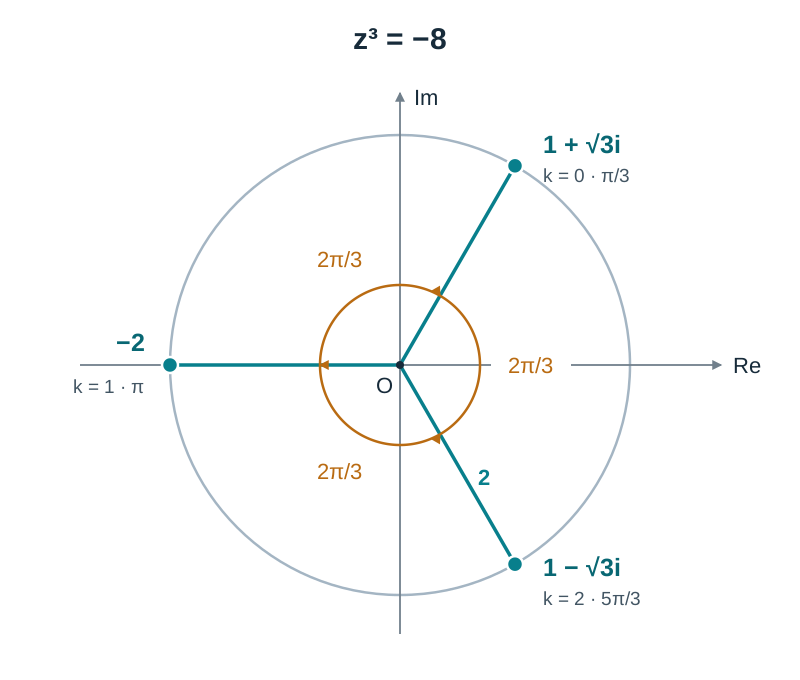
To solve zⁿ = w, use the general polar form w = r(cos(θ + 2kπ) + i sin(θ + 2kπ)) for k ∈ Z. Take the nth root: z = r^(1/n)(cos((θ + 2kπ)/n) + i sin((θ + 2kπ)/n)). Substitute k = 0, 1, ..., n-1 to find all n distinct roots. All n roots lie on a circle centred at the origin with radius r^(1/n), spaced 2π/n apart. When w = 1 they are called the nth roots of unity and lie on the unit circle. For example, to solve z³ = -8: write -8 = 8(cos(π + 2kπ) + i sin(π + 2kπ)); then z = 2(cos((π + 2kπ)/3) + i sin((π + 2kπ)/3)). Setting k = 0, 1, 2 gives the three roots: 2(cos(π/3) + i sin(π/3)) = 1 + √3i, 2(cos π + i sin π) = -2, and 2(cos(5π/3) + i sin(5π/3)) = 1 - √3i.
Polynomials and the Conjugate Root Theorem
The Conjugate Root Theorem states that if a polynomial has real coefficients, non-real roots always occur in conjugate pairs (a ± bi). If b² - 4ac < 0, a quadratic has two non-real conjugate roots; for example, z² - 6z + 13 = 0 gives z = (6 ± √-16)/2 = 3 ± 2i. Given a complex root, identify its conjugate, form the quadratic factor z² - (sum of roots)z + (product of roots) = 0, and use long division or the Factor Theorem to find the remaining roots. Two complex numbers are equal if and only if their real parts match and their imaginary parts match.
Key terms
- Modulus
- The distance of a complex number from the origin on an Argand diagram, |z| = √(a² + b²).
- Argument (arg z)
- The angle from the positive real axis to z, measured anticlockwise. Angles measured clockwise are negative; for example, 1 − i has argument −π/4 (equivalently 7π/4).
- Conjugate (z̄)
- For z = a + bi, the conjugate is z̄ = a - bi.
- De Moivre's Theorem
- A formula relating powers of complex numbers to trigonometry: [r(cos θ + i sin θ)]ⁿ = rⁿ(cos nθ + i sin nθ).
- Conjugate Root Theorem
- If a polynomial with real coefficients has a root a + bi, then a - bi is also a root.
- Factor Theorem
- If f(k) = 0, then (z - k) is a factor of the polynomial f(z).
Check yourself
What is the conjugate of -3 + 4i?
-3 - 4i
Write 1 - i in polar form.
4th quadrant; r = √(1² + 1²) = √2; α = tan⁻¹(1) = π/4, so θ = −π/4. Answer: √2(cos(−π/4) + i sin(−π/4)).
If 2 - i is a root of z² + pz + q = 0 (p, q ∈ R), what are p and q?
Conjugate 2 + i is also a root. Sum = 4 and product = 4 + 1 = 5, so z² - 4z + 5 = 0, which gives p = -4 and q = 5.