

Financial Mathematics applies algebra and geometric series to everyday money management. The central idea is the time value of money: cash available right now is worth more than the same cash in the future because it can earn interest. At Higher Level, you will use this principle to calculate compound growth, work out reducing-balance depreciation, model savings plans, derive the loan amortisation formula, and calculate income tax.
Compound Interest and Rates
Compound interest means you earn interest on both your starting principal and any interest that has accumulated in earlier periods. The standard formula from page 30 of your Formulae and Tables booklet is:
Here, is the final accumulated value, is the principal or present value, is the interest rate per compounding period as a decimal, and is the number of compounding periods.
When a bank lends money, it quotes an Annual Percentage Rate (APR), which reflects the true yearly borrowing cost. When a financial institution pays you for saving, it quotes an Annual Equivalent Rate (AER). You can also see AER written as CAR (Compound Annual Rate) or EAR (Equivalent Annual Rate). Despite having different names, both rates follow the same underlying mathematics.
Very often, payments happen monthly rather than yearly. You cannot simply divide an annual rate by 12 because that ignores monthly compounding. Instead, equate the annual growth factor to twelve compounding monthly periods:
Solving for the monthly rate gives:
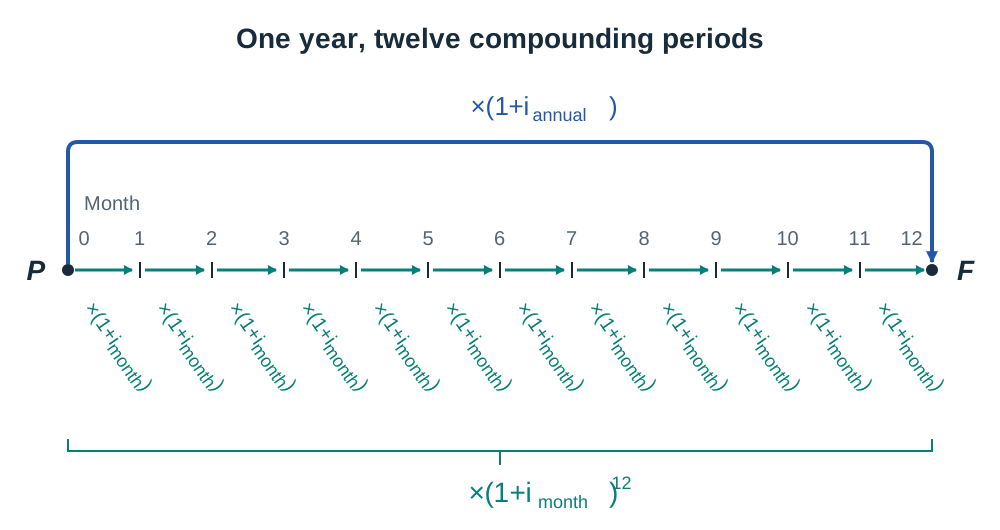
Store the full, unrounded rate in your calculator memory and round only the final answer.
Reducing-Balance Depreciation
Physical assets such as vehicles, computers, and factory machinery lose value over their useful lives due to wear, tear, and obsolescence. Under the reducing-balance method, an asset loses a fixed percentage of its current book value each year, rather than a fixed euro amount.
The formula from page 30 of the Formulae and Tables booklet is:
In this formula, represents the original purchase cost, is the depreciation rate written as a decimal, is time in years, and is the net book value (NBV) at the end of years. Because the percentage is applied to a shrinking balance each year, the euro depreciation drops as the asset ages.
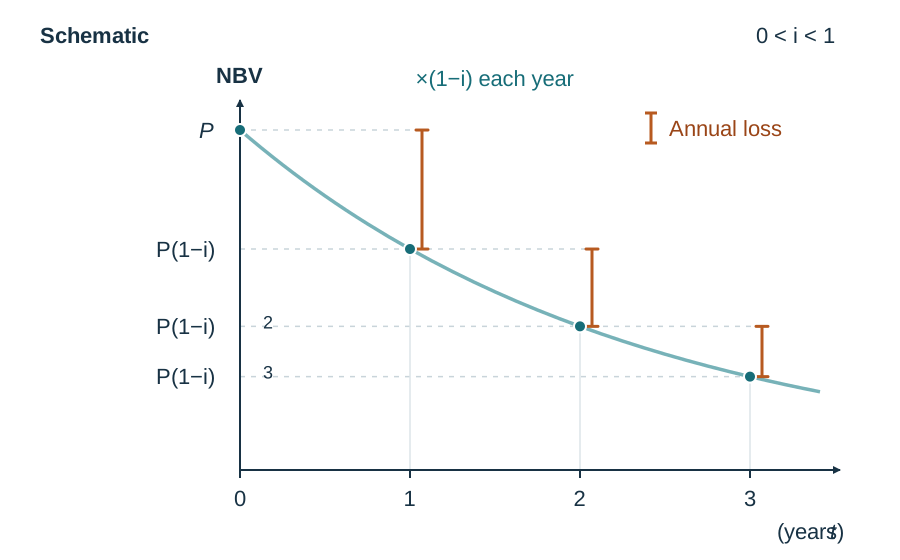
If an exam question asks for the total depreciation written off across the full period, subtract the final net book value from the original cost:
When an exam gives you the final net book value and asks for the original cost, rearrange the equation to isolate :
If you need to find how many years have passed, divide both sides by and take natural logs of both sides to bring the exponent down.
Loans and Amortisation
Amortisation means paying off a debt through regular, equal instalments over an agreed number of periods . The core rule is straightforward: the initial loan amount must equal the sum of the present values of all future repayments.
Assuming the first repayment happens at the end of the first period, we write out the present value of each payment:
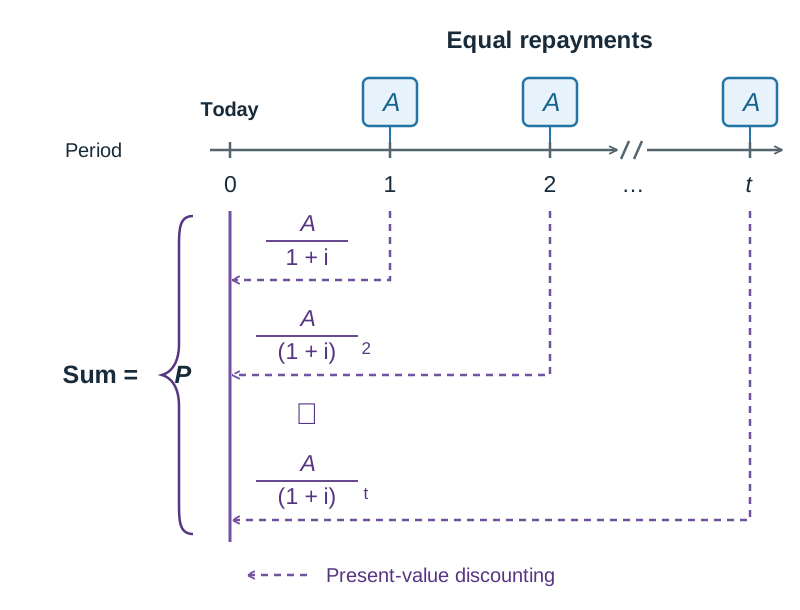
This is a finite geometric series where the first term is , the common ratio is , and the number of terms is .
Using the geometric series summation formula :
Simplify the denominator: . Substituting this back in gives:
Cancelling gives:
Rearranging to make the repayment amount the subject gives the official amortisation formula:
You must be able to derive this step by step on Paper 1. If an exam does not specifically ask for a derivation, you can quote this formula directly from page 31 of your tables.
Present Value and Savings Annuities
Present value is what an expected future sum is worth right now. To discount a future sum back to the present at interest rate , use:
In business investment problems, you evaluate projects using Net Present Value (NPV). Discount all future cash inflows and outflows to present values and combine them. If , the project earns more than the benchmark discount rate and makes financial sense.
A savings annuity involves depositing fixed sums at regular intervals to build up a future fund. The easiest way to avoid errors is to draw a quick timeline showing each payment.
Watch payment timing carefully. If deposits are made at the end of each year for 5 years, the final payment earns no interest, giving:
If deposits occur at the start of each year, every deposit compounds for one additional year:
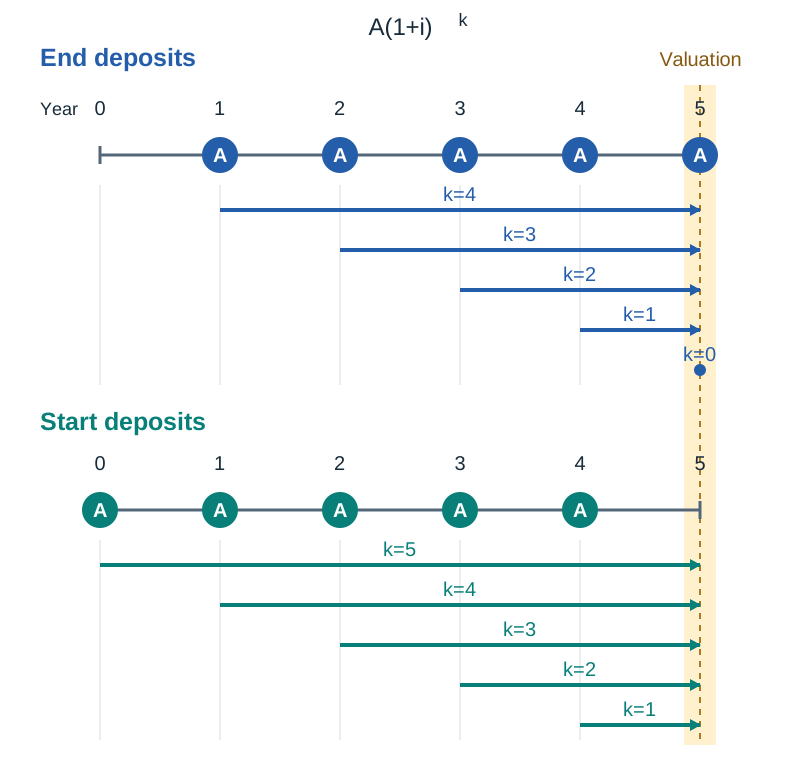
Treat this as a geometric series with and , then apply .
Income Tax and Net Pay
Income tax questions follow a dependable step-by-step routine. Gross pay is the full salary before any tax or deductions are taken out.
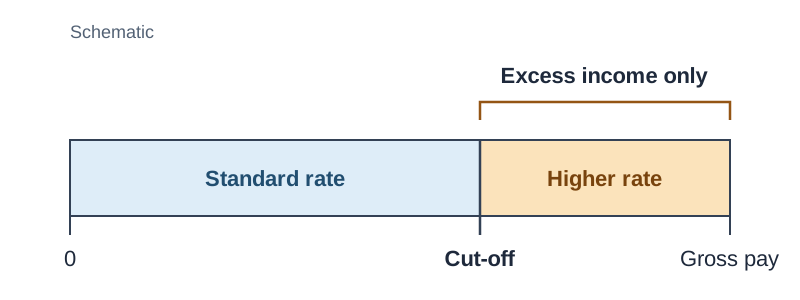
Every worker has a standard rate cut-off point. Income up to this threshold is taxed at the standard rate (typically 20%). Any income above this cut-off point is taxed at the higher rate (typically 40%). Adding these two amounts together gives the gross tax.
A tax credit reduces your tax bill directly euro for euro. It is not subtracted from gross income. Subtracting the tax credit from the gross tax yields the net tax payable:
Finally, subtract the tax payable and any other voluntary or statutory deductions from gross pay to get take-home pay:
Keep tax calculations laid out clearly in distinct stages on the page so you can pick up partial credit if an arithmetic slip occurs.
Key terms
- compound interest
- Interest calculated on both the initial principal and the accumulated interest from earlier compounding periods.
- present value
- The current value of a future cash amount or stream of payments, discounted at a specific rate of interest.
- amortisation
- The gradual repayment of a loan principal through regular, equal payments over an agreed duration.
- reducing-balance depreciation
- A depreciation method that deducts a fixed percentage from an asset's remaining book value each year.
- APR
- Annual Percentage Rate; the legally defined annual borrowing rate reflecting the true cost of a loan.
- AER
- Annual Equivalent Rate; the compound annual interest rate earned on a deposit or investment fund.
- tax credit
- A tax allowance that directly reduces an individual's gross tax liability euro for euro.
- standard rate cut-off point
- The income ceiling taxed at the standard income tax rate; income above this band is taxed at the higher rate.
- net pay
- Take-home pay remaining after income tax, universal social charges, and other deductions are subtracted from gross pay.
Check yourself
An investment bond offers an AER of 3%. What is the equivalent monthly interest rate written as a decimal?
i = (1.03)^(1/12) - 1 ≈ 0.002466 (or 0.2466%).
What is the present value of €5,000 due in 3 years' time at an annual discount rate of 4%?
P = 5000 / (1.04)^3 ≈ €4,444.98.
What is the common ratio r used when summing the present values of regular repayments in the loan amortisation derivation?
r = 1 / (1 + i), where i is the periodic interest rate.