

Differential calculus measures the instantaneous rate of change of a function, which gives the exact slope of the tangent line at any point along its curve. For Leaving Certificate Higher Level, you build on the foundational limit definition—known as differentiation from first principles—and master the standard operational rules. These include the product, quotient, and chain rules applied across polynomials, rational powers, exponential terms, logarithms, trigonometric functions, and inverse trigonometric expressions.
Differentiation from First Principles
For a straight line, the slope never changes. A curve is different because its steepness varies from point to point. To measure the slope of a curve at a single point , we pick a neighbouring point and construct a secant line between them. The slope of this secant line is the difference quotient:
As you shrink towards zero, slides along the curve towards . The secant line gradually pivots until it becomes the tangent line at . Taking the limit as gives the instantaneous rate of change, which is the derivative:
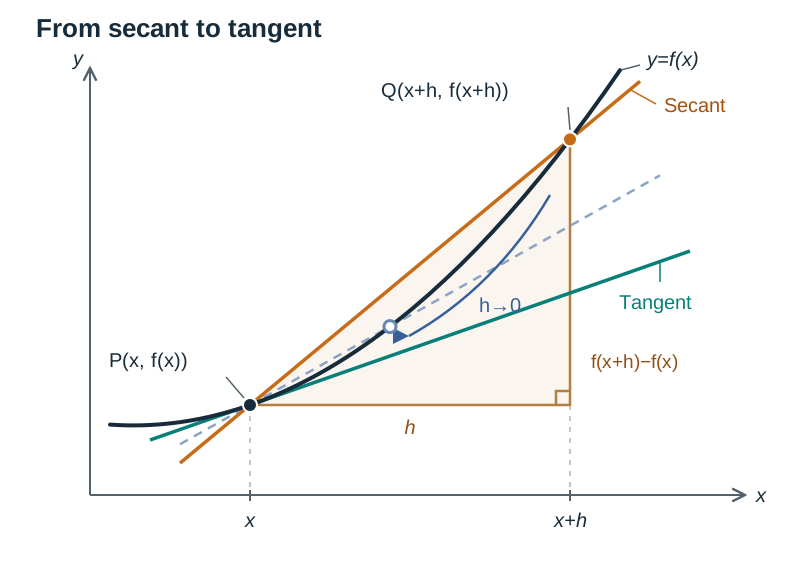
The syllabus specifically requires you to differentiate linear and quadratic functions using this first principles method. On the exam, write out the limit definition clearly, expand carefully in brackets, subtract , divide every remaining term by , and then evaluate the limit by setting .
Polynomials and Rational Powers
Once the principles are established, standard rules let us differentiate power terms quickly. For any term , multiply by the existing index and reduce the power by one:
The derivative of any isolated constant is zero because a constant value has a rate of change of zero. When a function is made up of sums and differences, differentiate each term separately.
Before differentiating roots or fractions, always convert them into index form. For instance, write as and as . When subtracting 1 from a negative or fractional power, take care with the arithmetic: , and . For example, differentiating gives .
Product and Quotient Rules
When two functions are multiplied or divided, you cannot simply multiply or divide their individual derivatives. You must apply dedicated formulas, both of which appear on page 25 of the Formulae and Tables booklet.
The Product Rule applies to products of functions :
In plain words, take the first function times the derivative of the second, plus the second function times the derivative of the first.
The Quotient Rule applies to algebraic fractions :
Order matters here because of the subtraction in the numerator. It must always be the bottom times the derivative of the top, minus the top times the derivative of the bottom, all over the bottom squared. Writing out , , , and separately at the side of your page keeps your working clean and helps avoid sign slips.
Chain Rule
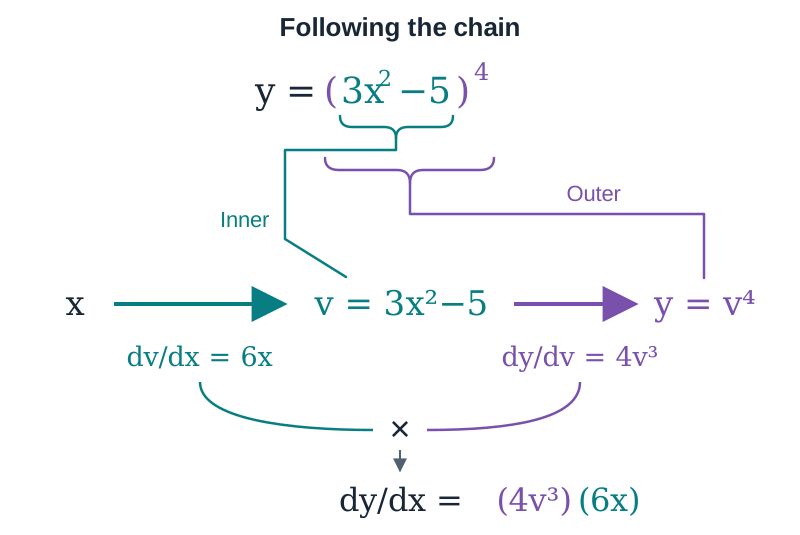
The chain rule handles composite functions, which are functions nested inside other functions, written as . If , where , the rule states:
Think of it as differentiating the outside layer while leaving the inside untouched, then multiplying by the derivative of whatever was inside. For brackets raised to a power, , this gives the quick working rule:
For example, to differentiate , treat the bracket as your variable first to get , then multiply by the internal derivative , giving .
Trigonometric, Exponential, and Logarithmic Functions
Trigonometric, exponential, and logarithmic functions each have a standard derivative, which you then combine with the chain, product, and quotient rules.
For trigonometric functions, your angles must be in radians:
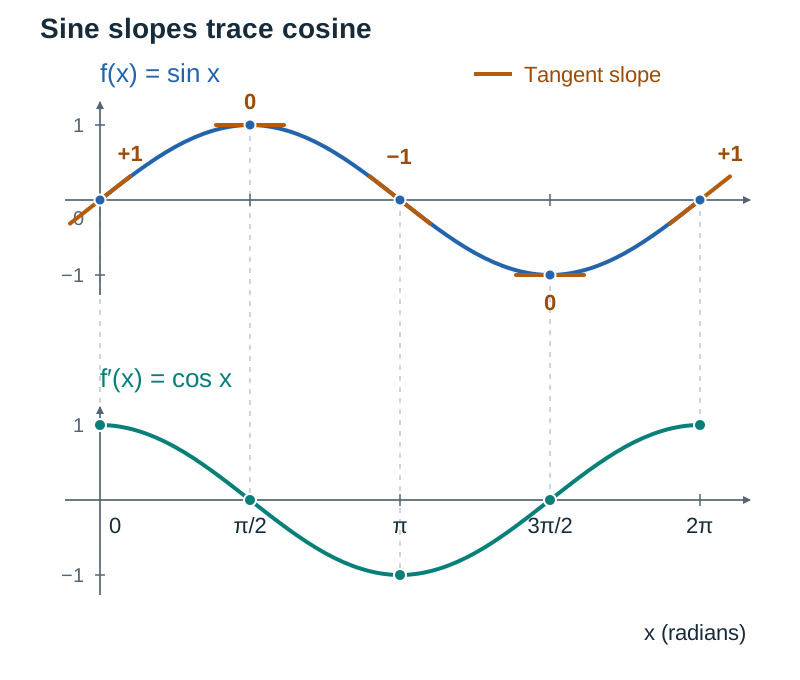
Applying the chain rule to an angle like introduces a factor of , so .
The natural exponential function is unique because it equals its own derivative: . By the chain rule, whenever the power is a function :
For the general exponential , the derivative is .
The natural logarithm has the derivative . When taking the log of a function, the chain rule gives:
For , if you face a log expression like , expand it using log laws into before differentiating. It saves considerable time and prevents messy fraction work.
Inverse Trigonometric Functions and Second Derivative
For , the derivatives of the inverse trigonometric functions and are given in your tables:
Notice that is only defined when , and its derivative has a square root in the denominator. The derivative of matches inverse sine but carries a negative sign: .
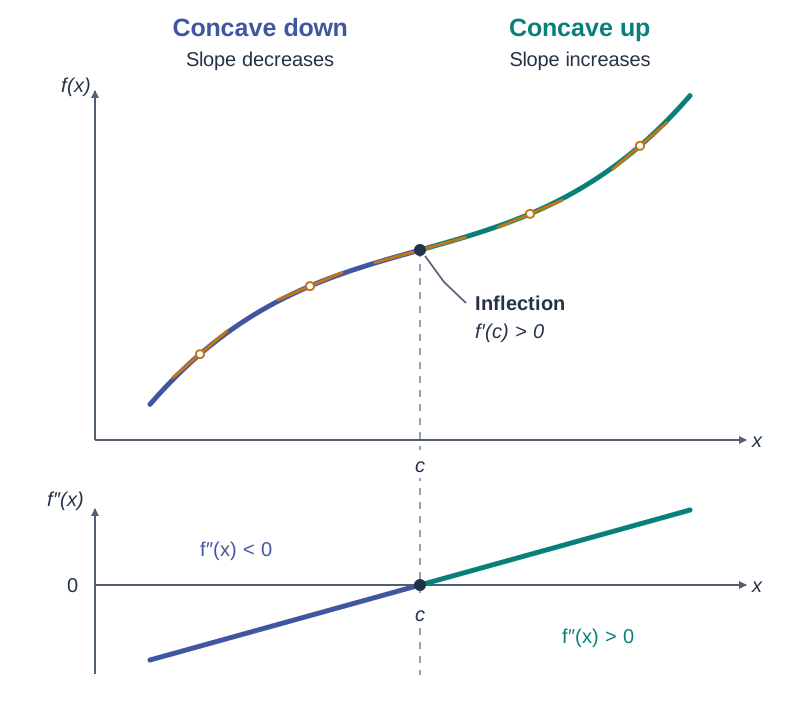
The second derivative, written as or , is simply the derivative of the first derivative. It describes how the slope changes, which controls the curve's concavity. Points where (and where concavity changes sign) locate points of inflection on the graph.
Tangent to a Circle
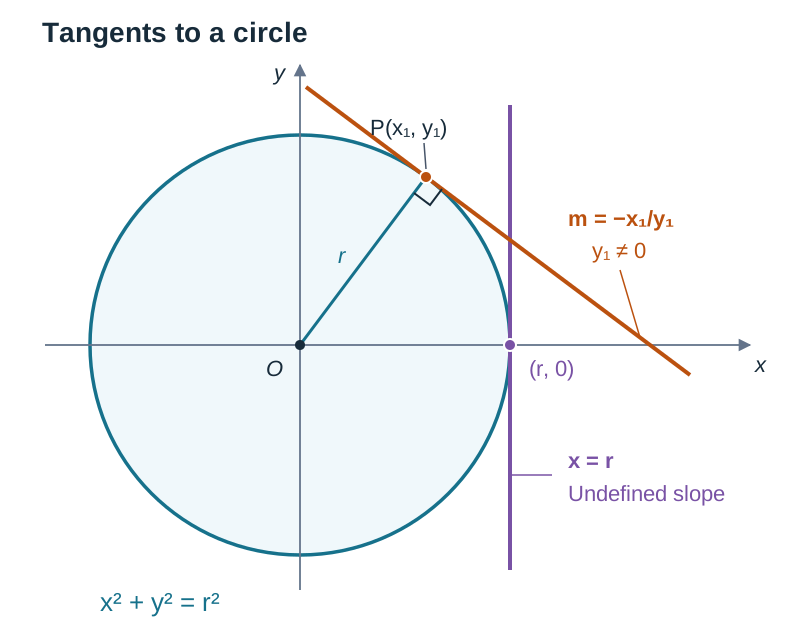
You can find the slope of a tangent to a circle centered at the origin, , using calculus rather than coordinate geometry. Differentiating both sides with respect to means treating as an implicit function of .
Differentiating gives . Applying the chain rule to produces . The constant becomes :
At a point on the circle with , the slope of the tangent line is . You can then write the equation of the tangent line directly using . When , the tangent is vertical and its equation is .
Key terms
- First principles
- The formal limit-based method used to establish the derivative of linear and quadratic functions.
- Product rule
- The rule for differentiating two multiplying functions: .
- Quotient rule
- The rule for differentiating algebraic fractions: .
- Chain rule
- The method for differentiating composite functions by multiplying the derivative of the outer expression by the derivative of the inner expression.
- Stationary point
- A point on a curve where the first derivative equals zero (), identifying a local maximum, local minimum, or horizontal point of inflection.
- Second derivative
- The rate of change of the first derivative, written as or , used to assess curve concavity and locate points of inflection.
Check yourself
What is the derivative of ?
Rewrite as . Differentiating gives or .
What is the derivative of ?
Using , differentiate the inner expression to get , giving .
What is the derivative of ?
Use the product rule with and . With and , we get .