

Differential calculus gives us the exact mathematical tools needed to analyse how changing quantities behave in real time. We use derivatives to find where functions peak or dip, track whether curves are climbing or falling, and link physical rates of change such as speed, acceleration, or expanding volumes.
Turning Points and Points of Inflection
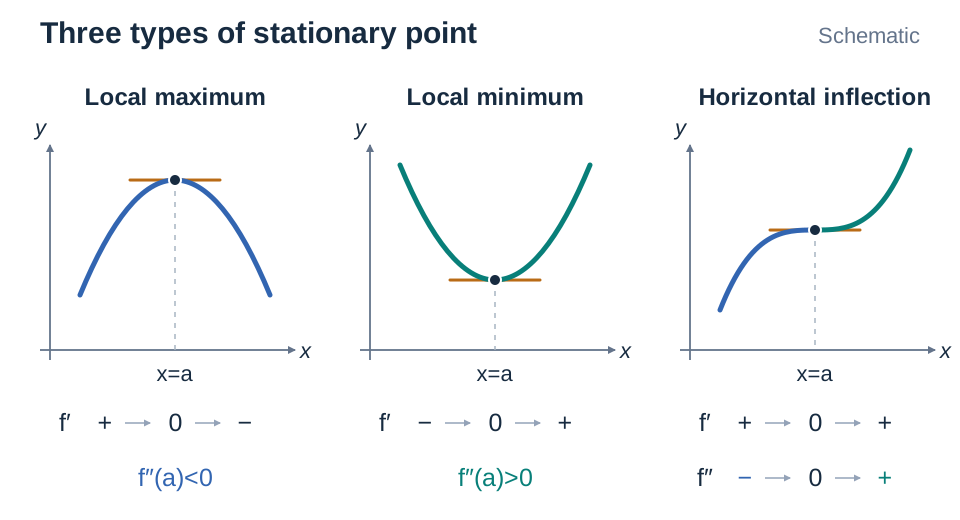
A stationary point occurs anywhere the gradient of the tangent is zero, meaning . You can classify stationary points using the second derivative test. Evaluate at the stationary point : if , the curve bends downwards like an upside-down bowl, confirming a local maximum; if , the curve bends upwards, confirming a local minimum. When , the second derivative test tells you nothing definite; you must test the sign of immediately to the left and right of the point.
A point of inflection is where a curve changes concavity, switching from concave up () to concave down (), or vice versa. Finding points of inflection always starts by solving and verifying that changes sign across that value. Keep in mind that a stationary point can occasionally be a horizontal point of inflection, which happens when both and with no change in the sign of on either side.
To show that a function has no turning points or no points of inflection, simplify the relevant derivative and explain why it can never equal zero. For example, gives . Because the numerator is a non-zero constant and the denominator is strictly positive for all , can never equal zero, meaning has no turning points. The same approach applies when solving to prove that a curve has no points of inflection.
Increasing and Decreasing Functions and Graphing Derivatives
A function is strictly increasing across an interval when its first derivative is strictly positive, . It is strictly decreasing wherever . If flat stationary intervals are permitted, we include equality, writing or .
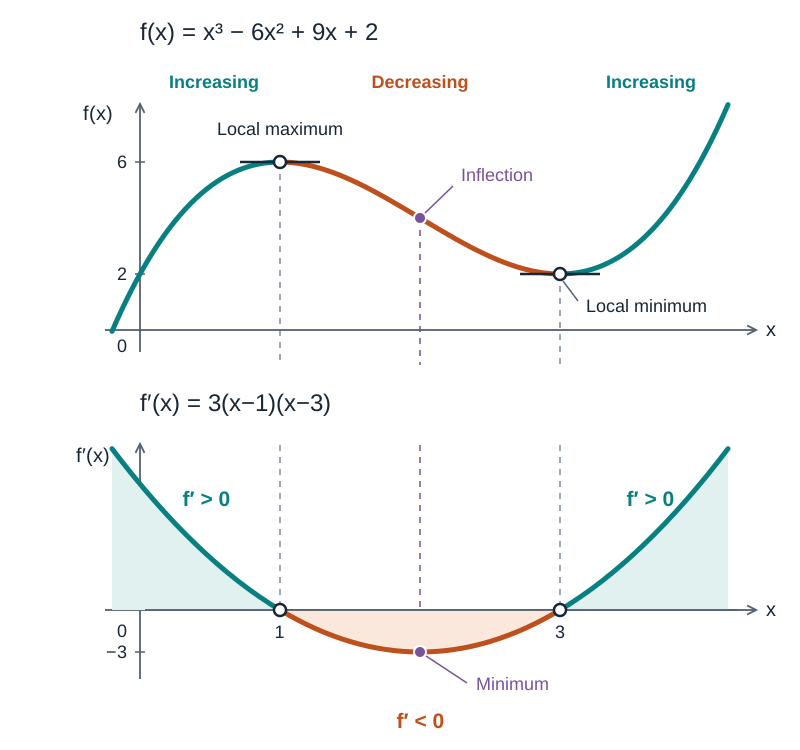
To find the intervals where a polynomial climbs or falls, start by solving to locate the values of where the slope is zero. For example, gives . This is a -shaped parabola, so it is negative between its roots. is decreasing for and increasing for or .
When sketching or identifying the graph of from the graph of :
- The turning points of become the roots (-intercepts) of , because the tangent slope is zero there.
- The graph of lies above the -axis where is rising and below the -axis where is falling.
- Any point of inflection of corresponds to a local maximum or minimum turning point on the graph of .
- A cubic function differentiates to produce a parabolic curve for .
Tangent Equations and Unknown Coefficients
The slope of the tangent to at is given by . Pair this slope with the contact point and substitute both into the line equation . Leaving Certificate questions often ask for this equation in standard integer form, .
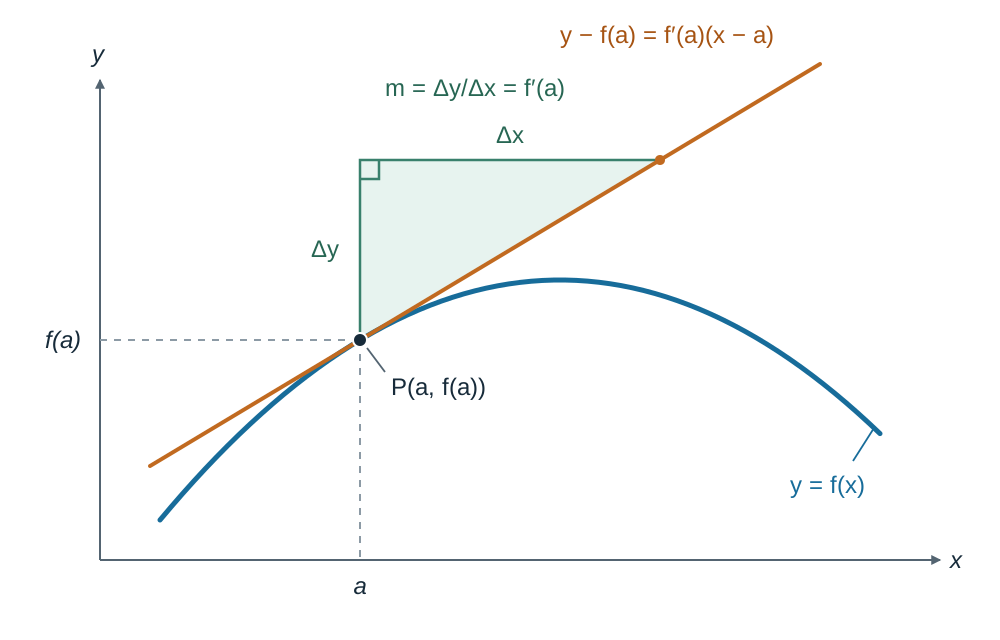
When an exam question states that a curve has a turning point at a given coordinate , it is handing you two distinct equations. First, because the point sits on the curve itself. Second, because the tangent at any turning point is completely flat. Setting up these two equations lets you solve for unknown coefficients such as and in a polynomial.
Maximum and Minimum Problems
Maximum and minimum problems ask you to find the greatest or least possible value of a variable, such as profit, capacity, or surface area. Start by setting up a formula for the quantity to be maximised or minimised. If that formula contains two variables, look for a geometric or physical constraint in the question to eliminate one variable before you touch calculus.
Once you have a single-variable function , differentiate it and solve to find stationary points. Reject values that make no sense in the context, such as negative lengths or dimensions that collapse the shape to zero volume. Confirm whether the remaining point is a maximum or minimum using the second derivative test.
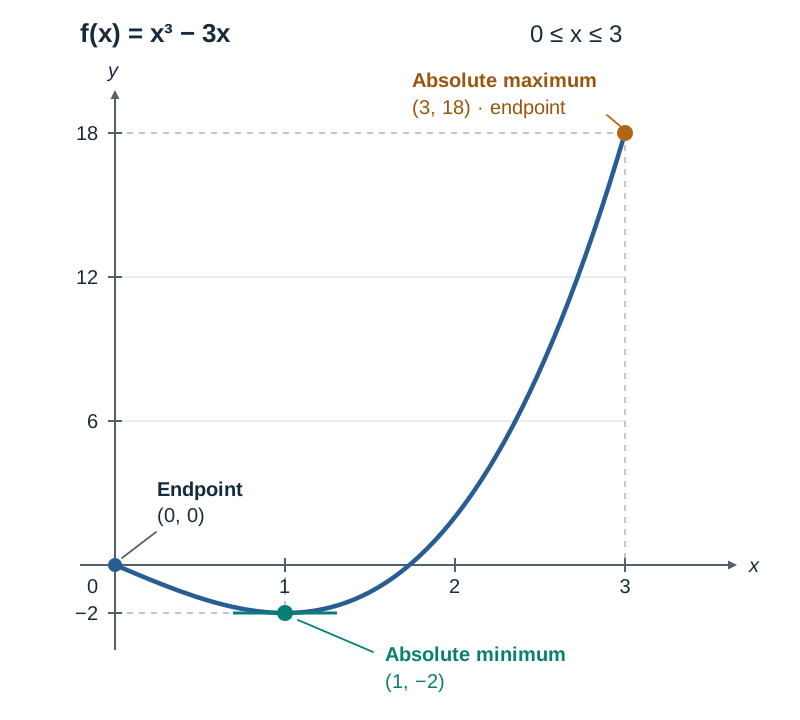
Crucially, if the problem specifies a closed domain , you must evaluate the function at both endpoints, and , as well as at any internal stationary points. The absolute greatest or least value on a restricted interval can occur right at a boundary rather than at a turning point.
For example, consider finding the extreme values of on the closed interval . Setting gives , so or . We reject because it lies outside . Evaluating at candidate points gives (left endpoint), (internal turning point), and (right endpoint). Therefore, the least value is and the greatest value is .
Rates of Change
Calculus lets us track how physical measurements change over time. For an object moving along a line with displacement , velocity is and acceleration is .
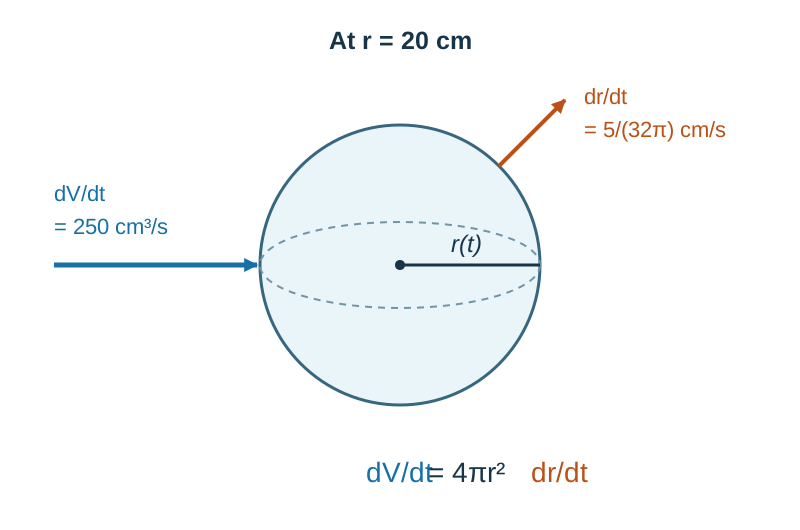
When two changing quantities depend on each other, connect their rates using the chain rule. For instance, if a sphere has volume and radius , the rate of change of volume with time links to the rate of growth of the radius by . Remember that any quantity that is shrinking, leaking, or cooling must have a negative rate of change. Never substitute fixed numbers before differentiating; doing that replaces a variable with a constant, which makes the derivative incorrectly collapse to zero.
For example, suppose air is pumped into a spherical balloon at a constant rate of . To find the rate at which the radius is increasing when :
- State the formula: .
- Differentiate with respect to : .
- Link the rates using the chain rule: .
- Substitute known values: .
- Solve for : .
Key terms
- Stationary point
- A point on a curve where the first derivative equals zero, meaning the tangent line is horizontal.
- Local maximum
- A peak on the curve, where the graph changes from rising to falling. There f'(x) = 0. If f'' is negative at that point, this confirms a maximum.
- Local minimum
- A trough on the curve, where the graph changes from falling to rising. There f'(x) = 0. If f'' is positive at that point, this confirms a minimum.
- Point of inflection
- A point where a curve transitions between concave up and concave down, which requires f''(x) = 0 and a sign change in f''(x).
- Chain rule
- A differentiation method used for composite functions and related rates of change, written as dy/dt = (dy/dx) * (dx/dt).
- Endpoints
- The boundary values of a closed interval [a, b], which must be tested alongside internal turning points when searching for absolute extrema.
Check yourself
If dV/dt = 12 and dV/dr = 48, what is the value of dr/dt?
By the chain rule, dr/dt = (dV/dt) / (dV/dr) = 12 / 48 = 0.25.
Does having f''(x) = 0 guarantee that a point of inflection exists at x?
No. The second derivative must actually change sign across the point for it to be an inflection point.
If a smooth curve has a local minimum at (2, 5), what is the value of f'(2)?
f'(2) = 0 because the tangent line at any local turning point is horizontal.