

The history of computing traces the shift from mechanical calculation to programmable electronic systems, global networks, and autonomous algorithms. For Leaving Certificate Computer Science Higher Level, questions focus on the practical significance of major breakthroughs over raw dates. Students must understand how key theoretical, hardware, software, and networking developments solved real engineering problems, while evaluating their wider societal, economic, and environmental impacts alongside emerging technologies.
Evaluating Historical Significance and Action Verbs
Most exam questions in this topic ask you to explain, discuss, or evaluate, so memorising dates and names alone will not secure full marks. You need to name the development, explain what engineering problem it solved, and show what changed as a result.
The Five Analytical Lenses
To structure a balanced answer on any historical milestone or emerging trend, examine it through five lenses:
| Dimension | Core Question | Concrete Example |
|---|---|---|
| Technical | What operational capability was gained that was previously impossible? | Vacuum tubes removed the moving mechanical contacts of relays, and transistors then removed fragile heated filaments, cutting power and heat dramatically. |
| Economic | How did it affect production costs, commerce, or jobs? | Microprocessors collapsed hardware production costs, making personal computers affordable for small businesses. |
| Social and Cultural | How did everyday life, communication, or human behaviour change? | Anyone with a web server could publish to the whole world without going through a newspaper or broadcaster. |
| Scientific | Did it reveal fundamental rules or limits about computation? | Turing proved that mathematically undecidable problems exist, defining the ultimate limits of all algorithms. |
| Environmental | How did it alter electricity use, resource extraction, or waste? | High-density data centres draw large shares of national grids, while rapid device replacement generates toxic e-waste. |
Here is how those lenses turn into a concise answer for the microprocessor (1971): technically, it placed an entire CPU onto a single silicon chip, eliminating the need for circuit boards packed with separate components. Economically, manufacturing costs collapsed, creating a mass consumer market. Socially, computing moved out of corporate basements into homes, schools, and pockets. Environmentally, each calculation uses vastly less energy, but billions of short-lived devices now create serious electronic waste problems.
What Question Words Ask For
- Identify / State: Give the fact briefly in one clear sentence. No elaboration is needed.
- Describe: Build a detailed picture of the system, component, or process using words or a diagram.
- Explain: Give a detailed account with reasons or causes. An explanation without a 'because' is usually incomplete.
- Discuss: Provide a balanced review covering arguments on both sides, supported by evidence, ending with a clear conclusion.
- Evaluate: Examine the evidence, make a reasoned judgement, and point out any limitations in the data or technology.
- Compare: Give an account of the similarities between two items or situations, referring to both of them throughout rather than describing one and then the other. If the question also asks for differences, deal with them separately.
Mechanical Foundations: Babbage and Lovelace
Early calculating devices automated arithmetic for maritime and astronomy tables. Charles Babbage and Ada Lovelace introduced architectural principles that anticipated modern digital computers.
In 1822, Charles Babbage designed the Difference Engine to evaluate polynomial functions using the method of finite differences. Its goal was to eliminate human calculation and printing errors in navigation tables. Babbage never completed a full working engine during his lifetime due to machining limitations, but the Science Museum in London built a fully operational Difference Engine No. 2 from his drawings in 1991, proving his engineering principles were sound.
In the 1830s, Babbage designed the Analytical Engine, which moved beyond fixed calculations to general-purpose computing. It separated operations into four core concepts:
- The Store: A mechanical memory made of gear columns that held numbers and intermediate variables.
- The Mill: The processing unit where gears carried out arithmetic operations, equivalent to a modern ALU.
- Punched Cards: Borrowed from the Jacquard textile loom, interchangeable cards supplied instructions and data, allowing programs to change without rebuilding hardware.
- Conditional Branching: The mechanical ability to alter the path of execution based on whether a calculation result was positive or negative.
In 1843, Ada Lovelace translated Luigi Menabrea's description of the machine and added extensive notes. She published an algorithm to calculate Bernoulli numbers step by step, which is widely considered the first published computer program. Lovelace saw that the engine could manipulate any information that could be represented symbolically, such as musical notes or letters, rather than just numbers.
Babbage and Lovelace provide essential background context on programmability. When an exam question specifies developments of the last 100 years under Learning Outcome 1.13, focus on the 1930s onwards: relays, valves, transistors, integrated circuits, the stored program, networking, the Web, mobile computing, and AI.
Theoretical Limits: Turing Machines and Undecidability
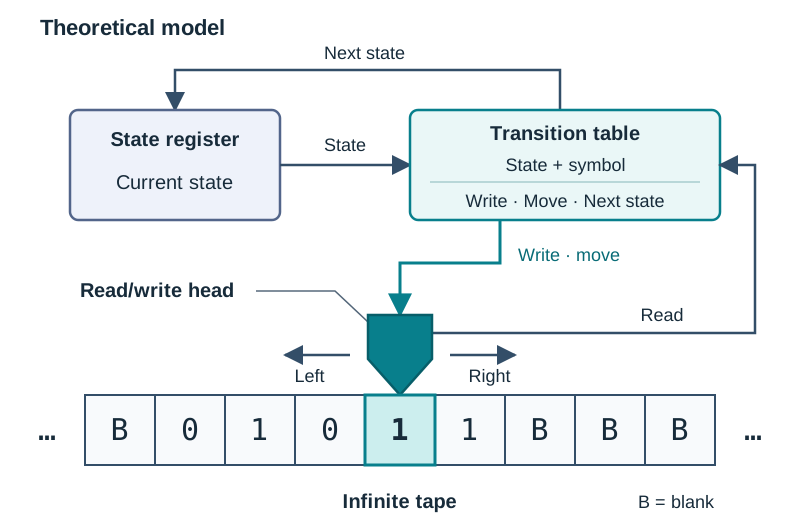
In 1936, Alan Turing introduced a mathematical model to define what can and cannot be computed by a mechanical algorithm. The Turing machine is a theoretical thought experiment, not a physical machine.
A Turing machine has four components:
- Infinite Tape: A ribbon divided into discrete cells stretching infinitely in both directions. Each cell holds one symbol from a finite alphabet (such as
0,1, or a blankB). It acts as unbounded memory. - Read/Write Head: Sits over one cell at a time. It reads the current symbol, can write a new symbol into that cell, and moves left or right by one cell.
- State Register: Stores the current condition of the machine from a finite list of states, including a start state and one or more halt states.
- Transition Table: The instruction set. Given the current state and the symbol read by the head, it specifies: the symbol to write, the direction to move (Left or Right), and the next state to enter.
Core Theoretical Principles
- Formal Definition of an Algorithm: Turing defined an algorithm as a deterministic series of transitions over discrete symbols.
- Universal Turing Machine (UTM): Turing showed that a single machine could simulate any other specialised Turing machine if given a description of that machine's rules alongside the input data on its tape. This is the theoretical basis of the stored-program computer.
- Turing Complete: A language or system is Turing complete if it can compute any problem that a Universal Turing Machine can calculate, provided it has sufficient memory and time.
- The Halting Problem: Turing proved that mathematically undecidable problems exist. No general algorithm can ever be written that takes any arbitrary program and its input and correctly decides whether it will halt or run forever.
In 1950, Turing turned to machine intelligence, proposing the Turing test to see if a computer could converse in a way indistinguishable from a human. Keep these two ideas distinct: the Turing machine is a model of computation, while the Turing test assesses conversational behaviour.
Hardware Evolution: Generations, Moore's Law, and Stored Programs
Over the past century, physical computer hardware evolved across distinct generations, driven by the search for faster switching, smaller size, and lower power consumption.
| Generation | Dominant Component | Era | Technical Strengths | Physical Limitations |
|---|---|---|---|---|
| Electromechanical | Relays | 1930s–1940s | Electromagnets opened and closed physical contacts to perform binary calculations. | Slow, noisy, and mechanical contacts wore out or jammed. |
| First Generation | Vacuum Tubes | 1940s–mid-1950s | Purely electronic switching with no moving parts; carried out thousands of operations per second. | High power consumption, heavy heat output, and filaments burned out frequently. |
| Second Generation | Transistors | mid-1950s–mid-1960s | Solid-state semiconductors invented in 1947; compact, highly reliable, and low heat. | Required thousands of discrete components to be hand-soldered onto circuit boards. |
| Third Generation | Integrated Circuits (ICs) | mid-1960s–1970s | Hundreds of interconnected components etched together onto a single silicon chip. | Expensive fabrication cleanrooms; photolithographic resolution limits. |
| Fourth Generation | Microprocessors (VLSI) | 1971–present | Entire CPU placed onto a single silicon chip (such as the Intel 4004 in 1971). | Heat dissipation limits at high clock speeds and electron leakage at nanoscale dimensions. |
Landmark Machines
- Z3 (1941, Konrad Zuse): The first programmable, automatic digital computer, built using electromechanical relays and controlled by punched tape.
- Colossus (1943–1944, Bletchley Park): The first large-scale electronic digital computer, built from vacuum tubes to break wartime ciphers. It was reconfigured using plugs and switches.
- ENIAC (1945): A general-purpose electronic computer built with vacuum tubes. Reprogramming required technicians to manually rewire cables and switches over several days.
- Manchester Baby (1948): The Small-Scale Experimental Machine ran the world's first stored program held in electronic memory, proving that changing a computer's job only required loading new software.
- UNIVAC I (1951): One of the first commercially sold computers, marking the transition from lab research to business data processing.
The von Neumann Architecture
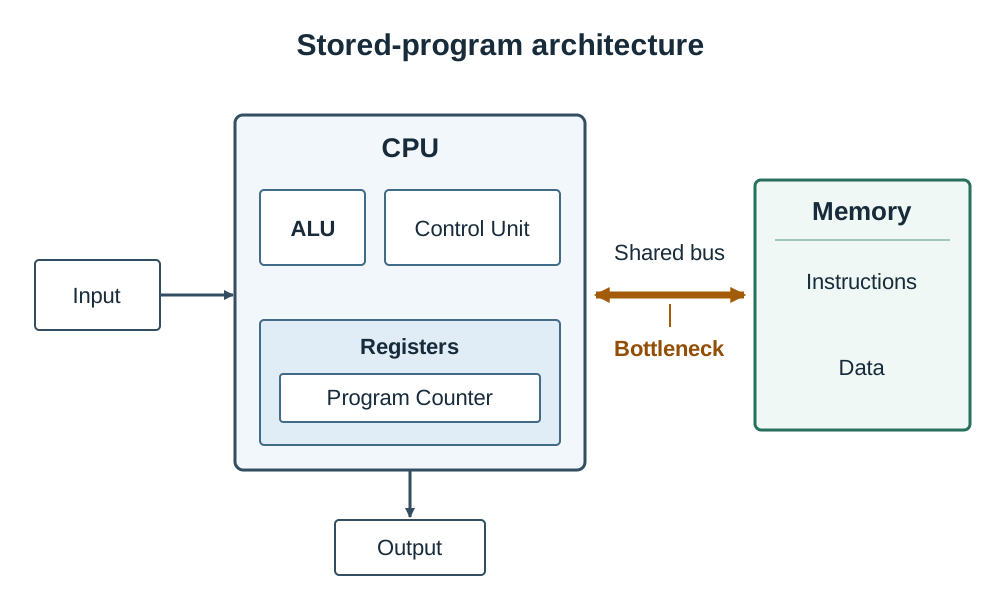
In 1945, John von Neumann and his team described an architecture that standardises almost all modern computers. It consists of:
- Memory: A unified store holding both program instructions and working data.
- CPU (Central Processing Unit): Containing the ALU (Arithmetic Logic Unit) for calculations and logic, the Control Unit for decoding instructions, and registers including the program counter holding the memory address of the next instruction.
- Input and Output Devices: Peripherals that allow the machine to receive data and return results.
The CPU runs the fetch-decode-execute cycle continuously. The shared bus between CPU and memory causes the von Neumann bottleneck: the CPU spends clock cycles waiting for instructions and data to arrive over the same physical pathway. Modern systems reduce this delay using fast on-chip cache memory.
Moore's Law
In 1965, Intel co-founder Gordon Moore observed that the number of transistors packed onto an integrated circuit at viable cost was doubling roughly every two years. Moore's Law is an empirical observation and industry target, not a law of physics. It explained why computers became steadily smaller, cheaper, and more powerful for decades. Today it is slowing down: transistor gates are only a few nanometres wide, leading to heat buildup and quantum tunnelling, where electrons leak across atomic-scale barriers. Manufacturers now improve performance using multi-core processors, graphics processing units (GPUs), and dedicated neural chips rather than raw clock speed.
Software Evolution: From Machine Code to Compilers
Hardware is unusable without software. The evolution of programming languages moved developers away from low-level hardware details toward natural human reasoning.
- Machine Code: Programs written directly in binary or hexadecimal instructions that the processor executes natively. It runs quickly but is slow and difficult to write, and code written for one processor cannot run on another.
- Assembly Language (1950s): Replaced binary numbers with short text mnemonics like
ADD,MOV, andJMP. An assembler converts assembly code into machine code. It was easier to read, but each line still mapped to a single CPU instruction and remained machine-specific. - High-Level Languages: Languages such as FORTRAN (1957, for scientific computation) and COBOL (1959, for business data processing) allowed programmers to write logic using English words and mathematical notation. Grace Hopper pioneered compiler development and promoted machine-independent programming, alongside popularising the term 'debugging'.
Translating Code
A compiler translates the entire high-level source code into machine code before execution, creating a standalone file. An interpreter reads, translates, and executes the source code line by line.
High-level languages transformed computing: software could be written much faster, was easier to maintain, and could be recompiled to run on different computer models without rewriting the entire program.
Networks, the Internet, and the World Wide Web
Before networks, data had to be moved between computers physically on punch cards or magnetic tape. In 1969, the US agency ARPA funded ARPANET so researchers could share computing resources between universities.
Packet Switching versus Circuit Switching
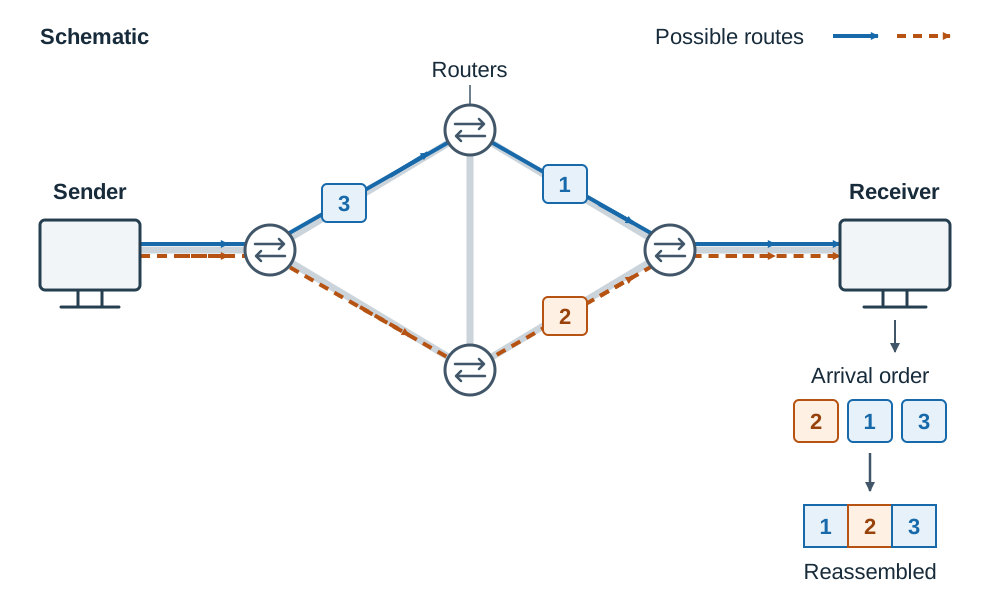
ARPANET's key innovation was packet switching, replacing telephone circuit switching:
- Circuit Switching: Establishes a dedicated, continuous physical connection between sender and receiver for the whole conversation. If any cable along the route is damaged, the connection drops immediately, and idle lines waste capacity.
- Packet Switching: Splits data into small chunks called packets. Each packet contains a chunk of data, destination and source IP addresses, and TCP sequencing information. Packets travel independently across whatever routes are clearest. If a link fails, routers send packets along an alternative route. At the destination, the receiving machine puts them back in order and requests any missing pieces.
In 1983, ARPANET adopted the TCP/IP protocol suite, creating an open standard that let disparate regional networks interconnect. This established the Internet: the physical network of cables, routers, satellites, and transport protocols.
The Internet and the World Wide Web are Different
Keep the Internet and the World Wide Web clearly separate:
- The Internet is the underlying global network infrastructure connecting hardware devices.
- The World Wide Web is an information-sharing service running on top of the Internet. Invented in 1989 by Tim Berners-Lee at CERN, it uses HTML to structure documents, HTTP to transfer files, and URLs to give every document a unique address. In 1993, CERN released the code royalty-free, making the Web a free, global platform.
Personal, Mobile, and Emerging Computing
The microprocessor allowed computers to shrink from room-sized appliances to consumer products. The 1970s and 1980s saw the rise of personal computers like the Apple II (1977) and the IBM PC (1981). Two developments drove everyday adoption:
- Productivity Software: Applications like VisiCalc (the first electronic spreadsheet) let businesses recalculate budgets in seconds instead of days, giving companies a clear commercial reason to purchase computers.
- Graphical User Interfaces (GUIs): Developed at Xerox PARC and commercialised in the Apple Macintosh (1984), GUIs replaced command-line prompts with windows, icons, menus, and pointers (WIMP). Users could point and click instead of memorising typed syntax.
Mobile and Ubiquitous Computing
From the 2000s, low-power mobile processors, cellular broadband (3G, 4G, and 5G), and smartphones (accelerated by the iPhone in 2007) shifted computing from fixed desks to connected devices carried everywhere.
- Positive Impacts: Instant access to navigation, banking, and public services; low-cost global video calls; flexible remote work; and real-time health monitoring.
- Negative Impacts: Continuous behavioural tracking by commercial apps; social media algorithms amplifying misinformation; sleep and mental health issues from high screen time; and an expanded digital divide, where individuals without modern hardware or reliable broadband are excluded from education, jobs, and government services.
Emerging Trends
- Cloud Computing: Moves processing and file storage from local devices to large data centres over the Internet. It cuts hardware costs for businesses and scales easily, but creates dependence on continuous network access and single commercial providers, alongside questions of data sovereignty.
- Artificial Intelligence and Machine Learning: Replaces hand-written rules with mathematical models trained on vast datasets. It automates diagnostics and natural language processing, but risks reproducing human bias present in training data, often operates as an opaque 'black box', and raises intellectual property issues.
- Internet of Things (IoT): Connects everyday objects like heating sensors and wearable medical trackers to networks. It automates energy management and predictive maintenance, but creates extensive cybersecurity vulnerabilities across poorly defended hardware.
- Quantum Computing: Replaces binary bits with qubits that exploit quantum superposition and entanglement. Quantum systems offer large speedups for a few specific problems, such as simulating molecules and factoring very large numbers into their prime factors — which is why they threaten RSA encryption, the public-key system still widely used today. They are not general replacements for home computers.
Environmental Realities
Computing cuts both ways environmentally. Modern microchips run individual calculations using far less power than early valves. However, the total demand from global cloud facilities, cryptocurrency networks, and large AI training runs consumes large percentages of national energy grids. Short consumer upgrade cycles also create massive volumes of toxic e-waste, containing lead and cadmium that are difficult to recycle safely.
Chronological Summary of Key Milestones
This timeline covers the major developments across the last 100 years of computing, alongside the 19th-century mechanical background:
| Year | Development | Why It Mattered |
|---|---|---|
| 1822 | Difference Engine | First design for an automated mechanical polynomial calculator. |
| 1837 | Analytical Engine | Designed a general-purpose computer with separate memory (store) and processor (mill). |
| 1843 | Lovelace's Algorithm | First published computer program, with the insight that machines could manipulate symbols. |
| 1936 | Turing Machine | Provided the mathematical definition of an algorithm and revealed undecidable problems. |
| 1941 | Z3 | First working programmable, automatic electromechanical digital computer. |
| 1943 | Colossus | First large-scale electronic digital computer using valves, built for cipher-breaking. |
| 1945 | ENIAC and von Neumann Architecture | First general-purpose valve computer; formalised storing data and instructions together in memory. |
| 1947 | Transistor | Solid-state electronic switch that replaced hot, fragile vacuum tubes. |
| 1948 | Manchester Baby | Executed the world's first stored program electronically in memory. |
| 1957–1959 | FORTRAN and COBOL | High-level languages that made programming accessible and portable using compilers. |
| 1958–1965 | Integrated Circuit and Moore's Law | Integrated multiple components on silicon; established the two-year transistor doubling pace. |
| 1969 | ARPANET | Proved packet switching worked, allowing different networks to share resources reliably. |
| 1971 | Intel 4004 Microprocessor | Placed a full CPU on a single silicon chip, starting the personal computing era. |
| 1983 | TCP/IP Adoption | Established the standard communications protocol suite that created the Internet. |
| 1989–1993 | World Wide Web | Tim Berners-Lee created HTTP, HTML, and URLs; CERN released them royalty-free. |
| 2007 | Modern Smartphone | Combined mobile broadband, touchscreens, and app stores into portable computing. |
Key terms
- Difference Engine
- An automatic mechanical calculator designed by Charles Babbage in 1822 to calculate and print polynomial tables using finite differences.
- Analytical Engine
- A proposed mechanical general-purpose computer designed by Babbage in 1837 featuring a store, a mill, punched cards, and conditional branching.
- Turing Machine
- A theoretical model of computation described by Alan Turing in 1936 consisting of an infinite tape, a read/write head, a state register, and an instruction table.
- Turing Complete
- The property of a computational system or language capable of simulating any computation that a Universal Turing Machine can perform.
- Halting Problem
- An undecidable problem in computer science proved by Alan Turing, showing no general algorithm can determine if an arbitrary program will halt or loop forever on an input.
- Stored-Program Concept
- The architectural principle where program instructions and operational data are stored together in the same addressable memory space.
- Von Neumann Architecture
- A computer design comprising a CPU (with ALU, control unit, and registers), memory holding both programs and data, input/output interfaces, and a shared system bus.
- Transistor
- A solid-state semiconductor component invented in 1947 that switches or amplifies electrical current without heated filaments or moving parts.
- Integrated Circuit (IC)
- A single silicon chip onto which multiple interconnected electronic components such as transistors and resistors are etched simultaneously using photolithography.
- Microprocessor
- An integrated circuit that contains the complete central processing unit (CPU) of a computer on a single silicon chip.
- Moore's Law
- The empirical observation by Gordon Moore in 1965 that the number of transistors on a microchip doubles roughly every two years at viable cost.
- Packet Switching
- A networking method that breaks data into addressed, sequenced packets that travel independently along dynamic network routes and are reassembled at their destination.
- TCP/IP
- Transmission Control Protocol / Internet Protocol; the core communication suite adopted in 1983 that enables diverse networks to interconnect as the Internet.
- World Wide Web
- An application-layer information space of linked hypertext documents accessed over the Internet via browsers, invented by Tim Berners-Lee in 1989.
- Compiler
- A software translator that converts an entire program written in a high-level language into machine code before it is executed.
- Digital Divide
- The socioeconomic gap between individuals and communities who have access to modern digital technologies and the Internet, and those who do not.
- Qubit
- A quantum bit in quantum computing that can exist in a state of 0, 1, or a superposition of both simultaneously.
- E-waste
- Discarded electronic equipment such as phones, computers, and monitors that contain hazardous materials like lead and mercury, requiring specialised recycling.
Check yourself
Which parts of Babbage's Analytical Engine corresponded to modern CPU and RAM components?
The 'mill' carried out arithmetic operations like a modern CPU, and the 'store' held numbers and intermediate results like modern RAM.
Name the four components of a theoretical Turing machine.
An infinite tape divided into cells, a read/write head, a state register, and a finite transition table.
Using the transition rules from the worked example (Rule 1: '1' -> write '1', Move R, State SCAN; Rule 2: 'B' -> write '1', Move R, State HALT), trace the machine on the tape [1, 1, B, B] starting at cell 1 in state SCAN. What is the final tape content?
Step 1: Cell 1 reads '1', writes '1', moves to Cell 2, stays in SCAN. Step 2: Cell 2 reads '1', writes '1', moves to Cell 3, stays in SCAN. Step 3: Cell 3 reads 'B', writes '1', moves to Cell 4, enters HALT. The final tape is
1 1 1 B, representing 2 + 1 = 3 in unary.What observation does Moore's Law make, and why is it currently slowing down?
Moore's Law observes that the number of transistors on a microchip doubles roughly every two years. It is slowing down because components are nearing atomic scales, causing excessive heat and quantum electron leakage.
Name the four primary components that make up the von Neumann architecture.
The CPU (containing the ALU, Control Unit, and registers), memory for instructions and data, input devices, and output devices.
State the key distinction between the Internet and the World Wide Web.
The Internet is the global physical and protocol infrastructure (TCP/IP) connecting computers, while the World Wide Web is an application-layer service of linked hypertext documents (HTTP/HTML) running over the Internet.
Give one positive and one negative societal consequence of the rise of smartphones.
Positive: Instant access to communication, navigation, banking, and public services from anywhere. Negative: Continuous commercial location tracking, sleep disruption, and the widening of the digital divide for those unable to afford modern devices.