

There are nine natural systems that keep the Earth stable enough for human society to survive and flourish: the climate, the variety of living species, fresh water, land and forests, the ozone layer, ocean chemistry, nutrient cycles of nitrogen and phosphorus, particles in the air, and man-made chemicals. For each of these, scientists have calculated a measurable safety limit. The planetary boundaries framework is the list of those nine limits and a running record of which ones human activity has pushed past.
The Holocene Baseline and the Safe Operating Space
For roughly 11,700 years before the Industrial Revolution, Earth was in the Holocene epoch. Global temperatures, rainfall cycles, and seasons stayed remarkably steady. That stability allowed humans to develop agriculture, build towns and cities, and create modern civilisation.
In 2009, Johan Rockström and an international team of scientists based at the Stockholm Resilience Centre asked a fundamental question: how much can human pressure change Earth's life-support machinery before the planet shifts into a new, hostile state? To answer it, they created the planetary boundaries framework.
Think of warning lights on a car dashboard. They turn on long before the engine seizes, giving the driver time to slow down and fix the problem. The planetary boundaries work the exact same way. Staying inside all nine boundaries defines the safe operating space for humanity. Inside this space, natural systems absorb shocks and keep the planet stable. Pushing past a boundary moves the Earth into a zone of increasing risk where abrupt or irreversible environmental shifts become much more likely.
This framework also serves as a scientific scoreboard for the Anthropocene — the proposed geological epoch in which human activity, rather than natural forces, has become the dominant driver of global environmental change.
Framework Mechanics: Control Variables and Risk Zones
To prevent subjective debates, scientists assign each Earth system a specific, measurable control variable. For instance, rather than saying humanity is damaging the climate, the framework measures atmospheric carbon dioxide concentration in parts per million (ppm) and radiative forcing in Watts per square metre ().
The framework monitors each control variable using three risk zones:
- Green zone (safe operating space): Human pressure remains below the precautionary boundary. Natural systems operate with high resilience.
- Yellow or orange zone (zone of increasing risk): The control variable is transgressed (it has crossed the safe boundary). The risk of triggering large-scale environmental disruption rises as warning signs appear.
- Red zone (high risk): Human pressure severely exceeds the boundary. Earth systems face high risks of reaching thresholds that lock in irreversible disruption.
The framework is deliberately cautious, applying a precautionary approach. Limits are placed at the conservative end of scientific uncertainty, well before a dangerous physical collapse point is reached. A boundary is officially transgressed the moment its control variable steps out of the green zone, signalling elevated systemic risk rather than an overnight collapse.
The Nine Planetary Boundaries and Their Status
To make the nine boundaries easy to remember under exam conditions, group them into three distinct sets:
- Global climate and atmosphere: climate change, stratospheric ozone depletion, atmospheric aerosol loading.
- Life and land: biosphere integrity, land-system change, freshwater change.
- What humans add to the system: biogeochemical flows, ocean acidification, novel entities.
The table below outlines each boundary, its control variable, and its status according to the landmark 2023 assessment (Richardson et al.), which was the first study to quantify all nine simultaneously.
| Boundary | Control Variable / Concern | Status (2023 Assessment) |
|---|---|---|
| Climate change | Atmospheric concentration (safe limit: 350 ppm; currently ) and radiative forcing | Transgressed (Zone of increasing risk) |
| Biosphere integrity | Genetic diversity (extinction rate) and functional integrity (human appropriation of plant biomass / net primary production) | Transgressed (High-risk red zone) |
| Biogeochemical flows | Disruption of global nitrogen (N) and phosphorus (P) cycles from synthetic fertiliser manufacture and mining | Transgressed (High-risk red zone) |
| Land-system change | Percentage of original forest cover remaining across tropical, temperate, and boreal biomes (safe limit: ) | Transgressed (Zone of increasing risk) |
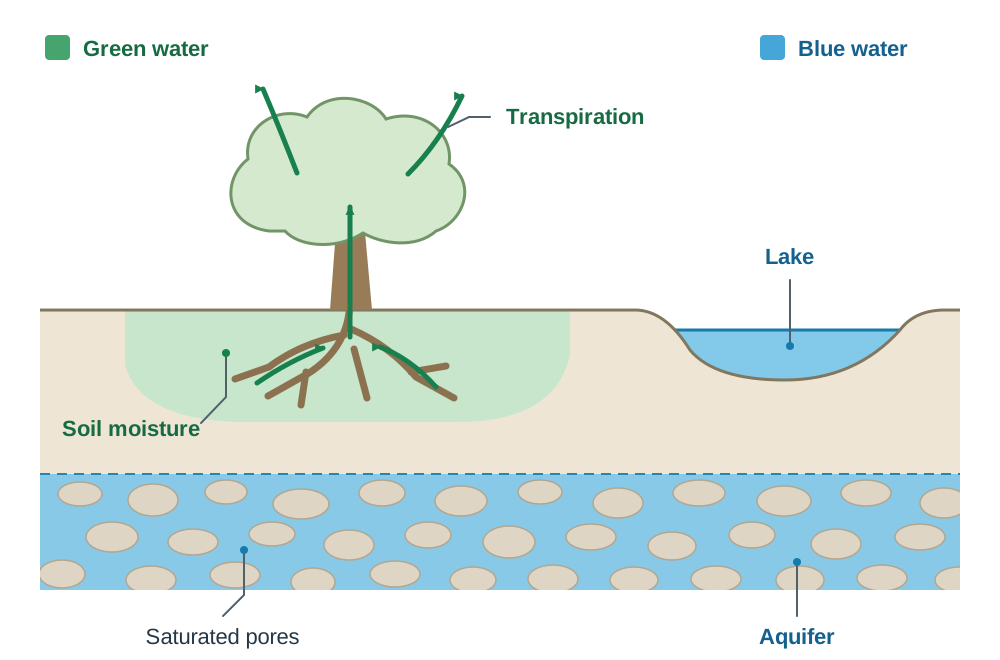
| Freshwater change | Split into blue water (rivers, lakes, aquifers) and green water (soil moisture and plant transpiration) | Transgressed (Zone of increasing risk) |
| Novel entities | Synthetic chemicals without natural analogues: plastics, PFAS ('forever chemicals'), pesticides, radioactive waste | Transgressed (High-risk red zone) |
| Ocean acidification | Seawater pH and aragonite saturation state affected by oceans absorbing excess atmospheric | Inside safe zone (Approaching boundary) |
| Atmospheric aerosol loading | Regional optical depth of airborne particulates (dust, soot, sulphates) affecting cloud formation and monsoons | Inside safe zone (Severe regional breaches) |
| Stratospheric ozone depletion | Stratospheric ozone thickness (Dobson Units) shielding Earth from harmful solar ultraviolet-B (UV-B) radiation | Inside safe zone (Safely recovering) |
Status Counts Over Time
The boundary status is not a static number; it is reassessed as scientific observation improves:
- In 2009, 7 boundaries were quantified, with 3 transgressed.
- In 2015, 7 boundaries were quantified, with 4 transgressed.
- In 2023, all 9 boundaries were quantified, with 6 transgressed.
Important exam distinction: Stratospheric ozone is an environmental success story, but it was never transgressed at a global scale. The breach was regional and seasonal (the Antarctic ozone hole). The Montreal Protocol (1987) phased out chlorofluorocarbons (CFCs) worldwide, allowing the Antarctic hole to slowly heal, making it the one boundary where the global trend is moving deeper into safety.
Tipping Points, Feedbacks, and Large-Scale Change
A central requirement of learning outcome 1.8 is explaining how exceeding boundaries induces large-scale environmental change. Earth systems rarely change in smooth, proportional lines. Instead, a system absorbs stress until it reaches a tipping point — a critical threshold where one more small push flips the system into a completely different state that sustains itself, even if human pressure stops.
Once past a tipping point, self-reinforcing positive feedback loops take over:
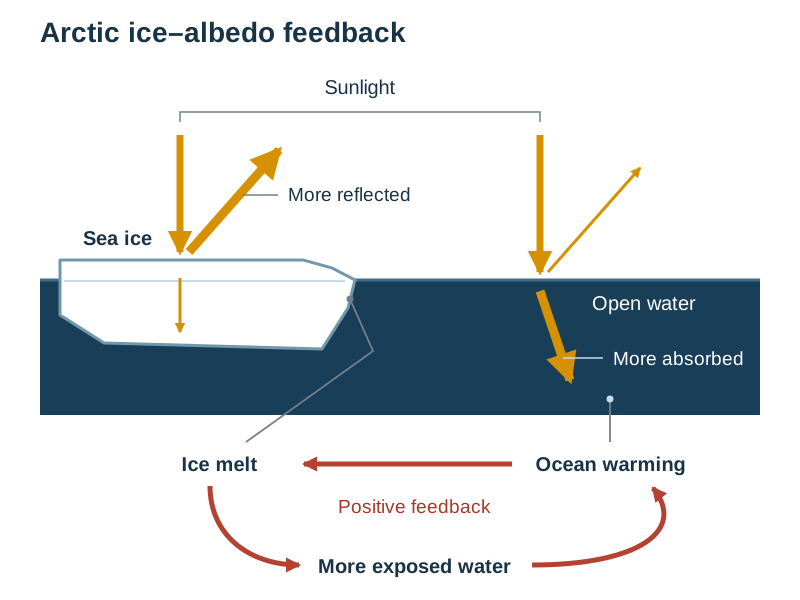
Arctic Ice-Albedo Feedback
Human greenhouse gas emissions warm polar air. White sea ice melts, exposing dark seawater underneath. Dark water absorbs significantly more solar radiation than reflective white ice, causing regional waters to warm further and melt more ice, independently of direct human emissions.
Permafrost Thaw
Frozen soils in high-latitude regions store vast quantities of ancient organic carbon. As rising temperatures thaw the ground, soil microbes digest this organic matter, releasing massive volumes of carbon dioxide and methane. This adds to the greenhouse effect, heating the planet and accelerating permafrost thaw.
Weakening of the AMOC
Melting freshwater from Greenland enters the North Atlantic, diluting salty surface water. Because fresh water is less dense than salty water, it does not sink as easily, weakening the Atlantic Meridional Overturning Circulation (AMOC). The AMOC transports warm equatorial water towards north-western Europe. A substantial slowdown would result in colder, stormier winters and severe weather disruption for Ireland, even as the wider planet warms.
Amazon Rainforest Dieback Cascade
Boundaries do not exist in isolation. Crossing one boundary frequently triggers a cascading effect across others:
- Deforestation across South America (land-system change) removes canopy trees.
- Tree loss halts transpiration, depleting soil moisture (freshwater change / green water).
- Local air becomes drier, creating prolonged droughts and vulnerability to wildfire.
- Dying and burning trees release enormous volumes of stored carbon into the atmosphere (climate change).
- Thousands of specialised species lose their habitat and go extinct (biosphere integrity).
Application to Ireland and Policy Evaluation
The planetary boundaries framework provides the scientific rationale for national sustainability policies and directly underpins climate action.
The Irish Context
Ireland contributes directly to several transgressed boundaries:
- Climate Change: Agriculture accounts for roughly one-third of national greenhouse gas emissions, primarily via methane () from cattle digestion and nitrous oxide () from fertiliser application and slurry.
- Biogeochemical Flows and Biosphere Integrity: Excess nitrogen and phosphorus applied to farmland leach into rivers and lakes. According to the Environmental Protection Agency (EPA), roughly half of Ireland's surface waters are not in good ecological status, with nutrient runoff from agriculture being the leading cause. The excess nutrients trigger eutrophication (rapid algal growth), depleting dissolved oxygen when the algae decompose and causing aquatic species die-offs.
- Irish Policy: The Climate Action and Low Carbon Development (Amendment) Act 2021 makes Ireland's climate targets legally binding, mandating a 51% reduction in greenhouse gas emissions by 2030 compared to 2018 levels and climate neutrality by 2050. It establishes 5-year carbon budgets and sectoral emissions ceilings across all sectors. The national Climate Action Plan is the annually updated operational strategy designed to meet these legal ceilings, while farm nutrient runoff is regulated under national Nitrates Regulations and nitrates derogation rules.
Evaluating the Framework
- Strengths: The framework provides a holistic view of Earth systems, proving that fixing climate change alone will not save the planet if biodiversity, land systems, and nutrient cycles collapse. Its traffic-light model communicates environmental risk clearly to governments and businesses while enforcing the precautionary principle.
- Limitations: Boundaries are measured as global averages, which can mask severe local crises (such as lethal urban particulate air pollution occurring while aerosol loading remains globally safe). Furthermore, the framework assesses biophysical limits only; it does not address social equity, historical emissions responsibility, or climate justice.
Key terms
- Planetary Boundaries
- A scientific framework identifying nine biophysical Earth system processes that regulate planetary stability, establishing quantitative limits within which humanity can safely thrive.
- Safe Operating Space for Humanity
- The low-risk green zone located within all nine planetary boundaries, where natural biophysical cycles maintain resilience and Holocene-like conditions.
- Holocene
- The post-glacial geological epoch of the last 11,700 years, characterised by a stable, mild climate that enabled human agriculture and civilisations to flourish.
- Control Variable
- The specific, measurable physical or chemical indicator used by scientists to monitor the state of an Earth system process against its safe threshold.
- Transgressed Boundary
- A status indicating that human pressure has pushed a control variable past its safe boundary into a zone of increasing or high risk.
- Tipping Point
- A critical biophysical threshold where a small additional disturbance forces an Earth system into an abrupt, self-reinforcing, and often irreversible new state.
- Positive Feedback Loop
- A self-amplifying cycle where the initial effect of a change triggers secondary processes that accelerate and intensify the original change.
- Cascading Effect
- A chain reaction in which exceeding the safe boundary of one Earth system destabilises one or more other interconnected boundaries.
- Precautionary Approach
- Setting safety margins at the conservative end of scientific uncertainty to prevent irreversible damage before dangerous physical tipping points are reached.
- Green Water and Blue Water
- Blue water comprises liquid surface water and groundwater (rivers, lakes, aquifers); green water refers to soil moisture and water vapour absorbed and transpired by plants.
- Biosphere Integrity
- The boundary assessing the health of living systems across two dimensions: genetic diversity (extinction rates) and functional integrity (how much plant biomass energy humans appropriate from ecosystems).
- Biogeochemical Flows
- The natural pathways through which key chemical nutrients—primarily nitrogen and phosphorus—cycle through the atmosphere, hydrosphere, lithosphere, and biosphere.
- Novel Entities
- Human-manufactured substances, organisms, or materials without natural analogues (such as synthetic chemicals, microplastics, and radioactive waste) released into the biosphere.
Check yourself
What is the primary scientific aim of the planetary boundaries framework?
To define a safe operating space for humanity by identifying precautionary limits on nine critical Earth system processes, maintaining the environmental stability characteristic of the Holocene epoch.
How many planetary boundaries were assessed as transgressed in the 2023 scientific assessment?
Six of the nine boundaries were assessed as transgressed (climate change, biosphere integrity, biogeochemical flows, land-system change, freshwater change, and novel entities).
What is the proposed safe numerical boundary for atmospheric carbon dioxide concentration, and how does modern concentration compare?
The proposed safe boundary is 350 ppm. Modern levels passed 420 ppm in the mid-2020s and continue to climb by 2–3 ppm per year; candidates should always refer to the specific value given in any exam stimulus.
Distinguish between blue water and green water in the freshwater change boundary.
Blue water is liquid freshwater in rivers, lakes, and underground aquifers. Green water is freshwater stored as soil moisture and plant biomass, which circulates through transpiration.
Why does crossing a biophysical tipping point lead to irreversible environmental changes?
Crossing a tipping point activates self-reinforcing positive feedback loops that keep the system moving toward a new, alternative state, making the disruption self-sustaining even if the original human pressure is removed.
Explain one way in which transgressing the biogeochemical flows boundary in Ireland impacts the biosphere integrity boundary. (4 marks)
Nitrogen and phosphorus from chemical fertiliser and slurry wash into waterways via surface runoff (1). This surplus of nutrients triggers rapid algal blooms, known as eutrophication (1). When the algae die and decompose, bacteria consume dissolved oxygen in the water (1). Aquatic species such as fish suffocate and die, directly causing freshwater biodiversity loss (1).