

The greenhouse effect is Earth's natural temperature-regulating process, keeping global surface temperatures roughly 33 °C warmer than they would otherwise be. Human activities since the Industrial Revolution have intensified this process by releasing vast quantities of heat-trapping gases into the atmosphere, creating the enhanced greenhouse effect. In Leaving Certificate Climate Action and Sustainable Development, mastering this topic requires understanding the radiation balance between incoming shortwave solar energy and outgoing longwave terrestrial energy, the molecular traits and warming potencies of key gases, and the specific economic activities that drive national and global emissions.
The Mechanism of the Natural Greenhouse Effect
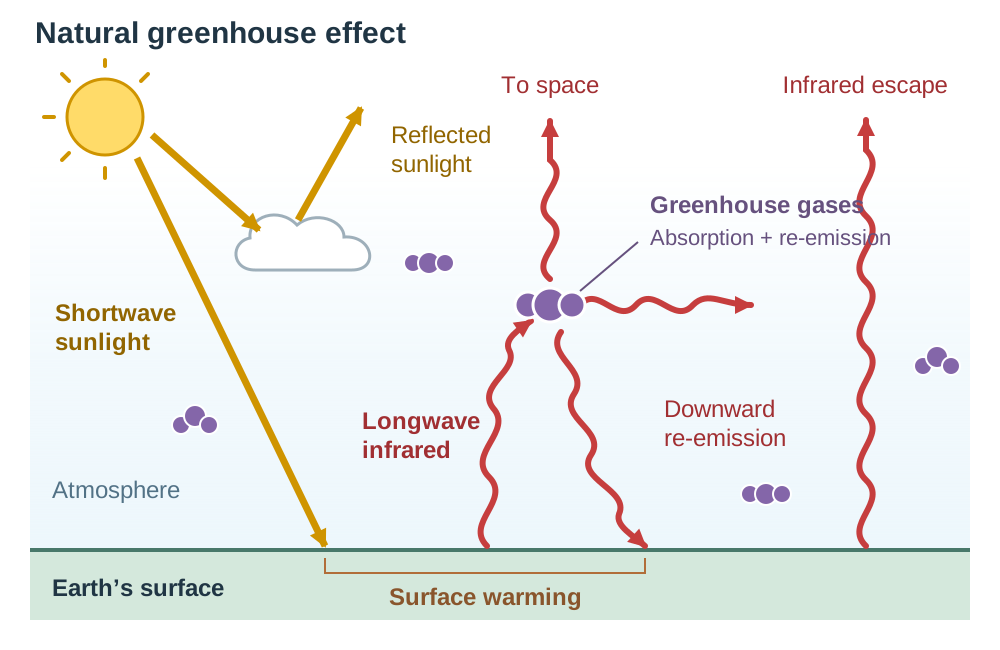
Earth's surface temperature is governed by a continuous planetary energy balance between incoming solar radiation from the Sun and outgoing terrestrial radiation from the Earth. The Sun is extremely hot, so it radiates high-energy shortwave radiation, mostly visible light and some ultraviolet radiation. Earth's atmosphere is largely transparent to these short wavelengths, allowing most of it to pass straight through to the surface.
Roughly 30% of incoming solar energy is reflected immediately back into space by clouds, atmospheric particles, and reflective surfaces like snow and ice. This fraction of reflected light is known as the planetary albedo. The remaining 70% is absorbed by Earth's land and oceans, warming the planet.
To balance this incoming energy, the warmed Earth radiates heat back toward space. Because Earth is far cooler than the Sun, it emits lower-energy, longwave infrared radiation. Naturally occurring greenhouse gases in the troposphere absorb this outgoing infrared radiation. The gas molecules store this thermal energy through vibrational movement and re-emit infrared radiation in all directions: upwards into space, sideways, and downwards back to Earth's surface.
This downward re-emission warms the lower atmosphere and the surface. Without the natural greenhouse effect, Earth's average surface temperature would be approximately −18 °C, leaving the oceans frozen and life impossible. The natural greenhouse effect maintains an average global surface temperature of roughly 15 °C, providing approximately 33 °C of natural warming.
Four-Step Answer Frame: Explaining the Mechanism
- Incoming shortwave: The Sun emits high-energy shortwave radiation (visible light and UV), which passes through atmospheric gases.
- Surface absorption: About 30% is reflected by clouds and ice (albedo); roughly 70% is absorbed by the surface, warming land and oceans.
- Outgoing longwave: The warmed Earth radiates lower-energy longwave infrared radiation back towards space.
- Atmospheric trapping: Polyatomic greenhouse gases absorb this infrared radiation and re-emit it in all directions, including back to the surface, keeping Earth roughly 33 °C warmer than it would otherwise be.
Greenhouse Gases and Molecular Structure
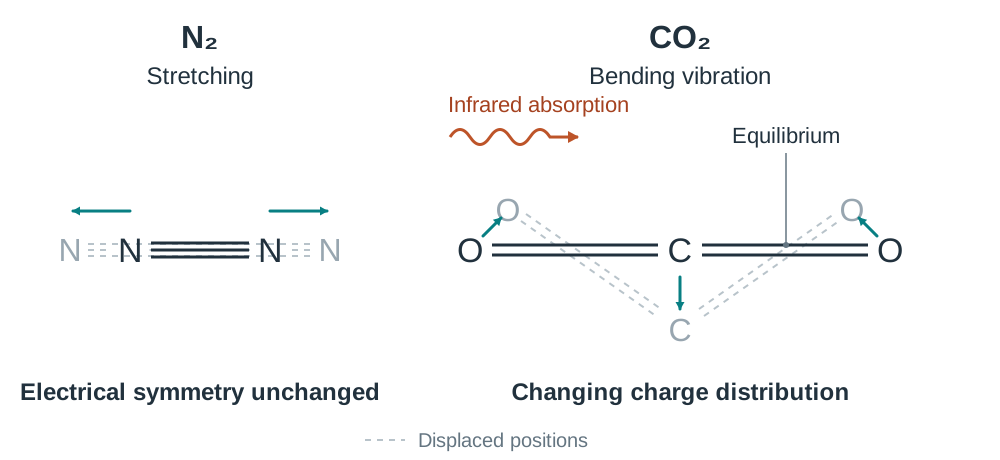
Roughly 99% of Earth's atmosphere consists of nitrogen (, ~78%) and oxygen (, ~21%). Neither gas acts as a greenhouse gas. Simple diatomic molecules consisting of two identical atoms have symmetrical electrical charges. When they vibrate, their electrical symmetry does not change, meaning they cannot absorb or emit infrared photons.
Greenhouse gas molecules have three or more atoms, or two different atoms, so they can bend, stretch, and twist in ways that change how electrical charge is distributed across the molecule. That asymmetric movement is what allows them to absorb and re-emit longwave infrared radiation.
The course specification highlights four critical greenhouse gases:
Water Vapour ()
The most abundant natural greenhouse gas, responsible for the largest share of the natural effect. Human activities do not control water vapour concentrations directly through tailpipes or chimneys. Instead, water vapour acts as a positive feedback. When other greenhouse gases cause initial warming, warmer air holds more moisture, evaporating more water from oceans and soils. This additional vapour absorbs more infrared radiation, amplifying the initial warming. If air becomes oversaturated, excess moisture condenses and precipitates out within days.
Carbon Dioxide ()
The primary baseline gas for human-driven climate change. Naturally cycled through photosynthesis, respiration, and ocean exchange, atmospheric concentrations have surged from a pre-industrial baseline of roughly 280 ppm to over 420 ppm today, driven by fossil fuel combustion and land clearing.
Methane ()
A powerful greenhouse gas produced when organic matter breaks down in anaerobic (oxygen-free) conditions. Major sources include enteric fermentation in ruminant livestock, manure and slurry storage, decomposing waste in landfills, flooded rice paddies, and fugitive leaks during fossil fuel extraction.
Nitrous Oxide ()
A long-lived gas generated by microbial nitrification and denitrification in soils, heavily accelerated by applying synthetic chemical nitrogen fertilisers and animal manure to farmland, as well as from certain chemical industries, chiefly nitric acid and adipic acid manufacture.
Global Warming Potential (GWP) and Carbon Dioxide Equivalent
Greenhouse gases differ significantly in their heat-trapping capacity and atmospheric lifespans. To compare their climate impacts on a standardised scale, scientists use Global Warming Potential (GWP). GWP measures how much heat a given mass of gas traps over a set timeframe (typically 100 years, denoted as ) relative to the same mass of carbon dioxide (), which has a baseline value of 1.
In standard national and European greenhouse gas inventory reporting (such as reports compiled by Ireland's Environmental Protection Agency):
| Gas | Atmospheric Lifetime | 100-Year GWP () | Primary Anthropogenic Sources |
|---|---|---|---|
| Carbon Dioxide () | Centuries to millennia | 1 | Burning fossil fuels, cement manufacturing, deforestation |
| Methane () | ~12 years | 28 | Enteric fermentation, slurry storage, landfills, gas leaks |
| Nitrous Oxide () | ~110 years | 265 | Synthetic nitrogen fertilisers, animal manure/urine, chemical industry |
Note on GWP values: These figures are from the IPCC Fifth Assessment Report (AR5), which the EPA and EU currently use for compliance reporting. Later IPCC reports cite slightly different values (such as 27 or 273). In an examination calculation, always use the specific GWP values provided in the question paper.
Because different gases have different warming strengths, total emissions across multiple sectors are expressed in carbon dioxide equivalent (CO₂ eq):
For example, releasing 1 tonne of methane causes warming equivalent to releasing . Releasing 1 tonne of nitrous oxide equals . On national emission charts, quantities are routinely expressed in kilotonnes (). While methane breaks down relatively quickly (~12 years), its high radiative potency makes cutting it the fastest way to curb near-term warming.
Activities Driving the Enhanced Greenhouse Effect
The enhanced greenhouse effect is the additional warming of Earth's atmosphere caused by human activities that release surplus greenhouse gases. The extra greenhouse gases absorb more of the outgoing longwave radiation, so less heat escapes to space than arrives from the Sun. This energy imbalance is what drives global average surface temperature up by roughly 1.1–1.3 °C compared with the 1850–1900 pre-industrial baseline.
The specification names seven activities to explore:
1. Burning Fossil Fuels
Combustion of coal, oil, fossil gas, and peat for electricity, domestic heating, and industrial boilers oxidises ancient geological carbon stored away over millions of years, releasing massive volumes of .
2. Transport
Internal combustion engines in passenger cars, heavy goods vehicles, shipping, and aviation burn refined liquid petroleum (petrol, diesel, kerosene), producing direct tailpipe emissions. Transport represents approximately one-quarter of global energy-related .
3. Agriculture
Farming generates substantial non- emissions. Ruminant livestock (cattle and sheep) produce methane during digestion through enteric fermentation, where anaerobic microbes break down plant cellulose in the rumen and the animal releases the gas primarily through belching. In flooded rice paddies the waterlogged soil has no oxygen, so methane-producing (methanogenic) microbes thrive and release to the air. Adding synthetic nitrogen fertilisers and animal manure causes soil microbes to produce and vent .
4. Deforestation
Clearing standing forests produces a double climate impact. First, burning or decomposing trees releases their stored biomass carbon into the air as . Second, removing the forest canopy permanently eliminates an active carbon sink, reducing future photosynthetic uptake of atmospheric .
5. Land-Use Change
Land-use change means altering how land is managed so that it stores less carbon, or releases carbon it had stored for centuries. It does not require tree felling. Deforestation releases carbon standing above ground in biomass, whereas land-use change like bog drainage or ploughing releases carbon stored below ground in soils.
- Drained peatlands and cutaway bogs: Peat is waterlogged, partially decayed plant matter. Draining a bog exposes the peat to atmospheric oxygen, enabling aerobic microbes to decompose it rapidly and release large volumes of alongside . Ireland has extensive areas of drained organic soils under grassland and plantation forestry, making its land sector a net emissions source.
- Converting permanent grassland to tilled cropland: Regular ploughing breaks up soil aggregates and accelerates microbial decomposition of soil organic carbon, releasing .
- Soil sealing: Paving over natural soil for roads, housing, and car parks permanently destroys vegetation and the soil carbon reservoir.
6. Industry
Heavy manufacturing generates direct chemical process emissions alongside energy combustion. In cement manufacturing, limestone is heated in kilns and chemically breaks down via calcination (). This reaction releases process independently of whatever fuel is burned to fire the kiln.
7. Technology and Digital Infrastructure
Data centres, telecommunications networks, cloud computing facilities, and digital processing require continuous baseload electricity and active cooling. Where national electrical grids still burn fossil fuels, expanding digital infrastructure drives significant indirect emissions.
National versus Global Emissions and Policy Targets
Globally, energy use dominates greenhouse gas emissions. Burning fossil fuels for electricity and heat, manufacturing, transport, and buildings accounts for roughly three-quarters of global emissions. Agriculture, forestry, and other land use account for roughly one-fifth, and industrial chemical processes make up the remainder.
In Ireland, the emissions profile is unusual because the country has a very large cattle and sheep herd relative to its human population, combined with an absence of heavy coal-based manufacturing. These EPA percentages are shares of national emissions excluding land use, land-use change and forestry (LULUCF). Ireland's land is currently a net source of emissions rather than a sink, largely because of drained organic (peat) soils, so including LULUCF raises the national total.
- Agriculture (~38%): By far the largest single sector, dominated by methane () from enteric fermentation and slurry, and nitrous oxide () from fertilisers and dung/urine deposition.
- Transport (~19% to 21%): The second-largest sector, driven by high private car dependency from dispersed settlement patterns, freight transport by road, and petroleum fuel combustion.
- Energy Industries (~14% to 17%): Electricity generation historically relied on peat, coal, and gas, though expanding onshore wind has reduced grid carbon intensity.
- Residential and Built Environment (~10% to 11%): Space and water heating in homes relying on kerosene, heating oil, fossil gas, and solid fuels.
- Manufacturing Combustion and Industrial Processes: Direct combustion in manufacturing and chemical process emissions from cement factories.
Policy Mechanisms: Act of 2021
Under the Paris Agreement, countries aim to limit global warming to well below 2 °C and pursue 1.5 °C. The Climate Action and Low Carbon Development (Amendment) Act 2021 legally binds Ireland to a 51% reduction in total national greenhouse gas emissions by 2030 relative to a 2018 baseline, on the pathway to a legally binding objective of a climate neutral economy by no later than the end of 2050 (often described in public discussion as net zero).
The 2021 Act operates through two distinct legal mechanisms:
- Carbon budget: A total legally permitted cap on greenhouse gas emissions across the whole Irish economy over a five-year window (e.g., 2021–2025 and 2026–2030).
- Sectoral emissions ceiling: Each five-year carbon budget is divided into specific limits for individual sectors. Sectors carry different percentage reduction requirements by 2030 under the Climate Action Plan (for example, electricity has an indicative ceiling cut of ~75%, transport ~50%, and agriculture ~25%). The 51% reduction is an economy-wide national target, not a uniform cut applied to every sector.
Reading an EPA Sectoral Emissions Graph
When answering data questions or preparing Section A of the Action Project Journal, follow four steps:
- Read axes and units: Emissions are shown in kt CO₂ eq (). The x-axis shows the years.
- Name the sector precisely: Identify the line by its official sector title (e.g. 'Agriculture' or 'Energy Industries'), never by its visual appearance alone ('the top line').
- Describe trends with numbers and years: Quote the start figure, end figure, and any turning points. Note that a sharp dip in transport emissions in 2020 reflects Covid-19 travel restrictions, followed by an immediate rebound, rather than long-term policy success.
- Calculate percentage changes: Use \text{% change} = \frac{\text{final} - \text{initial}}{\text{initial}} \times 100.
Connecting LO 1.4 to the 2027 Action Project
The 2027 Action Project topic is Reducing Ireland's Greenhouse Gas Emissions. The project journal is capped at 1,800 words and up to 10 images. Section B (Planning and Taking Action) carries 70 of the 200 marks, making it the most heavily weighted section. Feasible student-led school actions include:
- Transport (): Conducting a whole-school travel audit and implementing a park-and-stride, cycle-bus, or carpooling initiative.
- Agriculture and Food (): Running a school canteen food-waste audit combined with a low-carbon, plant-rich menu campaign.
- Residential/Energy (): Carrying out a school building thermal-loss and lighting survey, followed by radiator setback adjustments and an energy conservation protocol.
Key terms
- Natural Greenhouse Effect
- The natural process where atmospheric greenhouse gases absorb and re-emit outgoing longwave infrared radiation from Earth's surface, keeping average global temperatures at roughly 15 °C instead of −18 °C.
- Enhanced Greenhouse Effect
- The additional warming of Earth's climate system caused by human activities releasing surplus greenhouse gases since the Industrial Revolution, upsetting the planetary radiation balance.
- Shortwave Radiation
- High-energy radiation emitted by the Sun, primarily visible light and ultraviolet wavelengths, that passes easily through atmospheric greenhouse gases to reach Earth's surface.
- Longwave Infrared Radiation
- Lower-energy thermal radiation emitted outward by Earth's warmed surface, which is absorbed and re-emitted by polyatomic greenhouse gas molecules in the atmosphere.
- Albedo
- The fraction of incoming solar radiation reflected back into space by a surface, such as clouds, sea ice, and snow cover.
- Global Warming Potential (GWP)
- A metric measuring how much heat a specific mass of gas traps over a given timeframe (typically 100 years) compared to the same mass of carbon dioxide (), which is assigned a baseline of 1.
- Carbon Dioxide Equivalent (CO₂ eq)
- A universal metric used to compare emissions of different greenhouse gases on a common warming baseline, calculated as the physical mass of the gas multiplied by its GWP.
- Enteric Fermentation
- The digestive process in ruminant livestock (such as cattle and sheep) where anaerobic microbes break down plant cellulose in the rumen, releasing methane () gas primarily through belching.
- Carbon Sink
- A natural or artificial reservoir, such as a growing woodland or healthy bog, that absorbs and stores more carbon dioxide from the atmosphere than it releases.
- Land-Use Change
- Altering the management or purpose of land (such as draining peatlands or ploughing permanent pasture) in a way that depletes soil carbon reservoirs and releases greenhouse gases.
- Calcination
- The chemical process in cement manufacturing where limestone () is heated to form quicklime (), releasing process carbon dioxide () independently of fuel combustion.
- Carbon Budget
- A legally binding statutory ceiling on the total quantity of greenhouse gas emissions permitted across the entire economy over a five-year period under the Climate Action and Low Carbon Development (Amendment) Act 2021.
- Sectoral Emissions Ceiling
- The maximum permissible volume of greenhouse gas emissions allocated to a specific economic sector (e.g. agriculture, transport, electricity) within a five-year carbon budget period.
Check yourself
What would Earth's mean surface temperature be without greenhouse gases in the atmosphere, and how much warming does the natural greenhouse effect provide?
Without greenhouse gases, Earth's average surface temperature would be approximately −18 °C. The natural greenhouse effect provides roughly 33 °C of natural warming to maintain an average of +15 °C.
Why does carbon dioxide () absorb infrared radiation while nitrogen () cannot?
Nitrogen () is a symmetrical diatomic molecule whose electrical charge balance does not shift when it vibrates. Carbon dioxide () is a polyatomic molecule whose bonds bend and stretch asymmetrically, creating shifting dipoles that absorb and re-emit infrared photons.
Name one land-use change other than deforestation that releases greenhouse gases in Ireland, and explain the mechanism.
Draining peatlands. Removing water exposes waterlogged, partially decomposed plant matter to atmospheric oxygen, enabling aerobic microbes to break down the peat and release stored carbon as CO₂ alongside nitrous oxide (N₂O).
A sector emitted 10,000 kt CO₂ eq in 2018 and 9,200 kt CO₂ eq in 2023. Calculate the percentage change.
(9,200 − 10,000) / 10,000 × 100 = −800 / 10,000 × 100 = −8.0%, which is an 8% reduction.
Which economic sector is the largest source of greenhouse gas emissions in Ireland, and what are its two primary gases?
Agriculture accounts for roughly 38% of national emissions (excluding LULUCF), dominated by methane () from enteric fermentation and slurry, and nitrous oxide () from fertiliser application and animal soils.
How does cement manufacturing produce carbon dioxide independently of the fuel burned to heat its kilns?
Through the chemical reaction of calcination, where limestone () is thermally broken down into quicklime () and process carbon dioxide ().