

Biodiversity means the variety of life on Earth. It is measured at three levels: genetic diversity within a species, species diversity within an area, and the diversity of habitats across ecosystems. Human activities have driven current extinction rates to at least tens to hundreds of times higher than the average rate over the past ten million years (IPBES, 2019), pushing the safe planetary boundary for biosphere integrity into the high-risk zone. Strand 1 Learning Outcome 6 requires students to illustrate how biodiversity loss occurs across five main direct drivers: changing use of sea and land, direct exploitation of natural resources, climate change, pollution, and invasive non-native species. At Higher Level you need three things in every answer: the biological mechanism, a named real-world example, and the specific biodiversity outcome, while showing how multiple pressures compound each other.
Biodiversity Tiers and Root Drivers
Biodiversity operates across three connected levels, and damage at any level represents real biodiversity loss:
- Genetic diversity: The genetic variation among individuals within a species. High genetic diversity lets populations adapt to new diseases and shifting climates, such as the distinct adaptations of wild Atlantic salmon returning to their native Irish rivers. When numbers crash, surviving populations suffer a genetic bottleneck—a sharp loss of genetic variety that leaves the survivors far more vulnerable.
- Species diversity: The variety of distinct species (species richness) and the number of individuals within each species (species abundance). A species does not need to go completely extinct for biodiversity to decline; a collapse in abundance weakens the whole community.
- Ecosystem diversity: The variety of habitats across a landscape, from Irish blanket bogs and native sessile oak woods to coastal saltmarshes and marine biogenic reefs.
Direct and indirect drivers
Ecologists separate causes into two distinct tiers:
- A direct driver is the physical activity directly altering nature: draining a wetland, harvesting a fish stock, spreading slurry, or introducing a non-native competitor. These are the five syllabus drivers.
- An indirect driver is the underlying social or economic force that causes the direct activity to happen. Key indirect drivers include population growth and high consumption per person, globalised trade networks, governance failures, and growth-driven economic systems that treat natural resources as free inputs.
Consider this trade link (a teleconnection): Irish and European dairy and pig farming relies on imported soya meal for animal feed. Consumer demand for meat and dairy (indirect driver) funds the clearance of native Cerrado savanna and Amazon rainforest in Brazil for soya monocultures (direct driver: changing use of land). Biodiversity loss occurs 9,000 kilometres away from the consumer. In a global-connections question, showing that Ireland's ecological footprint extends far beyond its borders earns top-band marks.
Which Driver Matters Most? Global and Irish Evidence
A common mistake is assuming climate change has caused the most biodiversity loss to date. Global scientific assessments show the relative ranking depends on whether you look at land or the ocean:
| Rank | On land and in freshwater | In the ocean |
|---|---|---|
| 1 | Changing use of land | Direct exploitation (mainly industrial fishing) |
| 2 | Direct exploitation | Changing use of the sea |
| 3 | Climate change | Climate change |
| 4 | Pollution | Pollution |
| 5 | Invasive non-native species | Invasive non-native species |
Changing use of land has caused the greatest terrestrial damage historically, though climate change is projected to climb the rankings as global temperatures continue to rise.
Key evidence figures to quote
Use one global and one Irish statistic to support an evaluation answer:
- Global: The IPBES (2019) Global Assessment found that around one million animal and plant species face extinction. Separately, the IUCN Red List reports that roughly 28% of all assessed species are threatened. The Living Planet Index recorded an average 73% decline in monitored wildlife population sizes between 1970 and 2020 (note: this is a drop in population abundance, not a loss of 73% of species).
- Ireland: The National Parks and Wildlife Service (NPWS) reports under Article 17 of the EU Habitats Directive that approximately 85% of protected EU habitats in Ireland have unfavourable conservation status. Roughly 30% of Ireland's ~100 wild bee species are threatened with extinction. Over half of Ireland's regularly occurring bird species are red- or amber-listed on the Birds of Conservation Concern in Ireland list, and the EPA reports that about half of Irish surface waters fail to reach good ecological status.
- In May 2019, Dáil Éireann declared a national climate and biodiversity emergency, and the Citizens' Assembly on Biodiversity Loss (2023) recommended constitutional protection for nature.
Ecosystem Services: Why Biodiversity Matters
Ecosystem services are the direct and indirect benefits functioning natural systems supply to society. When human activities damage ecosystems, these services deteriorate:
- Provisioning services: Physical goods harvested from nature, such as commercial fish catches, timber, and clean drinking water.
- Regulating services: Natural processes that moderate environmental hazards. Examples include flood buffering by coastal saltmarshes and carbon storage in intact peat bogs.
- Supporting services: Fundamental ecological processes underpinning all other life, including soil formation, photosynthesis, and nutrient cycling.
- Cultural services: Non-material benefits enhancing human life, including outdoor recreation, mental health benefits from green spaces, and cultural traditions tied to local landscapes.
Driver 1: Changing Use of Sea and Land
Changing use of land and sea is the leading historical driver of terrestrial biodiversity loss. It occurs when diverse, natural habitats are cleared, fragmented, or converted into simplified systems for agriculture, commercial forestry, or urban infrastructure.
- Habitat destruction: Complete clearing of native vegetation. Draining Irish raised and blanket bogs for turf cutting, commercial forestry, or grazing destroys Sphagnum moss communities and eliminates nesting grounds for birds like the Eurasian curlew (Numenius arquata).
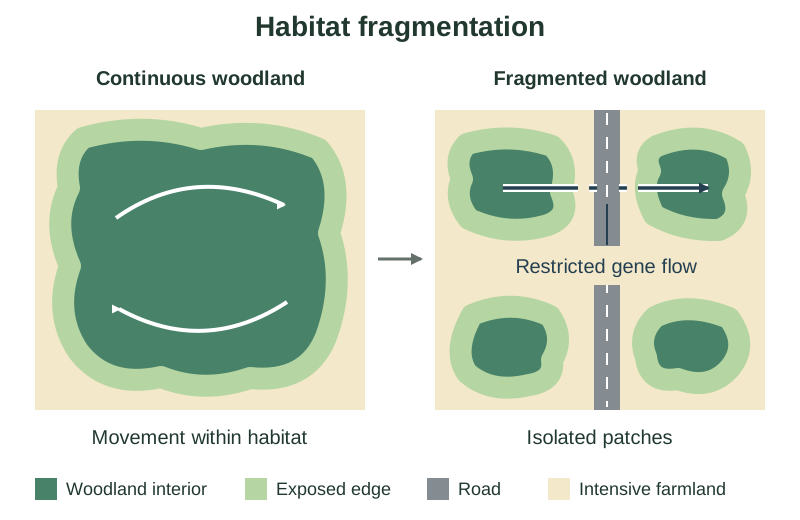
- Habitat fragmentation: Carving continuous habitats into small, isolated patches separated by roads and intensive farmland. Isolated patches suffer from edge effects—higher wind desiccation, easier predator access, and broken migration corridors that restrict gene flow.
- The Irish Corncrake (Crex crex):* Changing land management can wipe out a species without ever converting the field away from grass. Traditionally, Irish hay meadows were cut late in the summer, giving ground-nesting corncrakes time to rear their chicks safely in tall grass. The mechanised transition to silage changed everything: grass was cut earlier in summer, mown repeatedly, and cut at speed from the field margins inward, trapping and crushing chicks. Breeding ceased entirely in the Shannon Callows, once the national stronghold. Corncrakes are now restricted to Donegal, north Mayo, and Connemara, supported by the Corncrake LIFE project, which pays farmers to delay mowing and cut from the centre outward so chicks can escape.
- Marine sea-use change: Bottom trawling drags heavy gear across the seabed. In deep Atlantic waters off Ireland, it breaks slow-growing cold-water coral mounds (Desmophyllum pertusum, formerly Lophelia pertusa) on the Porcupine Bank, which take centuries to recover. In shallow inshore waters, trawling and dredging scar maerl beds, seagrass (Zostera) meadows, and horse-mussel reefs, all of which provide vital nursery grounds for juvenile marine species.
Driver 2: Direct Exploitation of Natural Resources
Direct exploitation involves taking wild organisms faster than their populations can naturally replace themselves through reproduction.
- Overfishing and trophic cascades: Industrial fleets using non-selective nets deplete fish stocks, triggering a trophic cascade—a chain reaction through a food web where removing top predators changes the abundance of prey and organisms further down the chain. The classic global example is the Newfoundland Grand Banks cod collapse; decades of intense offshore trawling destroyed the stock, leading to a commercial fishing moratorium in 1992.
- Irish Atlantic salmon (Salmo salar):* Coastal commercial drift-netting once intercepted migrating salmon at sea before they could reach their native rivers to spawn. Falling stock numbers forced the Irish government to ban commercial salmon drift-netting in 2007 to protect wild spawning populations.
- Bycatch: The non-targeted catch of marine wildlife in commercial gear. Longlines, gillnets, and trawl nets drown dolphins, harbour porpoises, diving seabirds, and turtles.
- Terrestrial exploitation: Overlogging of slow-growing wild timber (such as rosewood and mahogany), commercial bushmeat hunting, and poaching for international markets, including pangolin scales and rhinoceros horn.
Driver 3: Climate Change
Rising greenhouse gas emissions have pushed global average surface temperatures roughly 1.1 °C above pre-industrial baselines, altering habitats faster than many species can adapt or migrate.
- Coral bleaching: Marine heatwaves cause reef-building corals to expel the photosynthetic algae (zooxanthellae) living inside their tissues. These algae supply the coral polyp with food. Bleached corals turn bone-white and starve; if high temperatures persist, the corals die, collapsing reef structures that support a quarter of marine species.
- Ocean acidification: The ocean absorbs around 30% of human CO2 emissions. Dissolved CO2 reacts with seawater to form carbonic acid (H2CO3), which breaks down to release hydrogen ions. These ions lower ocean pH (surface pH has fallen from about 8.2 to 8.1 since pre-industrial times, roughly a 30% increase in hydrogen ion concentration). The surplus hydrogen ions bind with carbonate ions (CO3^2-), depleting the carbonate pool that shellfish, sea snails (pteropods), and cold-water corals require to build their calcium carbonate shells.
- Phenological mismatch: Shifts in biological timing. Warmer springs cause woodland oak trees to leaf early and winter moth caterpillars to peak earlier. Migratory birds like pied flycatchers, which time migration using day length rather than temperature, arrive at breeding grounds after the food peak has passed, leaving chicks to starve.
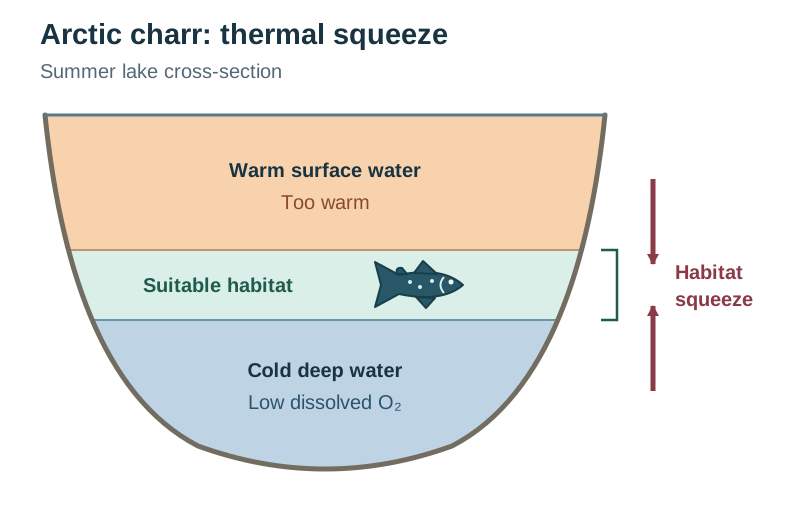
- Thermal squeeze on Irish Arctic charr (Salvelinus alpinus): Arctic charr are cold-water fish left behind in deep, clear Irish lakes after the last glacial retreat. As lakes warm, the surface layers heat up while the cold, deep waters lose oxygen during prolonged summer stratification. Charr are caught in a thermal squeeze and have disappeared from several Irish lakes—a local extinction, or extirpation*.
Driver 4: Pollution
Pollution introduces chemical contaminants, surplus nutrients, and physical wastes into ecosystems, degrading habitats and causing direct poisoning.
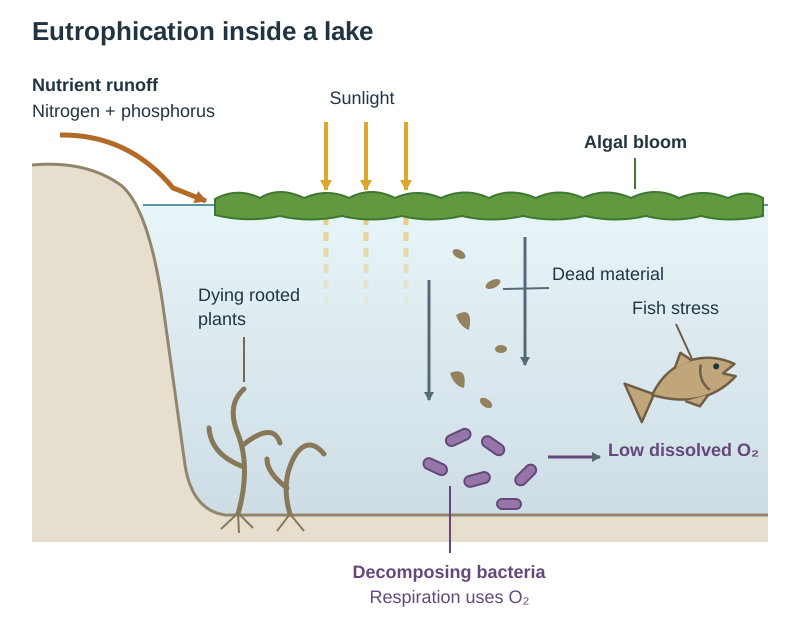
- Freshwater eutrophication: Excessive run-off of synthetic fertiliser, slurry, and poorly treated sewage releases high levels of phosphorus and nitrogen into waterways. This unfolds in a predictable five-step sequence:
- Surplus nutrients enter the water body.
- Rapid proliferation of algae and cyanobacteria forms a dense surface algal bloom.
- Thick algal mats block sunlight from reaching the lake bed, killing submerged rooted plants (macrophytes).
- Dying algae and plants sink, providing abundant food for aerobic decomposing bacteria, which multiply quickly.
- Bacterial respiration consumes dissolved oxygen, creating hypoxic (oxygen-depleted) conditions that suffocate fish like brown trout and sensitive stream invertebrates.
- The Freshwater Pearl Mussel (Margaritifera margaritifera):* This long-lived mollusc survives in clean, nutrient-poor Irish rivers. Fine sediment and nutrient run-off from agriculture, turf harvesting, and clear-fell forestry clog the clean gravels where young juvenile mussels bury themselves, cutting off their oxygen supply and halting reproduction.
- Synthetics and plastics: Neonicotinoid pesticides disrupt learning and navigation in wild foraging bees. Discarded plastics cause fatal digestive blockages in marine animals, while microplastics absorb toxic chemicals and concentrate them as they move up the food chain.
Driver 5: Invasive Non-Native Species
A non-native species is an organism introduced outside its natural geographical range by human actions. It is classified as an invasive non-native species only when it establishes breeding wild populations, spreads rapidly, and causes documented environmental or economic harm.
- Competitive exclusion and disease: Invaders often arrive without the specialised predators or parasites that keep them in check at home. They outcompete native species for light, nutrients, food, or nesting sites, and can carry diseases to which native wildlife has no immunity.
- Eastern Grey Squirrel (Sciurus carolinensis): Introduced to Co. Longford in 1911, the grey squirrel outcompetes native red squirrels (Sciurus vulgaris) in broadleaf woodlands because it digests unripe acorns and stores energy more efficiently. Greys also carry squirrelpox virus without dying from it; while squirrelpox caused catastrophic red declines in Britain and parts of Northern Ireland, in the Republic red declines were driven primarily by resource competition. The ongoing recovery of the native pine marten (Martes martes*) has reversed this trend: pine martens prey heavily on the larger, ground-feeding grey squirrel, allowing the agile red squirrel to return to midland and eastern woodlands.
- Rhododendron (Rhododendron ponticum):* Imported as an ornamental shrub, it has aggressively invaded western oak woods such as Killarney National Park. Rhododendron forms a dense, evergreen canopy that blocks light from reaching the woodland floor. Acorns cannot germinate, native bryophytes and wildflowers are smothered, and the forest loses its capacity to naturally regenerate.
- Zebra Mussel (Dreissena polymorpha):* Native to the Caspian and Black Sea basins, it arrived in the River Shannon during the mid-1990s, carried on the hulls and in the bilge water of imported second-hand pleasure boats. Zebra mussels form dense colonies on rocks and pipes, filter out native phytoplankton, and smother native freshwater mussels.
Driver Interactions: The 2023 Lough Neagh Collapse
In natural systems, the five drivers rarely act by themselves. They interact synergistically, meaning the combined ecological damage is far greater than the sum of each pressure operating alone.
The 2023 Lough Neagh crisis
During the summer of 2023, Lough Neagh—the largest freshwater lake in Ireland and Britain—suffered massive, toxic blooms of cyanobacteria (blue-green algae). The blooms killed wild fish and pet dogs, forced public recreation amenities to close, and threatened drinking water supplies that serve roughly 40% of Northern Ireland's population. Three drivers compounded each other:
- Pollution (chronic nutrient loading): Decades of intensive poultry and dairy farming throughout the catchment saturated soils with phosphorus, which washed into the lake alongside discharges from outdated municipal wastewater plants.
- Climate change (record high summer temperatures): Unprecedented heat warmed the surface water, accelerating cyanobacterial cell division and establishing strong thermal stratification that trapped warm, nutrient-rich water at the lake surface.
- Invasive non-native species (zebra mussels): Billions of invasive zebra mussels filtered out suspended sediments and native plankton. Clearer water sounds beneficial, but here it allowed sunlight to reach far deeper into the water column. The blue-green algae had both abundant phosphorus and deep light penetration, triggering explosive growth.
Lough Neagh is in Northern Ireland, meaning regulation falls under the Northern Ireland Environment Agency (NIEA) and DAERA rather than the EPA or Ireland's Nitrates Action Programme. A Republic of Ireland equivalent of agricultural and wastewater eutrophication is Lough Leane in Killarney, which required an integrated catchment management programme to tackle recurring algal blooms.
Treating one driver alone cannot fix a synergistic crisis: lowering fertiliser run-off will not stop blooms if warming waters and invasive species keep changing the lake's physical dynamics.
Summary of Drivers and Named Responses
To prepare for exam questions requiring you to evaluate solutions, learn one specific response for each driver:
| Driver | Mechanism | Irish example | Global example | Named response and function |
|---|---|---|---|---|
| Changing use of sea and land | Physical clearance, fragmentation, or altered management of native habitats | Corncrake decline due to early mechanised silage mowing | Amazon rainforest clearance for soya and pasture | Peatland rewetting on former cutaway bogs (raises water table to restore Sphagnum cover); Natura 2000 SAC/SPA legal protection |
| Direct exploitation | Harvesting wild populations faster than biological replacement | Salmon depleted by coastal netting | Collapse of Newfoundland Grand Banks cod | 2007 ban on coastal salmon drift-netting; strict EU commercial fishing quotas and Marine Protected Areas (MPAs) |
| Climate change | Shifting temperatures, ocean acidification, and altered seasonal timing | Arctic charr extirpation from warming post-glacial lakes | Coral bleaching from marine heatwaves | Legally binding 51% emissions cut by 2030 (Climate Action and Low Carbon Development Act 2021); hedgerow wildlife corridors |
| Pollution | Chemical contamination and nutrient run-off causing hypoxia | Agricultural run-off choking freshwater pearl mussel gravels | Ocean plastic patches and pesticide declines in insects | Good Agricultural Practice Regulations (buffer strips along streams, slurry spreading closed periods); All-Ireland Pollinator Plan |
| Invasive non-native species | Unchecked competition, predation, and disease transmission | Rhododendron shading out Killarney oak woodlands | Zebra mussel colonisation of waterways | "Check, Clean, Dry" biosecurity routines for angling boats and gear; systematic manual clearance of rhododendron |
Key terms
- Biodiversity
- The variety of all life on Earth, spanning genetic diversity within species, species diversity within an area, and the diversity of habitats across ecosystems.
- Biosphere Integrity
- A core planetary boundary measuring the genetic diversity and functional health of global ecosystems, currently crossed into the high-risk danger zone.
- Changing Use of Sea and Land
- The conversion, degradation, or fragmentation of natural habitats for agriculture, forestry, aquaculture, or urban development; the primary historical driver of land biodiversity loss.
- Direct Exploitation of Natural Resources
- Harvesting or extracting wild plants and animals at rates faster than the natural population can reproduce and replace itself, such as industrial overfishing.
- Direct Driver
- A physical human activity that directly causes biodiversity loss or environmental degradation, such as land clearing or toxic discharge.
- Indirect Driver
- An underlying social, economic, or political force driving direct human impacts, such as economic growth models, consumer demand, and global trade.
- Habitat Fragmentation
- The dividing of continuous wild habitats into smaller, isolated patches, creating edge effects and blocking gene flow between separated populations.
- Eutrophication
- The nutrient enrichment of water bodies by surplus nitrogen and phosphorus, driving algal blooms whose decomposition by bacteria strips dissolved oxygen from the water.
- Hypoxic
- A state of severe oxygen depletion in a water body, falling below the biological threshold required to sustain fish and aquatic invertebrate life.
- Ocean Acidification
- The ongoing decrease in seawater pH caused by absorbing excess atmospheric CO2, which forms carbonic acid and strips away carbonate ions needed by shell-building organisms.
- Phenological Mismatch
- The disruption in the seasonal timing of life-cycle events between interdependent species, such as bird chicks hatching after peak insect prey abundance has passed.
- Invasive Non-Native Species
- An introduced species that establishes wild breeding populations, spreads quickly, and causes documented harm to native species, ecosystems, or the economy.
- Extirpation
- The local extinction of a species from a specific geographic region, even though the species continues to survive elsewhere in the world.
- Trophic Cascade
- A chain-reaction disruption through an ecological food web triggered by the removal or drastic reduction of a top predator or keystone species.
- Ecosystem Services
- The direct and indirect benefits that functioning natural systems deliver to human society, grouped into provisioning, regulating, supporting, and cultural services.
- Species Richness
- The total count of different biological species living within a defined community or geographic area.
- Species Abundance
- The number of individual organisms representing a specific species present in an ecosystem.
Check yourself
What are the five direct drivers of biodiversity loss named in Strand 1 Learning Outcome 6?
Changing use of sea and land, direct exploitation of natural resources, climate change, pollution, and invasive non-native species.
How does the syllabus action verb 'illustrate' differ from 'outline'?
'Outline' means giving the essential main points or an overview without detail. 'Illustrate' specifically requires using named real-world examples to describe how a process occurs.
Classify each of the following under one of the five drivers: (a) draining a raised bog for grazing; (b) a fish kill after slurry enters a river; (c) rhododendron shading out oak seedlings; (d) Arctic charr losing cold water in a warming lake; (e) netting salmon at sea before they spawn.
(a) Changing use of sea and land; (b) Pollution; (c) Invasive non-native species; (d) Climate change; (e) Direct exploitation of natural resources.
Explain the biological mechanism connecting early silage cutting to corncrake population decline in Ireland.
Silage machinery cuts grass earlier in summer than traditional haymaking and mows at speed from field edges inward, destroying nests and trapping flightless chicks before they can fledge.
What chemical changes link higher atmospheric carbon dioxide to ocean acidification?
Dissolved carbon dioxide forms carbonic acid in seawater, releasing hydrogen ions that lower ocean pH and bond with carbonate ions, reducing the carbonate available for calcifiers to build shells and skeletons.
Why did clearer water caused by zebra mussels accelerate algal blooms in Lough Neagh?
Zebra mussels filtered out suspended particles, allowing sunlight to penetrate deeper into the water column, which supercharged photosynthesis for blue-green algae fueled by surplus agricultural phosphorus.