

Across Earth's 4.6-billion-year history, climate has shifted continuously between extreme greenhouse hothouses and deep ice ages. Strand 1 Learning Outcome 1.2 requires students to identify natural factors influencing the Earth's climate since its formation: volcanic eruptions, ocean formation, tectonic plate movements, the evolution of life, variations in sunlight intensity, slow changes in Earth's orbit (Milankovitch cycles), and fossil fuel formation. For each factor, you need to understand three core things: the physical or chemical mechanism, the timescale over which it acts, and whether it warms or cools the planet. These natural factors establish the baseline against which modern human-induced climate change is measured.
The Seven Factors at a Glance
When an exam question uses the command verb identify, you do not need an essay. You need the factor named together with its single distinguishing feature. Keep these seven summary statements ready:
- Volcanic eruptions: Explosive eruptions inject sulphur dioxide into the stratosphere, forming reflective sulphate aerosols that cool the surface for 1 to 3 years; sustained volcanic outgassing releases that warms the planet over millions of years.
- Formation of the oceans: Liquid water dissolved huge quantities of primordial atmospheric into carbonate sediments, while its high heat capacity stores and moves thermal energy across latitudes, steadying global temperatures.
- Tectonic plate activity: Continental drift changes where land sits relative to the poles, opens and closes oceanic gateways, and builds mountain ranges whose chemical weathering strips out of the atmosphere over millions of years.
- Evolution of life: Photosynthetic organisms restructured the atmosphere, most dramatically during the Great Oxidation Event roughly 2.4 billion years ago, which broke down atmospheric methane and triggered global cooling.
- Changes in sunlight intensity: The Sun has brightened by roughly 25% to 30% over 4.6 billion years, and it fluctuates weakly on an 11-year magnetic cycle, altering total energy entering the Earth system.
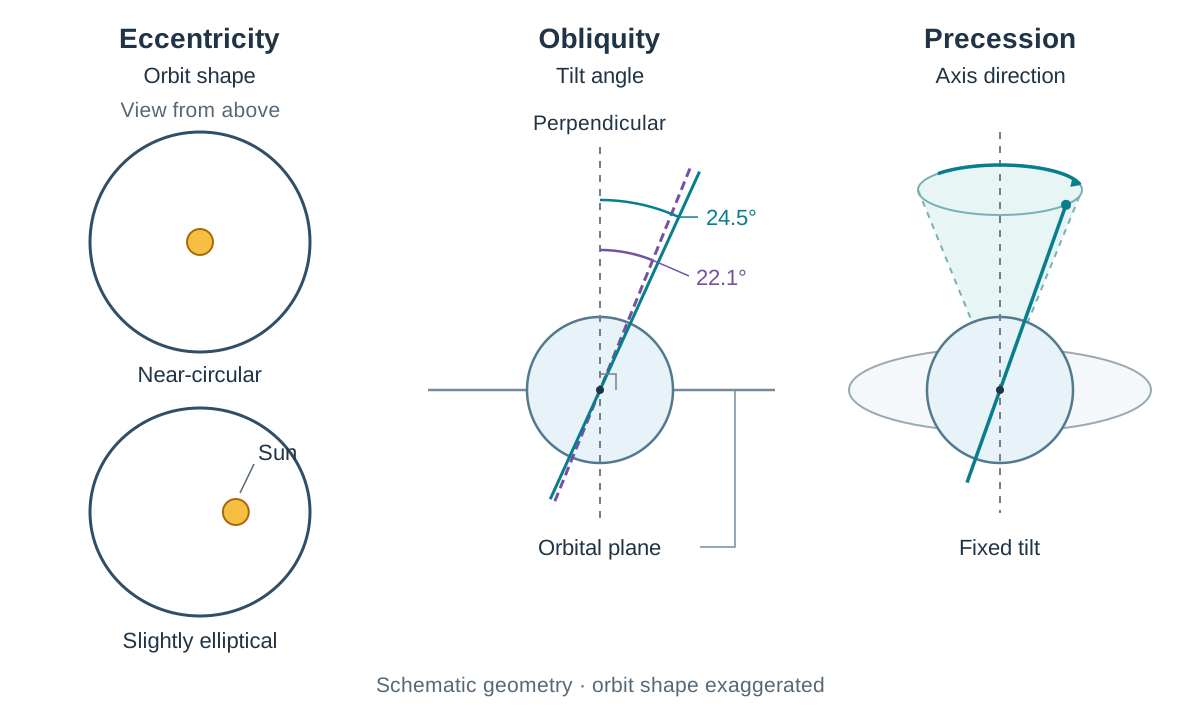
- Slow changes in Earth's orbit (Milankovitch cycles): Variations in eccentricity, obliquity, and precession redistribute seasonal sunlight across latitudes, pacing ice ages over tens to hundreds of thousands of years.
- Formation of fossil fuels: Rapid burial of ancient organic matter in anoxic environments locked carbon into rock for hundreds of millions of years, cooling ancient Earth by drawing down atmospheric .
Climate Framework: Forcings, Feedbacks, and Core Definitions
To make sense of climate history, we separate the initial push on the climate from the system's reaction.
A climate trigger (forcing) is an external or initial driver that alters the planet's energy balance. Examples include orbital shifts, solar brightening, or massive volcanic events.
A climate feedback is an internal process that responds to that initial push. A positive feedback amplifies the initial change, driving temperatures further in the same direction. A negative feedback pushes back against the initial change, stabilising the system.
Essential Definitions
Before examining the factors, master three foundational terms:
- Albedo is the fraction of incoming solar radiation that a surface reflects straight back into space, measured from 0 to 1 (or 0% to 100%). Fresh snow has an exceptionally high albedo of over 0.80, reflecting more than 80% of sunlight. Dark open ocean has a low albedo of roughly 0.06, absorbing nearly all of it. Anything that makes Earth brighter raises its planetary albedo and cools the surface.
- Insolation is the amount of incoming solar radiation received on a given surface area over a given time.
- A glacial is a cold period during an ice age when continental ice sheets expand. An interglacial is a warmer interval between glacials, such as our present Holocene epoch.
Systems Thinking: Transfers Between Earth Spheres
Every natural factor represents an exchange of energy or matter between Earth systems:
- Volcanic eruptions: geosphere atmosphere
- Formation of the oceans: atmosphere hydrosphere
- Tectonic activity: geosphere hydrosphere atmosphere
- Evolution of life: biosphere atmosphere
- Solar intensity: external energy input into the whole Earth system
- Orbital cycles: alters energy distribution across the cryosphere, ocean, and land
- Fossil fuel formation: biosphere geosphere
Volcanic Eruptions: Short-Term Cooling and Long-Term Warming
Volcanoes act as a direct pathway between the geosphere and the atmosphere, but their climate impact depends on whether you look at individual explosive blasts or deep geological time.
Short-Term Surface Cooling (1 to 3 Years)
When gas-rich magma produces an explosive eruption, it blasts out plumes of pulverised rock (ash) and sulphur dioxide () directly into the stratosphere. Because this sits above the troposphere, rain cannot wash the gases out.
Ash particles are relatively heavy, so they settle out within days or weeks. The sustained cooling comes from . In the stratosphere, reacts with ambient water vapour to produce microscopic droplets of sulphuric acid (), known as sulphate aerosols:
These pale aerosols scatter incoming solar radiation back into space, raising Earth's albedo and cooling the surface.
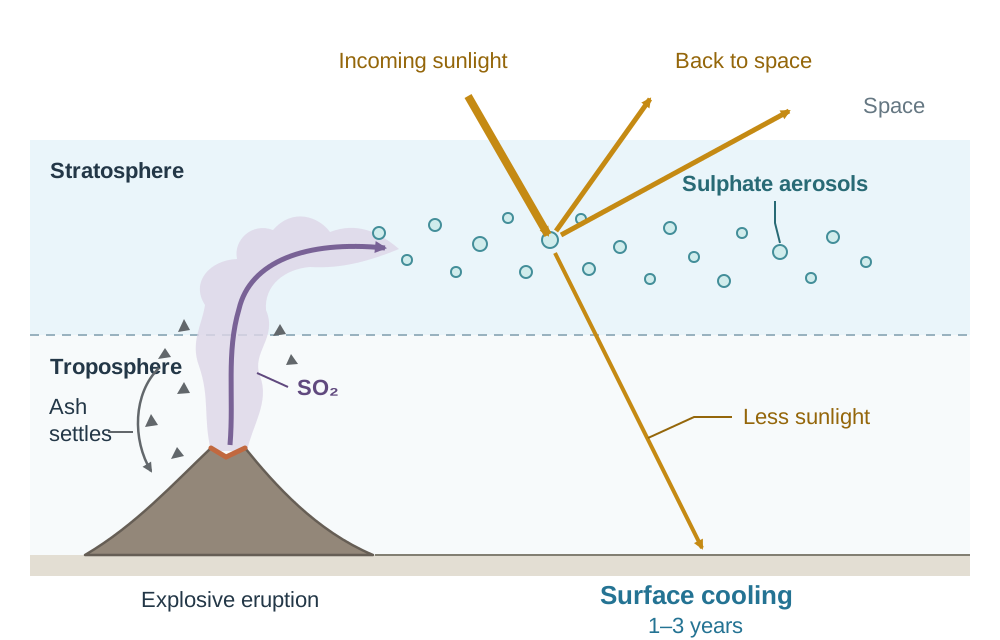
- Mount Pinatubo (Philippines, 1991): Injected roughly 20 to 22 million tonnes of into the stratosphere, lowering global average surface temperatures by roughly 0.5 °C for 18 to 24 months.
- Mount Tambora (Indonesia, 1815): The most powerful eruption in recorded history lowered global mean surface temperatures by 0.5 °C to 0.7 °C. In parts of Western Europe and eastern North America, regional summer temperatures dropped by up to 3 °C, causing widespread crop failures and the historic 'year without a summer' in 1816.
Long-Term Greenhouse Warming (Millions of Years)
Over geological timescales, volcanism warms the planet. Steady volcanic outgassing along mid-ocean ridges, continental rifts, and subduction zones releases and water vapour from the mantle into the atmosphere. During catastrophic volcanic episodes, such as the Siberian Traps eruptions roughly 252 million years ago, immense and sustained greenhouse gas emissions caused severe global warming and mass extinction.
Formation of the Oceans: Planetary Heat Buffer and Geochemical Sink
During Earth's accretion 4.6 billion years ago, heat from radioactive decay and meteorite bombardments kept the surface molten. As the crust cooled below 100 °C, water vapour released through primordial volcanic outgassing condensed. Rains fell over millions of years, filling crustal depressions to assemble the first oceans between 4.4 and 4.0 billion years ago.
Once the oceans existed (the hydrosphere, encompassing all water on Earth), they altered planetary climate in three ways:
1. Geochemical Carbon Sink
Liquid water dissolved huge amounts of from the primordial atmosphere. Marine chemical reactions precipitated this dissolved carbon into carbonate sediments on the seabed. Without the oceans removing vast amounts of from the early air, Earth could have suffered a runaway greenhouse effect like Venus, where surface temperatures exceed 400 °C.
2. Planetary Thermal Buffer
Water has a very high specific heat capacity. The oceans absorb and release vast quantities of thermal energy while changing temperature only slightly—a property called thermal inertia. This buffers maritime landmasses against harsh seasonal extremes.
3. Latitudinal Heat Transport
Ocean currents function as a giant conveyor belt, moving surplus heat from the tropics toward the poles. A key example is the North Atlantic Drift, which carries warm water toward north-western Europe. It keeps Irish winter temperatures markedly milder than places at equivalent latitudes, such as coastal Labrador in Canada.
Tectonic Plate Activity: Continental Drift, Ocean Gateways, and Weathering
Earth's outer shell is cracked into rigid plates (the lithosphere). These slide very slowly over a hotter, softer layer beneath them (the asthenosphere), typically at about 1 to 10 centimetres per year—roughly the speed human fingernails grow. Over tens of millions of years, this motion alters planetary climate through three distinct mechanisms:
1. Latitudinal Continental Drift
Plates carry landmasses into different climate zones. Continental crust has a lower heat capacity than water and cools quickly. When continents cluster over polar latitudes, winter snow survives the summer and builds into permanent ice sheets. This triggers the ice-albedo feedback: white ice reflects incoming solar radiation, cooling the planet further.
Irish Geological Evidence: Around 340 to 330 million years ago, tectonic drift placed the landmass that is now Ireland in warm, shallow equatorial seas. Skeletons and shells of marine organisms accumulated to build the Carboniferous limestone that underlies much of the Irish midlands. Later in the Carboniferous, roughly 320 to 300 million years ago, sea level fell and the same landmass—still near the equator—was covered in hot, humid swamp forests. The buried remains of those trees formed the coal seams mined at Arigna, Co. Roscommon, and Castlecomer, Co. Kilkenny.
2. Opening and Closing of Ocean Gateways
Tectonic movement can open or seal passages between ocean basins, redirecting global heat flow. Roughly 34 million years ago, the separation of South America from Antarctica opened the Drake Passage (and around the same time, Australia drifted clear of Antarctica). With no land barriers left, water circled the continent continuously, creating the Antarctic Circumpolar Current. This current isolated Antarctica from warm tropical waters, allowing its permanent continental ice sheets to develop.
3. Mountain Uplift and Silicate Weathering
When continental plates collide, mountain ranges rise. Uplift fractures fresh silicate rocks, exposing them to chemical weathering by rainwater. Rain absorbs atmospheric to form weak carbonic acid (), which breaks down silicate minerals:
Rivers carry these dissolved ions into the oceans, where organisms incorporate them into calcium carbonate () shells. When they die, their shells settle on the sea floor, locking atmospheric carbon into limestone for millions of years.
Silicate weathering acts as Earth's natural thermostat—a negative feedback. Chemical weathering reactions speed up in warm, wet climates. If atmospheric builds up and warms the planet, weathering accelerates, pulling out of the air faster and cooling the climate back down. If the planet turns cold, weathering slows, allowing volcanic outgassing to replenish and warm the surface. This negative feedback has kept Earth habitable for billions of years, but it operates over hundreds of thousands to millions of years—far too slowly to clean up human emissions today.
Evolution of Life: Oxygenation and Atmospheric Restructuring
Living organisms are not passive passengers; through metabolic processes like photosynthesis, life has actively reshaped the atmosphere and changed climate across geological time.
The Great Oxidation Event and Methane Collapse
Earth's early atmosphere was anoxic (oxygen-free) and rich in methane (). Roughly 2.4 billion years ago, primitive single-celled cyanobacteria began oxygenic photosynthesis on a global scale:
At first, this released oxygen was absorbed by dissolved ferrous iron in primordial oceans, precipitating out as sedimentary layers called Banded Iron Formations (BIFs). Once oceanic iron sinks were exhausted, free oxygen began escaping into the atmosphere.
This produced an abrupt climatic cooling. Free oxygen reacted with atmospheric methane, oxidising it to carbon dioxide and water vapour. Because methane traps far more heat per molecule than does—roughly 28 times as much over a 100-year period—replacing methane with carbon dioxide collapsed the atmospheric greenhouse effect. This plunged Earth into the Huronian Glaciation, an extreme ice age lasting millions of years.
Accumulating oxygen also formed the stratospheric ozone layer (), shielding the surface from harmful ultraviolet radiation and allowing life to eventually colonise land.
Land Plant Colonisation
Between 400 and 300 million years ago (the Devonian and Carboniferous periods), the evolution of deep-rooted land plants accelerated chemical rock weathering and drew down enormous quantities of atmospheric into plant tissue, driving down temperatures and sustaining late Paleozoic glaciations.
Sunlight Intensity: The Faint Young Sun and Modern Solar Irradiance
Solar radiation is the primary energy source powering Earth's climate system. Changes in solar output operate across two different timescales:
The Faint Young Sun Paradox
Models of how stars evolve show that when Earth formed 4.6 billion years ago, the Sun had converted much less of its hydrogen into helium. Its core was less dense and slightly cooler, fusion ran more slowly, and the Sun shone with roughly 25% to 30% less energy than it does today.
Under such low solar output, early Earth should have been completely frozen. Yet geological evidence—such as 3.8-billion-year-old pillow basalts formed underwater—proves that liquid oceans and early life existed. This paradox is resolved by atmospheric chemistry: intense early volcanic outgassing filled the atmosphere with high concentrations of greenhouse gases ( and ). This potent natural greenhouse effect trapped enough heat to keep the oceans liquid despite the dimmer Sun.
Modern Solar Cycles
On shorter timescales, the Sun's magnetic activity varies across an approximate 11-year solar cycle, tracked by sunspot counts. Between solar minimum and solar maximum, total solar irradiance changes by only about 0.1% (around ), altering global temperatures by less than 0.1 °C.
Satellites have measured the Sun's output directly since 1978. Over that time, solar irradiance has stayed flat or slightly declined while global surface temperatures have climbed sharply. The Sun cannot be the cause of modern warming.
Milankovitch Cycles: Orbital Pacing of Ice Ages
Milutin Milankovitch calculated that predictable shifts in Earth's orbital geometry alter how solar radiation (insolation) is distributed across latitudes and seasons. Over the Quaternary period (the last 2.6 million years), these cycles have paced the regular rhythm of glacial and interglacial periods.
| Orbital Parameter | Mechanism | Cycle Period | Climate Influence |
|---|---|---|---|
| Eccentricity | Earth's orbit shifts between near-circular and slightly elliptical. | ~100,000 and 413,000 years | Changes how much the Earth–Sun distance varies across the year; modulates the strength of precession. |
| Obliquity (Axial Tilt) | Earth's rotational tilt angle varies between about 22.1° and 24.5° (currently ~23.4°). | ~41,000 years | Higher tilt creates harsher seasons. Lower tilt softens seasons, causing cooler summers at high latitudes. |
| Precession (Wobble) | Earth's rotational axis slowly traces a circular wobble, like a spinning top. | ~19,000 to 24,000 years | Changes which hemisphere points toward the Sun at closest approach (perihelion), shifting seasonal severity. |
The Glaciation Trigger and Amplifying Feedbacks
Milankovitch cycles do not change Earth's total annual incoming sunlight significantly; they redistribute it. The critical trigger for starting an ice age is cool summers at high northern latitudes (~65° N). If summer sunlight is weak, winter snow in Canada and northern Eurasia does not completely melt. Unmelted snow survives the summer, thickens year-on-year, and gradually builds into continental ice sheets.
Two self-reinforcing positive feedbacks then take over and amplify that small initial nudge:
- Ice-Albedo Feedback: Expanding white ice replaces darker land and sea surfaces. Surface albedo jumps from ~0.06 (open water) to over 0.80 (snow and ice). More sunlight is reflected straight back to space, causing further cooling and allowing ice sheets to grow wider.
- Carbon Cycle Feedback: Cooler ocean waters dissolve more atmospheric . Antarctic ice cores prove that atmospheric dropped to roughly 180 ppm during glacial maxima and rose to roughly 280 ppm during warm interglacials. The weakened greenhouse effect deepens the global freeze.
Formation of Fossil Fuels: Deep Geological Carbon Sequestration
Before fossil fuels became an industrial energy source, their formation was one of Earth's most effective natural carbon sinks.
The Five Conditions for Formation
Transforming dead biological tissue into fossil fuel requires five specific environmental conditions:
- Large volumes of organic matter (trees, swamp vegetation, marine plankton)
- Rapid burial by sediments
- Anoxic (oxygen-depleted) conditions to halt decay
- Sustained heat and geological pressure
- Millions of years of time
Coal Formation and Coal Ranks
During the Carboniferous period (360 to 300 million years ago), vast equatorial swamp forests produced abundant plant debris. Trees collapsed into stagnant, waterlogged bogs where anoxic water prevented aerobic microbes from breaking down tough lignin. As thick sediment accumulated overhead, heat and pressure compressed the peat through progressive coal ranks:
Oil and Natural Gas Formation
In ancient oceans, microscopic plankton and algae died and settled onto muddy sea floors under anoxic conditions. Over millions of years, deep burial heated this kerogen-rich mud. Moderate heat cooked the organic material into liquid petroleum (crude oil), while higher temperatures and pressures cracked the molecules into natural gas (principally methane, ).
Geological Cooling versus Modern Warming
By burying billions of tonnes of carbon in sedimentary rock for hundreds of millions of years, fossil fuel formation drew huge amounts of out of the active carbon cycle, cooling ancient Earth.
Modern fossil fuel combustion does the reverse: it extracts carbon that took hundreds of millions of years to bury and returns it to the atmosphere in a couple of centuries. This rapid carbon release drives the modern enhanced greenhouse effect.
Evidence and Timescales: How We Know and How They Compare
Thermometers have recorded weather for only about 170 years. Everything we know about ancient climates comes from proxies—natural systems that record past physical and chemical conditions.
| Proxy Record | What It Preserves | Timescale Reached |
|---|---|---|
| Ice cores (Antarctica, Greenland) | Air bubbles preserve ancient atmospheric and directly; oxygen isotopes in the ice indicate past temperatures. | ~800,000 years |
| Ocean sediment cores | Oxygen isotopes in fossil shells of marine foraminifera track sea temperatures and continental ice volume. | Tens of millions of years |
| Tree rings | Ring width and wood density record growing-season temperature and moisture. | Thousands of years |
| Pollen analysis | Plant species preserved in lake and bog mud identify past regional vegetation and local climates. | Tens of thousands of years |
| Rock strata | Limestone signifies warm shallow seas; coal indicates tropical swamps; tillites signify glacial ice sheets. | Hundreds of millions to billions of years |
Comparing Natural Timescales
These seven factors operate on wildly different timescales. Knowing which is which is the fastest way to distinguish them in an exam:
| Natural Factor | Timescale | Warms or Cools? |
|---|---|---|
| Volcanic Eruptions (Explosive) | 1 to 3 years | Cools (sulphate aerosols raise albedo) |
| Volcanic Outgassing (Sustained) | Millions of years | Warms ( release builds greenhouse effect) |
| Ocean Formation | Hundreds of millions of years | Cools ( dissolved and locked into seabed rocks) |
| Tectonic Plate Activity | Tens of millions of years | Both (regulates currents, drift, and weathering sinks) |
| Evolution of Life (GOE) | Billions to millions of years | Cools (methane destroyed, captured into biomass) |
| Solar Intensity Changes | 11 years (cycles) to billions of years (luminosity) | Warms overall over billions of years; weak 11-year oscillations |
| Milankovitch Cycles | 19,000 to 413,000 years | Cycles between cold glacials and warm interglacials |
| Fossil Fuel Formation | Tens of millions of years | Cools (geological carbon sequestration) |
Why This Topic Matters for the Course
Every natural factor listed here is still active today: volcanoes still erupt, tectonic plates still creep, the Sun still runs its 11-year cycle, and Earth's orbit still wobbles. Because scientists can calculate the exact radiative forcing of each of these natural factors, we know that none of them account for the rapid warming of roughly 1.2 °C observed over the last 150 years. Understanding the natural baseline is what makes human attribution scientifically certain.
Key terms
- Natural Climate Factor
- Any non-human astronomical, geological, chemical, or biological process that alters Earth's climate by changing incoming solar radiation, planetary albedo, greenhouse gas concentrations, or oceanic heat transport.
- Albedo
- The fraction of incoming solar radiation reflected back into space by a surface, expressed as a decimal from 0 to 1 or as a percentage.
- Insolation
- The total amount of incoming solar radiation reaching a given area of Earth's surface over a given period.
- Sulphate Aerosols
- Microscopic droplets of sulphuric acid (H₂SO₄) formed in the stratosphere when volcanic sulphur dioxide (SO₂) reacts with water vapour, reflecting incoming sunlight and cooling the planet for 1 to 3 years.
- Volcanic Outgassing
- The continuous release of dissolved gases, primarily water vapour and carbon dioxide, from magma into the atmosphere along tectonic boundaries and vents.
- Thermal Inertia
- The property of large water bodies like oceans to absorb, store, and release massive quantities of heat with minimal temperature change, due to water's high specific heat capacity.
- Silicate Weathering
- The chemical breakdown of silicate rocks by carbonic acid in rainwater, which draws carbon dioxide out of the atmosphere and deposits it as carbonate rocks on the seafloor.
- Great Oxidation Event
- A major planetary transition roughly 2.4 billion years ago when cyanobacterial oxygen accumulated in the atmosphere, oxidising atmospheric methane and causing global cooling (the Huronian Glaciation).
- Banded Iron Formations
- Marine sedimentary rock strata made of alternating bands of iron oxide and chert, formed when early photosynthetic oxygen reacted with dissolved ferrous iron in the oceans.
- Faint Young Sun Paradox
- The problem of how early Earth maintained liquid oceans 4.6 to 3.8 billion years ago despite the Sun being 25% to 30% dimmer, resolved by high primordial atmospheric greenhouse gas concentrations.
- Milankovitch Cycles
- Predictable, cyclical variations in Earth's orbital eccentricity, axial tilt (obliquity), and axial precession that redistribute incoming solar radiation across latitudes and seasons.
- Ice-Albedo Feedback
- A positive feedback loop where expanding ice cover reflects more incoming solar radiation back to space, lowering temperatures and driving further ice growth.
- Carbon Sink
- Any natural biological, oceanic, or geological reservoir that absorbs and stores more carbon from the atmosphere than it releases.
- Coal Ranks
- The progressive stages of coal formation as increasing geological heat and pressure compact organic matter: peat → lignite → bituminous coal → anthracite.
Check yourself
Why does volcanic ash not explain multi-year cooling following a major volcanic eruption?
Ash particles are comparatively heavy and fall out of the atmosphere within days to weeks. Multi-year cooling is caused by microscopic sulphate aerosols formed from SO₂ in the stratosphere, which remain aloft for 1 to 3 years and reflect sunlight.
Which volcanic gas forms the stratospheric aerosols responsible for temporary global cooling after an explosive eruption?
Sulphur dioxide (), which reacts with water vapour in the stratosphere to produce reflective sulphuric acid () aerosols.
How did the Great Oxidation Event trigger the Huronian Glaciation roughly 2.4 billion years ago?
Oxygen produced by cyanobacteria reacted with and destroyed atmospheric methane, replacing a potent greenhouse gas with weaker carbon dioxide and collapsing Earth's natural greenhouse effect.
What seasonal condition at high northern latitudes is required to trigger an ice age under Milankovitch theory?
Cool summers (low summer insolation at ~65° N), which prevent winter snow from fully melting, allowing snowpack to accumulate year-on-year into continental ice sheets.
What is the Faint Young Sun paradox, and how is it resolved?
Early Earth had liquid oceans despite the Sun being roughly 25% to 30% dimmer 4.6 billion years ago. High concentrations of primordial volcanic greenhouse gases ( and ) trapped enough heat to keep the surface from freezing.
How does chemical weathering of silicate rocks act as a negative feedback on Earth's climate?
When the climate warms, weathering reactions speed up, stripping out of the air and cooling the planet. When the climate cools, weathering slows, allowing volcanic to accumulate and warm the planet back up.
Name the three Milankovitch cycles and state their approximate periodic timescales.
Orbital eccentricity (~100,000 and 413,000 years), axial tilt or obliquity (~41,000 years), and axial precession or wobble (~19,000 to 24,000 years).
State the four stages of progressive coal compression as organic matter is buried under heat and pressure.
Peat Lignite Bituminous Coal Anthracite.
Give two pieces of Irish rock evidence proving that Ireland once lay in equatorial latitudes.
The Carboniferous limestone of the Irish midlands (formed in warm, shallow tropical seas ~340–330 million years ago) and the coal deposits of Arigna and Castlecomer (formed in tropical swamps ~320–300 million years ago).