

Geologists divide Earth's history into named units of time. For the past 11,700 years, Earth has officially lived in the Holocene epoch, a post-glacial period of stable climate that allowed agriculture, towns, and global civilisation to develop. The Anthropocene is a proposed geological epoch defined by human activity becoming the dominant planetary force shaping Earth's climate, ecosystems, and rock strata. Popularised in 2000 by atmospheric chemist Paul Crutzen and ecologist Eugene Stoermer, the concept captures the shift away from Holocene conditions. The Leaving Certificate Climate Action and Sustainable Development specification requires Higher Level students to discuss the concept of the Anthropocene. The specification defines 'discuss' as a considered, balanced review that includes a range of arguments and a clearly stated conclusion supported by evidence. In this topic, the strongest answers do that by using measured Earth-system data, weighing competing start dates and considering critiques such as the Capitalocene.
The Anthropocene Concept and the Holocene Baseline
Geologists organise the 4.5 billion years of Earth's history into formal chronological intervals: eons, eras, periods, and epochs. Earth officially remains in the Holocene epoch, which began roughly 11,700 years ago when the last continental ice sheets retreated. This long spell of stable, mild climate is what allowed humans to develop farming, build permanent settlements, and grow large populations. During the Holocene, atmospheric carbon dioxide hovered close to 280 parts per million (ppm), and average surface temperatures stayed within a narrow range of roughly 1 °C.
In 2000, Paul Crutzen and Eugene Stoermer coined the word Anthropocene (from the Greek anthropos, meaning human, and kainos, meaning recent) to capture the idea that human activity now changes the planet as much as, or more than, natural forces such as volcanoes, erosion, and ice ages do. Humans now shift more rock and soil each year through mining, quarrying, and construction than the world's rivers carry to the sea. In environmental science, the concept operates on two levels: as a proposed unit of geological time requiring physical markers in rock strata, and as a broad systems framework describing human destabilisation of planetary processes.
Evidence of Human Dominance Across the Five Earth Systems
Under Strand 1, human impacts must be evaluated across the five interconnected Earth systems. High-scoring answers cite specific, measured figures for each sphere rather than making vague statements about pollution:
| Earth system | Measured physical evidence of human dominance |
|---|---|
| Atmosphere | Carbon dioxide has risen from a pre-industrial baseline of ~280 ppm to over 420 ppm today (a 50% increase), while methane has more than doubled. |
| Hydrosphere | Ocean acidification: average surface ocean pH has dropped from about 8.2 to 8.1, representing an approximate 30% increase in hydrogen ion acidity as seawater absorbs excess CO₂. |
| Cryosphere | Accelerating loss of Arctic summer sea ice, widespread retreat of mountain glaciers, and Antarctic ice-sheet mass loss, driving global average sea level up by roughly 20 cm since 1900. |
| Biosphere | Extinction rates are tens to hundreds of times above natural background rates; the IPBES (2019) report assessed around 1 million species as threatened with extinction. Domestic poultry (broiler chickens) and livestock now make up the vast majority of terrestrial bird and mammal biomass, leaving a distinct physical fossil trace. |
| Geosphere | Deposition of novel synthetic compounds and technofossils (plastics, refined aluminium, reinforced concrete), alongside spherical fly-ash particles from coal burning and artificial radionuclides from nuclear detonations. |
In the Stockholm Resilience Centre's Planetary Boundaries framework, human disruption has pushed Earth outside the safe operating space for at least six of the nine planetary boundaries (2023 assessment), including climate change, biosphere integrity, and biogeochemical flows.
Evaluating Candidate Start Dates: A Balanced Discussion
To achieve high marks when asked to discuss the Anthropocene, you must weigh the evidence for different proposed starting points:
Early Agriculture (The Ruddiman Hypothesis, c. 8,000–5,000 BP)
William Ruddiman argued that ancient forest clearance for crops and methane from irrigated rice paddies began altering atmospheric greenhouse gas levels thousands of years ago, delaying the onset of a natural glacial cycle. However, farming developed gradually across different continents at different times. Because this transition was slow and regional—what geologists call time-transgressive—it lacks a single, globally synchronous boundary line.
The 1610 Orbis Spike (Lewis and Maslin, 2015)
Following European arrival in the Americas, warfare, enslavement, and introduced diseases caused the deaths of approximately 50 million Indigenous people. The abandonment of agricultural land triggered rapid forest regrowth across the Americas, absorbing atmospheric carbon dioxide and creating a dip of roughly 7–10 ppm recorded in Antarctic ice cores around 1610. The term Orbis (Latin for world) marks the global exchange of species, crops, and trade networks. While precisely dated, critics point out that a 7–10 ppm dip is a modest signal compared to the modern 140 ppm surge, and contest anchoring geological time to a genocide.
The Industrial Revolution (c. 1750–1850)
Crutzen and Stoermer initially suggested starting the epoch around 1784, coinciding with James Watt's refinement of the steam engine. This transition to a fossil-fuel energy regime initiated the continuous, exponential rise in CO₂ above the 280 ppm baseline and deposited spheroidal carbonaceous particles (SCPs), or fly ash, in lakes and peat bogs. The weakness of this baseline is geographical: industrialisation began locally in Britain and took more than a century to diffuse globally, meaning it did not produce an instantaneous worldwide layer.
The Great Acceleration (c. 1950)
From 1950 onward, human population, real GDP, fertiliser consumption, plastics manufacture, and water use climbed exponentially. This period offers an ideal golden spike (GSSP): above-ground thermonuclear weapons testing scattered artificial radionuclides, predominantly Plutonium-239, into the upper atmosphere. This fallout produced a sharp, globally synchronous geochemical marker in annual varved sediments, such as those at Crawford Lake in Canada, and in polar ice cores.
Formal Stratigraphic Status: The 2024 IUGS Decision
To formalise an epoch, stratigraphers require a Global Boundary Stratotype Section and Point (golden spike (GSSP))—a physical reference layer in sediment, rock, or ice recording a globally synchronized change. The Anthropocene Working Group selected the sediment layers of Crawford Lake in Ontario, Canada, where annual mud layers cleanly register 1950s Plutonium-239 fallout.
In March 2024, the Subcommission on Quaternary Stratigraphy (SQS) and the International Union of Geological Sciences (IUGS) decisively voted down the Crawford Lake proposal. Consequently, Earth remains officially in the Holocene epoch.
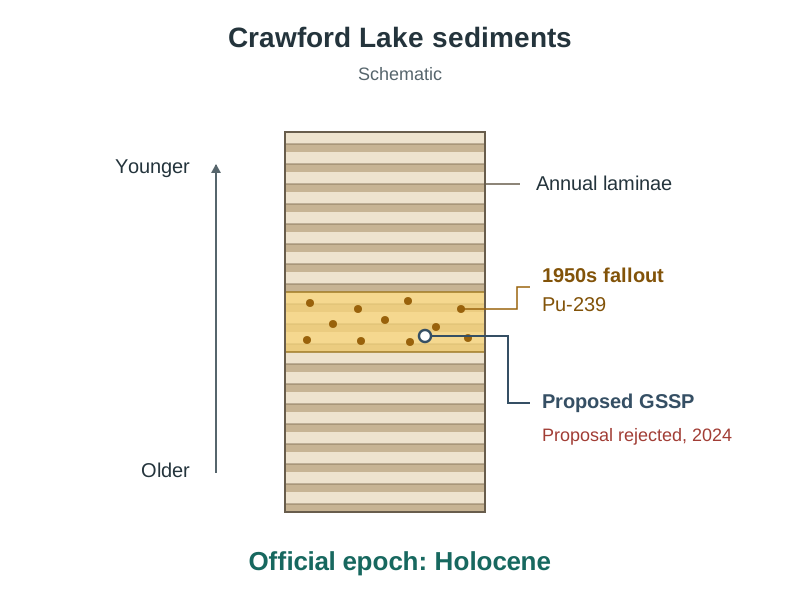
This vote was not a dismissal of human-induced environmental degradation. Rather, geologists argued that human alteration of Earth is an ongoing, cumulative geological event that began thousands of years ago with fire, hunting, and agriculture, rather than a neatly boxed epoch with an arbitrary start date in 1950. Comparing human impact to the Great Oxidation Event of 2.4 billion years ago—which unfolded across hundreds of millions of years—acknowledges humanity's profound physical legacy without forcing it into rigid chronostratigraphic rules.
Power, Climate Justice, and the Capitalocene Critique
A critical Higher Level perspective interrogates the prefix anthropo- (humanity). Presenting planetary destruction as the collective work of all humans conceals profound global inequalities in power and wealth. An undifferentiated 'humanity' did not cause global warming; the crisis has been driven primarily by industrialised nations in the Global North and multinational fossil fuel corporations pursuing infinite economic growth.
Historically, the poorest communities in the Global South have contributed the least to cumulative greenhouse gas emissions, yet they suffer the most severe consequences of climate breakdown, including prolonged droughts, crop failures, and sea level rise. To address this power imbalance, theorists propose the term Capitalocene, arguing that our planetary emergency is the outcome of capitalist extractivism, colonial exploitation, and unequal resource consumption, rather than an inevitable biological trait of the human species.
What the Concept Implies for Action and the Irish Context
Naming our era the Anthropocene is more than an academic exercise; it establishes human responsibility. If human socio-economic systems are driving planetary disruption, those systems can be redesigned. This understanding underpins international climate policy, such as the Paris Agreement objective to limit global warming to well below 2 °C above pre-industrial levels.
In Ireland, this responsibility translates into a legally binding national target of a 51% reduction in greenhouse gas emissions by 2030 relative to 2018 levels. Environmental Protection Agency (EPA) inventories show that Ireland's emissions are concentrated in agriculture, transport, and energy industries, and that current reduction rates remain insufficient to meet the 2030 target.
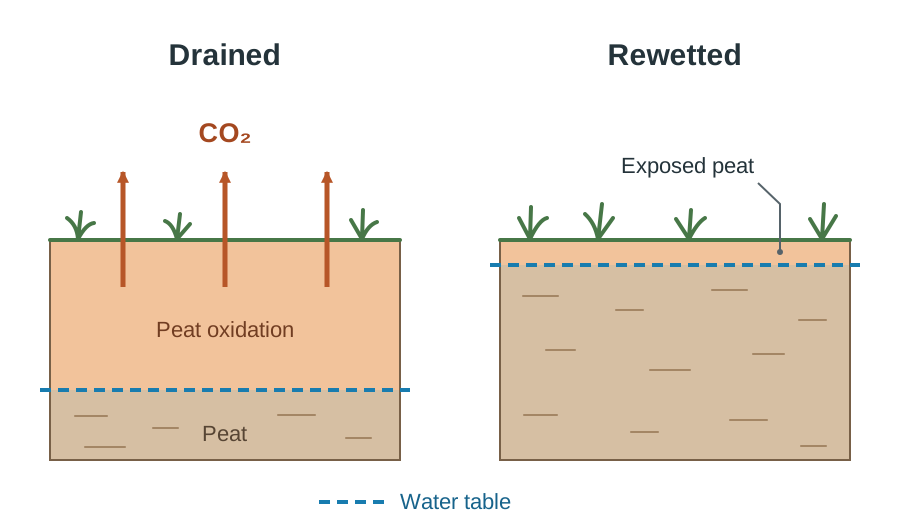
Ireland's peatlands offer a vivid local demonstration of the Anthropocene. Centuries of drainage, agricultural reclamation, and industrial peat harvesting by Bord na Móna transformed vast peatland areas from natural long-term carbon sinks into major net carbon sources. Drained organic soils release millions of tonnes of CO₂ annually as exposed peat oxidises. Restorative actions—such as the cessation of industrial harvesting and the rewetting of thousands of hectares of cutaway bogs—demonstrate how human systems can actively restore hydrological balance and re-establish biological carbon sequestration.
Key terms
- Anthropocene
- A proposed geological epoch in which human activity has become the dominant driver of global environmental, climatic, and geological change.
- Holocene
- The official geological epoch beginning approximately 11,700 years ago, characterised by a mild, stable climate that supported the development of human agriculture and civilisation.
- Golden Spike (GSSP)
- Global Boundary Stratotype Section and Point: an internationally agreed reference point in rock, sediment, or ice that marks the base of a unit of geological time.
- Great Acceleration
- The dramatic, exponential surge in socio-economic activity and global environmental disruption that began around 1950.
- Technofossils
- Novel manufactured materials, such as plastics, elemental aluminium, and concrete, that persist permanently in sedimentary rock layers.
- Geological Event
- A prolonged, time-transgressive transformation of Earth systems unfolding across centuries or millennia, such as the Great Oxidation Event, rather than a sudden epoch boundary.
- Planetary Boundaries
- A scientific framework developed by Johan Rockström and colleagues identifying nine critical biophysical thresholds within which humanity can safely develop.
- Capitalocene
- A critical alternative term arguing that planetary crises are driven by capitalist economic systems, colonial extractivism, and unequal wealth, rather than humanity as an undifferentiated whole.
Check yourself
What is the official geological epoch Earth currently resides in, and when did it begin?
The Holocene epoch, which began approximately 11,700 years ago following the end of the last major ice age.
What formal decision did the IUGS reach regarding the Anthropocene in March 2024?
The IUGS ratified a vote rejecting the proposal to classify the Anthropocene as an official geological epoch, maintaining that Earth remains officially in the Holocene.
Why did geologists who voted against the epoch proposal suggest classifying human impact as a 'geological event' instead?
Because human impacts developed gradually, regionally, and over thousands of years (time-transgressive), rather than appearing instantaneously across the entire globe at a single 1950 start line.
What is the 'Orbis spike' of 1610, and who proposed it?
Proposed by Simon Lewis and Mark Maslin, it refers to a 7–10 ppm dip in atmospheric CO₂ recorded in ice cores, caused by forest regrowth across the Americas after colonisation caused the deaths of roughly 50 million Indigenous people.
'The Anthropocene began in 1950.' Give one argument supporting this claim and one argument against it.
Supporting: 1950 marks the Great Acceleration and deposited a sharp, globally synchronous physical marker of artificial radionuclides (Plutonium-239) from nuclear testing. Against: Significant human disruption of land, carbon cycles, and ecosystems began centuries earlier with early agriculture and the Industrial Revolution.
How does Ireland's peatland landscape provide evidence of the Anthropocene?
Extensive drainage and mechanical harvesting converted natural peatlands from long-term carbon sinks into net carbon sources, releasing millions of tonnes of stored CO₂ into the atmosphere.