

Think of Earth as one big machine made of five connected parts: the rock (geosphere), the water (hydrosphere), the ice (cryosphere), the air (atmosphere), and the living world (biosphere). Energy from the Sun powers the entire machine, while water, carbon, and other vital elements move continuously across the different spheres. Within these spheres, life is organised into four major ecosystem realms: terrestrial, freshwater, marine, and subterranean. While Earth is an open system for energy, receiving solar radiation and radiating heat back to space, it is effectively a closed system for matter. Atoms are recycled over and over again through natural cycles. Because matter and energy move constantly across boundaries, a change in any single sphere or ecosystem never stays isolated; it triggers knock-on effects across the whole planet.
Earth as an Interconnected System: Energy Flow and Matter Cycles
A system is a set of interacting parts that function together as a unified whole. In environmental science, we track two primary things: stores (reservoirs where matter or energy is held for a duration) and transfers or fluxes (the physical and chemical processes that move matter and energy between stores).
One-way energy, round-and-round matter
In every ecosystem and across the planet as a whole, energy and matter behave in fundamentally different ways:
- Energy flows through: Sunlight enters our atmosphere and is captured by producers (green plants on land and phytoplankton in the sea) through photosynthesis. This energy passes to consumers that eat them, and some is lost as heat at every step. It cannot be recycled. Earth is therefore an open system for energy, requiring an uninterrupted supply of solar radiation to keep functioning.
- Matter cycles: The chemical elements that make up living things—such as carbon, hydrogen, oxygen, nitrogen, and phosphorus—are released by decomposers (bacteria and fungi) when organisms die and are absorbed again by new life. Earth is effectively a closed system for matter. With the exception of occasional meteorites, the planet has the exact same supply of matter today as it did billions of years ago.
Individual ecosystems function as open systems because both matter and energy cross their boundaries freely. For instance, autumn leaves falling from bankside trees provide organic matter and nutrients directly to stream insects, which are then eaten by fish that swim out to sea.
The Five Major Earth Systems
Your course divides our planet into five interacting Earth systems:
- Geosphere: The solid, non-living Earth, spanning from the metallic core and molten mantle up to the continental and oceanic crust, rocks, minerals, and soils. It supplies essential chemical nutrients, provides the structural foundation for life, and acts as a long-term geological carbon store. Irish example: The exposed Carboniferous limestone pavement of the Burren, Co. Clare.
- Hydrosphere: All liquid water on, under, and over Earth's surface. Oceans contain roughly 97% of all planetary water, with rivers, lakes, wetlands, and subterranean groundwater making up the rest. Atmospheric water vapour links it directly to the atmosphere. Irish example: The River Shannon catchment and Lough Corrib.
- Cryosphere: The frozen water components of the planet, including continental ice sheets (Antarctica and Greenland), mountain glaciers, sea ice, snowpack, and permafrost (frozen ground). The cryosphere is classified as a distinct system because of its high albedo (its ability to reflect incoming solar radiation back into space) and because it stores the vast majority of global fresh water. Global example: The Greenland ice sheet.
- Atmosphere: The layered blanket of gases held to Earth by gravity. Dry air consists of roughly 78% nitrogen (), 21% oxygen (), 0.93% argon (), and variable trace greenhouse gases, including carbon dioxide (, ~0.04% or 420+ ppm), methane (), and nitrous oxide (). It filters lethal solar ultraviolet radiation, redistributes heat around the planet, and provides the gases required for respiration and photosynthesis.
- Biosphere: All living organisms (plants, animals, fungi, protists, and bacteria) and the environments where they survive. Although it represents a tiny fraction of Earth's total mass, the biosphere actively regulates and alters the chemistry of all the other spheres. Irish example: The semi-natural sessile oak woodlands of Killarney National Park, Co. Kerry.
The Four Global Ecosystem Realms
An ecosystem is a community of living organisms (biotic factors) interacting with each other and with their non-living physical environment (abiotic factors, such as sunlight, temperature, water, and soil chemistry). Your course divides the world's ecosystems into four major types:
| Ecosystem Realm | Defining Abiotic Conditions | Primary Producers & Ecological Adaptations | Named Irish & Global Examples |
|---|---|---|---|
| Terrestrial | Land-based; variable moisture, fluctuating air temperatures, high sunlight, gravity. | Rooted plants, trees, grasses; structural woody tissue (lignin) and waxy leaf cuticles to prevent water loss. | Sessile oak woodland (Killarney, Co. Kerry); blanket bog (Connemara); Globally: Amazon rainforest. |
| Freshwater | Inland waters with low salinity (<0.5 parts per thousand); running water (lotic) such as rivers, or still water (lentic) such as lakes. | Microscopic algae (phytoplankton), rooted water plants, bankside mosses; flexible stems and holdfasts to resist water currents. | Lough Corrib; the River Shannon; Globally: Lake Victoria. |
| Marine | Saline aquatic waters (~35 ppt salinity); coastal shores, open ocean, and deep seabed. | Phytoplankton, brown kelp, seagrasses; salt-excreting glands and gas-filled bladders for buoyancy. | Dublin Bay UNESCO Biosphere; kelp forests off the Clare coast; Globally: Great Barrier Reef. |
| Subterranean | Underground caverns, fractured bedrock, and deep aquifers; permanent darkness and high humidity. | Chemotrophic bacteria that oxidise mineral ions; cave-dwelling invertebrates with lost pigmentation and heightened sensory antennae. | Cave systems of the Burren (Aillwee Cave, Doolin Cave); Globally: Deep-sea hydrothermal vent communities. |
Subterranean ecosystems are unique because they operate completely cut off from sunlight. Primary production cannot rely on photosynthesis. Instead, specialised bacteria generate energy through chemosynthesis (oxidising inorganic compounds like iron or sulphur). The rest of the food web relies on dead organic matter washed down from the surface through seeping rainwater and groundwater.
How the Four Ecosystems are Interconnected
No ecosystem functions in isolation. Matter, nutrients, and living organisms constantly cross boundaries from one realm to another. When writing about these links, always state the direction of transfer, what is being moved, and a named example:
- Terrestrial freshwater: Leaves, twigs, and insects fall from bankside trees into rivers. This organic litter forms the primary food supply for freshwater invertebrates in upland shaded streams, meaning the surrounding woodland directly feeds the river.
- Terrestrial freshwater marine: Rain washes soil particles, agricultural slurry, and chemical fertiliser off fields into drainage ditches, down rivers, and out through estuaries into coastal waters. Excess nitrogen and phosphorus can trigger harmful algal blooms (eutrophication) first in lakes and later in shallow coastal bays.
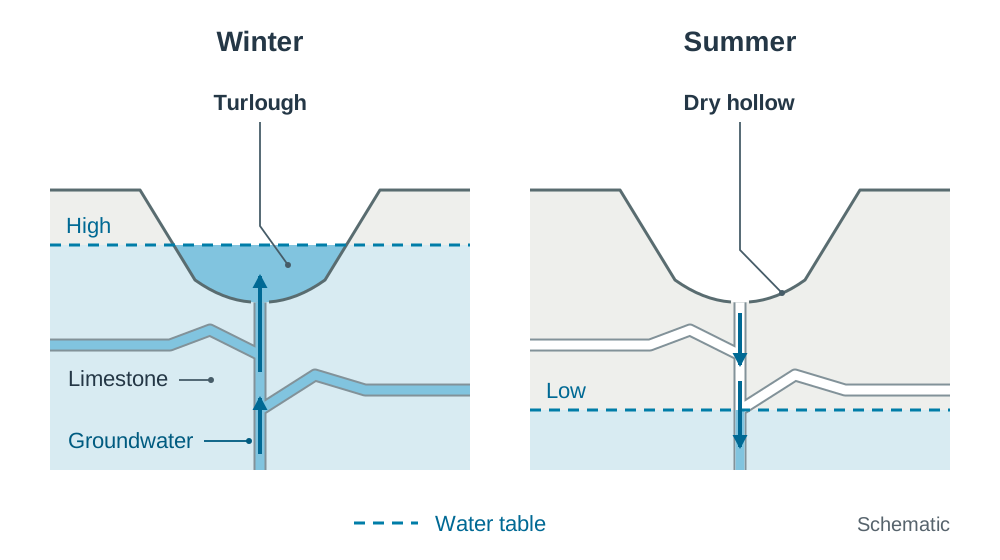
- Subterranean freshwater: In the limestone karst of the Burren, Co. Clare, rainwater dissolves the rock and drains underground through swallow holes into cave networks. When the water table rises during winter, water pushes back up through cracks to flood hollows on the surface, creating turloughs (seasonal disappearing lakes). In dry summer months, this underground aquifer feeds springs that sustain the baseflow of surface rivers.
- Marine freshwater (living migratory links): Atlantic salmon hatch in freshwater Irish rivers, migrate to marine feeding grounds in the North Atlantic to mature, and return years later to spawn in the exact same river. European eels do the reverse: spawning in the Sargasso Sea and migrating to Irish lakes and rivers to grow. Both species transfer significant quantities of nutrients and biomass between the sea and inland waterways.
- Marine terrestrial: Seabirds (such as puffins and gannets nesting on the Cliffs of Moher) feed entirely on marine fish, but deposit nutrient-rich guano on terrestrial cliff-tops, fertilising maritime grassland communities.
Natural Cycles: Water, Carbon, and Nutrients
The Hydrological Cycle
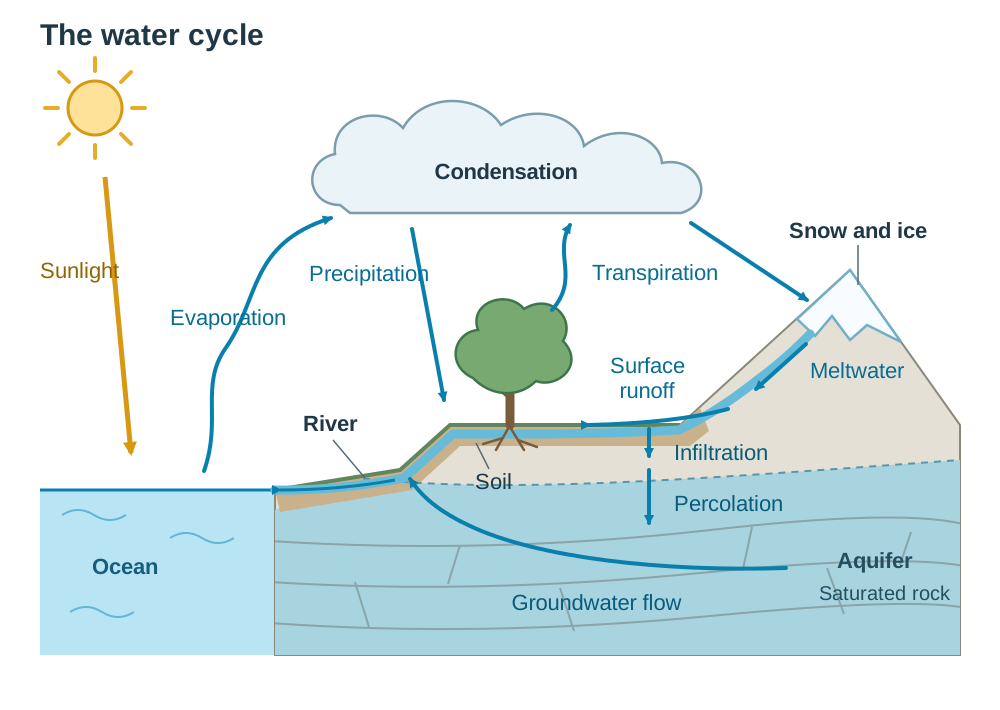
The water cycle moves water across all five spheres, driven by solar heat and gravity:
- Evaporation and Transpiration: The Sun warms water surfaces, turning liquid into vapour (hydrosphere atmosphere). Plant roots draw up soil water and release vapour through leaf pores during transpiration (biosphere atmosphere).
- Condensation: Rising air cools to its dew point, condensing vapour around microscopic particles into cloud droplets and ice crystals.
- Precipitation: Condensed droplets join together and fall as rain, sleet, or snow (atmosphere geosphere, hydrosphere, or cryosphere).
- Infiltration and Groundwater Flow: Rain striking land either flows overland (surface runoff) into streams or soaks into the soil (infiltration). Water moves deeper down (percolation) into rock strata, recharging underground aquifers that slowly feed surface rivers.
- Storage as snow and ice: In polar and high mountain areas, snow builds up and compacts into glacial ice over centuries, holding fresh water out of circulation until warmer seasons release meltwater back into rivers.
Distribution of planetary water: Oceans hold roughly 97% of all Earth's water. Only about 3% is fresh water. Of that 3%, roughly 69% is locked away in ice sheets and glaciers (cryosphere), roughly 30% is subterranean groundwater, and barely 1% sits in surface lakes, rivers, and wetlands.
The Carbon Cycle
Carbon is the fundamental building block of all organic life. It cycles through two connected pathways:
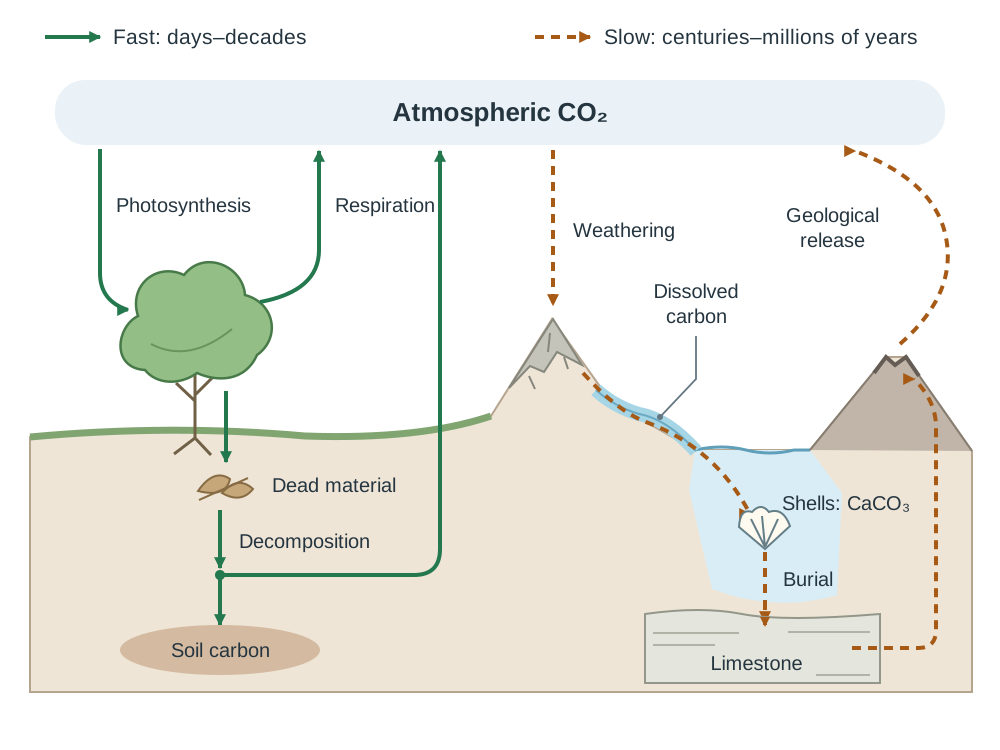
- Fast biological cycle (days to decades): Green plants on land and phytoplankton in the sea absorb atmospheric carbon dioxide through photosynthesis to build sugars:
Living things release carbon dioxide back to the atmosphere through cellular respiration. When plants and animals die, decomposers break them down, returning carbon to the soil and air.
- Slow geological cycle (centuries to millions of years): Rain absorbs atmospheric , forming weak carbonic acid that chemically weathers continental rocks. Dissolved calcium and bicarbonate wash down rivers into oceans, where sea creatures incorporate them into calcium carbonate () shells. When they die, shells settle onto the seabed, compressing over millions of years to form limestone (geosphere). Over geological timescales, volcanic activity and tectonic plate movements release this trapped carbon back into the atmosphere.
Fossil fuel formation: Hundreds of millions of years ago, dead swamp plants and marine plankton were buried under thick sediment layers without oxygen. Deep burial, intense heat, and the pressure of overlying rock compressed this organic material into coal, oil, and natural gas. Burning these fuels extracts ancient carbon stored in the geosphere and releases it into the atmosphere in seconds.
Nitrogen in Outline
Nitrogen gas makes up about 78% of the atmosphere, but plants cannot absorb it directly. Soil bacteria and microbes in the root nodules of legumes 'fix' it into nitrates that plants take up through their roots. While natural cycling maintains a balance, artificial fertilisers and agricultural slurry add enormous volumes of reactive nitrogen to soils, which washes into waterways and causes eutrophication.
System Feedbacks and Irish Peatlands: Clara Bog Case Study
Interactions between Earth systems often generate feedback mechanisms:
- Positive feedback loops (self-reinforcing): These amplify the initial change. For example, rising atmospheric temperatures melt white sea ice (cryosphere). The exposed dark ocean water (hydrosphere) has a lower albedo (reflectivity) and absorbs far more solar heat. This warms the regional water and air further, accelerating additional ice melt.
- Negative feedback loops (self-regulating): These dampen disturbances and push the system back toward balance. For instance, elevated atmospheric can temporarily stimulate plant growth where water and nutrients allow, drawing additional out of the air and slowing warming.
Caution on exam wording: In science, positive feedback does not mean beneficial. It means the change feeds on itself and gets progressively larger. Negative feedback does not mean harmful; it means the system steadies itself.
Case Study: Clara Bog, Co. Offaly
An intact Irish raised bog demonstrates all five systems working together in balance:
- Geosphere: Glacial till and lake clay that settled in a hollow at the end of the last ice age form an impermeable basin that prevents water from draining away.
- Cryosphere (legacy): Moving ice sheets during the last glaciation scoured the shallow depression in the Midlands, leaving behind mineral clays as the ice melted and retreated roughly 12,000 years ago.
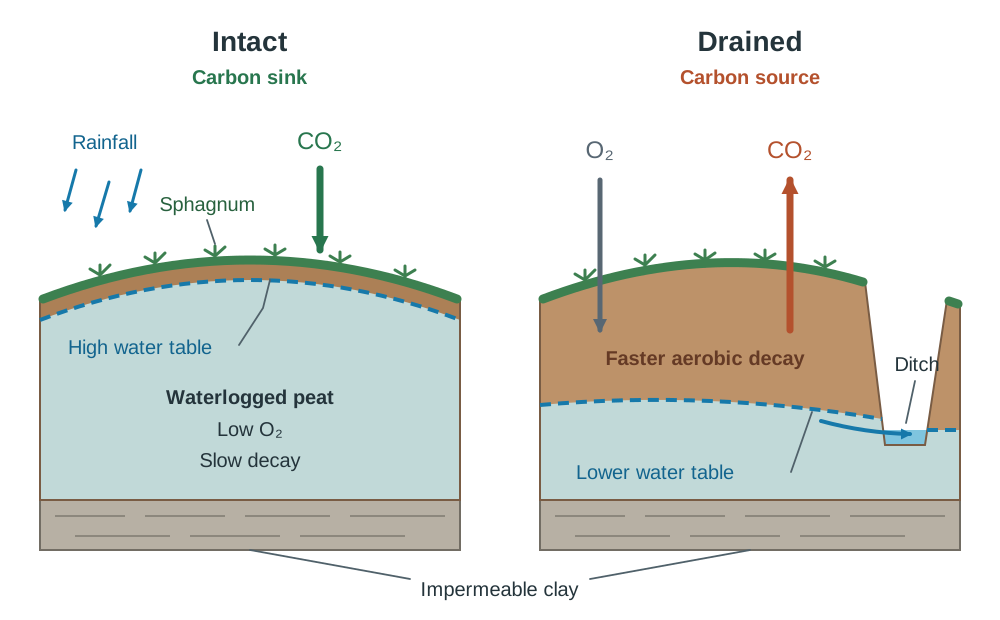
- Hydrosphere: High annual rainfall keeps the surface water table continuously high, saturating the peat and preventing atmospheric oxygen from penetrating the ground.
- Biosphere: Specialised Sphagnum mosses flourish across the wet surface, releasing acids. Because the peat is waterlogged and has almost no oxygen, oxygen-dependent (aerobic) decomposers cannot function. Decay is extremely slow, locking away dead plant material as peat for thousands of years. The very slow anaerobic decay that does happen releases small amounts of methane ().
- Atmosphere: The living surface vegetation captures atmospheric through photosynthesis, making the intact bog a powerful long-term carbon sink.
When a peatland is drained by cutting perimeter ditches, the water table drops. Atmospheric oxygen penetrates the dry peat, waking up aerobic bacteria. These microbes rapidly decompose the dried organic matter, releasing stored carbon into the air as carbon dioxide. Drainage immediately flips a millennia-old carbon sink into an active greenhouse gas source.
Key terms
- Geosphere
- The solid, inorganic Earth, comprising the core, mantle, crust, rocks, minerals, sediments, and soils.
- Hydrosphere
- All liquid water on, under, and over Earth's surface, including oceans, rivers, lakes, wetlands, and groundwater.
- Cryosphere
- The frozen water components of Earth, including ice sheets, mountain glaciers, sea ice, snowpack, and permafrost.
- Atmosphere
- The envelope of gases surrounding Earth held by gravity, primarily nitrogen and oxygen with trace greenhouse gases.
- Biosphere
- The global sum of all living organisms and the zones of land, water, and air in which life exists.
- Subterranean Ecosystem
- An underground ecological realm found in caves, aquifers, and bedrock fractures, characterised by perpetual darkness and reliance on chemosynthesis or organic material washed down from the surface.
- Closed System
- A physical system that allows energy to transfer across its boundaries but does not exchange significant amounts of matter with its surroundings.
- Carbon Sink
- A natural or artificial reservoir that absorbs more carbon from the atmosphere than it releases over a given timeframe.
- Carbon Source
- Any process, activity, or reservoir that releases more carbon into the atmosphere than it absorbs over a given timeframe.
- Albedo
- The fraction of incoming solar radiation reflected back into space by a surface, where light ice has high albedo and dark ocean water has low albedo.
- Positive Feedback Loop
- A self-reinforcing chain of cause and effect where the outcome of a process amplifies the original change, driving the system further from its initial state.
- Turlough
- A seasonal, groundwater-fed lake found in western Irish limestone karst areas that fills in winter as the water table rises and drains completely underground through sinkholes in summer.
Check yourself
Why is Earth considered an open system for energy but a closed system for matter?
Energy continuously arrives as solar radiation and escapes as radiated heat (open system), whereas Earth's physical matter and chemical elements are continuously recycled with virtually no addition or loss to space (closed system).
What proportion of Earth's total water is fresh water, and where is the majority of that fresh water stored?
Only about 3% of Earth's total water is fresh water, and approximately 69% of that fresh water is locked away in the ice sheets and glaciers of the cryosphere.
Name the four global ecosystem realms specified in Learning Outcome 1.
Terrestrial, freshwater, marine, and subterranean ecosystems.
How do primary producers create food in subterranean ecosystems where there is no sunlight?
They rely on chemosynthesis, using specialised chemotrophic bacteria that oxidise inorganic mineral compounds (such as iron or sulphur ions) for energy instead of solar radiation.
What is a turlough, and what two ecosystem realms does it connect?
A turlough is a seasonal lake in limestone karst areas (like the Burren) that floods in winter from rising groundwater and empties underground in summer, linking subterranean and freshwater ecosystems.
Why does melting sea ice trigger a positive feedback loop?
Melting bright sea ice exposes darker ocean water, which has a much lower albedo. The darker surface absorbs more solar radiation, warming the sea and causing even more ice to melt.
A housing development replaces grassland with tarmac and concrete. Name two changes to the water cycle and one environmental consequence.
Infiltration and plant transpiration both decrease because the soil is sealed by impermeable surfaces. Surface runoff increases, leading to a higher risk of flash flooding downstream and reduced groundwater recharge.