

Plant structure and transport examines how flowering plants absorb raw materials from soil and air, distribute water, minerals, and photosynthetic products throughout the plant body, and regulate gas exchange. Unlike animals, plants lack a muscular pump, relying instead on physical and cellular mechanisms including diffusion, osmosis, active transport, root pressure, and the cohesion-tension model proposed by Henry Dixon and John Joly. This topic covers the specialised anatomy of roots, stems, and leaves; the contrasting structures of xylem and phloem; stomatal regulation by carbon dioxide; and the laboratory investigations used to study osmosis and transpiration.
Plant Tissues and Organ Architecture
A flowering plant is organised into an underground root system and an above-ground shoot system made of stems and leaves. Three primary tissue systems make up these organs:
- Dermal tissue: The outermost single layer of cells (epidermis) that protects internal tissues against drying out and pathogen infection. In leaves and young stems, dermal cells secrete a waxy, waterproof cuticle. In roots, specialised epidermal cells form elongated root hairs that dramatically increase the surface area for absorption.
- Ground tissue: The bulk packing tissue between dermal and vascular layers. In leaves, ground tissue forms photosynthetic mesophyll. In stems and roots, it forms the cortex and pith, functioning in food storage (such as starch in potato tubers or carrots), water storage, and flexible support.
- Vascular tissue: Continuous conducting pipelines running throughout the plant, consisting of xylem and phloem.
Functions of the Three Plant Organs
- Root: Anchors the plant firmly in the soil; absorbs water and dissolved minerals from soil solution through root hairs; transports water and minerals up to the stem; and stores food reserves in the ground tissue (cortex).
- Stem: Supports and holds leaves out to catch sunlight, while displaying flowers and fruit; transports water and minerals upward in xylem and sugars throughout the plant in phloem; stores food and water in ground tissue; and carries out photosynthesis when young and green.
- Leaf: Serves as the principal organ of photosynthesis; carries out gas exchange through stomata; and loses water vapour through transpiration, which powers the upward pull of water.
Root and Stem Anatomy
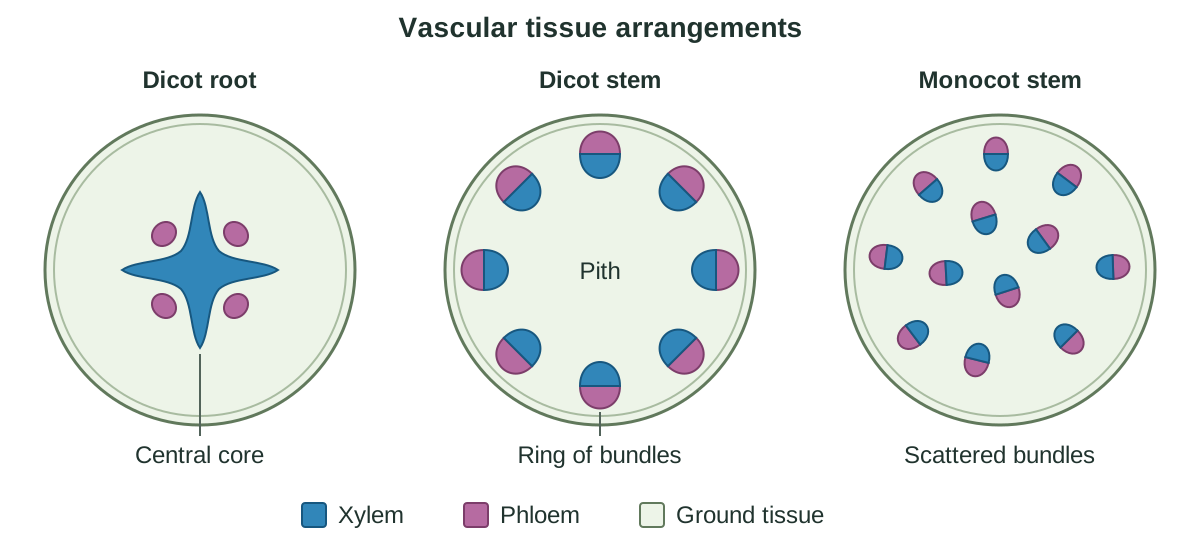
Behind the protective root cap, apical meristem cells divide, elongate, and then mature into specialised tissues. Root hairs emerge in this mature zone to take up water and minerals. In a cross-section of a dicotyledonous root, vascular tissue forms a solid central core: xylem forms an 'X' or star shape at the centre, with phloem patches tucked between the arms.
In a dicotyledonous stem, vascular bundles are arranged in a regular ring around a central pith. Inside each bundle, xylem faces the centre and phloem faces the outside. In a monocotyledonous stem, vascular bundles are scattered throughout the ground tissue.
Internal Leaf Structure
The leaf is engineered for light capture and gas diffusion:
- Upper epidermis: Transparent cell layer coated with a waxy cuticle that prevents desiccation while allowing light through.
- Palisade mesophyll: Tightly packed columnar cells rich in chloroplasts, positioned directly beneath the upper epidermis to capture maximum sunlight.
- Spongy mesophyll: Loosely arranged cells with large intercellular air spaces that allow rapid diffusion of carbon dioxide and oxygen.
- Leaf vein (vascular bundle): Delivers water and minerals via xylem on the upper side of the vein, while phloem on the lower side transports sugars away. Veins also provide mechanical support to hold the leaf blade flat.
- Lower epidermis: Perforated by microscopic pores called stomata, each bounded by two guard cells. Guard cells are the only epidermal cells that contain chloroplasts, and they regulate the opening of the pore.
Vascular Anatomy: Xylem versus Phloem
Plants rely on two distinct vascular tissues to transport fluids from root tips to the topmost leaves:
| Feature | Xylem | Phloem |
|---|---|---|
| Substances transported | Water and dissolved mineral ions | Dissolved sugars (principally sucrose) and amino acids |
| Direction of flow | Unidirectional: upward from roots to leaves | Multidirectional: from sources (e.g. mature leaves) to sinks (e.g. roots, buds, fruit) |
| Living status at maturity | Dead cells (hollow lumen, no cytoplasm) | Living cells: cytoplasm retained, but the nucleus breaks down during maturation (no nucleus) |
| Cell wall composition | Thick cellulose wall heavily reinforced with lignin | Cellulose cell walls; non-lignified |
| Conducting cells | Vessels and tracheids | Sieve tube elements supported by companion cells |
| Cross-walls | Vessels: end walls break down completely; Tracheids: tapered ends with pits | Sieve plates with open sieve pores |
| Position in dicot stem | Inner side of vascular bundle; bundles arranged in a ring | Outer side of vascular bundle; bundles arranged in a ring |
| Position in dicot root | Central star or 'X' shape | Packed in clusters between the arms of the xylem star |
| Position in leaf vein | Upper side of the vein | Lower side of the vein |
Structural Adaptations of Xylem
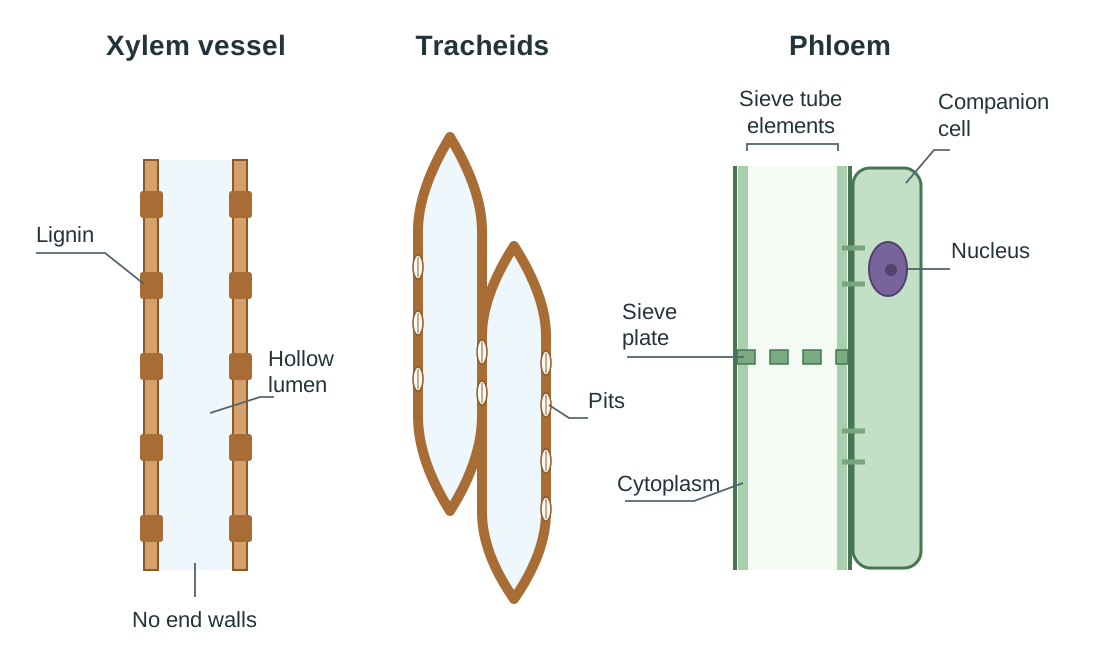
Xylem tracheids are elongated cells with tapered, overlapping ends. Water moves between adjoining tracheids through thin areas in their walls called pits.
Xylem vessels are wider, cylindrical cells stacked end-to-end. Their end walls break down completely during development, creating continuous, open capillary pipelines with minimal resistance to upward water flow.
Both vessels and tracheids deposit lignin in spiral, ring, or netted patterns along their walls. Lignin provides mechanical support to the plant stem and prevents the hollow vessels from collapsing inward under the negative pressure (tension) generated by transpiration pull.
Structural Adaptations of Phloem
Phloem pipelines consist of sieve tube elements joined end-to-end. Their end walls, termed sieve plates, contain open pores that allow organic solutions to pass from cell to cell. Because a mature sieve element loses its nucleus, it is kept alive by an adjacent companion cell connected via cytoplasmic strands (plasmodesmata). Companion cells retain their nucleus and dense mitochondria, supplying ATP and proteins to regulate the loading and unloading of sugars.
Membrane Transport, Plant Osmoregulation, and Mineral Uptake
Transport across plant cell membranes relies on three physical processes:
- Diffusion is the movement of molecules or ions from a region of high concentration to a region of low concentration down a concentration gradient. It is passive, requiring no energy from the cell. Carbon dioxide and oxygen move through leaf air spaces and stomata entirely by diffusion.
- Osmosis is the movement of water molecules from a region of high water concentration to a region of low water concentration across a semi-permeable membrane. It is also passive.
- Active transport is the movement of substances across a cell membrane against a concentration gradient using energy in the form of ATP. Carrier proteins in the cell membrane bind specific ions and pump them into the cell.
Comparing External Solutions
- Hypotonic: The outside solution is more dilute than the cell sap (higher water concentration, lower solute concentration), causing water to enter the cell by osmosis. Moist garden soil is hypotonic to root hair cytoplasm.
- Hypertonic: The outside solution is more concentrated than the cell sap (lower water concentration, higher solute concentration), causing water to leave the cell by osmosis. Strong brine or sugary jam syrup is hypertonic to microbial cells.
- Isotonic: Outside and inside solutions have equal solute concentrations, resulting in no net movement of water.
Turgor and Plasmolysis
When a plant cell is placed in a hypotonic environment, water enters its vacuole by osmosis. The swelling vacuole pushes the cytoplasm against the cell wall. The cellulose wall resists this expansion, creating an internal hydrostatic pressure known as turgor pressure. When the outward pressure balances the osmotic gradient, the cell becomes turgid. Turgor pressure provides essential mechanical support to keep soft stems and leaves upright.
If surrounding soil becomes hypertonic (due to drought or over-fertilisation), water leaves the vacuole by osmosis. The cytoplasm shrinks away from the cell wall, causing plasmolysis. Turgor drops to zero and the plant wilts.
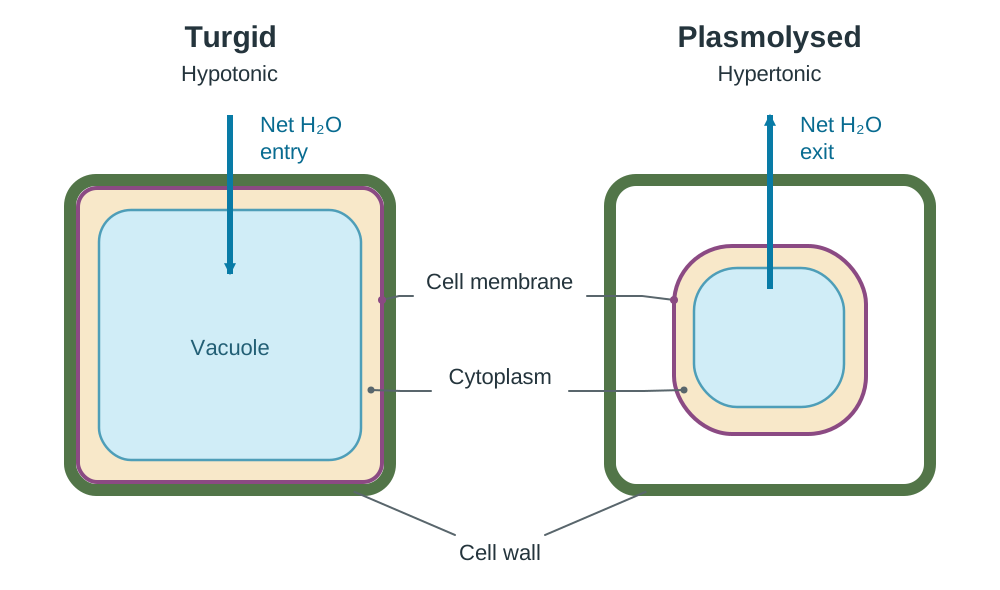
Classroom example: A limp lettuce leaf placed in pure cold water becomes crisp again because water enters by osmosis and restores turgor. If that same lettuce is sprinkled with table salt, it turns watery and limp within minutes because water exits the cells by osmosis into the hypertonic brine.
Osmosis in Food Preservation
Salting fish or storing fruit in concentrated sugar syrup creates an intensely hypertonic environment. When bacteria or fungi land on the food, water moves out of the microbial cells by osmosis. The resulting plasmolysis halts microbial enzyme activity and stops cell division. The food is preserved because microbes cannot multiply, though bacterial and fungal spores are not destroyed and can revive if water is reintroduced.
Mineral Transport
Plants take up essential mineral ions (such as nitrate for making amino acids and proteins, phosphate for ATP and DNA, and magnesium for chlorophyll) from soil water:
- When the concentration of an ion in the soil water is higher than in the root hair, it enters by diffusion.
- Usually, root hair cells already contain higher mineral concentrations than the surrounding soil. The plant must absorb these ions by active transport, using membrane carrier proteins and ATP produced by aerobic respiration in root hair mitochondria.
- The ions pass across the cortex and enter the xylem vessels.
- Mineral ions are carried dissolved in the xylem water stream up to the leaves. Minerals have no separate transport tissue.
Exam point: If soil becomes waterlogged, air spaces fill with water, starving root hair cells of oxygen. Without oxygen, aerobic respiration stops, ATP cannot be made, active mineral uptake fails, and the plant shows mineral deficiencies.
Upward Water Movement: Dixon–Joly Cohesion-Tension Model
Water moves from the soil through root hairs by osmosis, crosses the cortex, and enters the central xylem. Two mechanisms contribute to its upward movement:
1. Root Pressure
Active transport of mineral ions into root xylem lowers its water concentration. Water follows by osmosis, creating a positive hydrostatic push that lifts sap a few metres up the stem. Under high humidity when transpiration is negligible, root pressure pushes liquid droplets out through leaf margins in a process called guttation.
Limitation: Root pressure rarely exceeds one to two atmospheres, which is completely insufficient to push water to the top of tall trees (tens of metres high). Furthermore, root pressure is lowest in hot summer conditions when water movement is fastest. It cannot serve as the primary lifting force.
2. The Cohesion-Tension Model
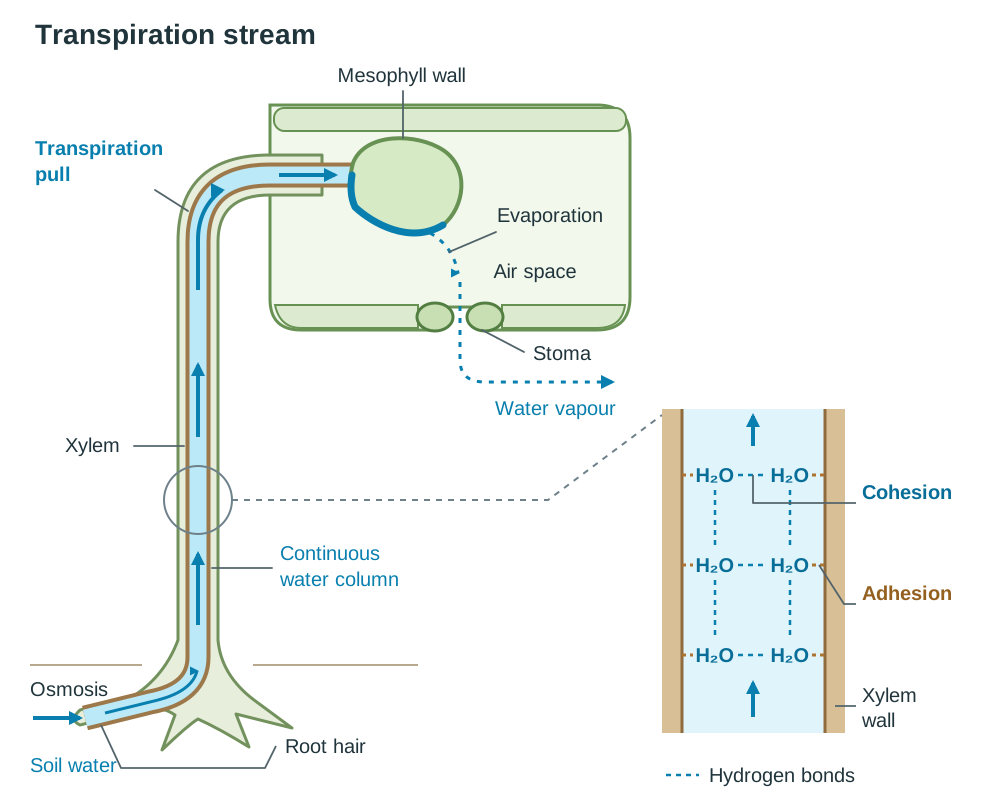
Proposed in 1894 by Irish scientists Henry Dixon and John Joly at Trinity College Dublin, this model explains how physical forces pull unbroken columns of water to the top of tall trees:
- Transpiration: Solar energy causes water to evaporate from moist mesophyll cell walls into leaf air spaces. Water vapour then diffuses out through open stomata into the drier atmosphere down a concentration gradient.
- Tension: Loss of water from mesophyll cells lowers their water concentration, drawing replacement water from leaf xylem veins. This generates a pulling force or negative pressure (tension) throughout the xylem pipelines.
- Cohesion: Water molecules are polar and stick to one another via hydrogen bonds (cohesion). This cohesive force gives the water column high tensile strength, holding it together in an unbroken chain from roots to leaves.
- Adhesion: Water molecules also adhere to the hydrophilic cellulose and lignified walls of xylem vessels (adhesion), preventing gravity from pulling the column downward.
As transpiration proceeds, this continuous column of water is pulled upward under tension, forming the transpiration stream.
Evidence for Tension in the Xylem
During warm daylight hours when transpiration is highest, the intense tension inside xylem vessels pulls their lignified walls slightly inward. This produces a small but measurable decrease in tree trunk diameter during the day. At night, when stomata close and tension subsides, the trunk relaxes back to its wider diameter.
Benefits of Transpiration
- Generates the transpiration pull that draws water from roots to leaves.
- Transports dissolved minerals throughout the plant in the xylem water stream.
- Evaporative water loss cools leaf tissues in hot sunlight.
- Keeps cells turgid, supporting soft non-woody tissues, and supplies water for photosynthesis.
Gas Exchange, Stomatal Control, and Phloem Translocation
Plants move gases entirely by diffusion through air spaces, stomata, and lenticels without any specialised gas-pumping system.
Gas Movement in the Plant
- Into the leaf (daytime): Photosynthesis in palisade cells consumes carbon dioxide rapidly. The carbon dioxide concentration in leaf air spaces drops below atmospheric levels, so carbon dioxide diffuses in through open stomata, diffuses along spongy mesophyll air spaces, dissolves in the moisture film on cell walls, and enters the chloroplasts.
- Out of the plant (continuous): Every living plant cell respires continuously, producing carbon dioxide. This gas diffuses into intercellular air spaces and exits through leaf stomata or through lenticels on woody stems.
- Day/night balance: In bright light, photosynthesis consumes carbon dioxide faster than respiration produces it, resulting in net carbon dioxide uptake and oxygen release. In darkness, photosynthesis ceases while respiration continues; carbon dioxide accumulates in air spaces, diffuses outward, and signals stomata to close.
Note on syllabus connection: Learning outcome 2.6.8 links stomatal control by carbon dioxide with the human breathing system, where rising blood carbon dioxide levels trigger an increased breathing rate.
Guard Cell Mechanics and Carbon Dioxide Control
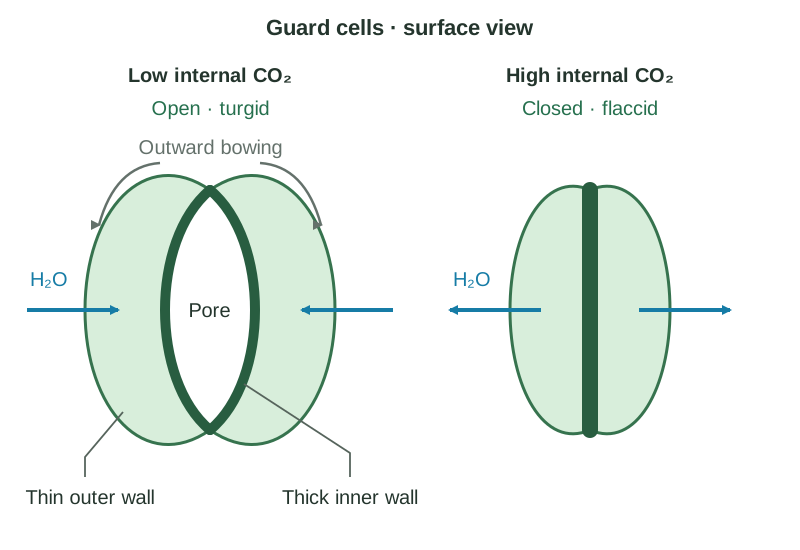
The carbon dioxide concentration inside leaf air spaces is the primary factor controlling whether stomata open or close. Guard cells feature asymmetric cell walls: the inner wall facing the stoma pore is thick and inelastic, while the outer wall is thin and flexible.
- Low internal carbon dioxide (stoma opens): During daylight, photosynthesis uses up carbon dioxide. Falling carbon dioxide levels signal guard cells to accumulate potassium ions. Water enters the guard cells by osmosis, increasing turgor. The thin outer walls bow outward, pulling the thick inner walls apart and opening the pore.
- High internal carbon dioxide (stoma closes): In darkness or under severe drought, carbon dioxide builds up from ongoing respiration. Rising carbon dioxide causes guard cells to lose potassium ions and water by osmosis. Turgor falls, guard cells become flaccid, and the pore closes.
Lenticels
In woody stems and mature roots, an impermeable cork bark prevents diffusion. Gas exchange occurs through lenticels—permanently open, lens-shaped slits packed with loosely arranged cells that allow oxygen entry for stem cell respiration and carbon dioxide release.
Phloem Translocation
Soluble carbohydrates made during photosynthesis are converted into sucrose and transported through phloem sieve tubes. Translocation moves organic food multidirectionally from sources (photosynthesising mature leaves or germinating seeds) to sinks (roots, shoot tips, developing flowers, or storage organs).
Investigating Osmosis and Transpiration
Investigation 1: Factors Affecting Rates of Osmosis (LO 2.6.2)
- Purpose: To investigate the effect of sucrose concentration gradient on the rate of osmosis across a semi-permeable membrane.
- Hypothesis: As external sucrose concentration increases, plant tissue will lose mass at an increasing rate because water exits cells by osmosis down a water concentration gradient.
- Variables:
- Independent variable: Sucrose concentration (e.g. 0.0 M, 0.2 M, 0.4 M, 0.6 M, 0.8 M, 1.0 M).
- Dependent variable: Percentage change in mass of plant tissue.
- Controlled variables: Potato source, cylinder diameter and length, immersion duration (e.g. 45 minutes), temperature, and blotting technique.
- Control: Cylinders submerged in 0.0 M distilled water. A second control using boiled, cooled potato cylinders tests whether changes require an intact, living semi-permeable membrane.
- Method:
- Cut identical potato cylinders using a cork borer and trim to 40 mm lengths with a scalpel on a tile.
- Blot cylinders lightly with a paper towel and record initial mass on an electronic balance (to 0.01 g).
- Place two cylinders into each labelled boiling tube containing equal volumes (20 cm³) of the sucrose solutions.
- Leave undisturbed for 45 minutes at room temperature.
- Remove cylinders, blot gently in a consistent manner to remove surface liquid, and record final mass.
- Calculate percentage change in mass:
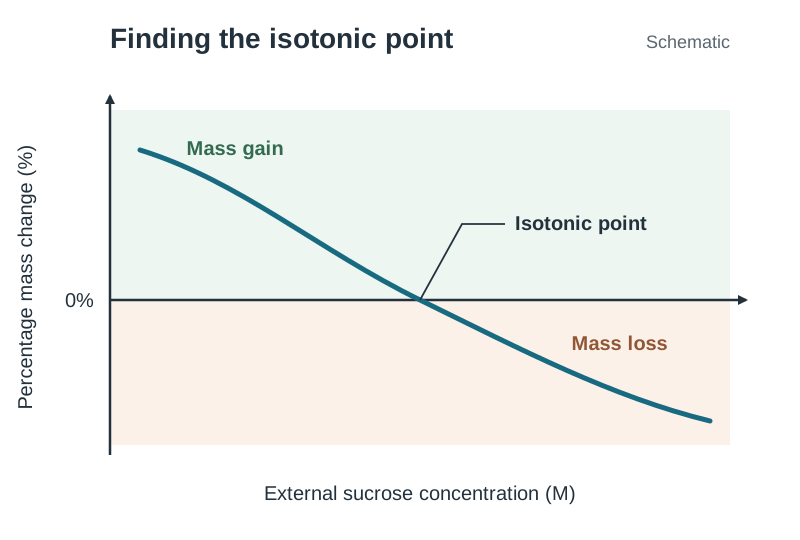
- Graphing and the Isotonic Point: Plot sucrose concentration on the x-axis and percentage change in mass on the y-axis. Draw a line of best fit. The point where the curve crosses the x-axis (0% mass change) represents the isotonic point, where the external solution matches the concentration of the cell sap.
- Temperature variations: If testing temperature, keep sucrose concentration constant (e.g. 0.4 M) and place tubes in water baths at 10 °C, 20 °C, 30 °C, and 40 °C. Above 50–60 °C, cell membrane proteins denature, destroying semi-permeability and causing cell contents to leak; this no longer measures osmosis.
- Surface area variations: keep the sucrose concentration constant (e.g. 0.4 M) and use potato pieces of the same mass but different surface areas — for example one whole cylinder versus the same cylinder cut into four smaller pieces. The pieces with the greater total surface area show a larger percentage mass change in the same time, because more membrane is available for water to cross.
Investigation 2: Factors Affecting Rates of Transpiration (LO 2.6.16)
- Purpose: To investigate the effect of environmental factors (e.g. air movement, light intensity, temperature, cuticle presence) on transpiration rate using a potometer.
- Apparatus and Precautions: A potometer measures the rate of water uptake by a leafy shoot, which closely reflects transpiration rate. Cut the woody shoot obliquely under water to prevent air locks in the xylem. Assemble the potometer submerged in water, and seal all stem-stopper junctions with petroleum jelly to make the apparatus completely airtight.
- Quantifying Rate: Introduce a single air bubble into the capillary tube. Measure the distance the bubble travels along the millimetre scale over a fixed time interval (e.g. mm per minute). Use the water reservoir to reset the bubble between runs.
- Testing Variables:
- Air movement: Position an electric fan at measured distances from the shoot. Moving air sweeps away the humid boundary layer at the leaf surface, steepening the concentration gradient for water vapour and accelerating bubble movement.
- Light intensity: Move a bench lamp to varying distances (20 cm, 40 cm, 60 cm). Place a clear glass water shield between the lamp and plant to absorb infrared heat. Brighter light stimulates guard cells to open stomata, increasing transpiration.
- Presence or absence of cuticle: Coat the upper surface of leaves with petroleum jelly to simulate a thicker cuticle; the rate falls only slightly because few stomata reside on the upper epidermis. Comparing glossy laurel shoots with thin-leaved shoots also tests cuticle effects. In contrast, coating the lower surface causes a steep drop in uptake because it physically blocks the stomata.
- Carbon dioxide concentration: Enclose the shoot in a clear plastic chamber. To produce a low carbon dioxide environment, place soda lime in a mesh container inside the chamber to absorb carbon dioxide (handle soda lime with a spatula; avoid skin contact). Low carbon dioxide stimulates stomata to open, increasing uptake. For a high carbon dioxide environment, add a small beaker of sodium hydrogencarbonate solution with a few drops of dilute acid; elevated carbon dioxide triggers stomatal closure, reducing bubble movement.
- Temperature: Place the potometer and shoot in rooms or water-jacketed chambers at different measured temperatures (e.g. 15 °C, 20 °C, 25 °C), keeping light and air movement constant. Higher temperature increases evaporation from the mesophyll walls, so the bubble moves faster.
- Surface area: Compare shoots with different total leaf areas, or remove leaves one at a time from the same shoot, re-measuring the rate after each removal. Reducing leaf area reduces the number of stomata available, so uptake falls.
Key terms
- Xylem
- Vascular plant tissue consisting of dead, hollow, lignified vessels and tracheids that transports water and dissolved mineral ions upward from roots.
- Phloem
- Living vascular plant tissue consisting of sieve tube elements and companion cells that translocates organic nutrients (sucrose, amino acids) multidirectionally.
- Lignin
- A hard, complex, waterproof chemical polymer deposited in xylem cell walls that provides mechanical support and prevents vessel collapse under tension.
- Osmosis
- The movement of water molecules from a region of high water concentration to a region of low water concentration across a semi-permeable membrane.
- Active Transport
- The movement of substances across a cell membrane against a concentration gradient using energy in the form of ATP.
- Turgor Pressure
- The outward hydrostatic pressure exerted by the fluid contents of the vacuole and cytoplasm against the rigid cell wall in a plant cell.
- Plasmolysis
- The shrinkage of the plant cell protoplast away from its cell wall caused by the osmotic loss of water in a hypertonic environment.
- Transpiration
- The loss of water vapour from the leaves and other aerial parts of a plant, primarily through the stomata.
- Cohesion
- The sticking together of similar molecules, such as water molecules holding to each other via hydrogen bonds.
- Adhesion
- The sticking of molecules of one substance to molecules of a different substance, such as water molecules adhering to xylem cell walls.
- Root Pressure
- A positive hydrostatic pressure produced in root xylem by the continuous osmotic influx of water following active mineral accumulation.
- Stoma
- A microscopic pore in the epidermis of a leaf or young stem bounded by two guard cells that regulates gas exchange and water vapour loss.
- Lenticel
- A permanently open pore on the bark of woody stems and roots consisting of loosely arranged cells that permits respiratory gas exchange.
- Translocation
- The transport of soluble organic products of photosynthesis through the phloem from source regions to sink regions.
Check yourself
Name the three primary tissue systems found in flowering plant organs and state one function of each.
Dermal tissue (protects against water loss and pathogens), ground tissue (photosynthesis and food storage), and vascular tissue (transports water, minerals, and sugars).
What is the primary role of companion cells in phloem tissue?
Companion cells contain a nucleus and dense mitochondria; they produce ATP and synthesize proteins to support and control adjacent enucleated sieve tube elements.
Name the two Irish scientists who proposed the cohesion-tension model of water transport.
Henry Dixon and John Joly.
How do guard cells change shape to open a stoma when internal carbon dioxide concentration drops?
Guard cells accumulate solutes, causing water to enter by osmosis. As turgor increases, their thin flexible outer walls bow outward while their thick inner walls pull apart, opening the stoma.
Why does food preservation using high concentrations of salt or sugar prevent bacterial decay?
The hypertonic external environment draws water out of bacterial and fungal cells by osmosis. This causes severe plasmolysis, halting metabolic enzyme action and preventing cell division.
In a potometer investigation, why must the leafy shoot be cut under water before insertion?
Cutting under water prevents air from being drawn into the xylem vessels, which would break the continuous cohesive water column and prevent water uptake.
How can the isotonic point of plant tissue be determined from an osmosis investigation graph?
By finding the point where the line of best fit crosses the x-axis (0% change in mass), indicating no net movement of water into or out of the cells.