

Respiration is the enzyme-controlled, catabolic release of energy from food, primarily glucose, within living cells. Instead of releasing energy all at once as heat, cells transfer that energy in small packets to adenosine triphosphate (ATP), the universal energy carrier that powers cellular work. Aerobic respiration requires oxygen to break glucose down completely into carbon dioxide and water across two main stages: glycolysis in the cytoplasm, followed by the transition reaction, the citric acid cycle, and the electron transport chain inside the mitochondrion. When oxygen is absent or limited, cells carry out anaerobic respiration (fermentation) in the cytoplasm, yielding a net gain of 2 ATP while regenerating NAD⁺ so glycolysis can continue. This topic links biochemical pathways with carbon accounting, energy transfer molecules, mitochondrial structure and function, and the practical investigation of fermentation conditions.
Principles of Cellular Respiration and Energy Transfer
Respiration and photosynthesis are opposite forms of metabolism in living systems. Photosynthesis is anabolic: it uses light energy to build glucose from carbon dioxide and water, acting as a global carbon sink. Respiration is catabolic: it breaks glucose down into simpler substances to release energy, acting as a carbon release mechanism that returns carbon dioxide to the atmosphere.
Overall Equations for Aerobic Respiration
Aerobic respiration requires oxygen and breaks glucose down completely into carbon dioxide and water. You should know the process in both forms:
- Word equation: glucose + oxygen → carbon dioxide + water + energy (ATP)
- Balanced formula equation:
If an exam question asks for a balanced equation, write the chemical formulae with the numbers 6, 6, and 6. If it asks for a word equation, the chemical names are sufficient.
| Substance | Role | Source in Living Organisms | Fate in Living Organisms |
|---|---|---|---|
| Glucose () | Reactant | Photosynthesis in plants; digestion and absorption of carbohydrates in animals | Broken down during glycolysis and the citric acid cycle to release energy |
| Oxygen () | Reactant | Internal release during photolysis in plants; gas exchange across alveoli, gills, or stomata | Serves as the terminal electron acceptor at the inner mitochondrial membrane |
| Carbon dioxide () | Product | Stripped from fuel molecules during Stage 2 in the mitochondrial matrix | Released through stomata in plants or exhaled via respiratory surfaces in animals |
| Water () | Product | Formed at the end of the electron transport chain when oxygen binds spent electrons and protons | Retained as a cellular solvent, used in metabolic reactions, or excreted |
| ATP | Product | Synthesised by adding inorganic phosphate to ADP using energy released from food | Hydrolysed back to ADP and phosphate to drive energy-consuming cellular activities |
Transfer Molecules: ATP and NAD⁺
Two transfer molecules drive respiration:
ATP stands for adenosine triphosphate. It consists of the nitrogenous base adenine, a five-carbon ribose sugar, and three bonded phosphate groups. It functions as the universal energy transfer molecule in all living cells.
- When a cell needs energy to perform work, the terminal phosphate bond is broken: .
- That released energy directly powers muscle contraction, active transport across membranes, nerve impulse transmission, cell division, and the synthesis of proteins and other biomolecules.
- Respiration releases energy from food to reattach a phosphate group to ADP, continuously recycling the cell's energy currency: .
NAD⁺ (nicotinamide adenine dinucleotide) is a coenzyme that acts as a mobile carrier of electrons and protons. During the enzymatic breakdown of respiratory intermediates, NAD⁺ picks up high-energy electrons and protons (hydrogen), becoming reduced NADH. NADH transports these electrons to the inner mitochondrial membrane to drive the electron transport chain. By contrast, photosynthesis uses the related carrier NADP⁺ (reduced to NADPH); the extra 'P' is a helpful reminder for photosynthesis.
Stage 1: Glycolysis in the Cytoplasm
Respiration always begins with glycolysis, whether oxygen is present or absent. Glycolysis takes place in the cytoplasm—specifically in the cytosol, which is the fluid portion of the cytoplasm outside the organelles. It is entirely anaerobic and does not require oxygen.
During glycolysis, one six-carbon () molecule of glucose is split through a sequence of enzyme-catalysed reactions into two three-carbon () molecules of pyruvate (also called pyruvic acid):
- Energy investment and yield: Two molecules of ATP are initially consumed to phosphorylate and activate glucose. Four ATP molecules are then produced directly in the cytoplasm, giving a net gain of 2 ATP molecules per glucose molecule.
- Electron transfer: Enzymes strip high-energy electrons and protons from the carbohydrate fragments and transfer them to two NAD⁺ molecules, generating 2 NADH.
- Carbon balance: No carbon dioxide is released during glycolysis. All six carbon atoms from the original glucose are accounted for in the two pyruvate molecules.
If oxygen is present, these two pyruvate molecules leave the cytoplasm and move into the mitochondrion to enter Stage 2. If oxygen is absent or limited, pyruvate remains in the cytoplasm and enters anaerobic fermentation pathways.
Fermentation: Anaerobic Energy Pathways
When oxygen is absent or in short supply, the second stage of respiration cannot operate. Without oxygen waiting at the end of the electron transport chain to receive electrons, NADH cannot shed its cargo, and cellular reserves of NAD⁺ run out. Without NAD⁺, glycolysis cannot proceed, and the cell produces no ATP at all.
Fermentation solves this blockage. Its biochemical purpose is to transfer electrons from NADH onto pyruvate or its derivatives. This regenerates oxidized NAD⁺, allowing glycolysis to continue producing its survival supply of energy. Anaerobic respiration gives a net gain of 2 ATP per glucose—all of it from glycolysis. The fermentation step itself makes no additional ATP.
1. Lactic Acid Fermentation
This pathway occurs in human skeletal muscle during strenuous exercise when the blood cannot supply oxygen fast enough to meet demand, as well as in certain anaerobic bacteria.
Pyruvate () accepts electrons and protons directly from NADH, reducing pyruvate to lactic acid ():
No carbon dioxide is produced. In human muscle, accumulated lactic acid causes muscle fatigue and stiffness. The extra oxygen the body must consume after exercise to convert accumulated lactic acid back to pyruvate (and on to carbon dioxide and water, or to glucose in the liver) is called the oxygen debt. This oxygen debt explains why heavy breathing continues for several minutes after a sprint.
2. Alcoholic Fermentation
This pathway occurs in brewing and baking yeasts (Saccharomyces cerevisiae) and in certain plant tissues deprived of oxygen. Pyruvate loses one carbon atom as carbon dioxide to form ethanal, which is then reduced by NADH into ethanol ():
Applications Across Key Themes
- Technology and food: Yeast fermentation generates carbon dioxide bubbles that cause bread dough to rise, while commercial brewing uses alcoholic fermentation to produce beer and wine. Lactic acid bacteria such as Lactobacillus ferment lactose in milk, producing lactic acid that coagulates milk proteins to make yoghurt and cheese.
- Sustainability: Yeast fermentation converts plant sugars derived from crops or agricultural waste into bioethanol. Bioethanol is a renewable biofuel blended with petrol to reduce transport emissions and decrease reliance on fossil fuels.
- Health: Lactic acid accumulation during anaerobic muscle work serves as a clinical and athletic indicator of muscle fatigue and exertion thresholds. Anaerobic bacterial fermentation in the human large intestine also breaks down dietary fibre to generate beneficial short-chain fatty acids.
| Feature | Aerobic Respiration | Fermentation (Anaerobic) |
|---|---|---|
| Oxygen requirement | Oxygen must be present | Operates when oxygen is absent or limited |
| Cellular location | Cytoplasm (Stage 1) and mitochondrion (Stage 2) | Cytoplasm only |
| Degree of breakdown | Complete breakdown into and | Incomplete breakdown; energy remains stored in ethanol or lactic acid |
| Net ATP yield per glucose | High yield (around 30–38 ATP, roughly 18 times more) | Low yield (exactly 2 net ATP, produced in glycolysis) |
Stage 2: The Citric Acid Cycle in the Mitochondrial Matrix
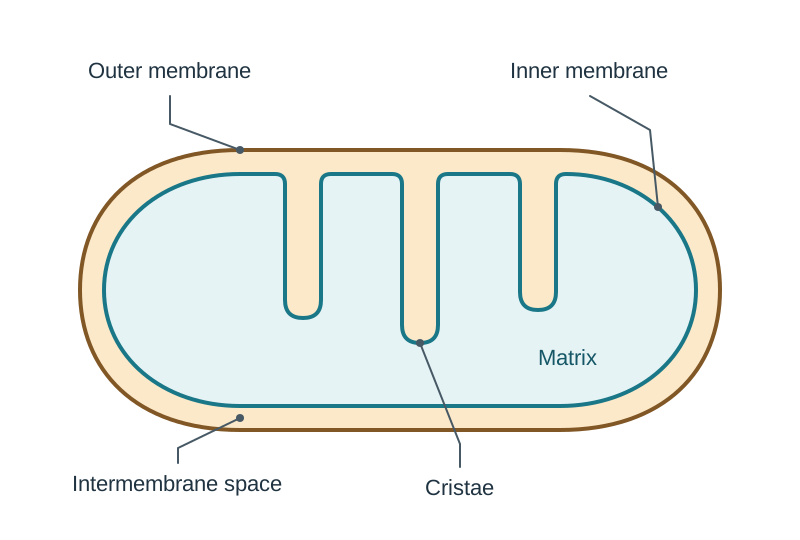
When oxygen is available, the two pyruvate molecules formed in glycolysis cross the outer and inner mitochondrial membranes into the fluid interior, known as the matrix. Stage 2 completes the breakdown of the carbon skeleton.
The Transition Reaction (Acetyl CoA Formation)
Before entering the cycle, each three-carbon pyruvate molecule is modified in the matrix:
- Pyruvate loses one carbon atom as carbon dioxide ().
- It loses electrons and protons to NAD⁺, producing NADH.
- The remaining two-carbon acetyl fragment joins with coenzyme A to form acetyl coenzyme A (acetyl CoA).
Because each glucose molecule produces two pyruvates, the transition reaction releases 2 and forms 2 NADH per glucose.
The Citric Acid Cycle (Krebs Cycle)
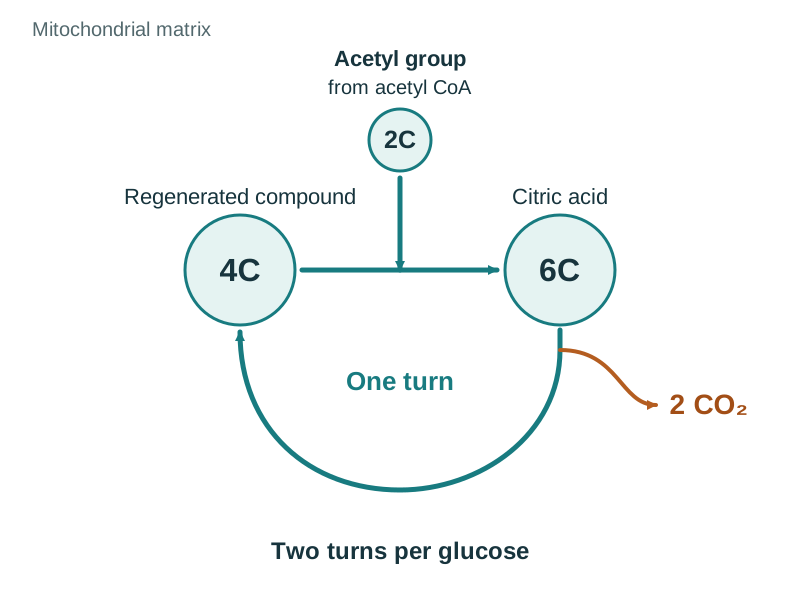
Acetyl CoA delivers its two-carbon acetyl group into a cyclical sequence of reactions within the matrix:
- The acetyl fragment combines with a four-carbon () compound to form six-carbon () citric acid, releasing coenzyme A to be reused.
- In a series of enzyme-catalysed steps, citric acid is oxidised. Two carbon atoms are stripped away and released as 2 .
- High-energy electrons and protons are transferred to coenzymes, yielding 3 NADH per turn of the cycle.
- One molecule of ATP is produced directly per turn.
- The starting compound is regenerated at the end of the pathway, ready to receive another acetyl fragment.
Because one glucose molecule supplies two acetyl CoA molecules, the cycle turns twice per glucose, producing 4 , 6 NADH, and 2 ATP.
Products of Stage 2 as a Whole
Taken as a whole, Stage 2 produces carbon dioxide, water, and most of the ATP. The carbon dioxide is produced during the transition reaction and the citric acid cycle in the matrix. Water is formed at the inner mitochondrial membrane when spent electrons and protons combine with oxygen at the end of the electron transport chain.
Carbon Accounting: Tracking the Six Carbons of Glucose
Exam questions regularly ask where each carbon atom goes:
| Respiration Stage | Cellular Location | Carbon Reaction | Released per Glucose |
|---|---|---|---|
| Glycolysis | Cytoplasm | glucose pyruvate | 0 |
| Transition Reaction | Mitochondrial matrix | pyruvate acetyl CoA | 2 |
| Citric Acid Cycle | Mitochondrial matrix | 2 turns ( acetyl groups oxidised) | 4 |
| Total | Complete oxidation of glucose | 6 |
The Electron Transport Chain, Chemiosmosis, and ATP Synthase
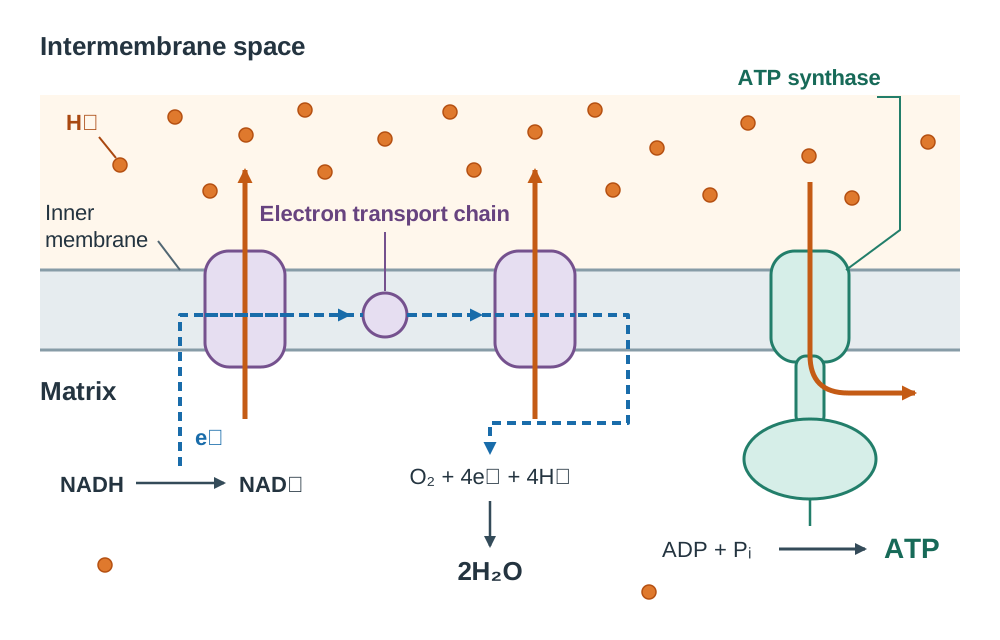
The electron transport chain delivers the vast majority of ATP generated in aerobic respiration. It is located on the inner mitochondrial membrane, where the membrane folds inward to form cristae.
The Mechanism of Chemiosmosis
Chemiosmosis links electron transfer to ATP production in four steps:
- Electron donation: NADH arriving from glycolysis and the citric acid cycle deposits high-energy electrons onto protein complexes embedded in the inner mitochondrial membrane, regenerating NAD⁺ for reuse in the cytoplasm and matrix.
- Proton pumping: High-energy electrons pass along a series of electron carriers. The energy released during this electron transfer is used by the protein complexes to pump protons () from the matrix across the inner membrane into the intermembrane space.
- Proton gradient and ATP synthesis: Because the inner membrane is impermeable to protons, they accumulate in the narrow intermembrane space, setting up a steep concentration gradient. Protons stream back into the matrix solely through the channel enzyme ATP synthase. ATP synthase harnesses this kinetic flow of returning protons to combine ADP and inorganic phosphate into ATP.
- Terminal electron acceptor: At the very end of the chain, electrons must be removed so that carriers do not become blocked. Oxygen acts as the terminal electron acceptor, binding low-energy electrons and free matrix protons to form metabolic water:
Mitochondrial Structure and Function
When identifying parts on a diagram, be familiar with these structures:
- Outer membrane: A smooth boundary membrane containing channel proteins that permit pyruvate, oxygen, and ADP to enter from the cytoplasm.
- Inner membrane: A selectively permeable membrane containing electron carriers and ATP synthase enzymes.
- Cristae: Inward folds of the inner membrane. Make sure not to label the fold as a separate membrane—it is a fold of the inner membrane. Cristae increase the total surface area, allowing thousands of electron transport chains and ATP synthase enzymes to fit into a single organelle.
- Intermembrane space: The narrow compartment between the inner and outer membranes. Its small volume ensures that pumped protons build up a steep concentration gradient rapidly.
- Matrix: The fluid interior containing ribosomes, mitochondrial DNA, and the specific enzymes required for acetyl CoA formation and the citric acid cycle.
ATP Yield Comparison
Aerobic respiration yields around 30 to 38 ATP molecules per glucose molecule, whereas anaerobic respiration yields exactly 2 ATP molecules. Aerobic respiration is therefore roughly 18 times more efficient at extracting energy from fuel molecules.
Required Investigation: The Conditions Necessary for Fermentation
The specification requires you to be able to investigate the conditions necessary for fermentation and to use both primary data (your own laboratory measurements) and secondary data (published or class data) to support your conclusions. Expect this on the written paper as an experiment question. It is separate from the Biology in Practice Investigation coursework, which is based on an annual SEC brief.
Experimental Setup and Methodology
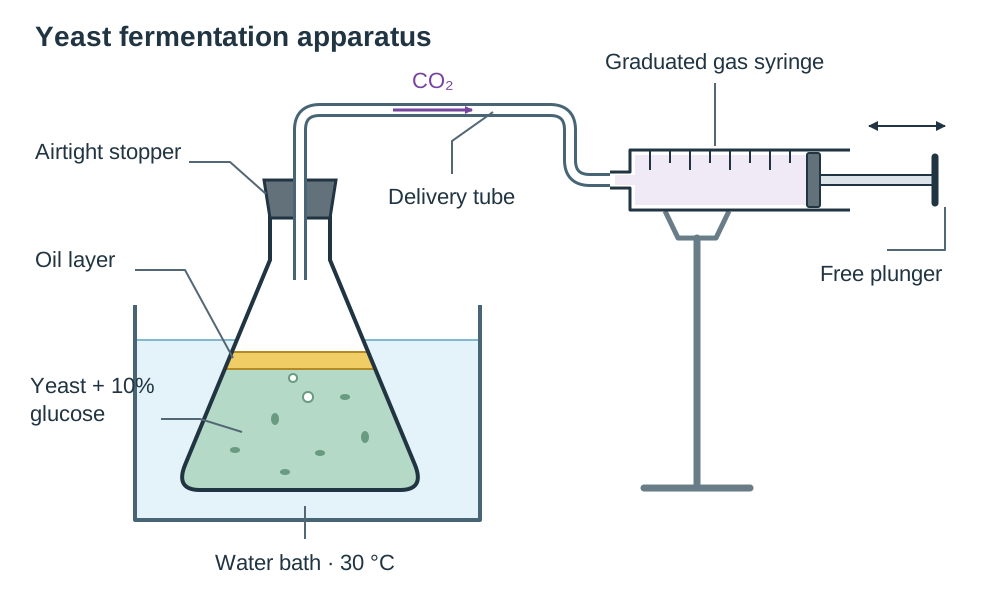
To investigate fermentation by yeast (Saccharomyces cerevisiae):
- Boil a 10% glucose solution vigorously for five minutes to drive off all dissolved oxygen.
- Allow the boiled glucose solution to cool to approximately 30 °C before introducing the yeast. Adding yeast to hot water would denature its enzymes and kill the cells.
- Add a measured mass of dried baker's yeast and swirl gently to suspend the cells.
- Carefully pipette a layer of vegetable oil or liquid paraffin over the mixture. The oil forms an impermeable physical barrier that stops atmospheric oxygen from dissolving back in, maintaining an anaerobic environment.
- Fit the flask with a rubber stopper and delivery tube leading into a graduated gas syringe (to measure gas volume) or into a test tube of limewater.
- Place the flask in a thermostatically controlled water bath at 30 °C for a timed period.
Fair Test, Reliability, and Safety
- Controlled variables: Keep all factors constant except the one being investigated. When testing the effect of temperature, use the same mass of yeast, the same volume and concentration of glucose solution, the same volume of oil layer, the same size conical flask, and the same gas-collection duration.
- Reliability: Set up each flask at least in duplicate or triplicate, calculate the mean volume of gas, and discard any clear anomalous readings before calculating the mean. Repeating the experiment under identical conditions checks repeatability; comparing your findings with another lab group's results or with published tables checks reproducibility.
- Safety: Use tongs or heat-resistant gloves when handling hot glassware and boiling glucose. Ensure the delivery tube remains unblocked so gas pressure does not build up inside the flask. Wash hands thoroughly after handling yeast suspensions.
Testing Environmental Variables and Controls
- Substrate test: Compare yeast in 10% glucose against a control of yeast in distilled water (no sugar). The sugar-free flask produces no gas, proving that sugar is the required respiratory substrate.
- Living biological catalyst test: Compare living yeast in glucose against a control containing boiled, denatured yeast in glucose. The boiled yeast flask produces 0 cm³ of gas, demonstrating that fermentation relies on active, functional biological enzymes.
- Temperature test: Set up identical anaerobic flasks at 10 °C, 25 °C, 35 °C, 45 °C, and 55 °C.
Chemical Confirmation of Products
Carbon dioxide production alone does not prove fermentation has occurred, because yeast also produces during aerobic respiration. Demonstrating fermentation requires confirming ethanol formation:
- Carbon dioxide: Gas bubbled through limewater (calcium hydroxide) turns it from clear to milky/cloudy.
- Ethanol (the iodoform test): Filter the yeast mixture to obtain a clear, cell-free filtrate. Add potassium iodide (KI) solution followed by sodium hypochlorite () solution, and warm gently in a water bath. The formation of pale yellow crystals of triiodomethane (iodoform) with a distinct antiseptic smell confirms ethanol. If a chemical test is omitted, note the characteristic ethanol aroma of the filtrate or evaluate secondary data.
Worked Data Analysis: Calculating Fermentation Rate
A student collected carbon dioxide gas from yeast in 10% glucose across five temperatures over 20 minutes:
| Temperature (°C) | Gas collected in 20 min (cm³) |
|---|---|
| 10 | 4 |
| 25 | 18 |
| 35 | 30 |
| 45 | 22 |
| 55 | 0 |
Rate is calculated as volume of gas divided by time:
- At 35 °C:
- At 10 °C:
Conclusion: The rate increases between 10 °C and an optimum near 35 °C because yeast enzymes and glucose molecules gain kinetic energy, resulting in more frequent collisions. Above 35 °C, the rate declines and drops to zero at 55 °C because high temperatures denature the active sites of yeast enzymes.
Key terms
- Respiration
- The controlled catabolic release of energy from food within living cells, transferring that energy into ATP.
- Catabolism
- Metabolic reactions that break down complex molecules into simpler ones, releasing energy.
- Aerobic Respiration
- The controlled release of energy from food using oxygen, completely breaking down glucose into carbon dioxide and water.
- Anaerobic Respiration
- The controlled release of energy from food without using oxygen, partially breaking down glucose in the cytoplasm.
- Adenosine Triphosphate (ATP)
- A nucleotide derivative made of adenine, ribose, and three phosphate groups that acts as the universal energy transfer molecule in cells.
- Nicotinamide Adenine Dinucleotide (NAD+)
- A coenzyme that acts as a mobile carrier of electrons and protons during respiration, becoming reduced to NADH.
- Glycolysis
- Stage 1 of respiration, occurring in the cytoplasm without oxygen, which breaks one 6C glucose into two 3C pyruvates with a net gain of 2 ATP and 2 NADH.
- Pyruvate
- The three-carbon product formed at the end of glycolysis.
- Acetyl Coenzyme A
- A two-carbon compound formed in the mitochondrial matrix when pyruvate loses a carbon atom as carbon dioxide before entering the citric acid cycle.
- Citric Acid Cycle
- A cyclical sequence of enzyme-controlled reactions in the mitochondrial matrix that oxidises acetyl fragments to carbon dioxide, producing NADH, ATP, and proton carriers.
- Electron Transport Chain
- A series of protein complexes and mobile carriers embedded in the inner mitochondrial membrane that transfer electrons and pump protons to establish a concentration gradient.
- ATP Synthase
- An enzyme embedded in the inner mitochondrial membrane that synthesises ATP from ADP and phosphate using the energy of protons flowing down their gradient.
- Cristae
- Infoldings of the inner mitochondrial membrane that provide a large surface area for electron transport chains and ATP synthase complexes.
- Mitochondrial Matrix
- The fluid-filled interior of the mitochondrion containing enzymes for acetyl CoA formation and the citric acid cycle.
- Oxygen Debt
- The extra volume of oxygen required after strenuous physical exercise to metabolise accumulated lactic acid back to pyruvate in the body.
Check yourself
What is the net gain of ATP molecules produced per glucose molecule in glycolysis?
A net gain of 2 ATP molecules (4 ATP are produced in the cytoplasm, but 2 ATP are consumed during the initial activation steps).
Write the balanced chemical formula equation for alcoholic fermentation in yeast.
C6H12O6 -> 2 C2H5OH + 2 CO2 (+ 2 ATP)
How many molecules of carbon dioxide are released from one glucose molecule during Stage 2 of aerobic respiration?
Six molecules of CO2 (2 CO2 from the transition reaction and 4 CO2 across two turns of the citric acid cycle).
What is the role of oxygen at the inner mitochondrial membrane during aerobic respiration?
Oxygen acts as the terminal electron acceptor at the end of the electron transport chain, binding spent electrons and free protons to form water.
Why is a layer of vegetable oil placed over the glucose and yeast mixture when investigating fermentation?
The oil forms an impermeable physical barrier that prevents atmospheric oxygen from dissolving into the mixture, maintaining anaerobic conditions.
What directly powers the synthesis of ATP by ATP synthase during chemiosmosis?
The flow of protons returning down their electrochemical concentration gradient from the intermembrane space into the matrix through ATP synthase.
When investigating the effect of temperature on fermentation rate, name two variables that must be kept constant.
Any two of: mass of yeast, volume of glucose solution, concentration of glucose solution, volume of the oil layer, size of the conical flask, or duration of gas collection.
What observation confirms the presence of ethanol in the iodoform test?
The formation of pale yellow crystals of triiodomethane (iodoform) with a characteristic antiseptic smell.