

Mutations, the Cell Cycle, and Cancer
A mutation is a change in the amount or structure of the DNA (or chromosomes) of an organism. While mutations provide the variation necessary for evolution, they can also disrupt normal protein function and cell regulation.
Causes of Mutations
Mutations can arise spontaneously through uncorrected replication errors. The mutation rate is increased by exposure to mutagens, which fall into three main categories:
- Radiation: ionising radiation (X-rays, gamma rays) and non-ionising ultraviolet (UV) light from sunlight and sunbeds.
- Chemical agents: tobacco smoke toxins, formaldehyde, benzene, and dioxins.
- Biological agents: viruses such as the Human Papillomavirus (HPV).
Classification and Modelling of Mutations
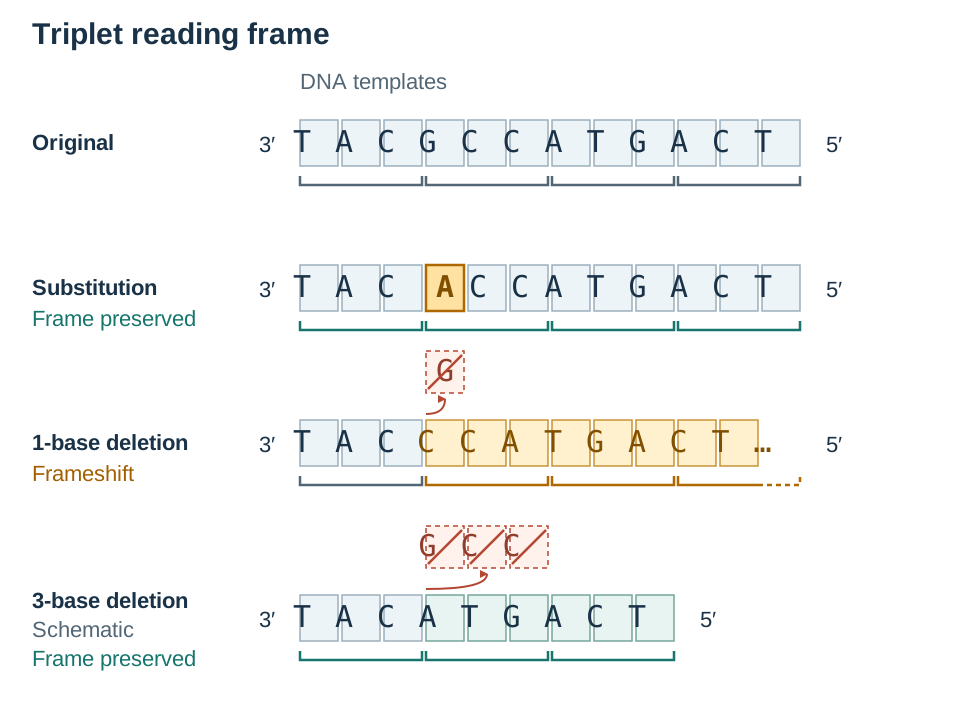
- Point mutation: A change in one or a few nucleotide bases within a single gene, typically caused by incorrect base pairing during replication.
- Substitution: One base is replaced by another. For example, in sickle cell anaemia, a single base substitution alters the codon for glutamic acid into a codon for valine. This changes one amino acid in the haemoglobin chain, causing red blood cells to deform into sickles under low oxygen. If a substitution changes a base but still codes for the same amino acid, it is a silent mutation.
- Insertion or Deletion: The addition or removal of a base changes the triplet reading frame for every codon downstream from that point (a frameshift). In cystic fibrosis, the most common mutation is a 3-base deletion in the CFTR gene, leading to the loss of a phenylalanine amino acid and producing non-functional chloride channels that cause thick mucus accumulation. Because exactly three bases are removed, the reading frame is not shifted; the protein simply lacks one amino acid (phenylalanine).
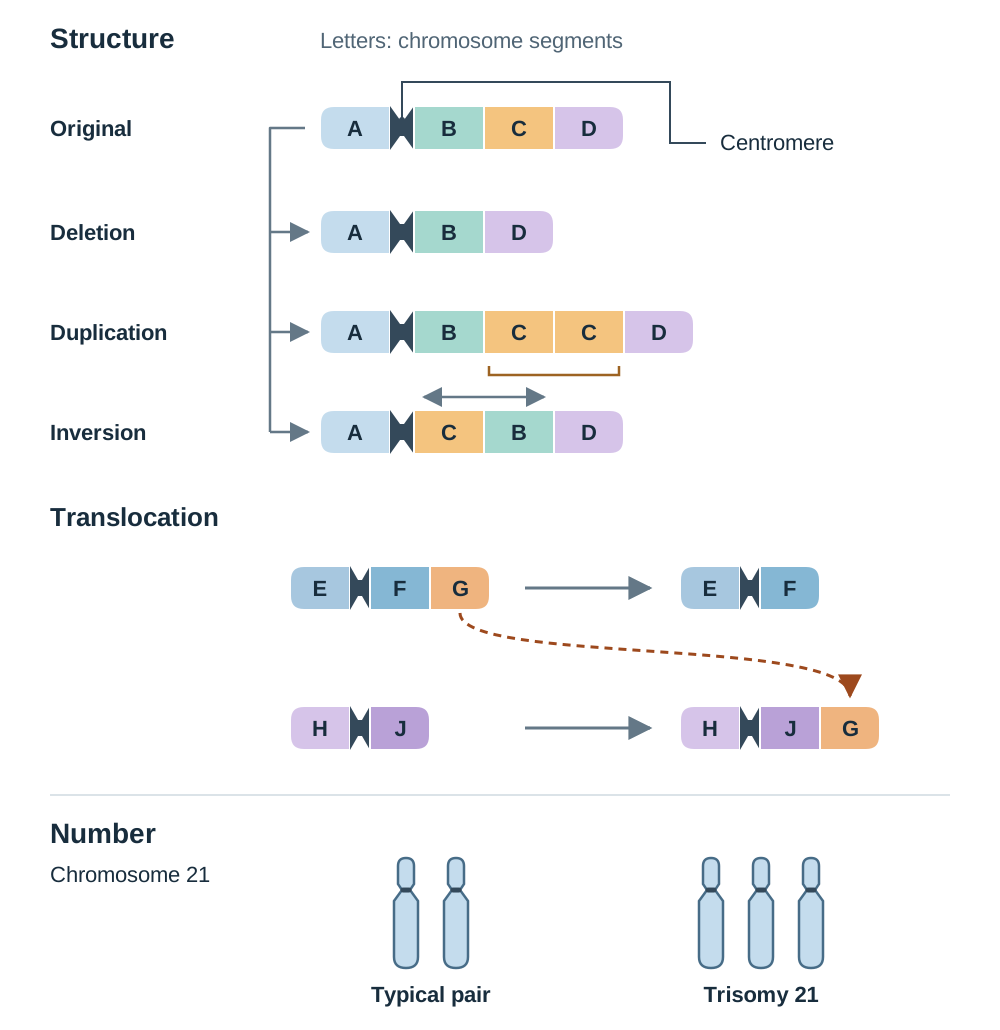
- Chromosomal mutation: A large-scale alteration in chromosome structure or chromosome number.
- Structural changes: Occur by deletion (loss of a chromosome segment, e.g. cri-du-chat syndrome on chromosome 5), duplication (a segment is repeated), inversion (a segment breaks off, flips, and rejoins), or translocation (a segment moves to a non-homologous chromosome, such as the translocation between chromosomes 9 and 22 in chronic myeloid leukaemia).
- Changes in number: Occur when chromosomes fail to separate during meiosis. Down syndrome (trisomy 21) is caused by an extra chromosome 21, resulting in 47 chromosomes instead of 46.
Cancer Biology, Factors, and Treatments
A carcinogen is any agent that causes cancer. Many carcinogens are mutagens that damage genes controlling the rate of mitosis. When these regulatory genes mutate, cells undergo abnormal regulation and divide uncontrollably, forming a tumour.
- Benign tumours: Enclosed cell masses that do not invade adjacent tissues or spread.
- Malignant tumours: Invasive cell masses that infiltrate nearby organs and can enter the bloodstream or lymphatic system to form secondary tumours elsewhere (metastasis).
Cancer Factors, Prevention, and Treatments
Cancer development is influenced by several interacting factors:
- Genetic susceptibility: Inheriting specific mutated alleles increases risk. For example, inherited mutations in BRCA1 or BRCA2 substantially raise the risk of breast and ovarian cancers, though inheriting the allele does not make cancer certain, because further mutations are still needed for cancer to develop.
- Environmental and lifestyle factors: Carcinogens such as tobacco smoke cause mutations in lung tissue. Evaluating public health statements requires looking at evidence: while smoking dramatically raises the probability of lung cancer, some non-smokers develop it and some smokers do not, reflecting individual genetic susceptibility and environmental exposure.
- Prevention: Irish public health initiatives include school-based HPV vaccination (preventing cervical and throat cancers) and national screening programmes (CervicalCheck, BreastCheck, and BowelScreen) to catch abnormal cellular changes early.
- Treatments: Surgery physically removes tumours; radiotherapy directs targeted radiation to destroy cancer cell DNA; chemotherapy uses cytotoxic drugs to kill rapidly dividing cells; and immunotherapy stimulates the body's own immune system to recognise and destroy cancer cells.