

Homeostasis and Negative Feedback Mechanisms
Homeostasis is the maintenance of a constant internal environment in an organism. Vertebrates coordinate internal stability using a stimulus-response model operated by negative feedback.
Every negative feedback system includes the same fundamental components:
- Stimulus: A deviation away from the normal set point.
- Receptor: Detects the deviation.
- Control centre: Evaluates the signal against the set point and sends a corrective message via nerves or hormones.
- Effector: The responsive gland or muscle.
- Response: Reverses the initial change back toward the set point, which switches off the original stimulus.
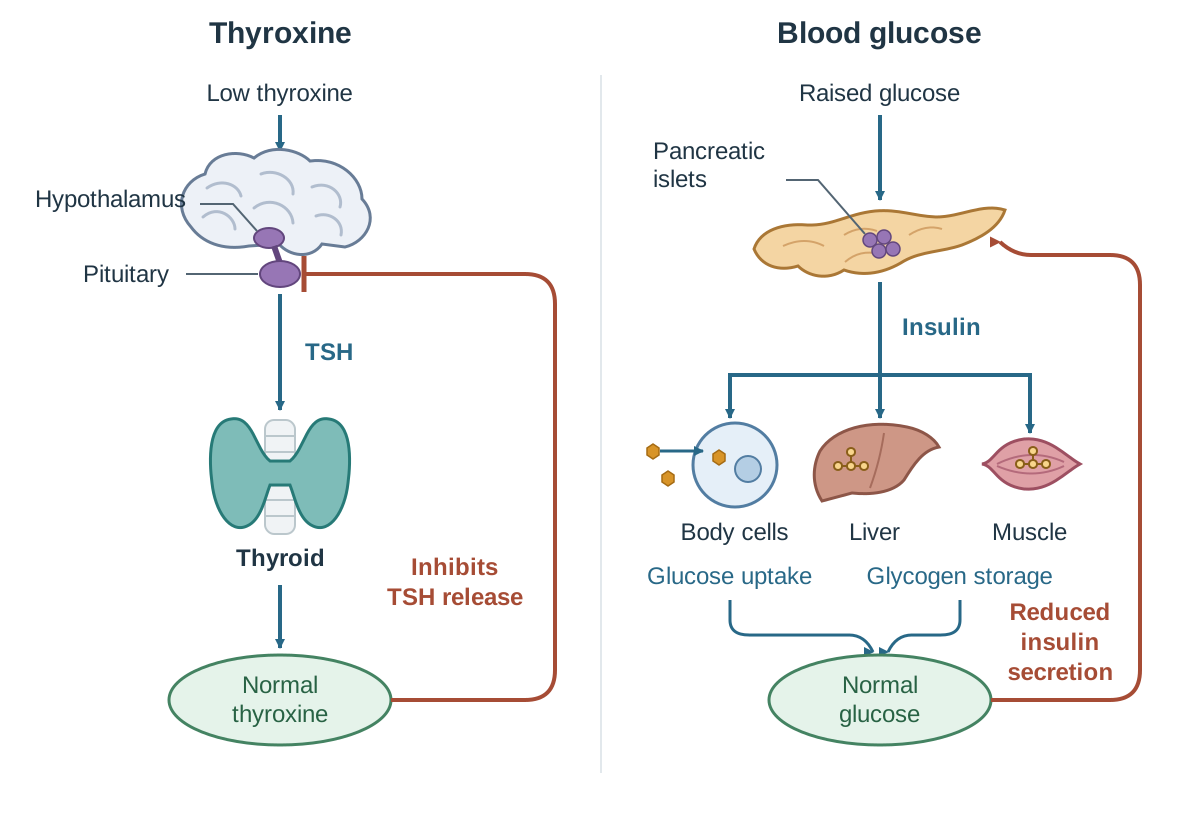
Negative Feedback Control of Thyroxine
- Stimulus: Blood thyroxine concentration drops below normal.
- Receptor and control centre: The hypothalamus and pituitary gland in the brain detect this decrease.
- Message: The pituitary gland secretes TSH into the bloodstream.
- Effector: TSH travels to the thyroid gland and stimulates it to synthesise and secrete thyroxine.
- Response: Thyroxine raises the basal metabolic rate across body tissues, warming the body and consuming energy.
- Feedback: As blood thyroxine levels return to normal, thyroxine inhibits TSH release from the pituitary gland. With less TSH, thyroid secretion settles, preventing an overproduction of thyroxine.
Clinical consequences: In hypothyroidism, too little thyroxine slows metabolism, leading to lethargy, weight gain, and cold sensitivity. If caused by a dietary lack of iodine, because little thyroxine is made, it no longer inhibits the pituitary, so the pituitary keeps secreting TSH, which makes the thyroid swell into a visible mass called a goitre. In hyperthyroidism, an overactive thyroid produces excess thyroxine, causing weight loss, rapid pulse, restlessness, and heat intolerance.
Negative Feedback Control of Blood Glucose
- Stimulus: Blood glucose rises above the standard set point, such as following a meal rich in carbohydrates.
- Receptor and control centre: Cells in the islets of Langerhans in the pancreas detect the rise in blood glucose.
- Message: The islets secrete insulin into the bloodstream.
- Effector: Body cells, the liver, and skeletal muscles.
- Response: Body cells take in glucose from the blood. Liver and muscle cells convert glucose into stored glycogen.
- Feedback: As blood glucose falls back to normal, the stimulus is removed and insulin secretion decreases.