

In this topic you will learn the parts of a flower and what each one does, how pollen is moved from one flower to another by insects or by wind, how to compare insect- and wind-pollinated flowers in the lab, what is inside a seed, how the seeds make the fruit grow, and how seeds and fruits are spread away from the parent plant.
1. Floral Anatomy and Reproductive Organs
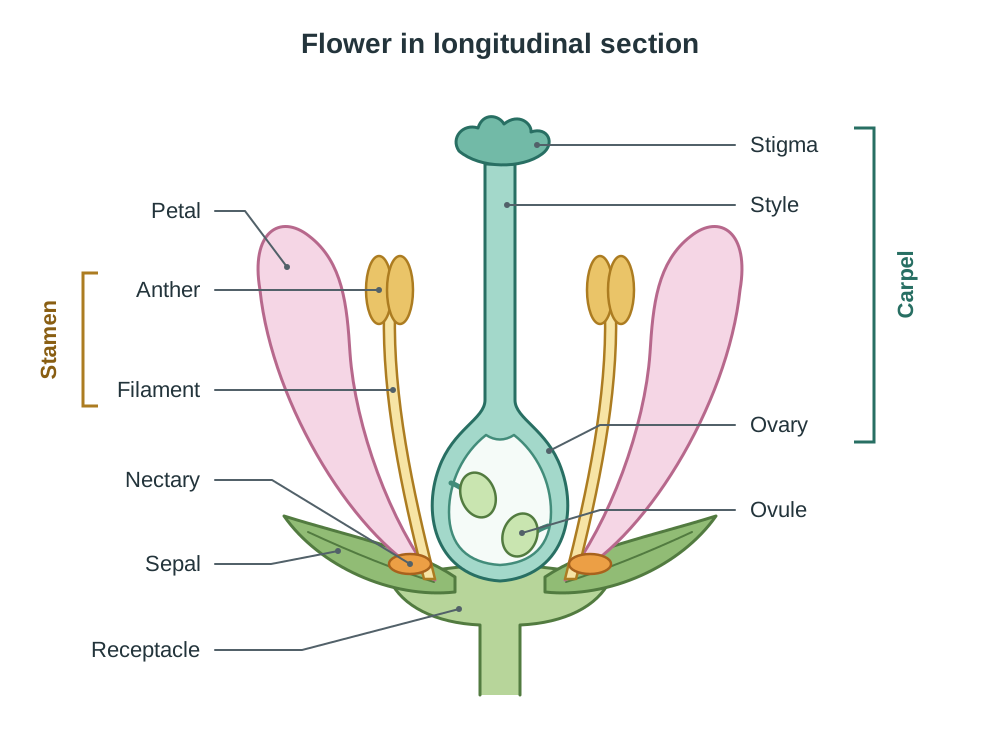
A flower is a specialised reproductive shoot designed for sexual reproduction. Its organs are arranged in concentric rings attached to a thickened stem base.
- Receptacle: The swollen stem tip that supports and anchors all the floral organs.
- Sepals: The outermost ring of green, leaf-like structures that enclose and protect the flower while it is still in the bud stage.
- Petals: Positioned just inside the sepals. In insect-pollinated flowers, petals are large, brightly coloured, and scented to attract pollinators; in wind-pollinated flowers, they are small, dull green or brown, or completely absent.
The Stamen (Male Reproductive Organ)
The stamen produces the male gametes and consists of two parts:
- Anther: The swollen sac where meiosis produces pollen grains, each containing male gamete nuclei.
- Filament: A thin stalk that supports the anther, supplying it with water and nutrients and positioning it for pollen transfer.
The Carpel (Female Reproductive Organ)
The carpel produces the female gametes and houses fertilisation:
- Stigma: The receptive surface at the top where pollen grains land and stick during pollination.
- Style: The neck of tissue through which the pollen tube grows down to the ovary.
- Ovary: The swollen base containing one or more ovules. Inside each ovule, an egg cell develops. Following fertilisation, the ovule develops into the seed, and the surrounding ovary develops into the fruit.
Reading a Flower Diagram
When examining a flower in longitudinal section (L.S.), work from the outside in and from the bottom up:
- At the base: the receptacle, with the sepals attached around the outside and the petals just inside them.
- Around the inner ring: the stamens, each composed of a slender filament with a swollen anther at the top.
- In the centre: the carpel, with the sticky stigma on top, the neck-like style below it, and the swollen ovary at the base enclosing the ovule.
- Nectary: located at the base of the petals in insect-pollinated flowers.
2. Pollination: Mechanisms and Structural Adaptations
Pollination is the transfer of pollen from an anther to a receptive stigma of a flower of the same species. It is a necessary physical step before fertilisation can take place.
- Self-pollination: The transfer of pollen from an anther to a stigma on the same plant. While it guarantees reproduction when pollinators are scarce, it restricts genetic variation.
- Cross-pollination: The transfer of pollen from an anther of one plant to the stigma of a different plant of the same species. This combines genetic material from two parents, increasing variation in the population.
Because flowering plants cannot move, they rely on external agents—principally insects or wind—to carry their pollen.
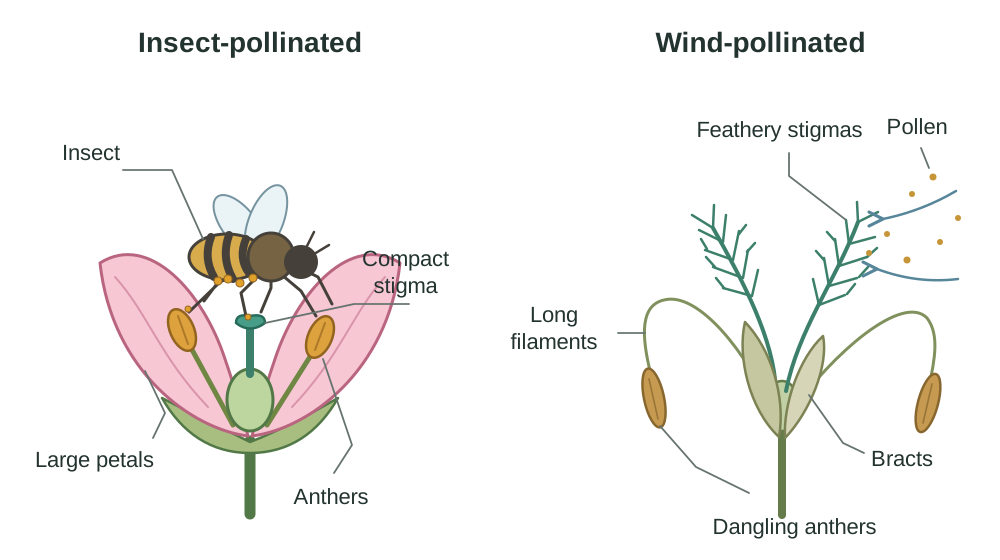
| Floral Organ / Feature | Insect-Pollinated Flower (e.g. Buttercup) | Wind-Pollinated Flower (e.g. Ryegrass) |
|---|---|---|
| Petals | Large, brightly coloured, scented; often bear nectar guides | Small, inconspicuous, dull green or brown, or absent |
| Nectaries & Scent | Present; produce sugary nectar and scent | Absent; no energy spent on rewards |
| Stamens & Filaments | Filaments short and stiff inside petals; anthers firmly fixed | Filaments long, slender, and flexible; hang outside the flower |
| Anthers | Firmly attached; open inward to brush pollen onto insects | Loosely attached (versatile) to swing freely in the breeze |
| Pollen Grains | Smaller numbers produced; large, heavy, sticky or spiky | Enormous numbers produced; small, light, smooth, and dry |
| Stigma | Small, compact, sticky surface held inside the petals | Large, branched, and feathery; hangs outside to catch pollen |
Memory Aid for Flower Adaptations
- Wind: everything out and about (anthers out, stigma out, pollen light and loose, no petals, no nectar, no scent).
- Insect: everything in and inviting (anthers in, stigma in, pollen heavy and sticky, big petals, nectar, scent).
3. From Pollination to Fertilisation
Pollination only places the pollen grain onto the stigma. Fertilisation is the actual fusion of nuclei, and it takes place inside the ovule.
Steps in Fertilisation
- A pollen grain lands on a stigma of the same species and adheres to its sticky surface.
- The pollen grain germinates and grows a pollen tube down through the style toward the ovary.
- Two male gamete nuclei travel down the pollen tube.
- The pollen tube enters the ovule and releases both male nuclei.
- One male nucleus fuses with the female egg nucleus to form a diploid zygote. This zygote divides by mitosis to form the embryo (which develops into the radicle, plumule, and cotyledon).
- The second male nucleus fuses with the two polar nuclei to form the triploid endosperm, which serves as the food store for the seed.
Because two separate fusions take place inside the ovule, this process is called double fertilisation.
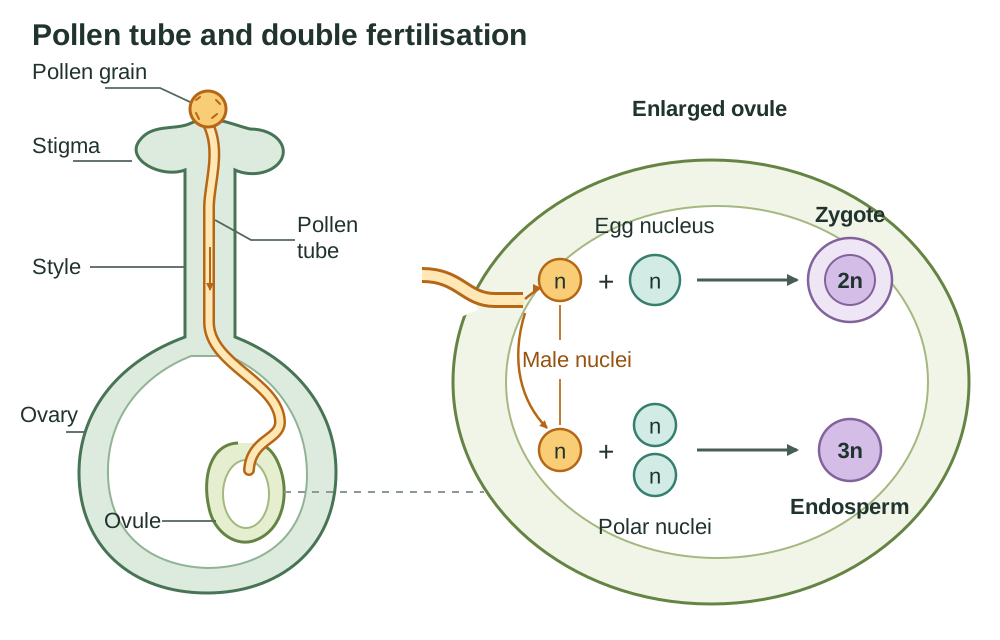
Following fertilisation, the ovule becomes the seed, the ovary becomes the fruit, and the petals, sepals, and stamens wither and fall off.
4. Investigating and Comparing Insect- and Wind-Pollinated Flowers
The specification requires you to investigate and compare the structural adaptations of insect- and wind-pollinated plants, relating them directly to function and using both primary and secondary data to support your conclusions.
- Primary data: Direct measurements and observations made by you in the laboratory (filament lengths in mm, dissection counts, microscopic pollen observations).
- Secondary data: Information gathered from published botanical reference charts, identification keys, or scanning electron micrographs.
Dissection and Examination Method
- Examine intact fresh flowers of an insect-pollinated species (e.g. buttercup) and a wind-pollinated species (e.g. ryegrass) under a hand lens. Note whether stamens and stigmas are held inside or outside the floral bracts.
- Dissect five flowers of each species on a white tile using fine forceps, carefully removing parts from the outside inward (sepals, petals, stamens, carpels).
- Measure filament lengths with a millimetre ruler and record stigma appearance (feathery vs compact).
- Tap mature anthers onto a drop of water on a microscope slide, add a coverslip, and observe pollen grains under ×100 and ×400 magnification. Record relative size, surface texture (smooth vs spiky), and whether grains clump together.
- Compare your recorded values and pollen morphology with published botanical reference data.
Sample Laboratory Results and Conclusion
- Buttercup (n = 5): Mean filament length 6 mm; anthers held firmly inside the petals; stigma small and sticky; pollen grains large, spiky, and clumped.
- Ryegrass (n = 5): Mean filament length 14 mm; anthers hanging freely outside the bracts; stigma large and feathery; pollen grains small, smooth, dry, and scattered.
- Conclusion: Primary data demonstrate that the grass has long, dangling filaments, versatile anthers, a feathery stigma, and lightweight, smooth pollen grains suited to airborne transit. The buttercup has internal anthers, a sticky stigma, and large spiky pollen adapted to stick to visiting insects. Secondary micrographs confirmed the spiky surface of buttercup pollen that was only partly visible at ×400.
Making It a Fair Comparison
- Standardisation: Use flowers at the same stage of development in both species — fully open, with anthers that are just releasing pollen — so that you are comparing like with like.
- Sample size: Dissect at least five flowers from different individual plants to account for natural biological variation and prevent an anomalous specimen from skewing the results.
- Safety: Cut away from your body on the tile when using a scalpel; wash hands after handling fresh flowers if pollen allergies are a concern.
5. Seed Structure and Biological Roles
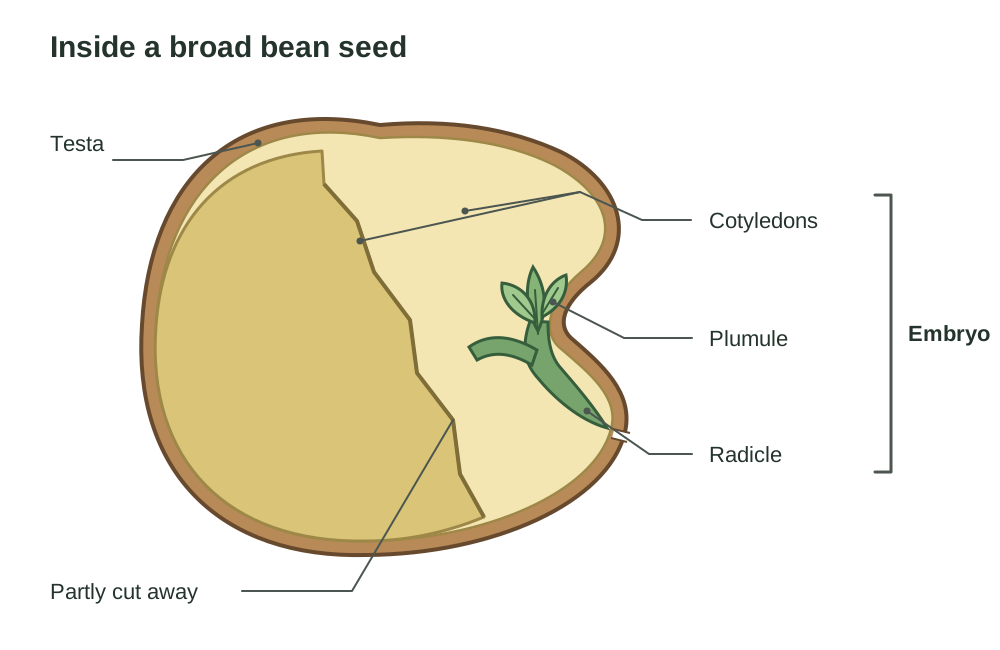
A seed is a fertilised, mature ovule containing an embryo plant and stored food reserves, surrounded by a protective coat.
Seed Anatomy
- Testa: The tough, protective outer seed coat formed from the outer layers of the ovule. It protects the embryo from physical damage, drying out, and bacterial or fungal infection.
- Embryo: The miniature young plant formed from the diploid zygote. It consists of:
- Radicle: The embryonic root that grows downward to anchor the seedling and absorb water and dissolved minerals.
- Plumule: The embryonic shoot that grows upward toward light to form the stem and leaves.
- Cotyledon: A seed leaf that stores food reserves or absorbs food from the endosperm.
- Endosperm: A food-storage tissue rich in starch, lipids, and protein formed during double fertilisation. In endospermic seeds (e.g. maize), the endosperm remains intact until the seed starts to grow. In non-endospermic seeds (e.g. broad bean), the growing cotyledon absorbs the endosperm food reserves before the seed fully matures.
Reading a Seed Diagram (e.g. Broad Bean)
- Testa: The outer boundary line enclosing the seed.
- Cotyledon: The large, fleshy food-storing lobes forming the bulk of the interior.
- Plumule: The small, feathery shoot bud attached above the radicle.
- Radicle: The pointed root tip directed toward the small opening in the testa.
Six Roles of Seeds in Plant Reproduction
- Protection: The tough testa protects the delicate embryo from mechanical damage and drought.
- Nutrition: Stored food in the cotyledon or endosperm provides energy for respiration until the seedling develops green leaves and carries out photosynthesis.
- Dormancy: Seeds can delay growth during unfavourable conditions such as winter frosts or dry periods, allowing survival until suitable conditions return.
- Dispersal: Seeds are packaged into units that can be moved far away from the parent plant.
- Fruit initiation: Developing seeds produce chemical growth regulators that trigger the ovary wall to expand into a fruit.
- Genetic variation and continuity: Because each seed develops from the fusion of male and female gametes, it carries a unique combination of genes. This variation provides the raw material for adaptation and natural selection.
6. Fruit Formation, Functions, and Growth Regulators
After fertilisation, the petals, sepals, and stamens wither and fall off. Meanwhile, the ovary wall enlarges to form the pericarp (the fruit wall). The pericarp together with the seeds inside it makes up the fruit: a mature ovary formed after fertilisation.
Functions of the Fruit
- Protection: The pericarp encloses and protects the developing seeds from drying out, physical damage, and being eaten before they are ripe.
- Dispersal: The fruit develops structural adaptations (wings, parachutes, hooks, or buoyant husks) that carry the seeds away from the parent plant.
- Attracting animals: As fleshy fruits ripen, they become sweet, soft, and brightly coloured, enticing animals to eat them and disperse the seeds.
Chemical Control by Auxin
Fruit formation is controlled by a plant growth regulator:
- Developing seeds synthesise auxin. This chemical diffuses outward into the surrounding ovary wall, stimulating rapid cell division and cell enlargement that causes the ovary wall to swell into fruit tissue.
- The Strawberry Evidence: A strawberry is a false fruit whose swollen red flesh is receptacle tissue, while the tiny hard pips on the outside are the true fruits, each containing a seed. The strawberry is used for this experiment precisely because its seeds sit on the outside, so they can be removed one by one without cutting into the flesh. If all pips are removed from an unripe green strawberry, the receptacle stops growing. However, if a paste containing auxin is smeared onto the bare receptacle, the flesh swells normally again. This confirms that developing seeds supply the chemical signals necessary for fruit enlargement.
If pollination or fertilisation fails, no auxin is produced, and the flower drops off. In commercial horticulture, spraying unpollinated flowers with synthetic auxin induces fruit development without fertilisation, producing seedless fruits (parthenocarpy), such as seedless grapes and greenhouse tomatoes.
7. Fruit and Seed Dispersal Strategies
Dispersal is the carrying of seeds or fruits away from the parent plant. Dispersal carries offspring away from the parent plant, reducing competition for light, water, minerals, and space, and allowing the species to colonise new habitats.
- Wind dispersal: Adaptations make seeds or fruits light or increase their surface area so air currents carry them.
- Parachutes: Dandelion fruits produce a feathery plume of fine hairs called a pappus that catches breezes.
- Wings: Sycamore and ash fruits have winged outgrowths of the pericarp that spin as they fall, delaying their descent so the wind blows them far away.
- Water dispersal: Seeds or fruits are lightweight, waterproof, and buoyant.
- Coconuts have a fibrous, air-filled husk that allows them to float across oceans.
- Alder seeds have air pockets inside that allow them to float along streams and rivers.
- External animal dispersal (seeds carried on the outside of an animal):
- Dry fruits such as burdock and goosegrass (cleavers) develop stiff hooked spines or barbs that cling to animal fur, feathers, or clothing, dropping off later in a new location.
- Internal animal dispersal (seeds eaten and passed out in droppings):
- Succulent fruits such as blackberries, strawberries, and tomatoes are brightly coloured and sweet, encouraging birds and mammals to eat them whole. The tough testa protects the seed from the digestive enzymes in the animal's gut, so the seed passes through undamaged and is deposited away from the parent in a patch of fertile dung.
Key terms
- Pollination
- The transfer of pollen from an anther to a receptive stigma of a flower of the same species.
- Fertilisation
- The fusion of a haploid male gamete nucleus with a haploid female egg nucleus inside the ovule to form a diploid zygote.
- Stamen
- The male reproductive organ of a flower, consisting of a pollen-producing anther supported by a filament.
- Carpel
- The female reproductive organ of a flower, consisting of an ovary containing ovules, a style, and a terminal receptive stigma.
- Seed
- A fertilised, mature ovule containing a plant embryo, stored food reserves, and a protective outer testa.
- Fruit
- A mature, swollen ovary formed after fertilisation, consisting of a fruit wall (pericarp) enclosing one or more seeds.
- Testa
- The tough, protective outer seed coat formed from the ovule integuments that shields the embryo against physical damage, drying out, and infection.
- Radicle
- The embryonic plant root within a seed that grows downward to establish the root system.
- Plumule
- The embryonic plant shoot within a seed that grows upward to develop stems and leaves.
- Endosperm
- The food-storage tissue formed inside the seed during double fertilisation, rich in starch, oils, and protein, which nourishes the developing embryo.
- Auxin
- A plant growth regulator produced by developing seeds that diffuses into the ovary wall to stimulate cell division and cell enlargement, driving fruit formation.
- Dispersal
- The carrying of seeds or fruits away from the parent plant to reduce competition and allow colonisation of new areas.
- Parthenocarpy
- The development of a fruit without prior fertilisation, resulting in seedless fruit.
- Cross-pollination
- The transfer of pollen from an anther of one plant to the stigma of a different plant of the same species.
Check yourself
A pollen grain lands on a stigma of the same species, but the style is broken and the pollen tube cannot grow. Has pollination occurred? Has fertilisation occurred?
Pollination has occurred because pollen reached the stigma, but fertilisation has not occurred because the male gamete nuclei never reached the egg cell in the ovule.
A grower removes all the stamens from a tomato flower before its anthers open and smears the flower with an auxin paste. Will a fruit form, and will it contain seeds?
A fruit will form because auxin stimulates the ovary wall to enlarge, but it will contain no seeds because without stamens, pollination and fertilisation did not occur (this is parthenocarpy).
State the post-fertilisation fates of the ovule and the ovary.
The ovule develops into the seed, and the ovary develops into the fruit.
State two structural adaptations of the anthers in a wind-pollinated grass flower.
They are loosely attached (versatile) to long, flexible filaments and hang outside the flower so breezes can shake their pollen free.
Name two functions of the fruit as a reproductive structure.
Protecting developing seeds from drying out or physical damage, and aiding in the dispersal of seeds away from the parent plant.
Give one example of an external animal-dispersed fruit and describe how it is adapted.
Burdock (or goosegrass), which possesses stiff hooks or barbs that catch onto animal fur or clothing to be carried away.