

Plants are sessile organisms anchored in soil. Lacking muscles and nerves, they rely on physical structures, chemical defences, and chemical messengers known as plant growth regulators to respond to environmental challenges. Plant responses include anatomical adaptations against physical damage and grazing, chemical defences against pathogens, directional growth responses (tropisms) regulated by auxin distribution, apical dominance, commercial hormonal manipulations in agriculture, and biosecurity measures against emerging plant diseases.
Principles of Plant Response and Anatomical Adaptations
A stimulus is any detectable change in an organism's internal or external environment, such as light, gravity, touch, water availability, or attack by a pathogen. A response is the resulting physiological reaction or growth adjustment.
Plants rely on structural barriers and chemical signalling rather than rapid neuromuscular pathways. When you write about any plant adaptation, answer in this order:
- The stimulus or stress
- The structure or chemical involved
- What it does
- How that helps the plant survive
Anatomical (Structural) Adaptations
An anatomical adaptation is a physical feature that shields the plant against biotic threats (grazing herbivores, microbial infection) or abiotic stresses (drought, frost):
- Epidermal Cuticle: A waxy, waterproof lipid layer covering the outer walls of epidermal cells on leaves and young stems. It restricts uncontrolled water loss through transpiration and acts as an impermeable physical barrier against fungal hyphae and bacteria.
- Thorns, Spines, and Prickles: Sharp physical deterrents that prevent herbivores from grazing vegetative tissues. Anatomically, thorns are modified stems (such as hawthorn), spines are modified leaves (such as gorse and cacti), and prickles are outgrowths of the epidermis or cortex (such as rose stems).
- Stinging Hairs (Trichomes): Hollow epidermal hairs, as seen in common nettles, that break off upon contact to inject chemical irritants such as histamine and formic acid into an animal's skin.
- Bark and Suberin: The outer bark of woody stems consists of cork cells impregnated with suberin, a waterproof, wax-like lipid. Suberin prevents desiccation and blocks pathogens from entering underlying vascular tissues.
- Sealing Damaged Tissue: When a plant is wounded by grazing, wind, or pruning, cells around the wound secrete sticky gums and resins that harden to seal the opening, while surrounding cell walls are reinforced with lignin. This blocks the entry of bacteria and fungi and prevents water loss, acting like a scab produced by cell wall chemistry.
Short-Answer Template
For questions asking for two anatomical and two chemical adaptations, pair each adaptation with a named plant and its specific effect:
- Thorns (hawthorn): deter grazing animals.
- Waxy cuticle (most leaves, e.g. holly): reduces water loss and blocks fungal entry.
- Tannins (oak bark): make tissue unpalatable and inactivate digestive enzymes.
- Phytoalexins (potato tubers): kill fungi at the site of infection.
Chemical Adaptations and Stomatal Regulation
Plants produce an array of secondary metabolites and chemical messengers to defend against biological attack and survive physical stress:
- Tannins: Bitter-tasting polyphenols found in oak bark and tea leaves. They deter herbivores by making plant tissues unpalatable and by binding to and inactivating digestive enzymes in the animal gut.
- Alkaloids: Nitrogen-containing compounds such as nicotine in tobacco and caffeine in coffee. They act as potent deterrents or neurotoxins against insects and grazing animals.
- Phytoalexins: Antimicrobial chemicals synthesised rapidly by plant cells immediately adjacent to a site of pathogen penetration. In potato tubers attacked by blight, phytoalexins accumulate rapidly to disrupt microbial cell membranes and stop fungal hyphae spreading.
- Heat-Shock Proteins: Chaperone proteins produced during heat stress that shield essential cellular enzymes from denaturing.
Stomatal Control and Abscisic Acid
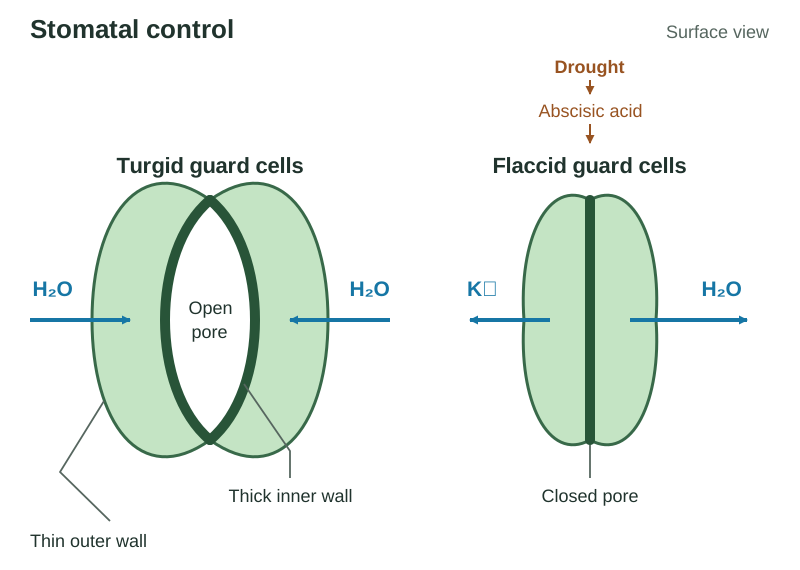
Stomata regulate gas exchange and water conservation. Each stoma is flanked by two guard cells located in the leaf epidermis:
- Structure: Guard cells have unevenly thickened walls — a thick, inelastic inner wall facing the stoma and a thinner, flexible outer wall.
- Opening: When water enters guard cells by osmosis, they become turgid. The flexible outer walls bow outwards, pulling the inner walls apart and opening the pore to allow carbon dioxide uptake for photosynthesis.
- Closing: When guard cells lose water, they become flaccid, causing the pore to close and preventing transpirational water loss.
- Hormonal Regulation: Under drought stress, roots and leaves produce abscisic acid. This regulator causes guard cells to lose potassium ions () and water, making them flaccid so the stoma closes. Stomata also respond to light and internal carbon dioxide levels, which balance photosynthesis and water conservation.
Tropisms, Auxin Action, and Apical Dominance
A tropism is a plant growth response to an external directional stimulus. Growth towards the stimulus is positive; growth away is negative. A tropism is directional. A response that happens in the same way whatever direction the stimulus comes from — such as a Mimosa leaf folding when touched — is a nastic response, not a tropism.
| Tropism | External Stimulus | Positive Example | Negative Example | Biological Benefit |
|---|---|---|---|---|
| Phototropism | Directional light | Shoots grow towards light | Roots grow away from light | Positions leaves to absorb maximum sunlight for photosynthesis |
| Geotropism | Gravity | Primary roots grow downwards | Shoots grow upwards | Roots anchor the plant and absorb water; shoots reach light |
| Thigmotropism | Physical contact / touch | Climbing tendrils coil around a support | Root tips steer away from stones | Holds climbing shoots upright towards sunlight without heavy woody stems |
| Hydrotropism | Moisture gradient | Roots grow towards moist soil | Not normally required | Secures essential water for cellular turgor and photosynthesis |
| Chemotropism | Chemical gradient | Pollen tube grows towards ovule chemicals | Not normally required | Delivers male gamete to the female ovule for fertilisation |
Mechanism of Phototropism
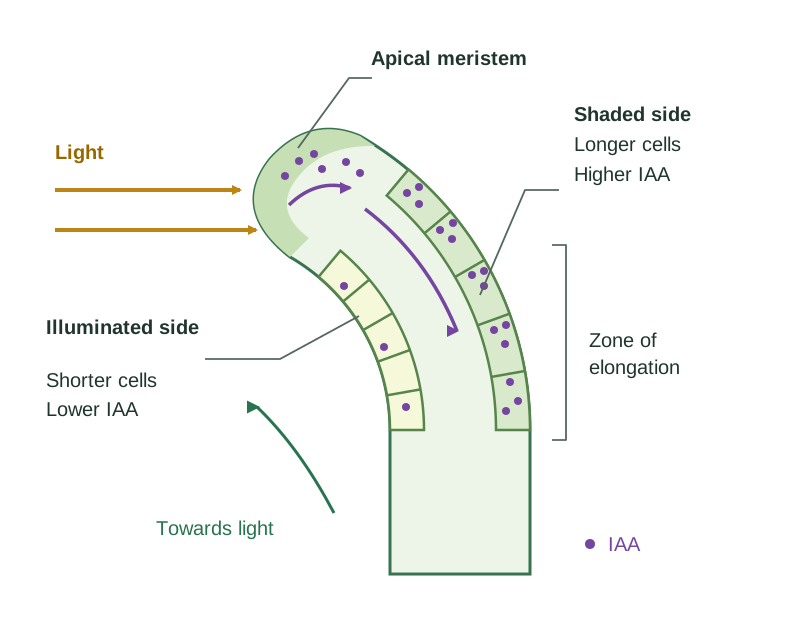
Indole-3-acetic acid (IAA) is the primary natural auxin (IAA). It is made in the shoot tip (the apical meristem) and moves down the shoot into the zone of elongation, the region just behind the tip where cells are stretching:
- Directional light strikes one side of a growing shoot.
- The shoot tip detects the light, causing auxin to migrate across to the shaded side.
- Auxin diffuses down into the zone of elongation, accumulating at a higher concentration on the shaded side.
- The extra auxin makes the cell walls on the shaded side more flexible, so water pressure inside the cells (turgor) stretches them and those cells become longer than the cells on the lit side.
- This unequal elongation forces the shoot to bend towards the light.
Contrasting Sensitivity in Roots and Shoots
Root and shoot cells have different sensitivity thresholds to auxin. High auxin concentrations stimulate cell elongation in shoots, but that same concentration inhibits elongation in roots. In a horizontal root, gravity pulls auxin to the lower side. This high concentration stops elongation on the lower side while the upper side elongates normally, turning the root downwards (positive geotropism).
Apical Dominance
In apical dominance, auxin produced in the apical bud (shoot tip) moves down the stem and suppresses the growth of lateral (side) buds. The plant grows upright rather than bushy, helping it compete for light. If the shoot tip is removed, the auxin supply falls and lateral buds are released from suppression, allowing side shoots to branch out. Gardeners exploit this by pinching out the growing tip of fuchsias or chrysanthemums to produce bushier flowering plants, and clipping hedges annually to make them thicken.
Plant Growth Regulators and Hormonal Manipulations
A plant growth regulator is an organic chemical produced in minute quantities in one part of a plant that is transported to another part where it elicits a specific physiological response.
| Regulator | Primary Biological Role | Commercial Agricultural Application |
|---|---|---|
| Auxin (IAA) | Promotes cell elongation, apical dominance, and adventitious root initiation | Rooting powders for stem cuttings; selective weedkillers (e.g. 2,4-D) for lawns and cereal fields |
| Gibberellin | Stimulates stem elongation and mobilises food reserves to break seed dormancy | Lengthens stems in seedless table grapes; speeds up the malting process in brewing barley |
| Cytokinin | Promotes cell division (mitosis) and delays leaf ageing | Used with auxin in plant tissue culture (micropropagation) to stimulate shoot development |
| Ethene | Gaseous regulator; stimulates fruit ripening and leaf abscission | Released as a gas into sealed ripening rooms so that green bananas or tomatoes all ripen together just before sale |
| Abscisic acid | Growth inhibitor; induces seed dormancy; triggers stomatal closure | Sprayed on nursery stock to cut water loss during dry transport periods |
Evaluating Hormonal Manipulations (Benefits vs. Risks)
- Selective Weedkillers (e.g. 2,4-D): Broad-leaved dicot weeds have broad leaves that absorb high doses of synthetic auxin. This triggers uncontrolled cell elongation that disrupts vascular bundles and exhausts energy reserves, killing the weed while narrow-leaved monocot grasses survive.
- Benefit: Increases crop yield by eliminating weed competition.
- Risk: Herbicide spray drift damages wild hedgerow plants and lowers nectar availability for pollinators; regular use can select for resistant weed strains.
- Controlled Fruit Ripening with Ethene: Fruit is picked green and firm to prevent transit damage, then treated with ethene gas in distribution centres.
- Benefit: Synchronises ripening for supermarkets and cuts transport bruising.
- Risk: Poor temperature control during ripening can trigger rapid fungal decay and food waste.
- Rooting Powders in Commercial Propagation: Synthetic auxins applied to stem cuttings induce rapid root development.
- Benefit: Quickly clones high-performing plant cultivars with identical characteristics.
- Risk: Large fields of cloned plants create a crop monoculture with no genetic variation, making them vulnerable to single disease outbreaks.
Broader Scope: Hormonal Manipulation in Sport and Health
Plant growth regulators represent the agricultural context of hormonal manipulation. The specification also addresses hormonal manipulation in sport (such as anabolic steroids to increase muscle mass, carrying cardiovascular and liver risks) and health (such as insulin for diabetes, thyroxine replacement, or hormones used in IVF). When evaluating any hormonal manipulation, use the same structure: name the hormone, describe its intended benefit, and provide a biological, ecological, or ethical drawback.
Plant Pathology, Emerging Diseases, and Biosecurity
An emerging infectious disease is an infectious illness that has newly appeared in a plant population or is rapidly increasing in geographic range or incidence.
Factors Contributing to Disease Emergence
- Pathogen Persistence: Pathogens that survive through winter as dormant spores in soil, fallen leaves, or carrier hosts provide an immediate source of re-infection each spring.
- Mutations and Novel Strains: Random mutations in pathogens can bypass host recognition receptors or overcome chemical treatments.
- Chemical and Fungicide Resistance: Overusing a single fungicide selects for resistant strains, rendering commercial chemical sprays ineffective.
- Monocultures and Low Genetic Diversity: Large agricultural fields planted with a single monoculture lack genetic variation. If a pathogen overcomes the defences of one plant, every neighbouring plant is equally susceptible.
- Global Trade and Movement: International shipping of live plants, timber, and soil carries novel pathogens across natural geographical boundaries.
- Basic Reproduction Number (): The basic reproduction number (R₀) is the average number of secondary infections produced by one infected individual in a completely susceptible population. If , the disease spreads exponentially; if , the infection declines and dies out.
European and Irish Case Studies
- Ash Dieback (Hymenoscyphus fraxineus)*: Ash dieback was first confirmed in Ireland in 2012, in young ash trees that had been planted from imported nursery stock. The fungus reached Europe from east Asia, where native ash species are resistant to it. In European ash, wind-borne spores released from fallen leaf stalks cause crown dieback, wilt, and high mortality.
- Potato Late Blight (Phytophthora infestans)*: A fungus-like protist that destroyed the Irish potato crop from 1845 onwards, the crop failure behind the Great Famine. Almost the entire crop was the single 'Lumper' variety, providing no genetic variation to slow the spread — the clearest historical example of monoculture risk. New, more aggressive genotypes of the blight pathogen keep appearing in Europe, and some are resistant to fungicides that used to control it, requiring farmers to alternate between sprays with different modes of action.
- Xylella fastidiosa: A xylem-blocking bacterium spread by sap-sucking insects that has killed millions of olive trees in southern Europe. Xylella* has not been found in Ireland. It is the main reason for plant passport and import inspection rules on olive, lavender, and oleander — keeping a pathogen out is far cheaper than controlling it once established.
- Tomato Brown Rugose Fruit Virus: An emerging plant virus of tomato and pepper crops that has spread through international seed trade since 2014. It spreads on workers' hands, tools, and direct plant contact. Because chemical sprays cannot cure a viral infection inside plant cells, control relies on strict biosecurity: certified virus-free seed, heat sterilisation of tools, destruction of infected plants, and breeding resistant varieties.
Investigating Plant Responses
These two investigations show how the investigation skills you need for your Biology in Practice Investigation — a testable hypothesis, a fair test, a control, and honest analysis of your data — apply to plant responses.
Sample Investigation 1: Effect of Unilateral Light on Shoot Curvature
- Hypothesis: Shoots exposed to unilateral light bend towards the light because auxin redistributes to the shaded side, stimulating greater cell elongation there.
- Apparatus: Two batches of 20 germinated cress seedlings, two opaque boxes with a side slit, cool LED lamp, and a rotating clinostat.
- Method and Control:
- Place 20 seedlings inside an opaque box with a side slit illuminated by an LED lamp (experimental group).
- Place an identical batch of 20 seedlings in an identical box with a side slit, mounted on a rotating clinostat turning at 1–2 rpm (control group). The clinostat exposes all sides to equal light, eliminating directional stimulation while keeping total light exposure identical.
- Keep temperature, moisture, and time (48 hours) identical for both groups.
- Measure the curvature angle of each stem relative to the vertical with a protractor.
- Why These Steps Matter:
- The clinostat control verifies that curvature is caused specifically by the directional nature of light rather than incidental warmth or moisture.
- Using 20 seedlings per dish accounts for biological variation and allows a reliable mean to be calculated.
- Cool LEDs prevent radiant heat from setting up an unintended temperature gradient.
- Limitation: Measuring stem angle provides indirect evidence of bending; it does not directly measure auxin molecules or verify cellular elongation.
Sample Investigation 2: Effect of Auxin Concentration on Root Growth
- Hypothesis: Low concentrations of auxin stimulate root elongation; higher concentrations inhibit it.
- Method:
- Prepare a serial dilution of IAA solutions (e.g. 0.01, 0.1, 1, and 10 mg/L).
- Place ten germinated radish seeds with straight, equal-length radicles on filter paper in each of four Petri dishes. Add an identical volume of the designated IAA solution to each dish.
- Set up a fifth dish containing distilled water only as the control.
- Seal dishes and place them vertically in darkness at constant temperature for 48 hours.
- Measure radicle lengths with a millimetre ruler and calculate the mean growth for each concentration.
- Why These Steps Matter:
- The water-only control shows baseline root growth without added regulator, so any differences can be attributed to the IAA.
- Ten seedlings per dish provide a reliable mean that accounts for natural seed variation.
- Constant temperature and dark conditions prevent phototropic responses from confounding the results.
- Expected Result: Mean radicle length is greatest at very low IAA concentrations and drops below the water control at higher concentrations, demonstrating organ-specific sensitivity.
Key terms
- Stimulus
- Any change in the internal or external environment that can be detected by an organism and elicit a physiological or behavioural response.
- Tropism
- A plant growth response to an external directional stimulus.
- Phototropism
- A plant growth response to an external directional light stimulus.
- Geotropism
- A plant growth response to the external stimulus of gravity.
- Thigmotropism
- A plant growth response to the external stimulus of physical contact or touch.
- Plant Growth Regulator
- An organic chemical produced in minute quantities in one part of a plant that is transported to another part where it elicits a specific physiological response.
- Auxin (IAA)
- A plant growth regulator produced in apical meristems that stimulates cell elongation in shoots, controls apical dominance, and mediates phototropism.
- Zone of Elongation
- The region of a growing root or stem located behind the meristem where newly formed cells expand and lengthen.
- Apical Dominance
- The suppression of lateral bud growth by auxin produced in the apical bud of a plant stem.
- Abscisic Acid
- An inhibitory plant growth regulator that triggers stomatal closure during water stress and maintains seed and bud dormancy.
- Ethene
- A gaseous plant growth regulator that stimulates fruit ripening, flower senescence, and leaf abscission.
- Phytoalexin
- An antimicrobial chemical synthesised rapidly by plant cells at an infection site in response to pathogen attack.
- Suberin
- A waxy, waterproof lipid found in the cell walls of cork tissue that protects plants against pathogen invasion and water loss.
- Guard Cells
- Specialised epidermal cells that flank a stoma and change shape by gaining or losing water to regulate gas exchange and transpiration.
- Monoculture
- The agricultural practice of cultivating a single crop species or genetically uniform cultivar over a large area.
- Emerging Infectious Disease
- An infectious disease that has newly appeared in a population or is rapidly increasing in geographic range or incidence.
- Basic Reproduction Number (R₀)
- The average number of secondary infections produced by one infected individual in a completely susceptible population.
- Clinostat
- A rotating apparatus used in plant growth experiments to expose all sides of a plant to a stimulus equally, eliminating directional influence.
Check yourself
What is the precise definition of a tropism?
A plant growth response to an external directional stimulus.
Where is auxin mainly produced in a growing shoot?
In the apical meristem of the shoot tip.
What is apical dominance, and what happens when the shoot tip is removed?
Apical dominance is the suppression of lateral bud growth by auxin from the shoot tip. Removing the tip stops the auxin supply, allowing lateral buds to grow into side branches.
Why does a horizontally oriented root bend downwards?
Gravity pulls auxin to the lower side of the root, where high concentrations inhibit cell elongation. The upper cells elongate normally, turning the root down.
Name the plant growth regulator used commercially to ripen green bananas uniformly.
Ethene.
Which plant hormone triggers stomatal closure during drought stress?
Abscisic acid.
Differentiate anatomically between a thorn and a spine.
A thorn is a modified stem, whereas a spine is a modified leaf.
Why are crop monocultures particularly vulnerable to emerging infectious diseases?
Monocultures consist of genetically identical plants. Because there is no genetic variation in disease resistance, a pathogen that infects one plant can infect all of them.
What is the role of a rotating clinostat in a phototropism experiment?
It rotates the control plants slowly so all sides receive equal illumination, cancelling out the directional effect of the light.
What does a basic reproduction number (R₀) of 2.0 mean for a newly arrived plant disease?
Each infected plant transmits the infection to an average of two new plants in a fully susceptible population, meaning the disease will spread.