

Plant physiology examines how agricultural crops capture energy, move water, absorb minerals, and build harvestable dry matter. For Leaving Certificate Higher Level Agricultural Science, this topic centres on four fundamental processes: photosynthesis, respiration, transpiration, and nutrient uptake, alongside the structural adaptations of leaves, stems, and roots. The specification also requires students to master core practical investigations—measuring dry matter, evaluating nutrient effects on above- and below-ground biomass, testing percentage germination, and hybridising plants to follow trait inheritance. Finally, it links physiological principles to crop improvement through field trials, genomic selection, and the Higher Level principles of genetic engineering.
1. Leaf Structure and Photosynthesis
A crop leaf is structurally adapted to balance two competing tasks: capturing sunlight for photosynthesis and absorbing carbon dioxide while minimising water loss. Photosynthesis is the process where green plants convert light energy into chemical energy stored in glucose:
Structural Adaptations of the Leaf
- Cuticle: A transparent, waxy waterproof layer covering both surfaces (thicker on the upper surface) that reduces evaporative water loss while allowing sunlight through to photosynthetic cells.
- Upper epidermis: A single layer of tightly packed cells without chloroplasts that protects inner tissues and transmits light.
- Palisade mesophyll: Columnar cells packed vertically beneath the upper epidermis. This layer contains the highest density of chloroplasts, positioned directly facing incoming sunlight to maximise light absorption.
- Spongy mesophyll: Loosely arranged, irregularly shaped cells separated by large intercellular air spaces. This open network allows carbon dioxide to diffuse rapidly toward the palisade cells and lets oxygen diffuse outward.
- Stomata and guard cells: Microscopic pores located predominantly on the lower epidermis to reduce solar evaporation. Guard cells swell with water and become turgid to open the pore for carbon dioxide intake; when they lose water and become flaccid, they close the pore to conserve moisture.
- Vascular bundles: Veins containing xylem, which delivers water and dissolved mineral ions from the roots, and phloem, which translocates manufactured sugars to developing sinks.
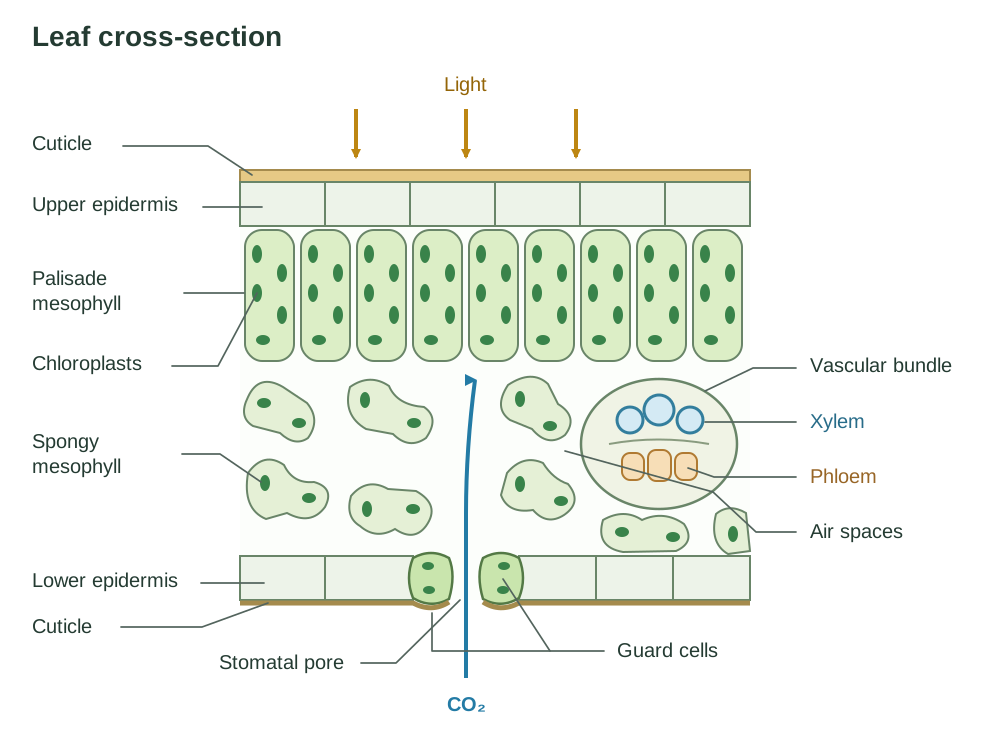
Chloroplasts contain photosynthetic pigments, primarily chlorophyll, along with carotenes and xanthophylls. Each pigment absorbs light at slightly different wavelengths across the spectrum, enabling crops like perennial ryegrass to absorb diffuse sunlight even on overcast Irish days.
Limiting Factors and Farm Practice
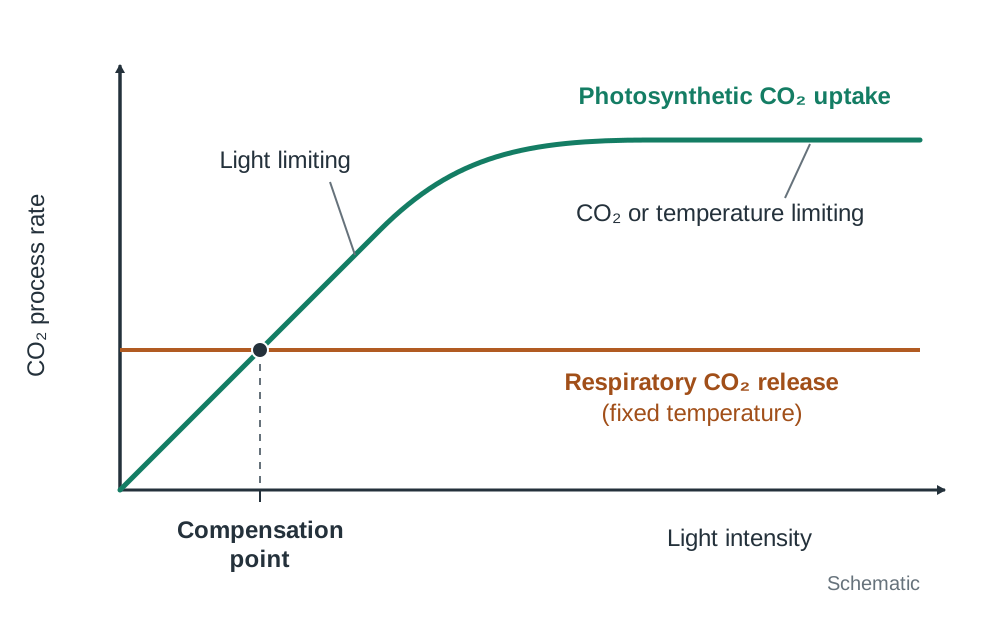
The rate of photosynthesis is governed by limiting factors: light intensity, carbon dioxide concentration, and ambient temperature. The factor in shortest supply is the limiting factor: it sets the maximum rate of photosynthesis, no matter how much of the other factors is available. A graph of photosynthetic rate against light intensity rises steeply at first, but then levels off into a plateau. At that plateau, light is no longer limiting; carbon dioxide concentration or temperature has become the limiting factor.
Understanding photosynthesis directly shapes grazing management. For instance, rotational grazing targets perennial ryegrass at the three-leaf stage. At this point, the plant has rebuilt enough leaf area to photosynthesise at full capacity, but has not yet started to lose its oldest leaf to death and decay. Similarly, grass growth in early spring remains near zero until soil temperatures reach 5–6 °C, because low temperature limits enzyme activity regardless of available daylight.
2. Respiration in Crops and Soil Aeration
Respiration is the controlled oxidation of glucose to release metabolic energy in the form of ATP. Respiration takes place continuously, day and night, in every living plant cell.
Aerobic respiration begins in the cytoplasm of the cell and is completed in the mitochondria, where oxygen is used to release the bulk of the energy:
At low light levels, such as dawn or dusk, the rate of carbon dioxide uptake by photosynthesis exactly matches the rate of carbon dioxide released by respiration. This balance point is the compensation point. Below the compensation point, respiration consumes more carbohydrate than photosynthesis produces, causing a net loss of stored dry matter.
| Feature | Photosynthesis | Aerobic Respiration |
|---|---|---|
| Purpose | Synthesises glucose and stores energy | Breaks down glucose to release ATP |
| Site | Chloroplasts (green tissues) | Cytoplasm and mitochondria (all living cells) |
| Light requirement | Light required | Continuous (day and night) |
| Gas exchange | Absorbs , releases | Absorbs , releases |
| Biomass impact | Increases crop dry matter | Consumes stored dry matter |
The Waterlogging Chain of Events
Exam questions frequently ask why poor drainage or soil compaction damages crops. The physiological explanation follows a strict causal chain:
- Water displaces air from soil pores, creating anaerobic conditions around the root system.
- Root cells cannot carry out aerobic respiration and are forced into anaerobic respiration.
- Anaerobic respiration produces very little ATP and generates toxic ethanol, which damages root tissue.
- Without sufficient ATP, root hairs cannot power the active transport carrier proteins needed to absorb essential mineral ions (such as nitrate, ) against a concentration gradient.
- Lack of nitrogen prevents the synthesis of proteins and chlorophyll, leading to severe leaf yellowing (chlorosis) and stunted growth.
Crop Storage Respiration
Harvested crops continue to respire. Wet grain or poorly sealed silage respires rapidly, generating heat, moisture, and carbon dioxide. This heat encourages storage moulds and rots, destroying feed value. For safe storage, malting barley must be dried below 14.5% to 15% moisture to suppress seed and microbial respiration.
3. Water Movement, Transpiration, and Transport Tissues
Water moves through a plant along an uninterrupted pathway: soil solution → root hairs → root cortex → xylem vessels → leaf mesophyll → stomata → atmosphere.
Water enters root hair cells by osmosis, moving across a selectively permeable membrane from an area of higher water concentration in the soil solution to the more concentrated cell sap of the root. Root hairs are long, thin extensions of the root's outer epidermal cells found just behind the root tip. There are huge numbers of them, creating an immense surface area with thin walls and no waxy cuticle to maximise water and mineral absorption.
Transpiration is the loss of water vapour from the aerial parts of a plant, primarily through open stomata. Evaporation from moist spongy mesophyll cell walls into leaf air spaces creates negative pressure (tension) in leaf xylem. According to the cohesion-tension model, water molecules stick to each other by cohesion (hydrogen bonding) and cling to xylem vessel walls by adhesion. This unbroken column of water is pulled upward through the stem from the roots.
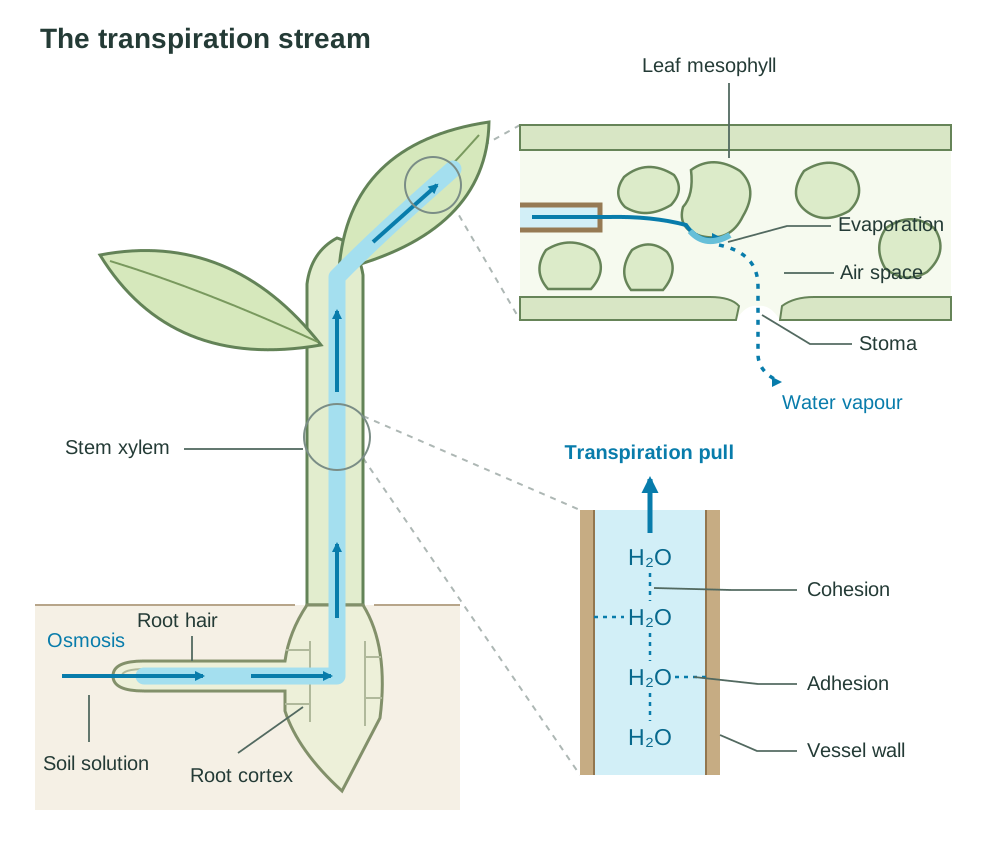
The transpiration stream does three important jobs:
- Transports dissolved mineral ions from the root zone to the canopy.
- Keeps the plant supplied with water so that cells stay turgid. Turgor pressure holds up soft, non-woody stems and keeps leaves flat and spread out to the light. When water is lost faster than it is taken up, cells lose turgor and the crop wilts.
- Cools the leaf canopy through evaporation, preventing leaf enzymes from denaturing on hot summer days.
Comparing Stem Transport Tissues
The stem supports leaves in the light and carries the vascular tissues connecting roots and leaves. In grasses, the stem base also stores carbohydrates used to fuel regrowth after grazing or silage cutting.
| Feature | Xylem | Phloem |
|---|---|---|
| Substances carried | Water and dissolved mineral ions | Dissolved sucrose and amino acids |
| Direction of flow | Upward only (root to leaf) | Upward and downward (source to sink) |
| Cell structure | Dead, hollow, lignified vessels | Living sieve tube cells with companion cells |
| Transport mechanism | Transpiration pull (cohesion-tension) | Translocation (requires metabolic energy) |
Factors Influencing Transpiration Rate
- Temperature: Warm air supplies heat energy, accelerating evaporation from cell surfaces.
- Humidity: Dry air steepens the water vapour concentration gradient between leaf air spaces and the surrounding atmosphere, speeding up transpiration. High humidity narrows this gradient and slows water loss.
- Wind: Air movement sweeps away the humid boundary layer hugging the leaf surface, maintaining a steep concentration gradient.
- Light intensity: Light stimulates guard cells to take up potassium ions, absorb water by osmosis, become turgid, and open the stomatal pore.
4. Plant Nutrition: Major and Trace Elements
Dissolved mineral ions move across root cell membranes via two distinct mechanisms: diffusion (passive movement along a concentration gradient through channel proteins) and active transport (movement against a concentration gradient using carrier proteins and respiratory ATP).
Plant nutrients are divided into macronutrients (needed in large amounts) and trace elements (micronutrients, needed in tiny amounts). They differ in the quantity required, not in their importance; a crop will fail if a trace element is missing just as surely as it will without nitrogen.
Major Elements
- Nitrogen (N): Component of amino acids, proteins, and chlorophyll. Deficiency causes stunted growth and pale yellowing (chlorosis) of older leaves.
- Phosphorus (P): Component of ATP, DNA, RNA, and cell membranes. Essential for early root development and tillering in cereals and grass. Deficiency causes purpling of leaves and stunted root systems.
- Potassium (K): Regulates stomatal opening and closing via guard cell turgor and activates metabolic enzymes. Deficiency causes marginal leaf scorch (browning of leaf tips and edges).
- Calcium (Ca): Structural component of cell walls (calcium pectate) and essential for cell division. Supplied through agricultural lime. Deficiency causes death of growing tips and distorted young leaves.
- Magnesium (Mg): Central atom in every chlorophyll molecule and enzyme activator. Deficiency causes interveinal chlorosis (yellowing between the veins) of older leaves. Supplying magnesium in pasture is also critical to prevent grass tetany in lactating ruminants.
- Sulfur (S): Component of essential amino acids (methionine and cysteine) used in protein synthesis. Deficiency causes yellowing of the youngest leaves first, commonly observed on intensively cut silage ground.
Trace Elements
- Copper (Cu): Enzyme activator in photosynthesis and respiration. Deficiency in spring cereals causes white-tipped, twisted leaves, poor grain fill, and blind ears.
- Boron (B): Essential for cell wall formation and sugar transport. Deficiency causes 'brown heart' in swedes, turnips, and fodder beet.
- Zinc (Zn), Manganese (Mn), Molybdenum (Mo), and Iron (Fe): Co-factors required for enzyme synthesis, nitrogen metabolism, and chlorophyll formation.
Soil pH and Biological Fixation
Soil pH dictates nutrient availability. In acidic soils (pH below 6.0), phosphorus binds tightly with iron and aluminium to form insoluble compounds that roots cannot absorb. Applying ground limestone neutralises acidity, raising the pH to the optimum 6.2–6.8 range for grass and tillage crops and unlocking bound nutrients. In legumes like white clover (Trifolium repens), symbiotic Rhizobium bacteria inside root nodules fix atmospheric nitrogen gas into ammonium () in exchange for carbohydrates, reducing synthetic fertiliser requirements.
5. Measuring Crop Growth: Biomass, Dry Matter, and Field Yield
Growth in crops occurs at meristems—regions of actively dividing, undifferentiated cells found at root and shoot tips (apical meristems) and grass stem nodes (intercalary meristems). Fresh crop weight in the field is unreliable because water content fluctuates with recent rainfall and dew. True growth is evaluated as biomass—the mass of living biological material—measured as dry matter (DM).
Specified Practical: Determining the Percentage Dry Matter of a Crop
Method
- Take a representative sample of fresh crop (e.g. grass or silage). Chop and thoroughly mix the material so the sub-sample represents the whole field.
- Weigh a clean, dry, heatproof container to find its tare mass ().
- Add the chopped crop sample and record the mass of the dish plus fresh crop (). Calculate fresh mass: .
- Place the dish in a ventilated drying oven set at 100 °C. Replicate this with at least three separate sub-samples to take a mean.
- Periodically remove the dish, cool it in a desiccator, weigh it, and return it to the oven. Continue until consecutive weighings remain identical (drying to constant mass). Take care not to char or burn the sample, as burning drives off organic carbon and distorts the result.
- Record the final mass of dish plus dry crop () and find dry mass: .
Farm relevance: Grassland farmers use %DM to balance livestock diets. In wet spring conditions, lush grass can drop to 14% DM, meaning animals must consume far greater bulk to meet their dry matter intake requirement.
Calculating Standing Yield (kg DM/ha) from a Quadrat Cut
Once the %DM of a crop is known, standing forage yield per hectare can be calculated:
(Note: There are 10,000 square metres in one hectare.)
Always cut several quadrats at random across a field in a 'W' walk pattern to obtain an accurate, representative average before calculating total available feed.
6. Specified Practical Investigations: Nutrients, Germination, and Trait Inheritance
Three of the specified practical activities in Strand 3 link directly to plant physiology; the dry matter method in Section 5 is a fourth.
Investigation: Effect of Nutrients on Plant Growth and Biomass (Above and Below Ground)
Method
- Fill 12 identical plant pots with washed sand or perlite (an inert, nutrient-free medium so that only the added solution supplies minerals). Sow the same number of barley or ryegrass seeds into each pot.
- Establish four treatments with three pots per treatment as replicates: complete nutrient solution (control), complete solution minus nitrogen (–N), minus phosphorus (–P), and minus potassium (–K).
- Keep all other variables identical: light intensity, temperature, watering frequency, and solution volume.
- Grow for 4–6 weeks, noting leaf colour, plant height, and tiller numbers weekly.
- Harvest the plants. Carefully wash all sand off the root systems. Cut each plant at the soil line to separate above-ground biomass (shoots) from below-ground biomass (roots).
- Oven-dry the shoots and roots separately at 100 °C to constant mass and weigh each on an electronic balance.
- Calculate the mean shoot dry mass, mean root dry mass, and root:shoot ratio for each treatment.
Results
- Complete solution (control): healthy, dark-green leaves and maximum shoot and root biomass.
- Minus N: pale yellow older leaves (chlorosis), thin stems, and severely reduced shoot biomass.
- Minus P: purpling of leaves and a severely stunted, underdeveloped root system.
- Minus K: browning and scorching of leaf margins and tips.
Why it matters on the farm: Demonstrates why soil testing and nutrient management planning are essential; a deficiency in any single element severely restricts yield.
Investigation: Effect of Temperature on Percentage Germination
A viable seed requires three conditions to germinate: water (to soften the seed coat and activate metabolic enzymes), oxygen (for aerobic respiration to produce ATP), and a suitable temperature (for enzyme activity).
Method
- Count out 100 certified spring barley seeds for each of three treatments.
- Place each batch on moist filter paper inside a petri dish.
- Place one dish in a refrigerator at 5 °C, one in a room at 10 °C, and one in an incubator at 20 °C.
- Control all other variables: keep moisture, air exposure, seed variety, and batch identical.
- After 7–10 days, count the number of seeds that have produced an emerged radicle. Calculate % germination for each temperature. Repeat the trial to ensure reliability.
Results: Germination is slow and minimal at 5 °C, moderate at 10 °C, and highest and most rapid at 20 °C, where enzyme activity is optimal.
Soil-condition variation: Keep temperature constant at 20 °C and vary soil moisture: air-dry soil, moist soil, and waterlogged soil. Waterlogged soil causes very poor germination because excess water displaces soil oxygen needed for respiration.
Farm relevance: Farmers check soil thermometer readings before drilling spring crops and adjust the seeding rate (kg/ha) upward if a seed batch has a lower germination percentage.
Investigation: Genetic Inheritance of a Trait by Hybridising Two Varieties
Method
- Select two pure-breeding varieties of peas or beans differing in one observable trait (e.g. purple flowers vs white flowers).
- Emasculate the flower of the chosen female parent plant: carefully remove the immature anthers with forceps before pollen ripens to prevent self-pollination.
- Using a fine brush, transfer ripe pollen from the male parent onto the stigma of the emasculated flower.
- Bag and label the pollinated flower to prevent contamination from wind-borne or insect-borne pollen.
- Harvest the resulting seed, sow it, and record the flower colour of the generation.
- Allow the plants to self-pollinate, harvest the seeds, grow the generation, and count the number of plants displaying each flower colour.
Results: The generation displays 100% purple flowers (the dominant phenotype). The generation exhibits a ratio close to 3 purple : 1 white.
Why it matters on the farm: Plant breeders transferring traits like disease resistance into commercial varieties must screen large progeny numbers across multiple generations to ensure desired traits become genetically fixed.
7. Genetic Improvement and Biotechnology
Crop performance depends on genetics and growing conditions:
Methods of Genetic Improvement
- Physical traits selection: Choosing parent plants based purely on visible characteristics (e.g. ear size, straw strength). While cheap and straightforward, it cannot tell genuine genetic merit apart from favourable growing conditions, such as a plant benefiting from extra fertiliser or deeper soil.
- Performance testing: Growing candidate varieties in replicated, randomised trial plots across multiple locations and seasons under identical management. Evaluators record traits such as dry matter yield, disease resistance, and lodging resistance. The Department of Agriculture, Food and the Marine (DAFM) uses performance testing to publish annual Recommended Lists, while Teagasc uses these data to build the Pasture Profit Index (PPI) for ryegrass.
- Progeny testing: Evaluating the breeding value of a parent plant by measuring the performance of its offspring grown under uniform conditions. It confirms whether superior traits are reliably passed on, though it takes several years.
- Natural selection: The survival and reproduction of individuals best adapted to their environment. Breeders collect wild relatives and traditional landraces shaped by natural selection to source hardy resistance genes.
- Genomic selection: Using laboratory assays to read DNA markers across the sequenced plant genome. Genomic models predict the breeding value of candidate lines at the seedling stage, speeding up breeding programmes by eliminating years of waiting for mature field expression.
Genetic Engineering and Disease Control (Higher Level)
Genetic engineering involves isolating a specific gene from a characterised genome and inserting it into a crop plant so that it expresses a protective protein.
Developing a genetically engineered crop involves six stages:
- Identify the gene of interest: Locate a gene conferring resistance, such as an R-gene (resistance gene), within a sequenced donor genome.
- Isolate the gene: Cut the target gene out of donor DNA using restriction endonucleases.
- Insert into a vector: Splice the isolated gene into a transport vehicle, such as a plasmid from Agrobacterium tumefaciens, using DNA ligase.
- Transfer into plant cells: Introduce the recombinant vector into plant cells via bacterial infection or a biolistic gene gun.
- Regenerate whole plants: Culture the transformed cells on nutrient agar containing plant growth regulators to regenerate whole plantlets.
- Test and select: Grow plants under containment to confirm stable gene expression and disease resistance.
Protein Synthesis and Defence Mechanisms
Inside the plant cell nucleus, the introduced gene is transcribed into messenger RNA (mRNA). The mRNA moves to the cytoplasm, where ribosomes translate the sequence into a specific defensive protein:
- Bt technology: In Bt maize, a gene from Bacillus thuringiensis codes for a crystal protoxin. When caterpillar pests feed on the maize, the alkaline conditions of the insect midgut activate the protein. It binds to receptors in the gut lining and forms pores in the gut wall, which kills the insect. Mammalian digestion is acidic, so the protein is broken down harmlessly as food.
- R-gene technology: In late-blight-resistant potatoes, the Rpi-vnt1.1 gene from the wild potato relative Solanum venturii codes for an intracellular immune receptor protein. When Phytophthora infestans (a fungus-like oomycete) attempts infection, the receptor detects pathogen elicitors and triggers a hypersensitive response, killing cells directly around the pathogen to stop its spread. Teagasc evaluated these potatoes in contained field trials at Oak Park, Carlow.
Evaluation: Genetically engineered resistance greatly reduces the number of fungicide sprays needed. An Irish maincrop potato grower may apply 10–15 blight sprays in a wet season, so fewer sprays mean lower input costs, less diesel used, and less soil compaction from tractor passes. However, commercial GM cultivation in the European Union remains restricted by strict regulatory frameworks and consumer concern over environmental impacts and pathogen resistance evolution.
Key terms
- Photosynthesis
- The biochemical process in chloroplasts where plants convert carbon dioxide and water into glucose and oxygen using light energy absorbed by chlorophyll.
- Aerobic Respiration
- The complete breakdown of glucose in the presence of oxygen, starting in the cytoplasm and ending in the mitochondria, to release ATP, carbon dioxide, and water.
- Compensation Point
- The light intensity at which the rate of photosynthesis equals the rate of respiration, resulting in zero net exchange of carbon dioxide or oxygen.
- Transpiration
- The loss of water vapour from the aerial parts of a plant, occurring mainly through open stomata in the leaves.
- Cohesion-Tension Model
- The model describing upward water movement through xylem vessels, driven by transpiration tension and maintained by cohesion between water molecules and adhesion to xylem walls.
- Osmosis
- The movement of water molecules from a region of higher water concentration to lower water concentration across a selectively permeable membrane.
- Active Transport
- The uptake of substances across a cell membrane against a concentration gradient using carrier proteins and metabolic energy in the form of ATP.
- Limiting Factor
- An environmental variable in the shortest supply that restricts the rate of a physiological process, regardless of the availability of other factors.
- Biomass
- The total mass of living biological material in an organism or crop, accurately evaluated as dry matter.
- Dry Matter (DM)
- The mass of plant material remaining after all water has been removed by heating to constant mass.
- Translocation
- The energy-requiring transport of soluble organic products of photosynthesis (mainly sucrose and amino acids) through living phloem sieve tubes from sources to sinks.
- Root Hair
- A specialised, elongated extension of an epidermal cell near the root tip that provides a large surface area for absorbing water and dissolved minerals.
- Percentage Germination
- The proportion of seeds in a batch that successfully germinate and produce a radicle under suitable conditions, expressed as a percentage of seeds sown.
- Performance Testing
- Evaluating candidate crop varieties across replicated field trial plots in multiple locations and seasons to measure agronomic traits under uniform management.
- Progeny Testing
- Evaluating the genetic merit and breeding value of a parent organism by measuring the performance of its offspring under controlled conditions.
- Genomic Selection
- A breeding tool that uses genome-wide DNA markers to predict the genetic merit of plants at the seedling stage without waiting for mature physical expression.
- Genetic Engineering
- The direct modification of an organism's genetic makeup using recombinant DNA technology to isolate, transfer, or edit specific genes.
- R-Gene (Resistance Gene)
- A plant gene that codes for an immune receptor protein capable of detecting specific pathogen molecules and triggering host defence responses.
Check yourself
Which leaf tissue layer contains the highest density of chloroplasts, and how is it arranged?
The palisade mesophyll. Its columnar cells are packed vertically directly beneath the upper epidermis to capture maximum sunlight.
What happens at the compensation point in a green crop leaf?
The rate of photosynthesis exactly equals the rate of cellular respiration, resulting in zero net intake or output of carbon dioxide.
Why does severe soil waterlogging stop active mineral uptake in crop roots?
Water displaces soil oxygen, preventing aerobic respiration. Without respiration, root cells cannot produce the ATP required to power active transport carrier proteins.
Why must a crop sample be dried to 'constant mass' when determining dry matter percentage?
To ensure that all evaporable water has been completely driven off without burning or destroying the organic matter.
A seed germination test yields 88 germinated seeds from 100 seeds sown. State the percentage germination and explain how an arable farmer uses this result.
88% germination. The farmer will increase the field seeding rate (kg/ha) to compensate for non-viable seeds and achieve the target plant population.
In a nutrient investigation, one treatment produces pale yellow older leaves and severely reduced shoot growth. Which element was omitted, and why does its absence cause these symptoms?
Nitrogen. It is an essential component of amino acids, proteins, and chlorophyll, so its absence restricts vegetative growth and causes chlorosis.
Distinguish between xylem and phloem in terms of substances transported and direction of flow.
Xylem transports water and dissolved mineral ions upward from roots to leaves. Phloem translocates dissolved sucrose and amino acids both upward and downward from source to sink.