

Product costing means working out what it really costs to make one product or finish one job. You add up the direct costs, add a fair share of the factory overheads, then add office and selling costs and profit to reach a selling price. This note covers how costs are classified, how overheads are shared out and charged to jobs, and what happens when the charge turns out too high or too low at the year end.
Management Accounting vs Financial Accounting
Before calculating product costs, you need to understand how management accounting differs from financial accounting:
| Feature | Financial Accounting | Management Accounting |
|---|---|---|
| Primary Users | External parties (shareholders, banks, Revenue). | Internal management (directors, plant managers). |
| Purpose | To report historical performance and stewardship. | To assist planning, controlling, and pricing decisions. |
| Time Perspective | Historical (recording past transactions). | Mainly forward-looking (budgets, forecasts, pricing), but also uses past and current data to control costs and compare actual results with budget. |
| Legal Requirement | Mandatory by company law and accounting standards. | Optional and internal; designed to suit management needs. |
| Format & Rules | Strictly governed by GAAP, IAS, and standard templates. | Flexible formats decided by internal management. |
Cost Classifications and Behaviour Patterns
Costs are categorised according to how they behave and how they relate to the production line:
- Manufacturing vs Non-Manufacturing Costs: Manufacturing costs are incurred inside the plant to convert raw inputs into goods (raw materials, factory labour, factory power). Non-manufacturing costs are operating expenses incurred outside the plant (office administration, sales commissions, delivery van expenses). In final accounts, manufacturing costs sit inside the manufacturing account, while non-manufacturing costs appear as operating expenses in the Profit and Loss Account.
- Direct vs Indirect Costs: Direct costs are traced specifically and exclusively to a single unit, batch, or job. Adding direct materials, direct labour, and direct expenses yields Prime Cost. Indirect costs (overheads) cannot be traced directly to an individual unit because they support general operations (factory rent, supervisor salaries, factory light and heat).
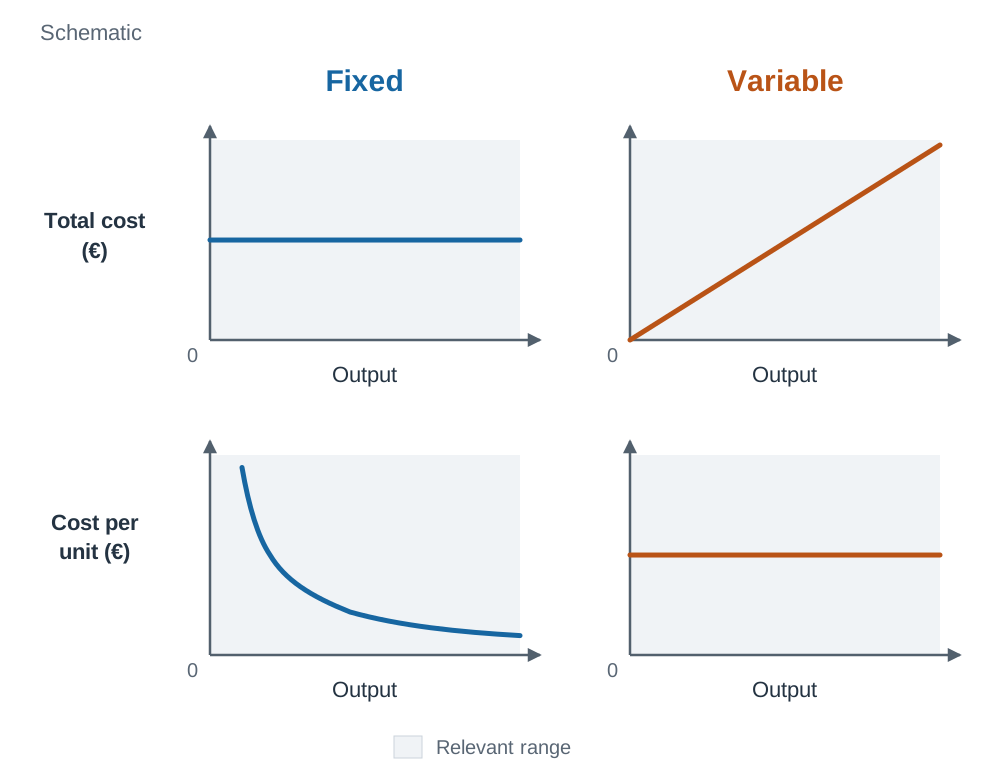
- Fixed vs Variable Costs: Variable costs change in total in direct proportion to output, but stay constant per unit (such as direct materials and piece-rate wages). On a graph of total cost against output, variable cost is a straight line rising from the origin. Fixed costs remain constant in total within a relevant range of output, regardless of production volume (such as factory rent and insurance). Because the total is fixed, the fixed cost per unit falls as output rises. On a graph, fixed cost is a horizontal line.
For example, if factory rent is €60,000 a year, at 10,000 units the rent is €6 per unit, while at 20,000 units it is €3 per unit, but the total remains €60,000. Conversely, direct materials at €4 per unit total €40,000 at 10,000 units and €80,000 at 20,000 units, staying €4 per unit.
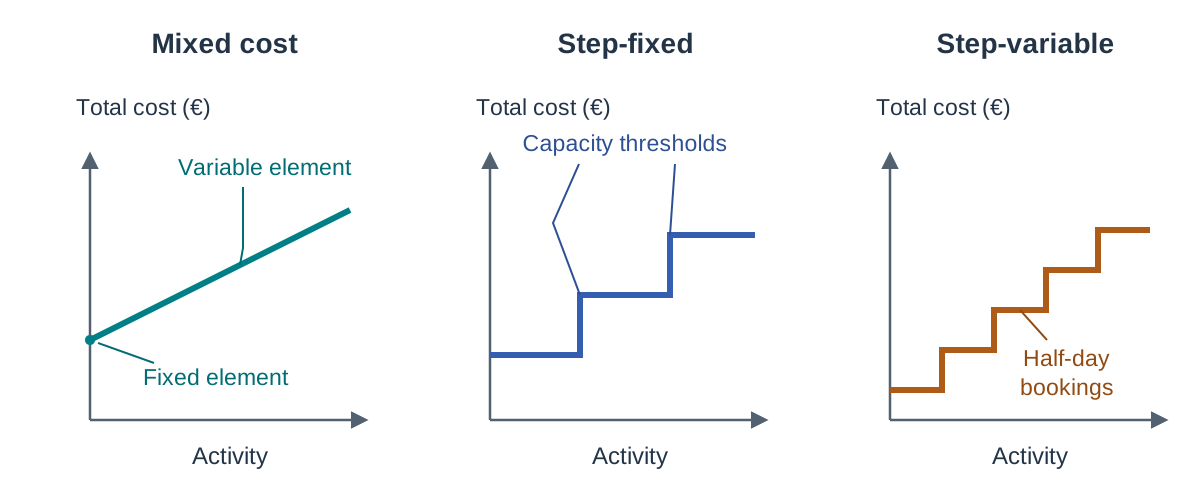
- Mixed Costs: Contain both a fixed standing charge and a variable usage charge. On a graph, mixed cost is a rising line starting above zero on the vertical axis. We separate the elements using the high-low method:
For example, if factory overheads are €420,000 at 100,000 units and €120,000 at 25,000 units:
Always check at the low point: €120,000 − (25,000 × €4) = €20,000.
- Step-Fixed and Step-Variable Costs: Step-fixed costs stay constant within a given capacity band, but jump abruptly to a higher fixed amount once that threshold is crossed (for example, hiring a second supervisor at €40,000 once output exceeds 1,000 units). On a graph, step-fixed costs appear as flat horizontal steps. Step-variable costs rise in discrete increments rather than on a continuous per-unit line (such as booking temporary workers in half-day blocks).
- Product Costs vs Period Costs: Product costs attach to physical units produced and are included in stock valuation under absorption costing (in line with the matching concept and IAS 2). If goods remain unsold at year end, their product cost stays in closing stock on the Balance Sheet. Period costs are not tied to stock valuation; they are written off in full as expenses in the Profit and Loss Account in the period incurred.
- Controllable vs Uncontrollable Costs: Controllable costs can be influenced or regulated by a specific departmental manager (such as raw material requisition quantities or departmental overtime). Uncontrollable costs lie outside a manager's direct authority, such as local authority commercial rates. Whether a cost is controllable depends on the level of management: commercial rates are uncontrollable for a production supervisor, but the decision on factory location is controllable at board level.
The Four Stages of Absorption Costing
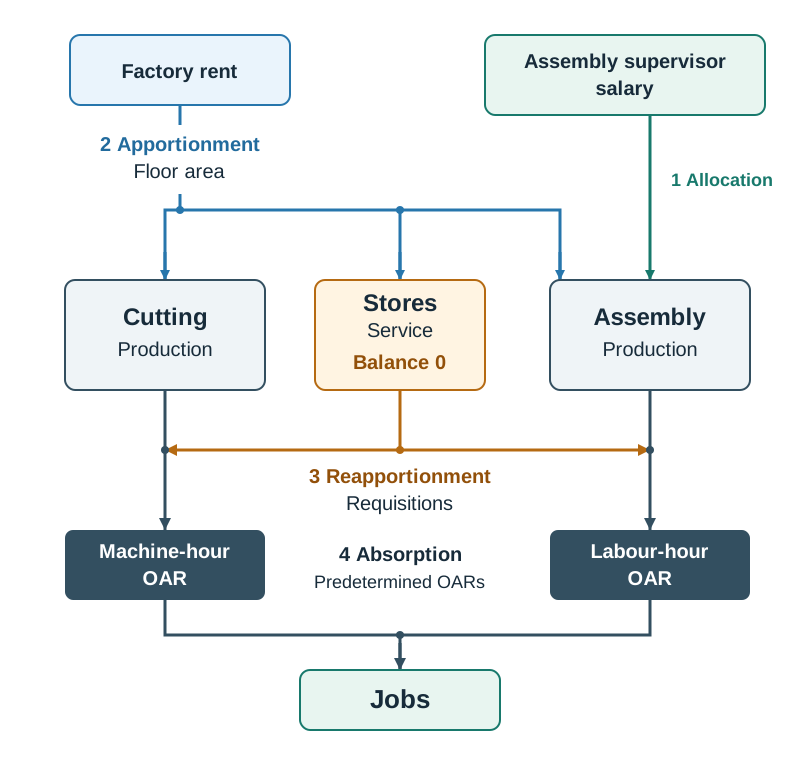
Absorption costing ensures that every manufactured unit absorbs its direct prime costs plus a fair share of factory overheads. It proceeds through four stages:
- Allocation: Charging whole overhead cost items directly and specifically to the department or cost centre that incurred them (for example, the salary of a supervisor who works only in Assembly, or lubricants and cleaning materials used only in the Cutting Department).
- Apportionment: Sharing general factory overheads that benefit several departments between them on a fair basis:
- Factory rent, rates, heating, and light: Apportioned by floor area (sq. metres).
- Machinery depreciation and equipment insurance: Apportioned by machinery value or book value.
- Canteen and personnel costs: Apportioned by number of employees in each department.
- Reapportionment: Service departments (such as stores or maintenance) support production but make no saleable units themselves. Because overheads can only be recovered through final product sales, accumulated service department costs must be redistributed to active production departments based on service usage (such as stores requisitions or maintenance hours).
- Absorption: Applying accumulated production overheads to individual jobs using a predetermined Overhead Absorption Rate (OAR).
Predetermined Overhead Absorption Rates
An Overhead Absorption Rate is calculated at the start of a financial year using budgeted figures:
Why Budgeted Rates Are Used
Actual overhead expenses are not known until final invoices arrive at the end of the year. A business cannot wait until the year end to quote prices to customers or tender for contracts; it needs reliable cost estimates immediately.
Selecting the Absorption Base
- In a machine-intensive department: use machine hours (Rate = Budgeted Overheads ÷ Budgeted Machine Hours).
- In a labour-intensive department: use labour hours (Rate = Budgeted Overheads ÷ Budgeted Labour Hours).
- Where a department produces a single, uniform product: use units of output (Rate = Budgeted Overheads ÷ Budgeted Output Units).
Under-Absorption and Over-Absorption
During the year, overhead is charged to jobs as work is completed:
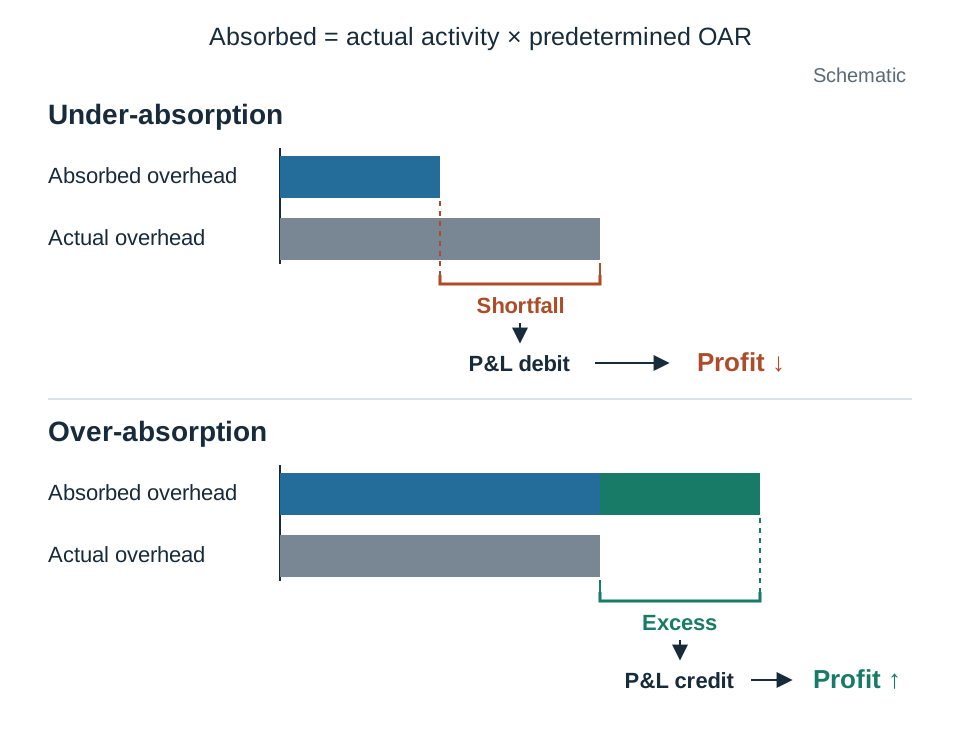
At year end, absorbed overhead is compared with actual overhead incurred:
- Under-absorption: Absorbed Overhead < Actual Overhead Incurred. Too little overhead was charged to production during the period. This shortfall is charged to the Profit and Loss Account (added to cost of sales), which reduces profit. It arises if actual overhead spending exceeded budget (for example, unexpected fuel or insurance increases), or if actual production activity fell short of budget (such as a machine breakdown cutting hours worked).
- Over-absorption: Absorbed Overhead > Actual Overhead Incurred. More overhead was charged to products than was actually spent. The over-absorbed amount is credited to the Profit and Loss Account at the year end, which increases profit. It arises if actual expenditure was lower than budgeted, or if activity levels exceeded expectations.
Compiling the Job Cost Sheet and Selling Price
Cost sheets follow a cumulative structure in examination questions:
- Direct Materials + Direct Labour + Direct Expenses = Prime Cost
- Prime Cost + Absorbed Factory Overheads = Factory Cost (Cost of Production)
- Factory Cost + Non-Manufacturing Overheads (Admin & Selling) = Total Cost
- Total Cost + Profit = Selling Price
Mark-up on Cost vs Margin on Sales
- Mark-up on cost: Profit is calculated as a set percentage of Total Cost:
- Margin on sales: Profit is expressed as a percentage of the final Selling Price. If the profit margin is 20%, Total Cost represents 80% of selling price:
Absorption Costing vs Marginal Costing
Marginal costing charges only variable production costs to each unit. Fixed production overheads are treated as period costs and written off in full in the Profit and Loss Account in the year they are incurred.
Absorption costing charges each unit with all production costs, both variable and fixed.
The key difference is the treatment of fixed production overheads. Under absorption costing, part of the fixed overhead is carried forward in the value of closing stock on the Balance Sheet. Under marginal costing, closing stock is valued at variable production cost only. When stock levels change, the two methods yield different profit figures.
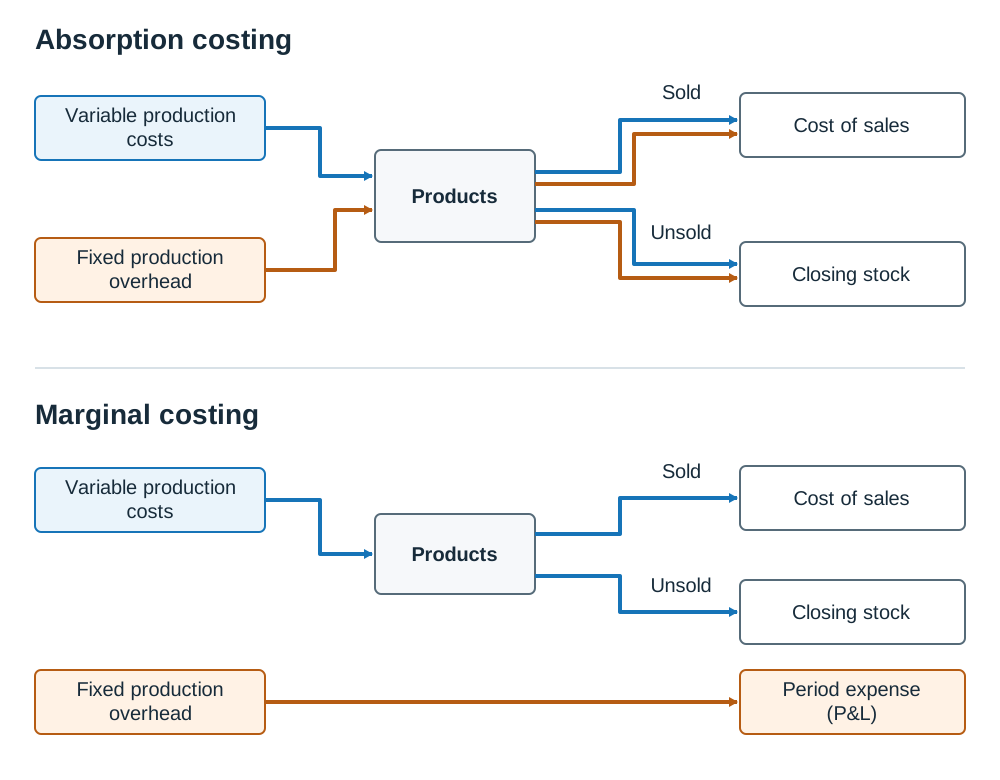
For financial accounting, absorption costing is used. IAS 2 requires inventory valuation to include a share of fixed production overheads, matching costs with the revenues they help generate (the matching concept).
Benefits of Absorption Costing
- All production costs, fixed and variable, are recovered in the selling price.
- Closing stock is valued in line with accounting standards (IAS 2).
- It gives the full cost of each product, which assists in pricing decisions.
- There is no need to separate costs into fixed and variable elements.
- It matches costs with revenues for the period.
Key terms
- Product Costing
- The management accounting technique of determining the total expenditure incurred to manufacture an item or complete an individual job.
- Prime Cost
- The total direct cost of production, comprising direct raw materials, direct factory labour, and direct production expenses.
- Allocation
- Charging a whole overhead cost item directly and specifically to a single cost centre where that cost originated.
- Apportionment
- Sharing an overhead that benefits several departments between them on a fair basis, such as floor area for rent or machinery value for depreciation.
- Reapportionment
- The transfer of accumulated overheads from service departments to production departments so they can be absorbed into final product costs.
- Overhead Absorption Rate (OAR)
- A predetermined hourly or per-unit rate derived from budgeted figures used to apply factory overheads to jobs as work progresses.
- Under-Absorption
- A situation where overhead charged into production is less than actual overheads incurred, requiring a year-end deduction from profit.
- Over-Absorption
- A situation where overhead charged into production exceeds actual overheads incurred, requiring a year-end addition to profit.
- Fixed Cost
- An expense that remains unchanged in total within a relevant range of output regardless of production volume, meaning its cost per unit falls as output rises.
- Variable Cost
- An expense that changes in total in direct proportion to the volume of output produced, while remaining constant per unit.
- Mixed Cost
- An expense containing both a fixed standing charge and a variable usage charge, separated using the high-low method.
- Step-Fixed Cost
- An expense that stays constant within a specific range of output, but jumps abruptly to a higher fixed tier when capacity is exceeded.
- Step-Variable Cost
- A cost that increases in discrete increments as activity increases rather than changing continuously.
- Controllable Cost
- An expense over which a specific departmental manager has direct authority and decision-making power.
- Uncontrollable Cost
- An expense that lies beyond the direct influence or decision-making power of a specific departmental manager.
- Absorption Costing
- A costing method that charges products with all manufacturing costs, both variable costs and a fair share of fixed production overheads.
- Marginal Costing
- A costing method that charges only variable production costs to products, treating fixed production overheads as period costs written off immediately.
Check yourself
What three cost components combine to form Prime Cost?
Direct materials, direct labour, and direct expenses.
Which apportionment bases should be used for (a) factory heating, (b) machinery insurance, and (c) canteen costs?
(a) Floor area (sq. metres), (b) machinery value or book value, (c) number of employees.
Why must service department overheads be reapportioned to production departments?
Service departments (such as stores and maintenance) support the factory but do not produce saleable items. Because overheads can only be recovered through the sale of finished products, service department costs must be transferred to production departments, which absorb them into product costs.
If budgeted overheads are €90,000 for 15,000 machine hours, and actual results show 14,200 machine hours worked with €88,000 actual overhead incurred, calculate the under- or over-absorption.
Predetermined OAR = €90,000 ÷ 15,000 = €6.00 per machine hour. Absorbed overhead = 14,200 hours × €6.00 = €85,200. Under-absorption = €88,000 actual − €85,200 absorbed = €2,800 under-absorbed.
A custom order has a Total Cost of €1,200. Calculate the selling price if the company requires a 25% profit margin on sales.
Selling Price = €1,200 ÷ (1 − 0.25) = €1,200 ÷ 0.75 = €1,600.