

A budget is a quantified financial plan prepared for a specific future period, setting clear operational targets for income, expenditure, and resource allocation. In Leaving Certificate Higher Level Accounting, budgeting requires preparing interconnected functional budgets, cash budgets, the master budget, and flexible budgets using marginal costing principles. Budgetary control enables management to compare actual results with the flexed budget, explain variances and take corrective action.
Principles, Objectives, and the Principal Budget Factor
A budget acts as a financial roadmap for a business, setting clear targets for income and expenditure while coordinating operations across every department. Preparing regular budgets serves four essential management functions:
- Planning: Forces management to look ahead, anticipate trading conditions, establish stock targets, and plan capital requirements rather than reacting to short-term crises.
- Coordination: Aligns individual departments (sales, production, purchasing, and finance) towards shared business goals, preventing departmental conflict.
- Communication and Motivation: Clarifies expectations for departmental supervisors. Involving line managers in budget formulation (participative budgeting) is vital because line staff possess direct operational knowledge; their input creates realistic targets and secures employee commitment.
- Control and Performance Evaluation: Establishes reliable benchmarks against which actual results are compared through variance analysis.
The Principal Budget Factor
The principal budget factor (or limiting factor) is the factor that limits how much the business can do in the budget period, usually sales demand. It is the starting point for preparing all other budgets, as a firm cannot justify manufacturing more goods than customers will purchase.
Internal constraints can also become the principal budget factor:
- Availability of raw materials
- Supply of skilled direct labour hours
- Factory machine capacity or floor space
- Capital or cash availability
All subsequent functional budgets are constructed around this constraint. For example, if machine capacity restricts output to 12,000 units, the production budget cannot be set at 15,000 units regardless of market demand.
The Functional Budget Sequence
When customer sales demand is the limiting factor, operational budgets must be prepared in a strict logical sequence, where each statement provides the foundation for the next:
- Sales Budget: Units and revenue
- Production Budget: Finished units to manufacture
- Raw Materials Usage Budget: Physical material quantities needed
- Raw Materials Purchases Budget: Quantities and expenditure to buy
- Direct Labour Budget: Labour hours and wage costs
- Factory Overhead Budget: Indirect manufacturing costs
- Closing Stock Budget: Valuation of finished goods and raw materials
- Non-Factory Expense Budget: Administration and selling expenses
- Master Budget & Cash Budget: Budgeted accounts and monthly liquidity
1. Sales Budget
The sales budget forecasts volume and value:
To forecast sales accurately, management evaluates market research, opinions of sales representatives, economic trends, past sales patterns, selling price adjustments, and competitor activity.
2. Production Budget
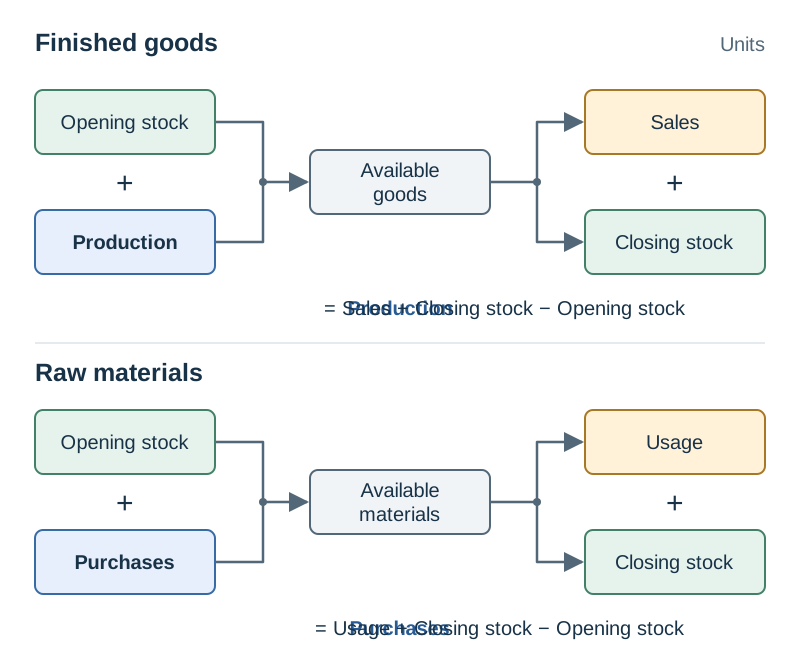
The production budget determines the number of finished goods units that must be manufactured to satisfy sales demand while leaving the planned closing stock:
Closing stock is added because these finished units must be made before the period ends. Opening stock is subtracted because these units are already in the warehouse.
3. Raw Materials Usage and Purchases Budgets
- Material Usage Budget: Multiplies budgeted production units by the standard raw material required per finished product (kg, litres, or metres).
- Material Purchases Budget: Adjusts usage for raw material stock policies and converts the final requirement into euro:
4. Direct Labour and Factory Overhead Budgets
- Direct Labour Budget: Multiplies budgeted production units by standard direct labour hours per unit, then multiplies total hours by the hourly wage rate.
- Factory Overhead Budget: Estimates the indirect factory costs, such as factory rent, supervision, power, and maintenance, splitting each into its fixed and variable parts where needed.
5. Closing Stock Budget
The closing stock budget values the stock held at the end of the budget period:
- Raw materials are valued at purchase price.
- Finished goods are valued at production cost per unit:
Selling price is never used to value closing stock.
The Cash Budget and Deficit Management
The cash budget shows the cash the business expects to receive and pay out each month, highlighting projected cash surpluses or deficits.
Structure and Layout
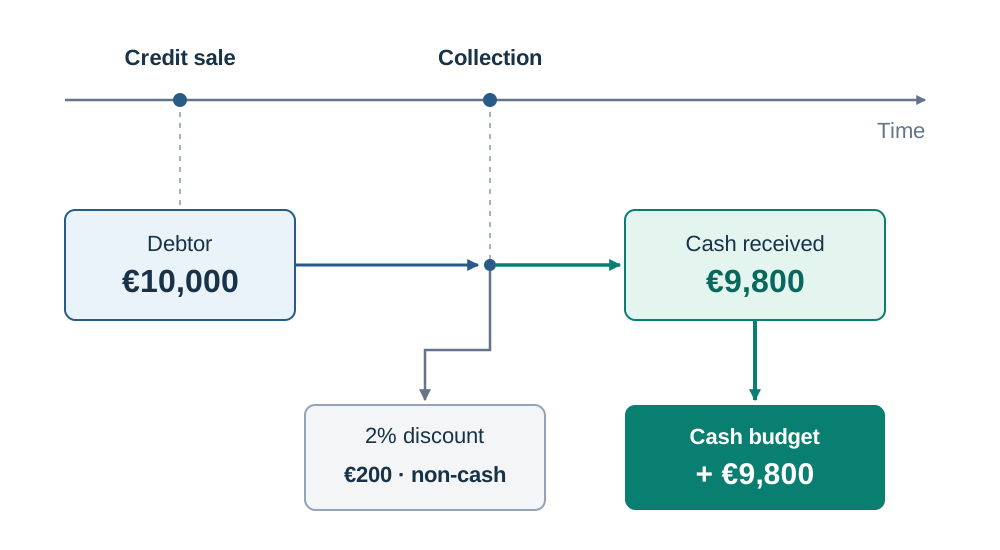
A cash budget records only cash transactions in the exact month money changes hands. Non-cash accounting entries (such as depreciation and bad debt provisions) are completely excluded.
Discount allowed is not a payment. Instead, receipts from debtors are shown net of discount (for example, €10,000 owed with a 2% discount gives a receipt of €9,800).
Standard monthly cash budget layout:
| Month 1 (€) | Month 2 (€) | Month 3 (€) | |
|---|---|---|---|
| Receipts | |||
| Cash sales | X | X | X |
| Receipts from debtors | X | X | X |
| Total receipts | A | A | A |
| Payments | |||
| Payments to creditors | X | X | X |
| Direct wages | X | X | X |
| Overheads (excluding depreciation) | X | X | X |
| Capital expenditure | X | X | X |
| Total payments | B | B | B |
| Net cash flow (A − B) | C | C | C |
| Opening cash | D | E | F |
| Closing cash (Net cash flow + Opening cash) | E | F | G |
The closing cash balance of one month becomes the opening cash balance of the following month.
Managing Projected Cash Deficits
When a cash budget reveals a looming deficit, management should take practical steps:
- Arrange a bank overdraft facility in advance with the bank.
- Accelerate cash inflows from debtors by offering cash discounts for prompt payment or tightening credit periods.
- Negotiate extended credit terms with suppliers, keeping in mind that delaying payments risks losing prompt payment discounts and can damage supplier goodwill.
- Defer major capital expenditure or lease equipment rather than making outright cash purchases.
- Review and trim discretionary overheads, such as non-essential advertising or administrative outgoings.
The Master Budget and Non-Factory Expenses
The Master Budget
The master budget is the overall plan for the whole business. It summarises all the functional budgets into a budgeted profit and loss account, a budgeted balance sheet, and a cash budget:
- Budgeted Manufacturing Account: Collates raw materials consumed, direct labour, and factory overheads to calculate total cost of manufacture.
- Budgeted Trading, Profit and Loss Account: Summarises projected sales revenue, cost of sales, and administrative and selling expenses to forecast net operating profit.
- Budgeted Balance Sheet: Projects the financial position of assets, liabilities, and capital at the end of the budget period.
- Cash Budget: Month-by-month expected cash receipts, payments, and closing bank balance. Some master budget packages also include a budgeted cash flow statement.
Non-Factory Expense Budget
The non-factory expense budget estimates the costs of running the business outside the factory gates:
- Administration expenses: Office salaries, directors' fees, and office rent.
- Selling and distribution expenses: Sales commissions, advertising campaigns, and delivery van costs.
Some of these costs vary with sales (such as sales commission and delivery), while others are fixed (such as office rent). These totals appear below gross profit in the budgeted profit and loss account; they are never included in the manufacturing account or in the unit production cost.
Flexible Budgeting, Cost Behaviour, and Variances (HL)
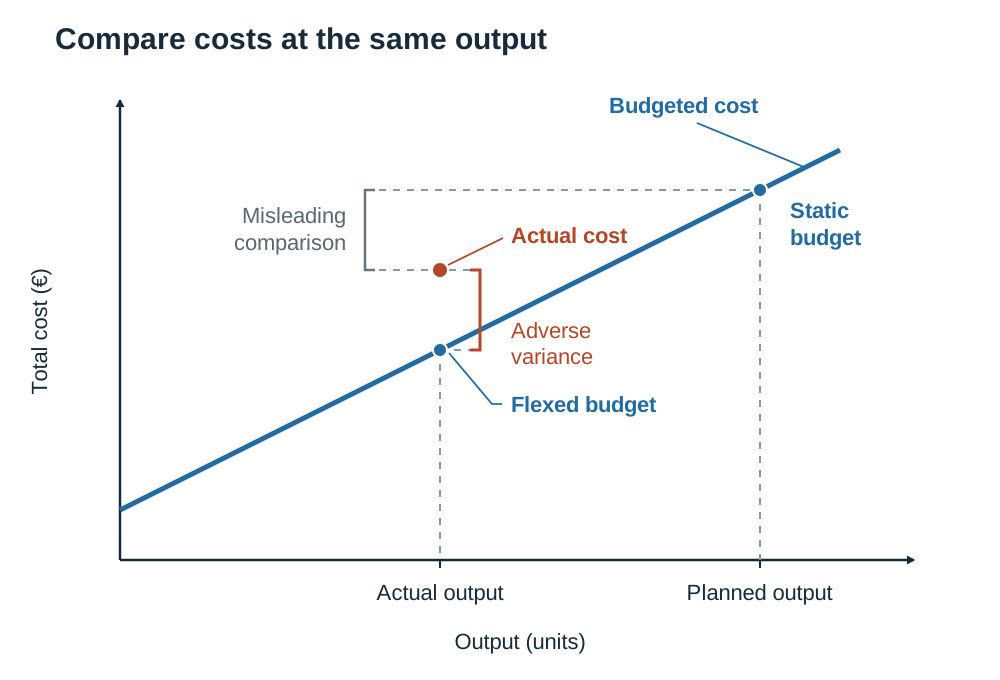
A static budget plans for a single activity level. If actual output differs, comparing actual costs directly against a static budget is misleading because higher production inevitably causes total variable costs to rise.
A flexible budget restates budgeted costs to match the actual level of activity achieved, allowing a fair, like-for-like performance comparison.
Cost Behaviour Patterns
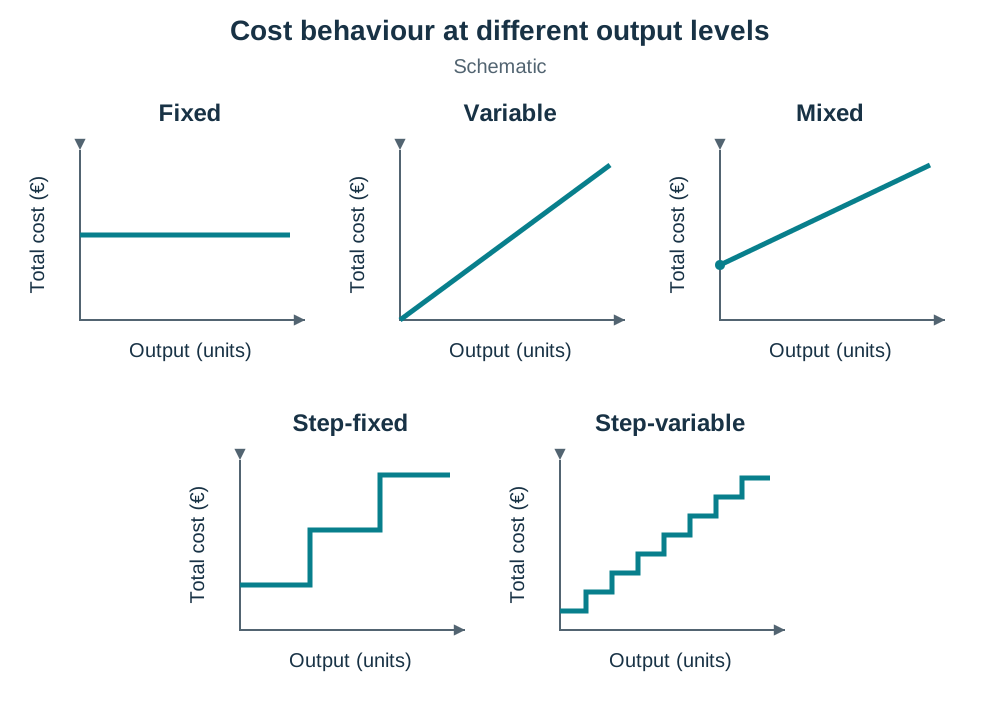
- Fixed Costs: Remain unchanged in total within a relevant range of activity (for example, factory rent).
- Variable Costs: Change in total in direct proportion to output, but stay the same per unit (for example, direct materials at €5 per unit).
- Semi-Variable (Mixed) Costs: Contain both a fixed base charge and a variable rate per unit (for example, electricity or maintenance).
- Step-Fixed Costs: Remain constant over a specific activity range, then jump by a lump sum once an activity threshold is crossed (for example, hiring a second supervisor when output exceeds 10,000 units).
- Step-Variable Costs: Rise in frequent small steps as output increases, behaving almost like a variable cost over a wide range (for example, casual packing staff hired for each extra batch of 500 units, or packaging bought in boxes of 100).
The High-Low Method for Mixed Costs
To isolate the fixed and variable elements of a semi-variable cost from two activity levels:
Flexible Budget Presentation
Flexible budgets are normally set out in marginal costing format, and the question will usually ask for this:
| Item | Amount (€) |
|---|---|
| Sales Revenue | X |
| Less: Total Variable Costs | (X) |
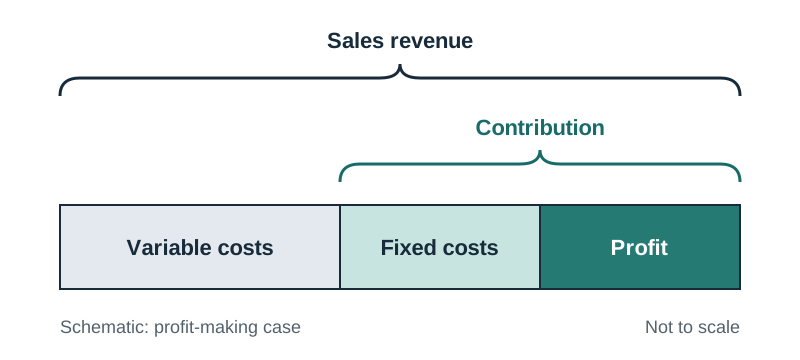
| Contribution | X |
| Less: Total Fixed Costs | (X) |
| Budgeted Net Profit | X |
Contribution (Sales Revenue minus Variable Costs) represents the surplus generated to cover fixed costs. Once fixed costs are fully recovered, every additional euro of contribution adds directly to net profit.
Comparing Actual Results with the Flexible Budget
To evaluate performance, flex the budget to the output actually achieved and compare it line by line with actual results:
| Cost Item | Flexed Budget (€) | Actual (€) | Variance (€) |
|---|---|---|---|
| Direct materials | 80,000 | 84,500 | 4,500 A |
| Direct labour | 160,000 | 154,000 | 6,000 F |
| Fixed overheads | 92,000 | 92,000 | nil |
A favourable variance (F) occurs when actual costs are lower than budget or revenue is higher. An adverse variance (A) occurs when actual costs exceed budget or revenue falls short. A variance on direct materials can come from price (the material cost more or less per kg than planned, for example because of a bulk discount) or from usage (more or fewer kg were used than planned). A variance on direct labour can come from the wage rate or from efficiency (fewer hours were needed than budgeted, for example because staff worked more productively). In the table above, the €6,000 F on labour could arise because fewer hours were needed than budgeted. Comparing actual costs against a static budget instead of the flexed budget can make an overspend look like a saving.
Controllable versus Uncontrollable Costs
- Controllable Costs: Costs that a specific departmental manager has the direct authority to influence and regulate (such as raw material scrap rates or direct labour overtime). Managers can be held accountable for variances in these costs.
- Uncontrollable Costs: Costs that a departmental manager cannot influence because they are set externally or by central management (such as local authority commercial rates). A manager cannot be held responsible for variances on uncontrollable costs.
Sensitivity Analysis
Sensitivity analysis is a 'what-if' technique that measures how budgeted profit changes if key variables alter. For example, in the Boyne Ltd flexible budget below (sales €575,000, profit €115,000), if the selling price falls by 5% while volume and costs stay the same, sales revenue falls by 5% × €575,000 = €28,750, so budgeted profit falls from €115,000 to €86,250.
Key terms
- Budget
- A formal financial and quantitative plan prepared for an agreed future period, outlining projected revenues, costs, and operational targets.
- Budgetary Control
- The ongoing management process of comparing actual performance against budget targets, analysing variances, and taking corrective action.
- Principal Budget Factor
- The factor that limits how much the business can do in the budget period, usually sales demand but sometimes labour hours, materials or machine capacity. It is the starting point for preparing all other budgets.
- Master Budget
- The consolidated financial plan summarising all subsidiary functional budgets into a budgeted manufacturing account, trading and profit and loss account, balance sheet, and cash budget.
- Flexible Budget
- A budget designed to adjust budgeted costs to match the actual volume of activity achieved, ensuring a valid, like-for-like performance comparison.
- Step-Fixed Cost
- A cost that remains constant up to a specific activity threshold and then increases by a lump-sum fixed amount, such as hiring a second factory supervisor.
- Step-Variable Cost
- A cost that increases in frequent, small discrete steps as output rises, such as packaging purchased in boxes of 100 or casual labour hired per 500 units.
- High-Low Method
- A mathematical technique that isolates the fixed and variable elements of a semi-variable cost using the difference between the highest and lowest activity levels.
- Contribution
- Sales revenue minus total variable costs, representing the surplus generated to cover fixed costs and deliver profit.
- Variance
- The monetary difference between an actual financial result and the budgeted or standard cost or revenue for a specific period.
- Controllable Cost
- An expenditure that a designated departmental manager has the direct operational power to authorise, regulate, and keep within budget.
- Uncontrollable Cost
- An expenditure outside the direct authority or control of a local department head, such as local authority commercial rates.
- Sensitivity Analysis
- A 'what-if' technique that measures how changes in underlying variables (such as selling price, sales volume, or material costs) affect budgeted profit.
Check yourself
What is the principal budget factor, and why must management identify it first?
The principal budget factor is the overriding constraint (such as customer sales demand, machine capacity, or skilled labour availability) that limits activity. It must be identified first because every other functional budget depends on this restriction.
A business plans to sell 15,000 units. Opening stock of finished goods is 1,200 units, and the firm wants to reduce closing stock by 25% from opening levels. How many units should be produced?
14,700 units. Closing stock is 1,200 × 0.75 = 900 units. Production = 15,000 (Sales) + 900 (Closing Stock) - 1,200 (Opening Stock) = 14,700 units.
Sales for March are €20,000. 40% are cash sales, and the remaining 60% are collected in April subject to a 5% prompt payment discount. What is the cash receipt in April?
€11,400. Credit sales are 60% × €20,000 = €12,000. Applying the 5% discount gives €12,000 × 0.95 = €11,400 received in April.
Distinguish between a step-fixed cost and a step-variable cost.
A step-fixed cost jumps by a large lump sum at broad capacity thresholds (such as hiring a new supervisor or leasing an extra warehouse). A step-variable cost rises in frequent, small discrete steps as output increases (such as packaging bought in boxes of 100 or casual packing labour per 500 units).
Why is a departmental manager not held responsible for variances in uncontrollable costs?
Because the manager has no authority or power to influence or regulate uncontrollable costs (such as central local authority rates or head-office insurance premiums).