

Final accounts show the trading performance, operational profitability, and financial position of an enterprise at the close of its financial year. In Leaving Certificate Higher Level Accounting, preparing final accounts requires drafting a Trading, Profit and Loss Account and a Balance Sheet in vertical format, incorporating complex year-end adjustments such as stock valuations, asset disposals, revaluations of land and buildings, bad debt provisions, expense and income accruals, and suspense corrections.
Structure of the Trading, Profit and Loss Account
The Trading, Profit and Loss Account measures trading performance over an accounting period, typically twelve months. It calculates gross profit, operating profit, and net profit in a clear sequence.
Line-by-Line Presentation Order
- Gross Profit
- Add Operating Gains (such as discount received, bad debts recovered, or reductions in the provision for bad debts)
- Less Operating Expenses (classified into Administration Expenses and Selling and Distribution Expenses)
- = Operating Profit
- Add Investment Income
- Less Finance Costs (mortgage or debenture interest)
- = Net Profit for the year
- For a limited company: less taxation, less dividends paid, add opening profit and loss balance = closing profit and loss retained balance carried to the balance sheet.
The Trading Account
The trading account calculates Gross Profit by deducting Cost of Sales from net sales revenue:
- Net sales represents gross sales less sales returns (returns inwards).
- Purchases represents gross purchases less purchases returns (returns outwards), minus any goods taken by the owner for personal use.
- Drawings of stock: goods taken by the owner for private use are deducted from purchases at cost price and added to drawings in the balance sheet. No profit is recorded on goods taken for own use.
- Carriage inwards is the transport cost incurred to bring trading goods into the business. It is added directly to purchases in the trading account. In contrast, carriage outwards is the delivery expense of sending goods to customers, which belongs under selling and distribution expenses.
Classifying Operating Expenses
Present operating expenses under two headings, Administration Expenses and Selling and Distribution Expenses, as in published solutions. Marks are mainly for correct figures, but a clear, classified layout is expected at Higher Level.
- Administration Expenses: general costs of managing the business, such as office salaries, rent and rates, insurance, auditor fees, directors' remuneration, patent write-offs, and depreciation of office buildings and equipment.
- Selling and Distribution Expenses: costs incurred in marketing, warehousing, selling, and delivering products, including advertising, sales commission, carriage outwards, bad debts written off, increases in the bad debt provision, and depreciation of delivery vans.
Bad Debts Recovered
A bad debt recovered occurs when cash is received from a debtor whose account was written off as irrecoverable in a previous year. Because last year's accounts already bore the loss, this receipt is income for the current year. Show it as a gain in the profit and loss account.
In exam questions, check whether the cash was lodged. If the cash was received and lodged but wrongly credited to the customer's account, remove the credit from Debtors and record the credit as a gain under bad debts recovered in the profit and loss account.
The Vertical Balance Sheet and Capital Structures
The Balance Sheet sets out the financial position of a business on the final day of the trading year in vertical format, showing that Total Net Assets equals Total Capital Employed.
Asset Groupings and the Order of Permanence
Assets appear in order of permanence, moving from the most permanent resources down to the most liquid cash balances:
- Intangible Assets: assets with no physical existence, such as patents and goodwill. Patents are amortised (written off) over their useful life. For example, if patents are written off over 6 years starting in 2022, a 2024 trial balance balance of €62,400 represents 4 remaining years (2024, 2025, 2026, 2027). The annual write-off is €62,400 ÷ 4 = €15,600, charged under Administration Expenses. The remaining book value of €46,800 is shown under Intangible Assets.
- Tangible Assets: premises, plant, and vehicles, set out across three columns: Cost, Accumulated Depreciation, and Net Book Value.
- Financial Assets: long-term investments held to generate income, stated at original cost.
- Current Assets: items held for conversion into cash within twelve months, listed in increasing order of liquidity: Closing Stock, Debtors (less bad debt provision), Prepayments, Accrued Income, and Bank.
Working Capital and Creditors
- Creditors: amounts falling due within one year: short-term liabilities payable within twelve months, including Trade Creditors, Bank Overdraft, Accrued Expenses, Accrued Interest, and statutory tax liabilities.
- Net Current Assets (Working Capital): Current Assets minus Creditors falling due within one year.
- Creditors: amounts falling due after more than one year: long-term borrowing, such as Debentures or fixed Mortgages.
Statutory Tax Deductions in the Balance Sheet
VAT and payroll deductions (PAYE, PRSI, and USC) are balance sheet items and never appear as operating expenses in the profit and loss account:
- A credit balance on the VAT account means the business owes money to Revenue. Show it as a current liability under Creditors: amounts falling due within one year. A debit balance represents an amount refundable by Revenue and appears under Current Assets.
- PAYE, PRSI, and USC deducted from employee wages but not yet remitted to the Collector General are current liabilities under Creditors: amounts falling due within one year.
Sole Trader Capital vs. Limited Company Capital
The equity section differs depending on the legal ownership structure:
Sole Trader Capital Presentation:
- Capital at 01/01
- Add Net Profit for the year
- Less Drawings (cash and goods taken)
- = Capital at 31/12
- A Revaluation Reserve is shown separately if premises have been revalued upwards; otherwise, operating profits merge directly into the owner's capital account.
Limited Company Capital and Reserves:
- Authorised Share Capital: state the nominal ordinary and preference share capital authorised by the company's constitution for information. Do not add this figure into the balance sheet total.
- Issued Share Capital: enter the ordinary and preference shares actually issued and paid up. Only this issued figure is extended into the capital total.
- Reserves: list the Share Premium, Revaluation Reserve, and retained Profit and Loss balance.
Stock Valuation, Mark-up and Margin, and Sale or Return
Stock adjustments directly alter both the Cost of Sales figure in the trading account and the Current Assets total in the balance sheet.
Valuation at Lower of Cost or Net Realisable Value
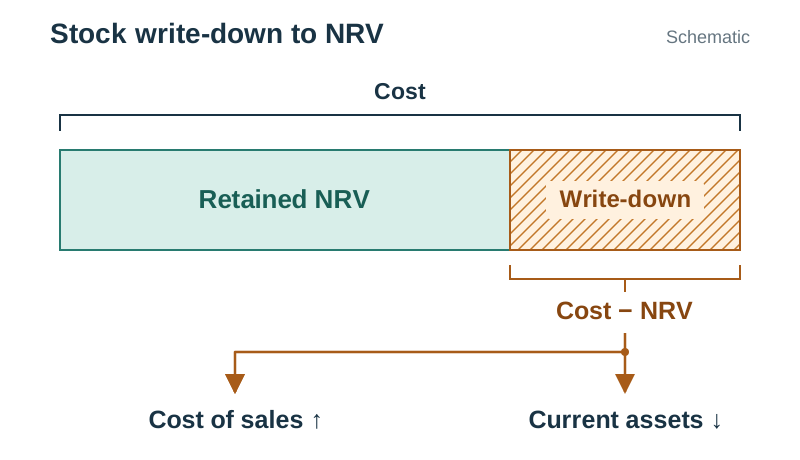
In accordance with the prudence concept, closing stock must be valued at the lower of cost and Net Realisable Value (NRV):
When stock items are damaged, calculate their NRV. If the NRV is below cost, reduce the closing stock figure by the drop in value (Cost − NRV). Do not deduct the entire NRV from closing inventory.
Mark-up and Margin Principles
Exam adjustments regularly give profitability percentages to calculate unknown costs or selling prices:
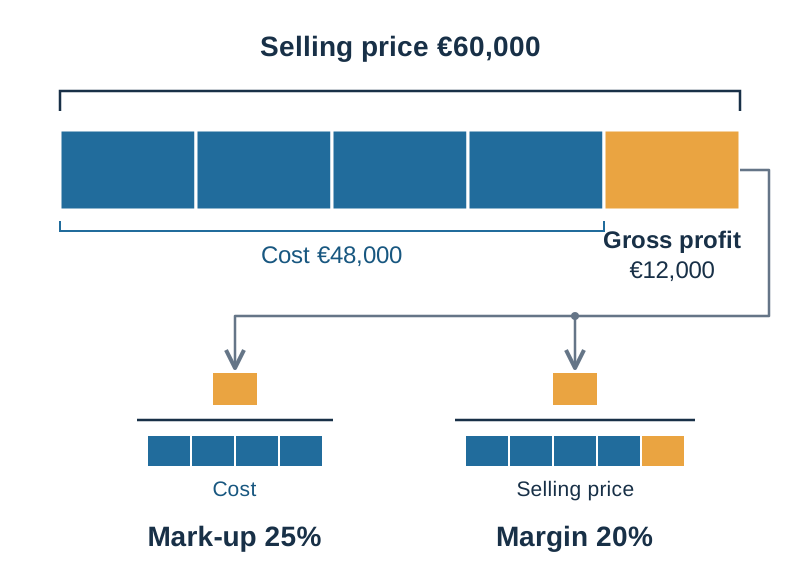
A mark-up of 1/n on cost equals a margin of 1/(n + 1) on selling price. For example, a 25% mark-up (1/4) corresponds to a 20% margin (1/5). If sales are €60,000 at a 20% margin, gross profit is €12,000 (€60,000 × 20%) and cost of sales is €48,000 (€60,000 − €12,000).
Goods on 'Sale or Return'
When goods are supplied to a customer on approval, no sale has taken place until the customer accepts the goods or the trial period expires. If an invoice was posted as a credit sale, two separate entries are needed:
- Reverse the sale: deduct the selling price from Sales in the Trading Account, and deduct the selling price from Debtors under Current Assets.
- Reinstate the inventory: add the original cost price of the unsold goods back into Closing Stock in the Trading Account and into Closing Stock under Current Assets.
Fixed Asset Adjustments: Depreciation, Disposals, and Revaluation
Tangible fixed assets require systematic accounting for usage, asset replacements, and changes in market value.
Methods of Depreciation
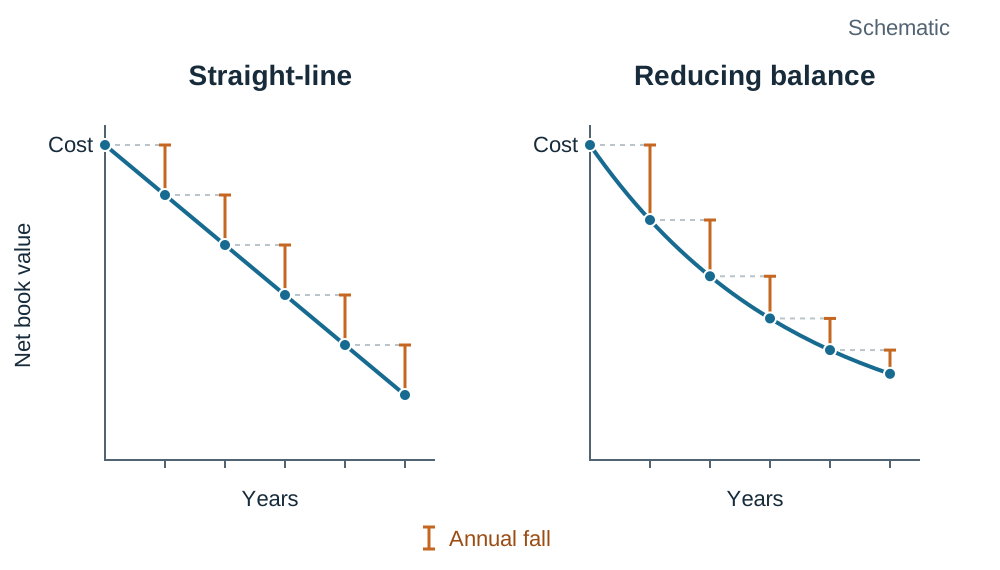
- Straight-Line Method: charges an equal annual expense based on original cost:
- Reducing Balance (Diminishing Value) Method: calculates the annual charge on the net book value at the start of the period:
Disposals and Trade-Ins
When an asset is traded in or sold during the financial year:
- Charge depreciation on the asset disposed of for the exact months it was used up to the disposal date.
- Compute the profit or loss on disposal:
A loss is charged as an operating expense (usually under Administration or Selling and Distribution depending on the asset); a profit is credited as an operating gain.
- Update the asset cost account by removing the original cost of the old asset and adding the full purchase cost of the new asset.
- Remove the accumulated depreciation of the old asset up to the date of disposal.
Disposal Worked Mini-Example
A delivery van costing €40,000 was bought on 01/01/2023 and depreciated at 20% of cost per annum. On 30/06/2026, it was traded in for €10,000 against a new van costing €56,000, with the net balance of €46,000 paid by cheque.
- Ownership period: 3.5 years (2023, 2024, 2025, plus 6 months in 2026).
- Accumulated depreciation to disposal: €40,000 × 20% × 3.5 = €28,000.
- Net book value at disposal: €40,000 − €28,000 = €12,000.
- Loss on disposal: €10,000 trade-in allowance − €12,000 net book value = €2,000 loss (charge to Selling and Distribution Expenses).
- Depreciation on the new van in 2026: €56,000 × 20% × 6/12 = €5,600.
Depreciating and Revaluing Land and Buildings
Land is not depreciated because it does not have a finite economic life. When dealing with premises containing both land and buildings:
- Calculate depreciation on the buildings portion only on its historical cost before revaluation.
- Calculate the revaluation surplus:
- Remove the accumulated depreciation on buildings: it becomes part of the revaluation surplus.
- Show the property at its new revalued figure in the balance sheet with zero accumulated depreciation at the revaluation date. In subsequent years, depreciate buildings based on their revalued figure.
Time Apportionment, Bad Debt Provisions, and Suspense Entries
Accruals and adjustments must be precisely dated to match expenses and income to the correct financial year.
Time Apportionment
Charge interest, investment income, and depreciation only for the months the loan, investment, or asset was active during the financial year.
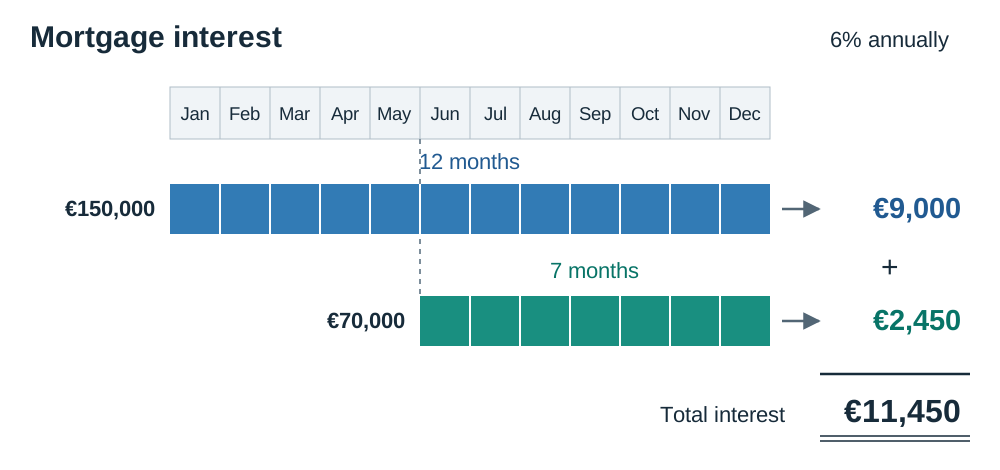
- Interest on loans received during the year: split the liability into its separate tranches. For example, a 6% mortgage of €220,000 that includes €70,000 received on 01/06 requires: €150,000 × 6% × 12/12 = €9,000, plus €70,000 × 6% × 7/12 = €2,450. Total annual interest charge = €11,450. Deduct interest already paid in the trial balance (such as €7,400); the remaining €4,050 is interest accrued, listed under Creditors: amounts falling due within one year.
- Investment income: for 3% investments of €120,000 acquired on 01/06, the annual income is €120,000 × 3% × 7/12 = €2,100. If part has been received, credit the full €2,100 in the profit and loss account (after Operating Profit and before Finance Costs) and enter the unpaid balance as investment income accrued under Current Assets.
Bad Debts and the Bad Debt Provision
Bad debts written off reduce debtors and represent an operating expense. The Bad Debt Provision is an estimated year-end adjustment:
- Calculate adjusted debtors: Trial Balance Debtors − New Bad Debts − Sale or Return Invoices Cancelled.
- Calculate the required closing provision: Adjusted Debtors × Provision Percentage.
- Compare the required closing provision with the opening provision in the trial balance. An increase is charged as an expense under Selling and Distribution; a decrease is credited as a gain in the profit and loss account.
- In the balance sheet under Current Assets, present Debtors at the adjusted figure less the full closing provision.
Correcting Errors via the Suspense Account
A Suspense Account is a temporary ledger account created when the trial balance fails to balance, holding the discrepancy until the underlying bookkeeping errors are discovered.
Mini-Example of an Expense Incorporating Suspense: A trial balance shows General Expenses of €24,000. An investigation reveals that a €1,500 cash payment for new office equipment was posted to the bank account but completely omitted from the equipment account, causing a €1,500 debit discrepancy that was placed into General Expenses.
- Correction: Debit Office Equipment at cost €1,500, Credit Suspense (General Expenses) €1,500.
- Effect on Profit and Loss: General Expenses becomes €24,000 − €1,500 = €22,500.
- Effect on Balance Sheet: Office Equipment cost increases by €1,500.
The Manufacturing Account
A manufacturing enterprise makes finished products from raw materials. It prepares a Manufacturing Account to calculate the production cost of completed goods before compiling its trading account.
Sequence of Costs
- Direct Materials Consumed: Opening Stock of Raw Materials + Purchases of Raw Materials + Carriage Inwards on Raw Materials − Closing Stock of Raw Materials.
- Direct Labour: wages of factory staff directly involved in making the product.
- Direct Expenses: specific costs traceable to production volume, such as patent royalties or equipment hire.
- Factory Overheads: indirect factory costs, including factory supervisor wages, factory power, factory insurance, and depreciation of plant and machinery.
- Sale of scrap: income from selling waste or scrap materials is deducted directly in the manufacturing account, reducing Factory Cost.
- Work-in-Progress (WIP): unfinished goods remaining on the factory floor:
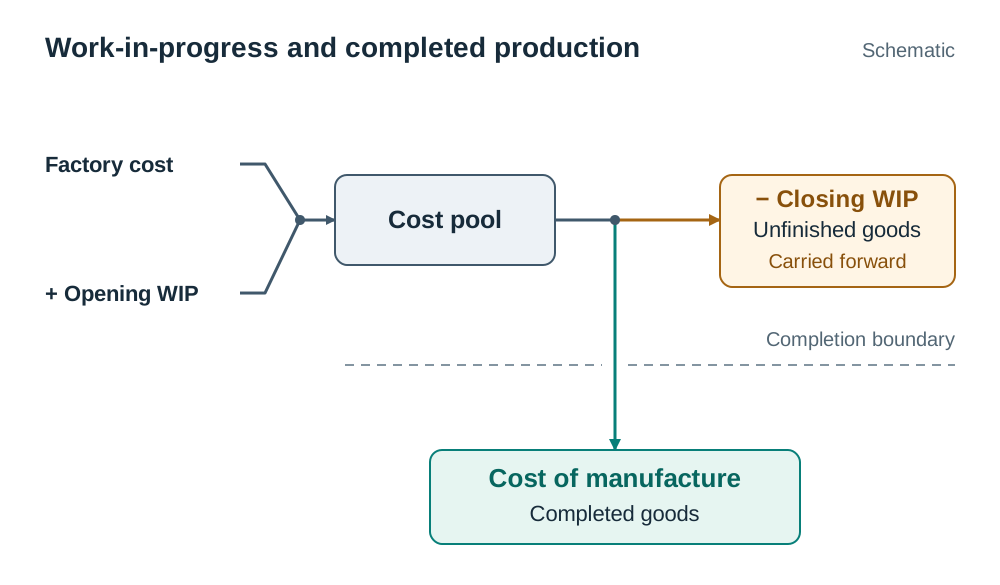
Transfer at Market Value and Unit Cost
- Transfer at market value: some businesses transfer finished goods to the trading account at current market value rather than their cost of manufacture. The difference is called factory profit:
Factory profit is credited to the profit and loss account. This comparison reveals whether internal production is cheaper than purchasing completed items from external suppliers.
- Unit cost of production: calculated to monitor operational efficiency:
If the internal unit cost is €15 and identical goods can be bought on the market for €14, manufacturing is less cost-effective than buying from outside suppliers.
Key terms
- Cost of Sales
- The direct cost of purchasing or manufacturing the goods sold during the trading period, calculated as opening stock plus purchases and carriage inwards minus closing stock.
- Gross Profit
- The trading profit earned directly from selling goods before operating overheads are deducted, calculated as Sales revenue minus Cost of Sales.
- Net Profit
- The profit remaining after all expenses, including finance costs, have been deducted from gross profit and all gains added.
- Net Realisable Value (NRV)
- The estimated selling price of inventory in the ordinary course of business less all estimated costs of completion and selling expenses.
- Accruals Concept
- The accounting convention requiring revenues and costs to be recognised in the period to which they relate, regardless of when cash is received or paid.
- Prudence Concept
- The accounting rule that revenue and profits are not anticipated but recognised only when realised, whereas provision is made for all known liabilities and losses.
- Revaluation Reserve
- A capital reserve created in the balance sheet when fixed assets, such as land and buildings, are restated upwards to their current market valuation.
- Bad Debt Provision
- An estimated allowance deducted from trade debtors in the balance sheet to account for expected non-payment of accounts.
- Prime Cost
- The total of all direct production costs in a manufacturing account, consisting of direct materials consumed, direct factory wages, and direct factory expenses.
- Working Capital
- The net liquid resources funding daily business operations, calculated as Current Assets minus Creditors falling due within one year.
- Suspense Account
- A temporary balancing account opened to hold ledger discrepancies or unposted entries until errors are discovered and corrected.
- Sale or Return
- A transaction where goods are delivered to a buyer on approval, with legal title remaining with the seller until the buyer confirms the purchase.
Check yourself
A business holds closing inventory of €50,000 at cost, which includes items costing €4,500 that suffered water damage. They can be sold for €3,200 after spending €400 on repackaging. What is the corrected closing stock value?
€48,300. Net realisable value is €3,200 − €400 = €2,800. The write-down in value is €4,500 − €2,800 = €1,700. Corrected closing inventory is €50,000 − €1,700 = €48,300.
Goods costing €8,000 were delivered on 'sale or return' with a 25% mark-up on cost and erroneously booked as a credit sale. What entries correct the accounts?
The selling price is €8,000 + 25% = €10,000. Deduct €10,000 from Sales in the Trading Account, deduct €10,000 from Debtors under Current Assets, and add €8,000 (cost) to Closing Stock in both Cost of Sales and Current Assets.
Trial balance debtors stand at €82,000 and the bad debt provision is €3,000. A customer owing €2,000 is written off as bad. The business sets a 4% provision on remaining debtors. What figures appear in the Profit and Loss Account and Balance Sheet?
Adjusted debtors = €82,000 − €2,000 = €80,000. New provision = 4% of €80,000 = €3,200. The increase in provision is €3,200 − €3,000 = €200, charged as an operating expense. The €2,000 bad debt is also charged as an expense. In the balance sheet under Current Assets, show Debtors at €80,000 less Provision of €3,200 = €76,800.
A trial balance includes Rent Receivable of €14,000, which represents 14 months of rent received up to 28/02/2027. The financial year ends on 31/12/2026. How is this treated?
The monthly rent is €14,000 ÷ 14 = €1,000. The current year (12 months) receives €12,000 as an operating gain in the profit and loss account. The remaining 2 months (€2,000) is rent received in advance (prepaid income), shown as a current liability under Creditors: amounts falling due within one year.
What three elements constitute Prime Cost in a Manufacturing Account?
Direct Raw Materials Consumed, Direct Factory Labour (wages), and Direct Factory Expenses (such as royalties or machine hire).