
Judaism is one of the five major world religions studied in Religious Education. It teaches belief in one God and in the Covenant, a sacred agreement between God and the Jewish people. In the exam, you will usually be asked to describe Jewish beliefs, sacred scripture, synagogue worship, prayer, rites of passage, or how Jewish moral codes guide everyday decisions.
Beliefs, Creation, and Founders
Judaism is a monotheistic faith, meaning Jews believe in one God who created the universe. The foundation of Jewish life is the Covenant, where God promises care and protection, and the Jewish people promise to live by God's commandments. The central prayer, the Shema, proclaims this core belief: 'Hear, O Israel: The Lord our God, the Lord is one.'
In the book of Genesis, the creation story teaches that God made the world in six days and rested on the seventh. This provides the reason Jews keep the Sabbath. Genesis also teaches that all humans are made in the image of God, meaning every person has equal worth and dignity.
Two central figures show deep commitment to their faith:
- Abraham left his homeland in Ur when God called him, trusting God's promise of land and descendants, and sealed the Covenant.
- Moses returned to Egypt to confront Pharaoh, led the Hebrew slaves to freedom in the Exodus, and received God's laws on Mount Sinai.
The Torah, Diversity, and Dialogue
The Torah is the most sacred text in Judaism and consists of the first five books of the Hebrew Bible: Genesis, Exodus, Leviticus, Numbers, and Deuteronomy. Believers hold that God revealed the Torah to Moses on Mount Sinai. Scribes handwrite the scrolls on parchment, and readers use a pointer, a yad, so fingers do not touch the holy ink.
The Torah contains 613 mitzvot (commandments) that govern worship, daily behaviour, and food laws. Kosher rules, such as not eating pork and keeping meat and dairy separate, show how the Torah guides daily life.
Diversity and Dialogue
- Orthodox Jews follow the Torah's laws strictly and sit separately by gender during synagogue worship.
- Reform (Progressive) Jews adapt practices to modern life, allow families to sit together, and ordain women as rabbis.
- Judaism shares Abrahamic roots with Christianity and Islam. Belief in the same God of Abraham gives a valuable foundation for interfaith dialogue to promote peace.
Synagogue Worship, Prayer, and Rituals
The synagogue is the formal Jewish place of communal prayer, study, and assembly. When praying, Jewish men and many women wear a kippah (skullcap showing reverence) and a tallit (prayer shawl).
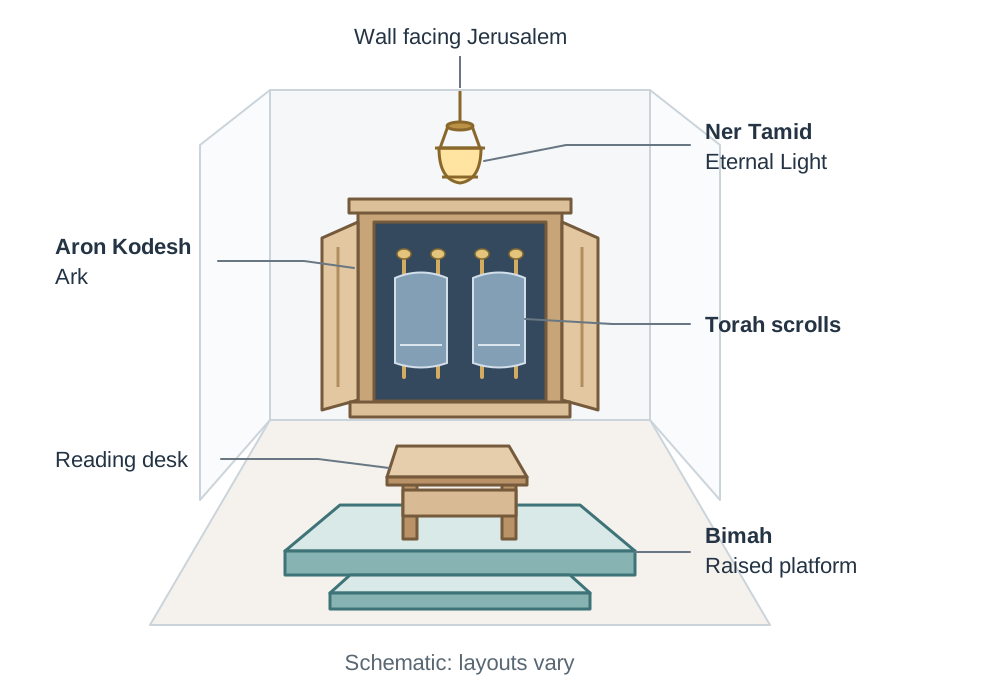
Key features of the synagogue include:
- Aron Kodesh (Ark): the decorated cupboard, set into the wall facing Jerusalem, where the Torah scrolls are kept.
- Ner Tamid (Eternal Light): the lamp hanging above the Ark that burns constantly to symbolise God's presence.
- Bimah: the raised platform where the reader stands to chant from the Torah.
Prayer allows Jews to praise God, say thanks, ask for help, and seek forgiveness. Observant Jews pray three times a day. Communal prayer requires a minyan (ten adults), which binds the community together.
Religious rituals mark major life stages. Shabbat begins at sunset on Friday and ends on Saturday night, bringing families together for rest and synagogue services. At age 13 for boys (Bar Mitzvah) and 12 or 13 for girls (Bat Mitzvah), young Jews read from the Torah and accept adult religious responsibility. Jewish weddings take place under a chuppah (canopy), ending when a glass is broken to remember the ancient Temple's destruction.
Living Jewish Values and History
Jewish ethics focus on turning faith into action for others and the planet.
- The Decalogue (Ten Commandments) is Judaism's best-known moral code, giving clear rules against lying, stealing, and murder.
- Tzedakah means giving to those in need as a binding duty of justice and fairness, not optional charity.
- Tikkun olam ('repairing the world') guides Jews to fight injustice, while pursuing shalom (peace).
- Bal tashchit is the commandment that forbids needless destruction or waste, directing Jews to protect natural resources.
Key Historical Timeline
| Date | Event | Significance |
|---|---|---|
| c. 1800 BCE | Covenant with Abraham | Founding of the Jewish people and faith |
| c. 1250 BCE | The Exodus and Sinai Covenant | Moses leads slaves to freedom and receives the Torah |
| c. 1000 BCE | King David unites the kingdom; Solomon builds the First Temple | Time of growth and expansion in Jerusalem |
| 586 BCE | First Temple destroyed | Babylonian exile; faith preserved in writing |
| 70 CE | Second Temple destroyed | Dispersion of Jews across the world (Diaspora) |
| 1939–1945 | The Holocaust (Shoah) | Nazi murder of six million European Jews |
Key terms
- Covenant
- The solemn, sacred agreement between God and the Jewish people involving mutual promises and responsibilities.
- Shema
- The central Jewish prayer declaring the monotheistic belief that God is one.
- Torah
- The most sacred Jewish scripture, consisting of the first five books of the Hebrew Bible.
- Synagogue
- The formal Jewish place of communal worship, prayer, and study.
- Shabbat
- The Jewish weekly day of rest and renewal, observed from Friday sunset to Saturday nightfall.
- Decalogue
- The Ten Commandments given to Moses on Mount Sinai that form a central moral code.
- Mitzvot
- The 613 divine commandments in the Torah covering worship, moral behaviour, and daily life.
- Bal Tashchit
- The Jewish ethical rule that prohibits senseless waste and the destruction of the earth.
Check yourself
What is the central prayer in Judaism that proclaims God is one?
The Shema.
What is the lamp hanging above the Ark that burns continuously called?
The Ner Tamid.
Give one way Moses showed commitment to his religious beliefs.
He confronted Pharaoh to demand freedom for the Hebrew slaves and led them out of Egypt.
Why is tzedakah different from ordinary charity?
It is a required duty of justice and fairness under Jewish law, rather than an optional choice.
Which Jewish teaching specifically forbids environmental waste and needless destruction?
Bal tashchit.