
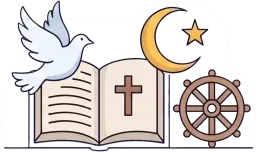
A community of faith is a group of people who share a religious tradition, beliefs, and practices. In the Junior Cycle exam, you must show how members live out their beliefs in daily life, identify sacred spaces, and explain how dialogue builds peace.
What is a Community of Faith?
A community of faith is a group of people who share a religious tradition marked by shared beliefs, practices, and histories of interpretation.
- The Junior Cycle specification focuses on five major world religions: Buddhism, Christianity, Hinduism, Islam, and Judaism.
- A faith community can be a denomination (such as the Church of Ireland), a religious order, or a religious organisation (such as the Society of St Vincent de Paul).
- You study two communities of faith from your own locality or region, each linked to a different one of the five major world religions.
- A local community of faith can be your local parish church, a local mosque, or a local synagogue.
- In an exam answer, you can write: "In my area, the Catholic parish church and the Islamic Cultural Centre of Ireland in Clonskeagh are two communities of faith."
Two Communities of Faith in Action
Faith communities in Ireland turn their beliefs into practical help for other people.
| Feature | Society of St Vincent de Paul (SVP) | Muslim Sisters of Éire (MSOE) |
|---|---|---|
| Religion | Christianity (Catholic organisation) | Islam |
| Core belief | The teaching of Jesus to love your neighbour and care for the poor | Islamic pillar of zakat (obligatory charity) and compassion |
| Practical action | Home visits to isolated people, emergency food vouchers, and fuel aid | Friday night street outreach in Dublin providing hot meals and clothing |
SVP's motto is "Turning concern into action." MSOE assists vulnerable people regardless of their background while breaking down negative stereotypes about Muslim women.
Everyday Faith and Engagement
Talking to members of a faith community shows how their beliefs shape an ordinary day.
- In interviews or visits, ask open questions such as: "How does your faith affect an ordinary day?"
- Listen respectfully and distinguish one person's personal testimony from the official doctrine of the whole community.
- Muslims pray five times a day (salat) because they believe they are called to submit to Allah, and they choose halal food.
- Christians practice daily personal prayer and attend weekly Sunday worship to express faith in God.
- Faith also directs moral choices, such as how believers spend money, treat neighbours, and volunteer their time.
Worship, Rituals, and Sacred Spaces
Believers express their relationship with the Divine through symbolic rituals and dedicated spaces.
- A religious ritual is a ceremony consisting of a series of actions performed according to a prescribed order which have a religious and a symbolic value attached to them.
- In Christian baptism, water and formal prayers symbolise washing away sin and beginning life in Christ.
- A formal place of worship is a specially-designed building where people gather to worship together: Christianity – church; Islam – mosque; Judaism – synagogue; Hinduism – temple (mandir); Buddhism – temple (vihara).
- A sacred space is a place considered sacred or holy that fulfils a religious purpose, including buildings, shrines, holy wells, and mountains.
- Croagh Patrick in Mayo is an Irish sacred mountain linked to St Patrick's fast; thousands climb it on Reek Sunday to pray and do penance.
- St Brigid's Holy Well in Kildare is linked to St Brigid's monastic foundation; pilgrims visit to pray the rosary and leave prayer intentions.
Dialogue, Peace, and Reconciliation
Communities of faith communicate and cooperate to build understanding and tackle social problems.
- Inter-faith dialogue is discussion and cooperation between two different world religions, for example between Muslims and Christians.
- Intra-faith dialogue is discussion and cooperation between different traditions, branches, or denominations within the same major world religion, such as Catholics and Presbyterians.
- Dialogue means listening and talking respectfully; it often leads to the groups working together on a shared problem.
- Dialogue builds peace by breaking down prejudice and false stereotypes, revealing shared values like caring for the poor, and rebuilding trust after conflict.
- The Dublin City Interfaith Forum is an Irish inter-faith example where leaders of different world religions meet to build respect and counter racism.
- The Corrymeela Community in Northern Ireland is an Irish intra-faith example promoting peace between Catholic and Protestant traditions.
Key terms
- Community of faith
- A group of people who share a religious tradition marked by shared beliefs, practices and histories of interpretation.
- Major world religions
- For the purposes of this specification, Buddhism, Christianity, Hinduism, Islam and Judaism.
- Religious ritual
- A ceremony consisting of a series of actions performed according to a prescribed order which have a religious and a symbolic value attached to them.
- Formal place of worship
- A specially-designed building where people gather to worship together, such as a church, synagogue, temple or mosque.
- Sacred spaces
- Places that are considered sacred or holy and fulfil a religious purpose, including rivers, mountains, wells, burial sites, buildings, and shrines.
- Inter-faith dialogue
- Discussion, interaction, and cooperation between different major world religions to promote peace and understanding.
- Intra-faith dialogue
- Discussion, interaction, and cooperation between different traditions, branches, or denominations within the same major world religion.
Check yourself
Name the formal places of worship for Judaism and Islam.
Judaism uses a synagogue, and Islam uses a mosque.
Which Islamic pillar motivates the street outreach of the Muslim Sisters of Éire?
Zakat, the religious duty of obligatory charity to care for those in need.
Give one reason why Croagh Patrick is a sacred space for Irish Christians.
It is a pilgrimage mountain associated with St Patrick's fast, where thousands climb on Reek Sunday for prayer and penance.
State one way that inter-faith dialogue helps to build peace in a community.
It breaks down false stereotypes and prejudice by bringing people of different faiths together to focus on shared values.