

Hinduism is one of the world's oldest living religions. It began in India thousands of years ago and has no single human founder. For the Junior Cycle exam, you need to understand core Hindu beliefs about the Divine and the soul, the Bhagavad Gita, worship in the home and mandir, and moral principles such as ahimsa.
Origins, Core Beliefs and Creation
Hindus often call their faith Sanātana Dharma, meaning 'the eternal way of life'. Hinduism is one of the fastest-growing religions in Ireland, with communities worshipping in mandirs and cultural centres in Dublin and other cities.
| Belief | Meaning |
|---|---|
| Brahman | The supreme, formless divine reality and source of all existence. |
| Trimurti | Three main forms of Brahman: Brahma (creator), Vishnu (preserver), and Shiva (destroyer, who brings things to an end so new life can begin). |
| Atman | The eternal soul in every living being, a spark of Brahman. |
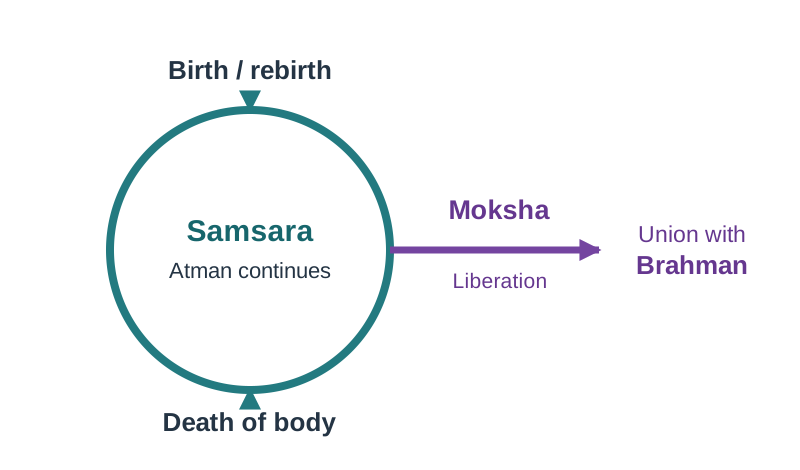
| Samsara | The continuous cycle of birth, death, and rebirth (reincarnation). |
| Karma | The universal law of cause and effect where actions shape future lives. |
| Moksha | Spiritual liberation from samsara and eternal union with Brahman. |
Creation in Hinduism
Hindus believe creation is cyclical and never-ending, rather than happening just once. Brahma creates the world, Vishnu preserves it, and Shiva brings it to an end before the cycle begins again. In the Purusha hymn of the Rig Veda, creation is described as emerging from a cosmic sacrifice. Because the entire universe comes from Brahman, all life is sacred and must be respected.
Sacred Texts and Key Figures
Hindu scriptures include the Vedas (ancient hymns) and the great epic poems. The Bhagavad Gita ('Song of the Lord') is part of the epic Mahabharata and is the designated Hindu sacred text for Junior Cycle.
The text is a dialogue where Krishna, an avatar (earthly form) of Vishnu, guides Prince Arjuna through a moral crisis on a battlefield. Krishna teaches him to perform his duty through karma yoga—acting selflessly without attachment to reward. Believers read the Gita for daily ethical guidance.
If an exam asks for a founder or key follower
Hinduism has no human founder, so write about a prominent Hindu figure of commitment: Mahatma Gandhi.
- He put ahimsa (non-violence) into practice by leading peaceful protests and marches against British rule in India.
- He lived out dharma (moral duty) by fasting to stop violence between religious groups and defending the rights of the poor.
Worship, Prayer and Festivals
Hindu worship is called puja (honour or adoration). It takes place at home shrines before images or statues of deities called murtis, or communally in a mandir (a Hindu temple and dwelling place of God).
- At the mandir, worshippers remove their shoes and ring an entry bell. A tall spire called a shikhara rises over the temple, representing a sacred mountain reaching up to the Divine.
- In the arati ritual, a lighted lamp is waved before a deity. Worshippers pass their hands over the flame and touch their forehead to receive the blessing.
- Daily prayer uses mantras, sacred phrases repeated aloud or silently. The most famous is the sound Om (Aum), representing Brahman. Devotees often use prayer beads (mala) to repeat them.
Diwali — The Festival of Lights
Celebrated over five days in autumn, Diwali marks the triumph of light over darkness and good over evil, recalling the return of Prince Rama and Sita from the Ramayana. Hindus light small clay lamps called diyas, clean their homes, pray to Lakshmi (the goddess of wealth and good fortune), and share festive sweets.
Moral Codes, Ahimsa and the Earth
Hindu morality is rooted in duties and deep respect for living things:
- Dharma: Living righteously according to universal moral order and individual duty. A student's dharma is to learn, while a parent's dharma is to care for their family.
- Ahimsa: The rule of non-violence toward all living beings. Because every creature has an atman connected to Brahman, many Hindus follow a vegetarian diet. The cow is revered as a sacred symbol of life and motherhood, so beef is strictly avoided.
- Seva: Selfless service to others carried out without seeking reward or praise, such as feeding the poor or cleaning the mandir.
- Care for the Earth: Nature is seen as an expression of Brahman. Harming the environment harms living souls and creates negative karma, while protecting sacred rivers like the Ganges and caring for habitats fulfills dharma.
Key terms
- Brahman
- The supreme, eternal divine reality and source of everything in the universe.
- Atman
- The individual, eternal soul present in every living creature, originating as a spark of Brahman.
- Samsara
- The continuous cycle of birth, death, and rebirth (reincarnation).
- Moksha
- Spiritual liberation from the cycle of rebirth and final union with Brahman.
- Dharma
- Sacred moral duty, righteousness, and correct conduct in life.
- Karma
- The universal moral law of cause and effect where intentional actions shape future rebirths.
- Ahimsa
- The moral principle of non-violence and harmlessness toward all living beings.
- Mandir
- A Hindu temple, meaning the dwelling place of God, used as a formal place of worship.
Check yourself
What is a mandir?
A Hindu temple, the house of God and formal place of worship.
Which sacred text would you write about in a question on Hinduism?
The Bhagavad Gita.
Name the three deities of the Trimurti and their roles.
Brahma (creator), Vishnu (preserver), and Shiva (destroyer, who brings things to an end so new life can begin).
What do Hindus mean by karma?
The universal moral law that your intentional actions have consequences and shape your next life.