
Christianity is a world religion based on the life, death and resurrection of Jesus Christ. In the exam you can choose Christianity to answer questions on beliefs, its sacred text, rituals, prayer, its moral code and its place in Irish heritage.
Key Beliefs, Big Questions and the Founder
Christians believe in one God revealed as three divine persons: Father, Son, and Holy Spirit (the Trinity).
- Incarnation: God took on human form in Jesus Christ.
- Jesus of Nazareth: A Jewish teacher who lived in the Holy Land about 2,000 years ago; he preached about God's love, healed the sick and gathered twelve disciples.
- Crucifixion and Resurrection: Roman authorities executed Jesus on a cross, but Christians believe he rose from the dead on Easter Sunday, offering eternal life.
- Salvation: Christians believe that Jesus saves people from sin and brings them back into friendship with God.
- Saint Paul's commitment: He travelled across the Roman Empire setting up Christian communities, and kept writing letters to encourage them while in prison.
- Why are we here? Christians believe God created each person out of love, to know and serve God and to love others.
- What happens when we die? Christians believe in life after death: the soul lives on and shares eternal life with God in heaven.
The Gospels: Development and Guidance
Christianity's sacred text for this course is the New Testament Gospels: Matthew, Mark, Luke and John. Name them, not "the Bible".
The Gospels developed across three historical stages:
| Stage | Historical process |
|---|---|
| 1. Life of Jesus | Jesus lived, taught the Kingdom of God, and performed actions among his followers. |
| 2. Oral tradition | After his death and resurrection, apostles passed on his words and deeds by word of mouth. |
| 3. Written Gospels | The four evangelists wrote the Gospels down for their own communities, roughly 35 to 70 years after Jesus died. |
Believers read the Gospels during services and private prayer for moral guidance. Parables like the Good Samaritan teach active compassion, while the Prodigal Son models forgiveness.
Worship, Ritual and Prayer
A church is the formal Christian place of worship where the faith community gathers, especially on Sunday. Worshipping together lets believers pray, sing and support one another.
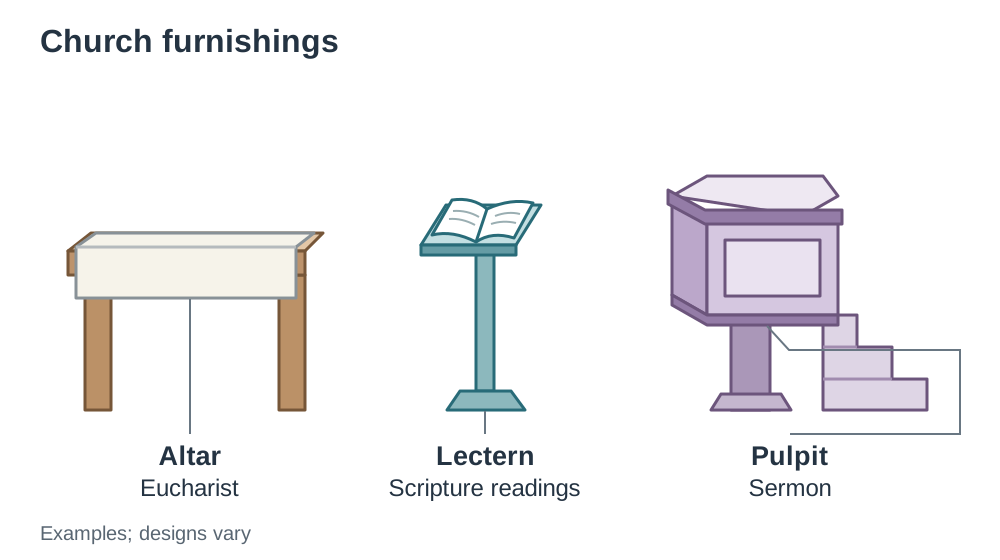
Church Furnishings
- Altar: The sacred table where the Eucharist is celebrated.
- Lectern: The reading stand from which scripture is read aloud.
- Pulpit: The raised platform where the sermon is preached.
Rituals and Prayer
- Baptism: Water is poured over the person's head; it welcomes them into the Christian community and washes away sin.
- Eucharist (Mass or Holy Communion): Bread and wine are blessed and shared, remembering the Last Supper and Jesus's death and resurrection.
- Prayer: Christians talk to God to give praise and thanks, to ask for help, or to say sorry.
- The Our Father: The prayer Jesus taught; Christians pray it alone and together at Mass.
- Denominations: Christianity has different communities of faith, including Catholic, Church of Ireland, Presbyterian, Methodist and Orthodox.
Moral Guidance and Stewardship
Christian ethics guide everyday choices through divine commandments, scriptural examples, and care for creation.
- The Ten Commandments: Rules given to Moses that guide Christian behaviour, such as honour your father and mother, do not steal, do not kill.
- The Great Commandment: Jesus taught followers to love God wholeheartedly and love their neighbour as themselves.
- The Golden Rule: Believers are instructed to treat others as they would wish to be treated.
- Stewardship: In Genesis, God appoints humanity as caretakers of the earth. In his letter Laudato Si', Pope Francis urged Christians to protect our "common home" by living sustainably.
- Action for justice: Organisations like Trócaire and the Society of Saint Vincent de Paul put Christian values into practice by tackling poverty and global injustice.
Christianity in Irish Culture and Heritage
Christianity has shaped Irish landscape, art, language, and customs for over 1,500 years.
- Monastic settlements: Historic sites such as Glendalough and Clonmacnoise served as centres of education and craftwork, featuring stone round towers used as bell towers and storehouses.
- High crosses: Carved stone high crosses served as open-air teaching tools, illustrating biblical stories for people who could not read.
- Sacred manuscripts: Monks produced illuminated texts like the Book of Kells, preserving Gospel stories in detailed Celtic art.
- Linguistic heritage: Placenames starting with "Kil-" (from the Irish cill, meaning church), such as Kilkenny or Kildare, reflect early Christian foundations.
- Pilgrimage: Ancient spiritual journeys continue today at holy wells and sacred mountains such as Croagh Patrick.
Key terms
- Trinity
- The Christian belief in one God in three distinct persons: Father, Son, and Holy Spirit.
- Incarnation
- The Christian belief that God took on human form in the person of Jesus Christ.
- Gospels
- The four New Testament books (Matthew, Mark, Luke, and John) narrating the life, teachings, death, and resurrection of Jesus.
- Church
- A formal place of worship where the Christian faith community gathers for communal prayer and ritual.
- Eucharist
- A central Christian ritual where bread and wine are blessed and shared in memory of Jesus's Last Supper.
- Moral Code
- A given rule or set of rules that orients behaviour and helps believers determine right from wrong.
- Stewardship
- The religious duty to care for, protect, and responsibly manage the earth as God's creation.
Check yourself
What does the Christian doctrine of the Incarnation mean?
It is the belief that God took on human form in the person of Jesus Christ.
What are the three stages in the development of the New Testament Gospels?
The historical life and teachings of Jesus, the period of oral tradition, and the writing down of the Gospels.
What is the primary difference between a lectern and a pulpit?
A lectern is used for proclaiming scripture readings, while a pulpit is a raised stand used for delivering sermons.
How did carved stone high crosses assist early Christian communities in Ireland?
They served as open-air visual teaching aids, illustrating biblical scenes for people who could not read.
Name two Christian rituals and state the central action of each.
Baptism (pouring water over the head) and the Eucharist (blessing and sharing bread and wine).