
Islam is a major world religion founded on belief in one God, Allah, whose revelations were received by the Prophet Muhammad. In the Junior Cycle examination, questions focus on core beliefs, the Prophet and sacred text, worship in the mosque, and moral living.
Core Beliefs and the Nature of God
Islam means submission to God, and Muslims believe in Tawhid, the absolute oneness of Allah.
Muslim beliefs are summarised in the Six Articles of Faith:
- Allah: Faith in the one supreme God without partners or equals.
- Angels (Malaikah): Spiritual beings who follow Allah's commands, such as Angel Jibril.
- Holy Books (Kutub): Revelations sent to humanity, with the Qur'an as the final scripture.
- Prophets (Risalah): Human messengers including Ibrahim, Musa, and Isa, ending with Muhammad.
- Day of Judgement (Yawm al-Din): Allah will judge everyone's deeds, and a faithful life is rewarded with paradise.
- Predestination (Al-Qadr): Allah knows and controls all things, but people are still responsible for their own choices.
The Prophet Muhammad and the Qur'an
Muhammad is revered as the final prophet and an example of commitment to Allah.
- 570 CE: Born in Mecca.
- 610 CE: Received the first revelation from Angel Jibril on Mount Hira.
- Preached monotheism despite facing severe persecution from Meccan leaders.
- 622 CE: Led his followers from Mecca to Medina to escape persecution. This migration is the Hijra, marking year one of the Islamic calendar.
- 630–632 CE: Returned peacefully to Mecca, then died in Medina in 632 CE.
The Qur'an is Islam's sacred text, believed to be the exact words of Allah revealed in Arabic to Muhammad over about 23 years. Followers memorised and recorded these revelations, which were later compiled into an authorised written text by Caliph Uthman.
The Five Pillars and the Mosque
The Five Pillars are the five main duties of every practising Muslim:
| Pillar | Meaning and Practice |
|---|---|
| Shahadah | Declaration of faith in Allah and Muhammad as His messenger. |
| Salah | Ritual prayer five times daily facing Mecca. |
| Zakat | Giving 2.5% of surplus wealth annually to support the poor. |
| Sawm | Fasting from dawn to sunset during Ramadan. |
| Hajj | Pilgrimage to Mecca, once in a lifetime for those able. |
Salah shapes the day, reminding Muslims of Allah, building self-discipline, and uniting the ummah. Believers perform wudu (ritual washing) before prayer.
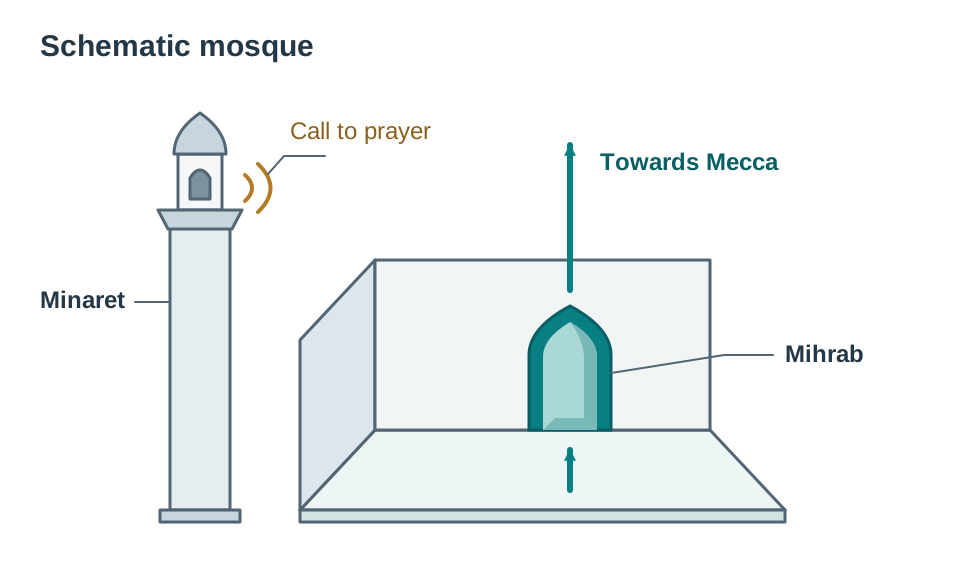
In a mosque, the mihrab indicates the direction of Mecca, while the minaret is the tower used for the call to prayer. On Fridays, Muslims gather for Jumu'ah congregational prayer and a sermon. Major celebrations include Eid al-Fitr (marking the end of Ramadan) and Eid al-Adha (celebrating Ibrahim's obedience). In Ireland, the Islamic Cultural Centre in Clonskeagh, Dublin, is a major mosque and community centre.
Living Islamic Values
Islamic morality is guided by Shari'ah, the moral code derived from the Qur'an and the Sunnah (the Prophet's lived example).
- Shari'ah guides everyday moral choices between halal (permitted) and haram (forbidden, such as alcohol, injustice, or dishonesty).
- Khalifah: Humans are stewards trusted by Allah to care for creation and avoid waste.
- Compassion and justice: Expressed through compulsory Zakat and voluntary charity (sadaqah). The aid organisation Islamic Relief puts these values into action worldwide.
- Modesty: Muslims show dignity and respect in behaviour and dress, such as wearing the hijab.
- Jihad: Meaning 'struggle', its primary form is the personal, spiritual effort to live faithfully, while also working peacefully for justice and the dignity of others.
Key terms
- Tawhid
- The core Islamic belief in the absolute oneness and unity of Allah.
- Qur'an
- The sacred scripture of Islam, believed to be the exact word of Allah revealed to Muhammad.
- Hijra
- The migration of Muhammad and his followers from Mecca to Medina in 622 CE.
- Khalifah
- The Islamic teaching that humans are stewards or guardians, trusted by Allah to care for creation.
- Shari'ah
- Islamic law drawn from the Qur'an and Sunnah, guiding what is halal (allowed) and haram (forbidden).
- Ummah
- The worldwide community of Muslim believers united by shared faith.
- Wudu
- The ritual washing performed by Muslims to purify themselves before prayer.
Check yourself
What does the term Tawhid mean?
That Allah is one, supreme, and without partners or equals.
Which event in 622 CE marks the beginning of the Islamic calendar?
The Hijra (Muhammad's migration from Mecca to Medina).
What is the function of a mihrab inside a mosque?
It is an alcove in the wall that indicates the qibla (the direction of Mecca).
Which festival marks the end of Ramadan?
Eid al-Fitr.