

Buddhism is a major world religion founded in ancient India by Siddhartha Gautama, known as the Buddha or 'Awakened One'. In the Junior Cycle examination, questions focus on the Buddha's life story and commitment, core teachings such as the Four Noble Truths and Eightfold Path, the sacred Tripitaka, meditation, and Buddhist moral living.
The Buddha, Founding Story, and Commitment
Siddhartha Gautama was born a prince about 2,500 years ago at Lumbini, in present-day Nepal, near the border with northern India. At twenty-nine, he travelled outside the palace walls for the first time and encountered the Four Sights:
- An old person (ageing cannot be avoided)
- A sick person (illness causes pain)
- A dead body (death comes to everyone)
- A holy man (a simple life seeking spiritual answers)
What he saw convinced him to renounce his royal life. He rejected extreme starvation to teach the Middle Way—a life between luxury and hardship. While meditating under a Bodhi tree at Bodh Gaya, he reached enlightenment and became the Buddha.
Two clear acts of commitment in his life were:
- Leaving his palace, family, and wealth behind to find an end to human suffering.
- Sitting in meditation under the Bodhi tree, refusing to leave until he attained enlightenment, then spending forty-five years travelling to teach others.
The Dharma, Rebirth, and the Eightfold Path
The Buddha's teachings are known as the dharma. The Four Noble Truths work like a doctor visit: name the illness, find its cause, say a cure is possible, and give the treatment:
- Dukkha (Suffering): Dissatisfaction and pain affect all living beings.
- Samudaya (Cause): Suffering is caused by selfish craving, greed, and attachment.
- Nirodha (Cure): Suffering ends when selfish craving ceases, leading to nirvana (complete peace).
- Magga (Treatment): The cure is following the Eightfold Path.
Buddhists teach rebirth rather than reincarnation: there is no permanent soul passing into a new body, only a continuous stream of karma shaping future lives within samsara (the cycle of rebirth).
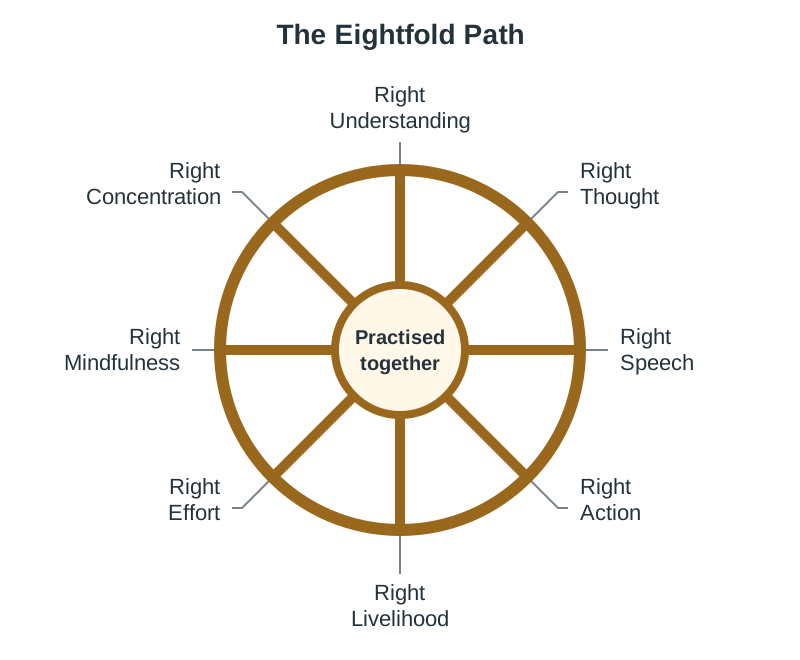
The Eightfold Path is symbolised by an eight-spoked wheel. The eight steps are practised together, not one after the other, grouped into three areas: wisdom (Right Understanding, Right Thought), morality (Right Speech, Right Action, Right Livelihood), and meditation (Right Effort, Right Mindfulness, Right Concentration).
The Sacred Text and the Spread of Buddhism
The Buddha's teachings were preserved through oral tradition before being written down in Sri Lanka as the Tripitaka ('Three Baskets'):
| Basket | Contents |
|---|---|
| Vinaya Pitaka | Rules and discipline for monks and nuns in the sangha (monastic community). |
| Sutta Pitaka | Sermons and teachings of the Buddha, including the ethical verses of the Dhammapada. |
| Abhidhamma Pitaka | Detailed philosophical analysis of the mind and reality. |
Believers read and chant the Tripitaka to guide daily decisions. For example, the Dhammapada teaches that 'hatred is never ended by hatred, but by love', which guides a Buddhist to forgive rather than seek revenge.
Around 250 BCE, the Indian emperor Ashoka converted to Buddhism and sent missionaries across Asia. It spread to Sri Lanka, China, Tibet, and Japan, and is established in Ireland today through communities like Dzogchen Beara in Co. Cork.
Worship, Meditation, and Compassion in Action
Buddhists do not worship the Buddha as a creator god. Instead they show respect to the Buddha as an enlightened teacher in acts of devotion called puja.
- Vihara: A Buddhist temple and monastery.
- Stupa: A dome-shaped shrine containing holy relics.
- Offerings: Candles symbolise wisdom. Fading flowers and burning incense remind believers of anicca (impermanence).
- Meditation: Buddhists meditate instead of praying to a creator god. Sitting quietly, focusing on the breath, and chanting mantras build calm and awareness. Many maintain a home shrine holding a Buddha image.
- Wesak: The major festival in May celebrating the Buddha's birth, enlightenment, and death.
Buddhists put their faith into action through metta (loving-kindness) and karuna (compassion to relieve suffering). For example, the Dalai Lama promotes peace, dialogue, and non-violence worldwide.
Buddhist Moral Code and Care for the Earth
Buddhists follow the Five Precepts as practical guidelines for living a morally good life:
- Do not harm or kill living beings.
- Do not take what is not given.
- Avoid sexual misconduct.
- Avoid false or harmful speech.
- Avoid alcohol and drugs that cloud the mind.
Care for the earth is encouraged in two direct ways:
- The first precept commands non-harm towards living beings, leading many Buddhists to practise vegetarianism and protect animal habitats.
- Buddhism teaches that all life is interconnected, meaning damage to the environment harms human wellbeing as well. Avoiding greed encourages mindful consumption, simple living, and minimal waste.
Key terms
- The Buddha
- A title meaning 'the Awakened One', given to Siddhartha Gautama after reaching enlightenment.
- Dharma
- The universal truth and teachings given by the Buddha, including the Four Noble Truths.
- Tripitaka
- The sacred scripture of Buddhism, meaning 'Three Baskets' (Vinaya, Sutta, and Abhidhamma).
- Samsara
- The repeating cycle of birth, death, and rebirth driven by karma.
- Karma
- Intentional actions and their moral consequences across present and future lives.
- Nirvana
- The ultimate state of liberation from greed, hatred, suffering, and rebirth.
- Anicca
- The core Buddhist teaching of impermanence, showing that all things change and pass away.
- Sangha
- The Buddhist community, especially monks and nuns living under monastic rules.
Check yourself
What four sights did Siddhartha Gautama encounter outside the palace walls?
An old person, a sick person, a dead body, and a holy man.
What is the difference between rebirth and reincarnation?
Rebirth involves no eternal soul, only a flow of karma; reincarnation involves a permanent soul passing into a new body (Hinduism).
What are the three baskets of the Tripitaka?
The Vinaya Pitaka (monastic discipline), Sutta Pitaka (sermons and teachings), and Abhidhamma Pitaka (philosophy).
Name two Buddhist teachings that encourage care for the earth.
The first precept against harming living beings and the understanding that all living things are interconnected.
What do the terms metta and karuna mean?
Metta means loving-kindness towards all beings, and karuna means active compassion to relieve suffering.