

Textile care involves sorting, cleaning, drying, and repairing fabrics to help them last longer. The Junior Cycle exam tests your ability to interpret international care symbols, evaluate laundry habits from an ecological perspective, and extend fabric life.
The Five Basic Care Symbols
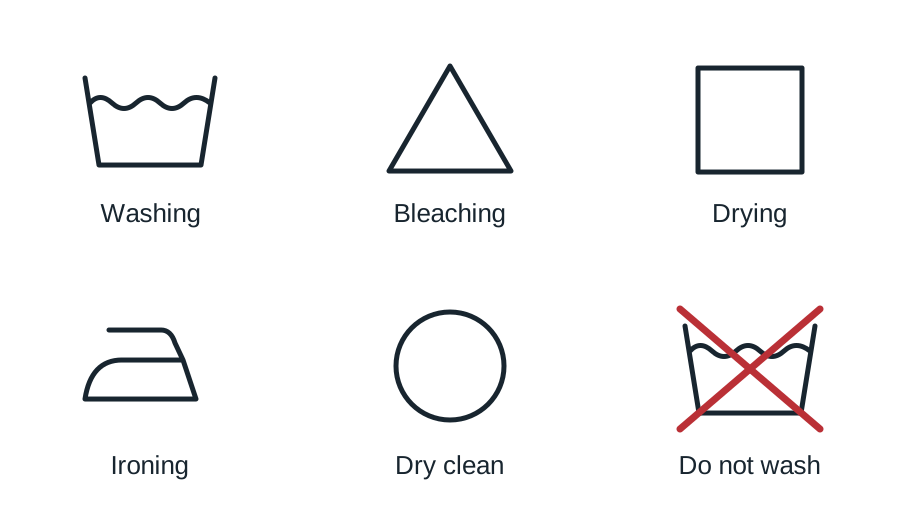
A care label uses international symbols so consumers can clean garments safely.
| Shape | Care treatment |
|---|---|
| Wash tub | Washing |
| Triangle | Bleaching |
| Square | Drying |
| Iron | Ironing |
| Circle | Dry clean |
A cross through any symbol means that treatment must not be used. A crossed wash tub means do not wash; look at the circle symbol to see whether it can be dry cleaned. A letter inside the circle (such as P, A, or F) instructs the professional cleaner which solvent to use, but for the exam it simply means dry clean.
Not every label symbol is a care instruction. The Woolmark symbol (a ball of yarn) is a fibre-content mark proving an item is made of 100% pure new wool.
Washing, Drying, and Ironing Symbols
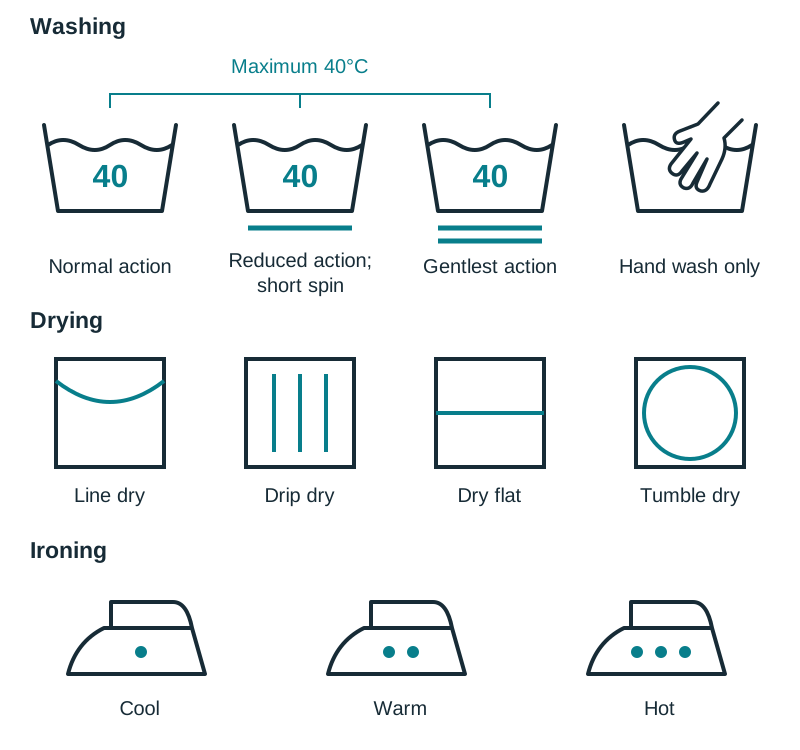
Markings inside each symbol provide specific instructions:
- The number inside the wash tub shows the maximum temperature in degrees Celsius (such as 30°C or 40°C). A hand inside the tub means hand wash only.
- Bars underneath show how gently the machine should move the clothes. No bar means normal wash and spin. A bar under the tub means a gentler wash — reduced washing action and a shorter spin, used for wool and delicate fabrics. Two bars mean the very gentlest action of all. In an answer, say 'wash at 40°C using a reduced/minimum washing action and short spin'.
- A square with a curved line means line dry. A square with a vertical line (or lines) inside means drip dry — hang the garment up still wet, without wringing it. A horizontal line means dry flat. A circle inside the square means tumble dry.
- Dots on the iron indicate heat: one dot for cool, two for warm, and three for hot.
Pre-Wash Steps, Stains, and Extending Textile Life
Before washing, empty pockets to protect clothes and the pump, close fastenings so they do not snag, and sort loads into whites, darks, and colours.
Soak blood, egg, and milk stains in cold water first; hot water sets them into the fabric.
Caring for clothes also means extending their usable life:
- Repair: stitch a split seam, sew on a missing button, replace a broken zip, or darn a hole in knitwear.
- Reuse: pass clothes down to family, swap with friends, or donate wearable items to a charity shop.
- Re-purpose: cut worn towels into cleaning cloths or turn old curtains into draught excluders.
- Upcycle: transform an old item into something of higher value, such as turning worn jeans into a tote bag or denim shorts.
Ecological Textile Care
Evaluating textile care means weighing common habits against greener alternatives:
| Everyday habit | Greener choice | Environmental reason |
|---|---|---|
| Washing at 60°C | Washing at 30°C | Heating water uses most of the machine's electricity |
| Running half loads | Running full loads | Washes more clothes for the same water and electricity |
| Tumble drying | Clothesline or clothes horse | Air-drying uses no electricity and is gentler on fabric |
| Chemical bleach | Sunlight, baking soda, vinegar | Avoids harmful chemical pollution in waterways |
In an evaluation question, give a clear judgement and reason: 'Washing at 30°C is the better choice because heating the water uses most of the machine's electricity, so a cooler wash cuts energy use and cost.' Measure the detergent. Using too much wastes money and sends extra chemicals into waste water.
Creating a Care Label for CBA 1
In Classroom-Based Assessment 1 (Creative Textiles), you must create a clear, accurate care label for your finished textile item:
- Fabric type and properties: state the fibre content (e.g. 100% cotton) and key qualities like durability or heat resistance.
- Core care symbols: draw correct symbols for washing, drying, and ironing that match your chosen fabric.
- Special instructions: write clear notes, such as 'wash with similar colours' or 'dry flat to maintain shape'.
- Presentation: stitch a physical label into your item, attach a separate tag, or present it clearly inside your design brief booklet.
Key terms
- Care label
- A tag attached to a textile item providing symbols and instructions for safe cleaning and maintenance.
- Maximum temperature
- The number inside the wash tub symbol showing the hottest safe water temperature for that fabric.
- Washing action
- The gentleness of machine movement and spin speed, indicated by horizontal bars under the wash tub.
- Dry flat
- Drying a wet garment on a flat surface to prevent heavy, water-soaked fibres from stretching out of shape.
- Woolmark
- A symbol showing that an item is made from 100% pure new wool meeting certified quality standards.
- Upcycle
- Transforming waste materials or unwanted garments into a new product of higher value or quality.
Check yourself
What information does a square containing a circle give to the consumer?
Tumble dry.
What does a single bar under a 40°C wash tub indicate?
Wash at a maximum temperature of 40°C using a reduced/minimum washing action and a short spin.
What does the Woolmark symbol tell the consumer about a garment?
The item is made from 100% pure new wool.
Give one example of upcycling an old textile item.
Cutting down worn jeans into shorts or stitching them into a tote bag.
Why is drying clothes on a washing line better for the environment than using a tumble dryer?
Line drying uses no electricity and relies entirely on natural air and sunlight.