

Cooking food makes it safe to eat, improves flavour and texture, and makes nutrients easier to digest. For Junior Cycle Home Economics, you must understand heat transfer, evaluate cooking methods, apply kitchen hygiene and safety, explain chemical changes in nutrients, and adapt recipes to follow healthy eating guidelines.
Why We Cook Food and Heat Transfer
We cook food for five core reasons: safety (destroying harmful bacteria), flavour, digestibility, variety, and attractive appearance.
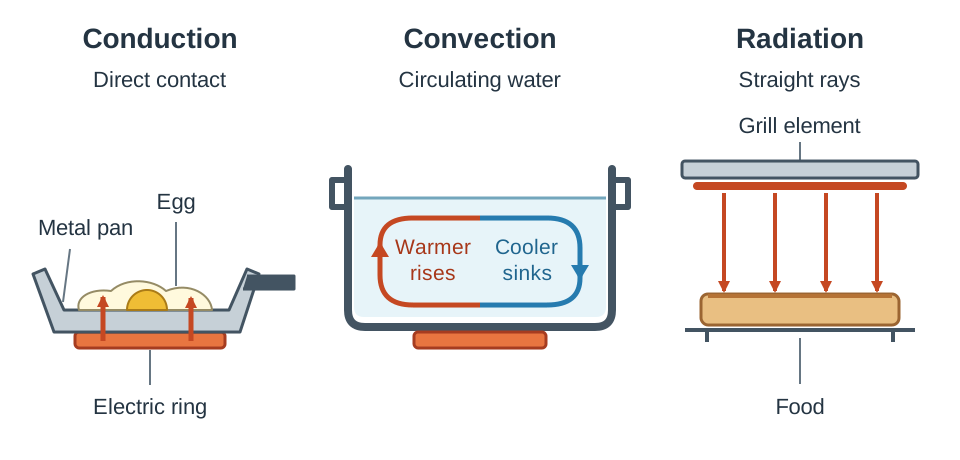
Heat enters food through three processes:
- Conduction: Heat passes directly from molecule to molecule through a solid object. For example, heat moves from an electric hob ring through the metal base of a frying pan into an egg.
- Convection: Warm liquid or air rises, cools and sinks again, setting up convection currents. This heats boiling water and the air in an oven during baking.
- Radiation: Heat travels in straight rays directly from the heat source to the food surface without heating the air between. Grilling and toasting rely on radiant heat.
Choosing a Cooking Method
Cooking methods fall into three main groups: moist methods, dry methods, and methods using fat.
| Method | How it works | Advantage | Disadvantage |
|---|---|---|---|
| Boiling | Rapid bubbling at 100°C | Simple; no fat added | Water-soluble vitamins B and C leach into water |
| Steaming | Food suspended over boiling water | Preserves vitamins, colour, and texture | Slower; food can taste plain |
| Stewing | Slow cooking in gentle liquid (80–90°C) | Tenderises cheap cuts; juices stay in sauce | Takes a long time |
| Grilling | Fast cooking by radiant heat | Fat drips away; quick | Food burns or dries out easily |
| Frying | Fast cooking in hot oil or fat | Adds rich flavour and crisp texture | Adds fat and calories; burn risk from hot oil |
Food Safety and Kitchen Hygiene
Safe food handling prevents food poisoning and cross-contamination:
- Wash hands thoroughly in warm soapy water before cooking and after handling raw meat, waste, or touching your face.
- Wear a clean apron, tie hair back securely, and cover any cuts with a blue waterproof plaster.
- Use separate colour-coded chopping boards and knives for raw meat and ready-to-eat foods.
- Store raw meat covered on the bottom shelf of the fridge so juices cannot drip onto other food.
- Keep the fridge at 0–5°C and the freezer at −18°C. Bacteria multiply fastest in the danger zone between 5°C and 63°C.
- Cook food thoroughly to at least 75°C in the centre, hold hot food above 63°C, and reheat leftovers once only.
The Effects of Heat on Nutrients
Cooking causes distinct physical and chemical changes in food:
- Protein coagulates (sets and firms up) between 60°C and 70°C. Egg white turns from a clear liquid to an opaque solid, and meat shrinks and browns.
- Solid fats melt into liquids, improving flavour and tenderness.
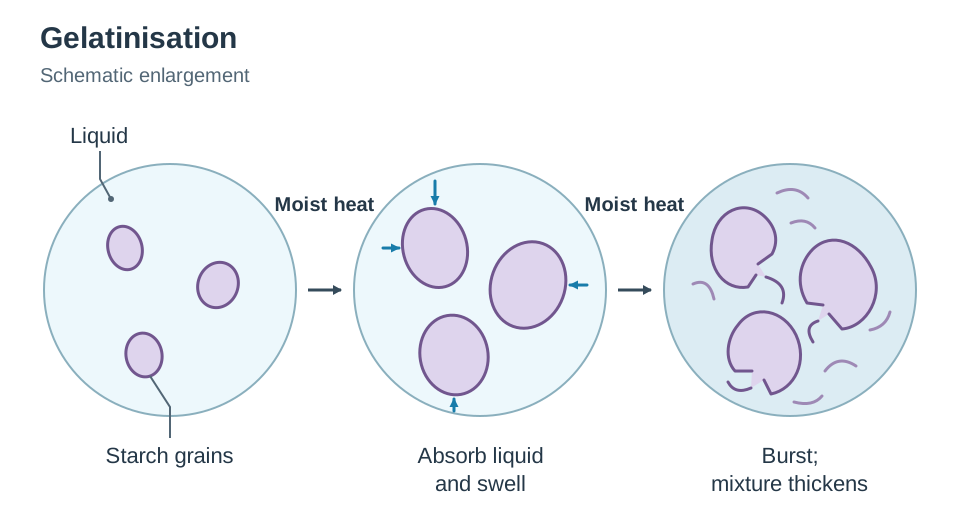
- Starch grains undergo gelatinisation: in moist heat they absorb liquid, swell, burst, and thicken the mixture (such as in a roux sauce).
- Plant cellulose (fibre) softens, making vegetables easier to chew and digest.
- Vitamin C and the B group vitamins are water-soluble, so they dissolve into cooking water, and prolonged heat destroys them. To preserve them, peel thinly and cook in minimal water for the shortest time.
Recipe Modification and Culinary Presentation
Recipes can be modified easily to meet healthy eating guidelines:
- Increase fibre: substitute wholemeal flour for white flour in pastry or crumbles, and add oats, lentils, or grated vegetables to mince.
- Reduce saturated fat: trim visible fat from meat, drain browned mince, swap whole milk for low-fat milk, and choose steaming or grilling over frying.
- Reduce sugar and salt: replace salt with garlic, citrus juice, or fresh herbs, and sweeten bakes with pureed fruit.
Good presentation makes dishes appealing:
- Garnish: added to savoury dishes (fresh parsley, chives, a lemon twist, or cucumber slices).
- Decorate: added to sweet dishes (piped cream, fresh berries, chocolate curls, or sifted icing sugar).
Key terms
- Conduction
- The transfer of heat from molecule to molecule through a solid object by direct contact.
- Convection
- The transfer of heat through liquids or gases by circulating currents of rising warm fluid and sinking cool fluid.
- Radiation
- The transfer of heat in straight rays directly from a heat source to the food surface without heating the air between.
- Coagulation
- The setting and firming of proteins when heated, occurring between 60°C and 70°C.
- Gelatinisation
- The process where starch grains absorb moist heat, swell, burst, and thicken a liquid.
- Simmering
- Cooking food gently in a liquid maintained just below boiling point, at approximately 90°C.
- Garnish
- An edible item added to a savoury dish to enhance its colour, flavour, or appearance.
- Decorate
- An edible item added to a sweet dish or baked good to enhance its appearance.
Check yourself
Which method of heat transfer browns bread under an electric grill?
Radiation.
What is the danger zone and why does it matter in food safety?
5°C to 63°C, the temperature range where food-poisoning bacteria multiply fastest.
What is the difference between boiling and simmering in terms of temperature?
Boiling occurs at 100°C with rapid bubbling, while simmering occurs at approximately 90°C with gentle, occasional bubbling.
What happens to starch grains when heated in a moist sauce?
They swell, burst, and absorb liquid, causing the sauce to thicken (gelatinisation).
Where should raw meat be stored in a domestic refrigerator?
Covered on the bottom shelf so juices cannot drip onto other food.