

Sewing is the skill of joining, repairing, and decorating fabrics by hand or using a sewing machine. For Junior Cycle Home Economics, you need to identify basic stitches, follow rules for operating and caring for a sewing machine, construct seams, and apply textile care symbols.
Essential Hand Stitches
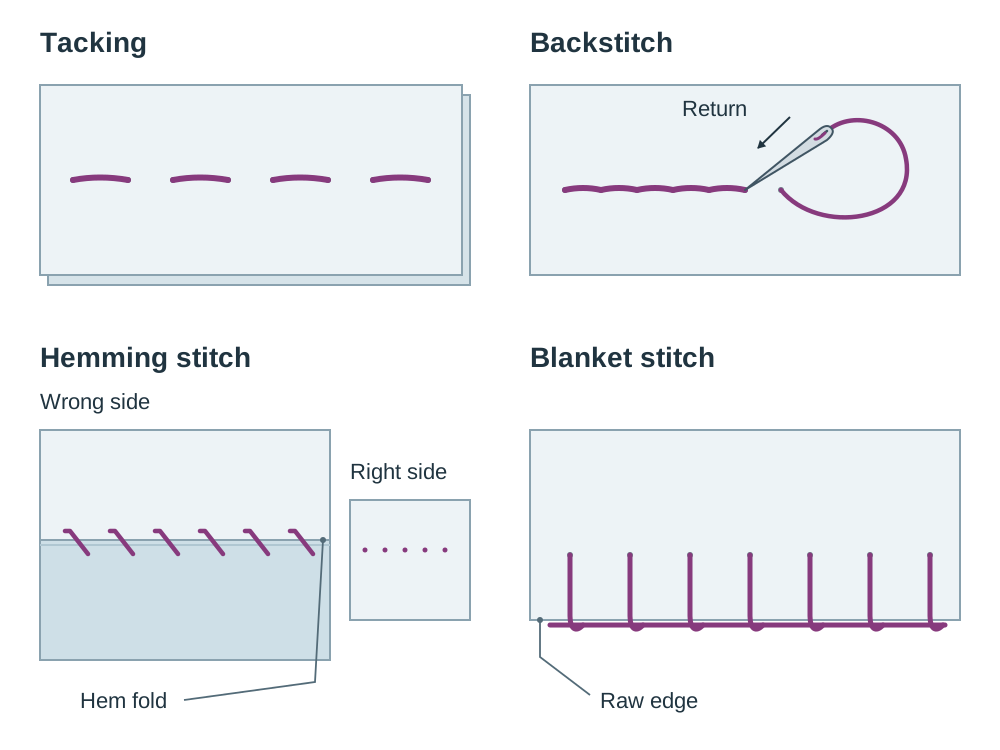
Hand sewing is used for temporary assembly, neat hems, repairs, and decorative finishes.
- Tacking: a loose, temporary stitch sewn in a contrasting thread to hold fabric layers together before permanent stitching. Pull it out once the permanent seam is sewn.
- Backstitch: a strong, permanent hand stitch where each stitch loops back into the start of the previous one. It replaces machine stitching on small, awkward seams.
- Hemming stitch: small, slanted stitches that catch the hem fold. The stitches are clear on the wrong side and show as tiny dots on the right side.
- Blanket stitch: a looped stitch worked along raw edges to prevent fraying or to secure appliqué shapes to a background fabric.
Operating and Caring for the Sewing Machine
A sewing machine joins the top thread and the bobbin thread underneath to make a strong, even row of stitches.
Rules for using
- Thread the machine correctly, following the threading guide on the machine, and use the correct needle and thread for the fabric.
- Test the stitch tension and length on a scrap piece of your fabric before starting.
- Lower the presser foot to hold the fabric flat against the feed dogs.
- Guide the fabric gently with flat hands; never push or pull it.
- Reverse stitch over the first and last few stitches to lock the seam.
Rules for caring
- Cover the machine when not in use to keep dust out of the mechanism.
- Oil moving parts occasionally and have the machine serviced regularly.
- Never run a threaded machine without fabric under the presser foot.
Common faults and solutions
| Fault | Common cause | Solution |
|---|---|---|
| Needle breaks | Sewing over metal pins | Remove pins before the needle reaches them |
| Thread snaps | Upper thread tension is too tight | Loosen the tension dial and re-thread |
| Skipped stitches | Needle is blunt, bent, or inserted incorrectly | Insert a new, correct needle facing the right way |
Flat Seams and Extending Textile Life
A seam joins two pieces of fabric. The flat seam is the standard construction method used in class projects.
Making a flat seam
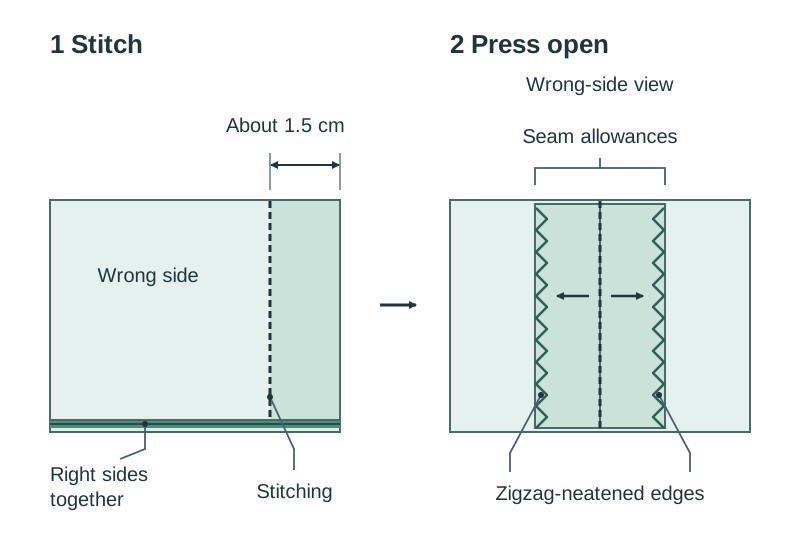
- Place the fabric pieces right sides together, matching the raw cut edges.
- Pin and tack along the seam line, then remove the pins.
- Machine stitch about 1.5 cm in from the cut edge. This strip of fabric between the stitching and the raw edge is the seam allowance.
- Remove the tacking stitches and press the seam open, using the correct iron temperature for the fabric.
- Neaten each raw edge with pinking shears or a machine zigzag stitch to stop fraying.
Ways to extend the life of textiles
- Repair: sew a button back on, patch a hole, darn a worn knee, or re-stitch a fallen hem.
- Reuse or re-purpose: cut old towels into cleaning cloths or turn a shirt into a cushion cover.
- Upcycling: add decorative fastenings like buttons, zips, or patch pockets to turn an unwanted item into something better.
- Recycle: bring unwearable textiles to a clothing bank rather than throwing them in the bin.
Embellishment and Textile Care Symbols
Embellishment adds colour, texture, and pattern to textiles. Common techniques include:
- Appliqué: stitching cut-out fabric shapes onto a background fabric using blanket stitch or machine satin stitch.
- Satin stitch: close, straight embroidery stitches worked side by side to fill solid shapes with colour.
Textile care symbols
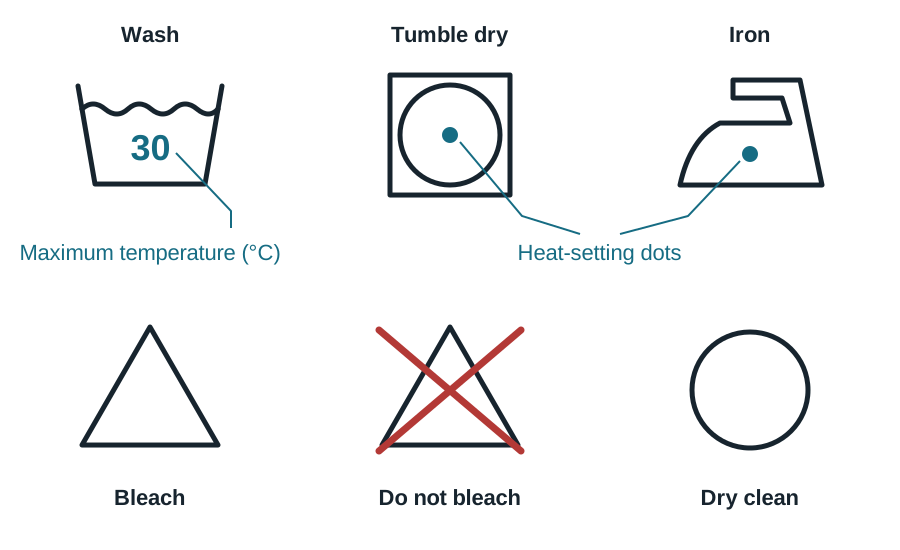
Care labels carry five basic symbols to guide cleaning. A cross through any symbol means do not do it.
| Symbol | Meaning | Example for fabrics |
|---|---|---|
| Washtub | Machine wash (number shows max temperature in °C) | Cotton takes 60°C; wool needs a cool 30°C wash |
| Triangle | Bleaching allowed; crossed out means do not bleach | Most dyed clothes carry a crossed triangle |
| Square with circle | Tumble drying (dots indicate heat setting) | One dot for delicate synthetics; two for cotton |
| Iron | Ironing (one dot cool, two dots warm, three dots hot) | Cool iron for nylon/polyester; hot iron for linen |
| Circle | Dry clean only (letters guide the dry cleaner) | Used on tailored wool coats and delicate silks |
Key terms
- Tacking
- A loose, temporary running stitch used to hold fabric layers together before permanent stitching.
- Backstitch
- A strong, permanent hand stitch with overlapping stitches, used where a machine cannot reach.
- Presser foot
- The metal attachment that holds fabric flat against the feed dogs during machine sewing.
- Feed dogs
- The toothed metal mechanism beneath the needle plate that moves fabric forward through the machine.
- Seam allowance
- The strip of fabric between the stitching line and the raw cut edge, usually about 1.5 cm wide.
- Appliqué
- A decorative technique where cut fabric shapes are stitched onto a base fabric to form a pattern.
- Upcycling
- Refashioning discarded garments or textiles into new products of higher quality or usefulness.
Check yourself
What is the seam allowance?
The fabric between the stitching line and the raw cut edge, usually about 1.5 cm.
Give one reason a sewing-machine needle might break.
Sewing over metal pins, or pulling the fabric while the needle is down.
What does a cross through a textile care symbol mean?
It means do not carry out that action, such as do not bleach or do not tumble dry.
Which embroidery stitch is used to fill a shape with solid colour?
Satin stitch.