

Textile sustainability covers how fabrics and garments are produced, bought, looked after, and disposed of to protect people and the environment. In the examination you may be asked to discuss ecological and ethical issues in clothing, to explain how textiles can be repaired, reused, repurposed, recycled or upcycled, and to read textile care symbols.
Ecological and Ethical Issues in Textiles
Fast fashion means huge amounts of cheap clothing are made quickly to follow changing trends. This damages the environment and harms the people who make it.
| Ecological Issues (The Planet) | Ethical Issues (People and Animals) |
|---|---|
| Fossil fuels: synthetic fibres like polyester are made from non-renewable oil. | Low pay: workers in low-income countries are often paid very little for long hours. |
| Water and land: cotton farming needs vast areas of agricultural land and thousands of litres of water. | Unsafe factories: poor building safety, lack of fire exits, and inadequate ventilation. |
| Chemical pollution: toxic dyes and pesticides pollute rivers and harm wildlife. | Child labour: children are illegally employed instead of going to school. |
| Microplastics: washing synthetic garments sheds tiny plastic fibres into rivers and oceans. | Animal welfare: intensive farming or trapping for fur and leather harms animals. |
Influences on Clothing Choices and Sustainable Shopping
Teenagers face many pressures when choosing clothing, but consumers can make choices that reduce textile waste.
Influences and Factors to Consider
- Factors influencing what we buy include fashion trends, social media, advertising, peer pressure, and brand marketing.
- When buying clothes, sensible consumers consider cost, fit and size, quality and durability, suitability for purpose, and care instructions.
Shopping More Sustainably
- Buy fewer, better-quality garments made to last rather than disposable fashion.
- Shop second-hand in charity shops, visit vintage outlets, or swap clothes with friends.
- Rent formal outfits for once-off occasions like graduations or weddings.
- Check the care label and fibre content before purchasing, opting for organic cotton, recycled fibres, or Fairtrade items.
The 5 Rs and Practical Repair
Extending the life of existing garments keeps waste out of landfill and reduces demand for new raw materials.
| Action | Definition | Everyday Example |
|---|---|---|
| Repair | Mending damage to keep an item functional | Restitching an open seam or replacing a broken zip |
| Reuse | Using an item again for its original purpose | Passing outgrown clothes to siblings or charity shops |
| Repurpose | Changing an item into something with a completely new function | Cutting worn towels into cleaning cloths or making curtains into bags |
| Upcycle | Redesigning an item to add value, beauty, or usefulness | Turning old denim jeans into a fashionable shoulder bag |
| Recycle | Breaking old textiles down industrially to make new products | Shredding worn clothes to produce carpet underlay or home insulation |
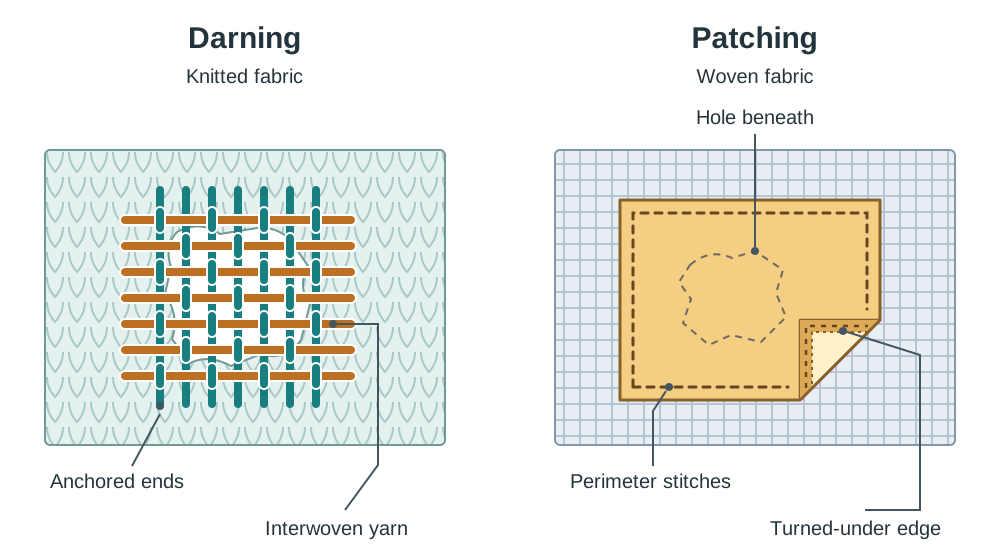
Basic Mending Techniques
- Darning: interweaving yarn across a hole in two directions to repair knitted items such as socks.
- Patching: stitching a piece of fabric over a hole in woven items, turning in the raw edges to prevent fraying.
Eco-Friendly Textile Care in the Home
Washing and drying clothes uses a lot of electricity and water. Better laundry habits save both and cause less pollution.
- Wash at lower temperatures: washing everyday items at 30°C uses far less electricity than 60°C cycles.
- Wash full loads: wait until there is a full machine load to avoid wasting water and power on half-empty drums.
- Detergent choice: choose eco-friendly, phosphate-free, or concentrated detergents to reduce packaging waste and prevent water pollution.
- Air-dry naturally: dry clothes on a washing line outdoors or on a clothes horse indoors rather than using an electric tumble dryer.
- Avoid dry cleaning: dry cleaning uses strong chemical solvents, so wash at home whenever the garment label allows.
Understanding Textile Care Symbols
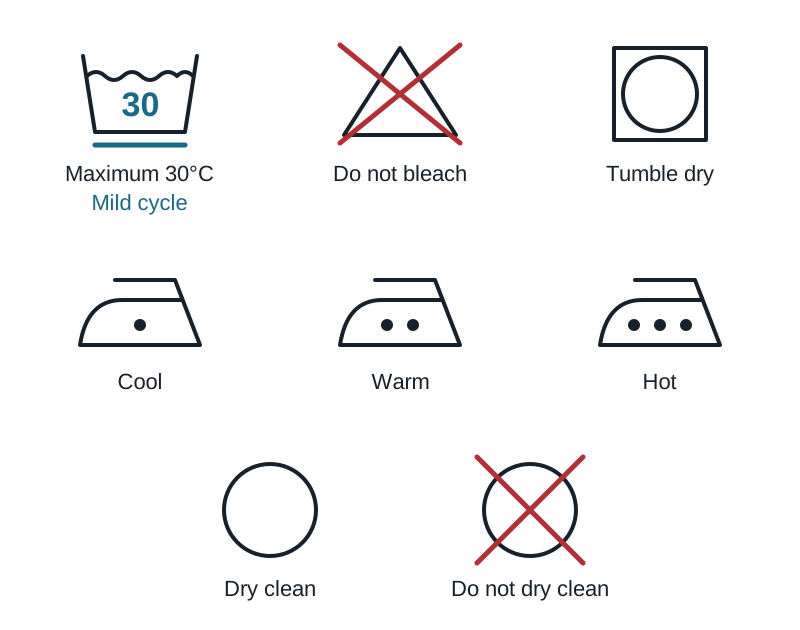
Garment care labels follow the International Care Labelling Scheme. Each symbol shape represents a specific cleaning process, while a cross through any symbol means that process must not be used.
- Wash tub: shows washing instructions. Numbers give the maximum safe water temperature in degrees Celsius (such as 30°C or 40°C). A bar underneath indicates a mild wash cycle with reduced spin, while a hand inside means hand wash only.
- Triangle: indicates bleaching. A plain triangle permits bleach, whereas a crossed-out triangle forbids it.
- Iron: shows ironing temperature using dots. One dot is cool, two dots are warm, and three dots mean hot.
- Square: indicates drying. A circle inside means tumble drying; a curved top line means line dry; vertical lines mean drip dry; a flat bar means dry flat.
- Circle: indicates professional dry cleaning. A crossed-out circle means do not dry clean.
Key terms
- Fast fashion
- Inexpensive clothing produced rapidly by mass-market retailers to capture catwalk trends, leading to frequent purchases and rapid disposal.
- Microplastics
- Tiny plastic fibres shed from synthetic fabrics like polyester during washing that pollute waterways and oceans.
- Darning
- A repair technique where threads are interwoven across a hole in two directions to rebuild knitted fabrics.
- Patching
- A mending method where a piece of fabric is stitched over a hole or worn area on a woven garment.
- Care label
- A label attached to or supplied with a textile item giving international symbols for washing, bleaching, drying, ironing, and dry cleaning, plus fibre content.
Check yourself
What non-renewable raw material is used to manufacture synthetic fibres such as polyester and nylon?
Crude petroleum oil.
Name two things a teenager should check on a label before buying a jumper.
Fibre content and care instructions (or price and size).
What is the difference between reusing an old shirt and repurposing it?
Reusing keeps the original purpose (e.g. wearing it or donating it), while repurposing gives it a new function (e.g. cutting it into dusting rags).
Which repair technique should you use to mend a small hole in a knitted wool sock?
Darning.
What does a care symbol showing a square with a circle inside mean?
Tumble dry.