

Home baking is making your own breads, cakes, and pastries from scratch rather than buying commercial products. Junior Cycle exam questions test ingredient functions, raising agents, mixing methods, doneness tests, recipe costing, and healthy recipe adaptations.
Core Ingredients and Heat Transfer
Every basic ingredient has a job to do in a baked mixture.
- Flour gives structure through gluten, a stretchy protein formed when wheat flour mixes with liquid.
- Fat adds flavour, keeps bakes fresh, and provides shortening by coating flour particles to produce a crumbly texture.
- Sugar sweetens the mixture, softens crumb texture, and caramelises under heat to give a golden crust.
- Eggs trap air when beaten, bind ingredients together, and coagulate in the oven to set the shape.
- Liquid binds dry ingredients and activates chemical raising agents.
People with coeliac disease must avoid gluten completely. For them, use certified gluten-free flour and clean utensils to prevent cross-contamination.
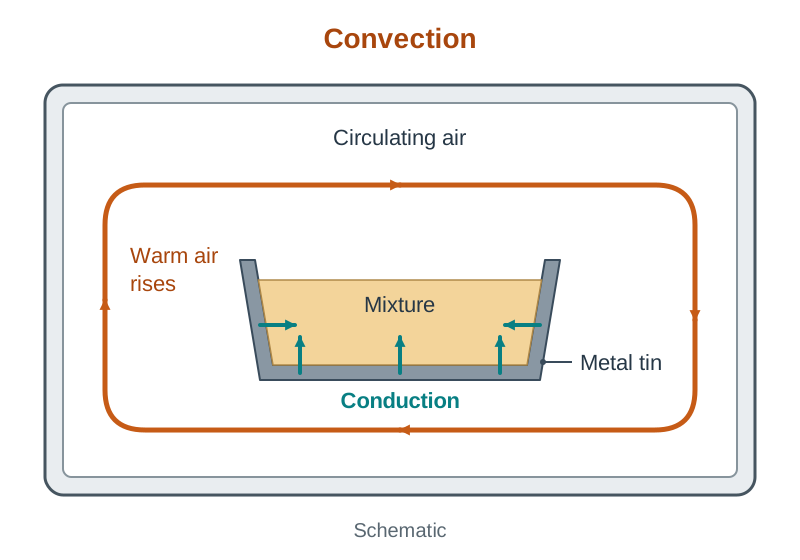
Baking cooks food by convection. Warm air expands, rises, and circulates in continuous currents around the oven. Conduction also heats the food directly where the mixture touches the metal baking tin.
Raising Agents and How They Work
A raising agent introduces gas into a mixture to give it a light, open texture.
All raising agents follow three simple steps: gas enters or forms in the mixture, oven heat expands the gas bubbles to push the dough upwards, and heat sets the structure around them.
| Type | Examples | How Gas Is Formed |
|---|---|---|
| Natural (Mechanical) | Air | Trapped by sieving flour, creaming fat and sugar, or whisking eggs |
| Chemical | Baking powder, bread soda | Produces carbon dioxide (CO₂) gas through an acid-alkali reaction with liquid and heat |
| Biological | Yeast | A living fungus that ferments sugar to produce carbon dioxide (CO₂) gas and alcohol |
Baking powder contains both an acid and an alkali. Bread soda is just an alkali, so it needs an acidic liquid like buttermilk to react and produce gas.
Mixing Methods and Pastry Making
The way you combine ingredients decides the finished texture of your bake.
- Rub-in method: rub cold fat into flour using your fingertips until it looks like breadcrumbs, used for scones and pastry.
- Creaming method: beat softened fat and sugar together until pale and fluffy to trap air, used for queen cakes.
- Whisking method: whisk eggs and sugar until thick and frothy before folding in flour, used for fatless sponges.
- All-in-one method: beat all ingredients together in one bowl at the same time, used for quick sandwich cakes.
- Melting method: melt fat and syrup together in a saucepan before stirring in dry ingredients, used for gingerbread.
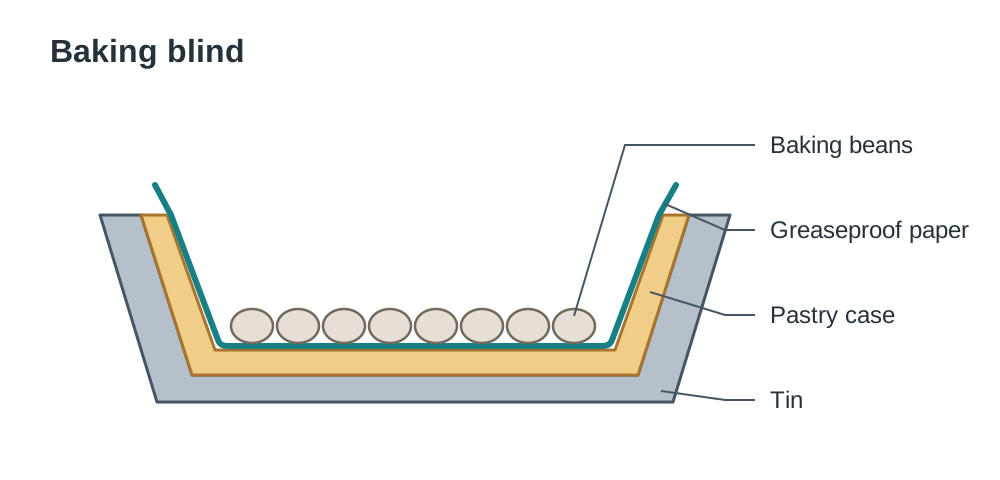
Shortcrust pastry uses a 2:1 ratio of flour to fat, such as 200 g flour to 100 g butter. Keep ingredients cold and handle the dough as little as possible to stop tough gluten developing. Baking blind means pre-baking an empty pastry case lined with greaseproof paper and baking beans so the base stays crisp before adding a wet filling.
Doneness Tests, Healthy Swaps, and Mixes
Always check your bake before taking it out of the oven.
- Bread: tap the bottom of the loaf; it should sound hollow.
- Sponge: press the top gently with a fingertip; it should spring back.
- Cakes: insert a clean skewer into the centre; it must come out clean and dry.
Commercial cake mixes save time and effort for beginners, but they cost more and often contain extra sugar and additives. Baking from scratch gives you control over ingredients and costs less.
You can easily make recipes healthier. Swap white flour for wholemeal flour to boost dietary fibre, cut added sugar by a third, or fold in fresh fruit like berries for extra vitamins. Remember to cool bakes on a wire tray so steam escapes, preventing a soggy bottom.
Key terms
- Gluten
- A stretchy protein formed when wheat flour proteins combine with liquid, providing structure to baked goods.
- Shortening
- The ability of fat to coat flour particles and limit gluten development, creating a crumbly, melt-in-the-mouth texture.
- Raising agent
- A substance or action that introduces gas into a mixture to make it rise and turn light.
- Convection
- The transfer of heat through circulating currents of heated air or liquid.
- Baking blind
- Pre-baking an unfilled pastry case lined with greaseproof paper and baking beans to keep the base crisp.
- Coeliac disease
- An autoimmune condition where eating gluten damages the small intestine and stops proper nutrient absorption.
Check yourself
Which method of heat transfer circulates hot air around an oven to bake food?
Convection.
What is the standard ratio of flour to fat in shortcrust pastry?
2:1 (two parts flour to one part fat).
How do you test a freshly baked loaf of soda bread for doneness?
Tap the base of the loaf; it should sound hollow.
Why must separate chopping boards and utensils be used when baking for someone with coeliac disease?
To prevent cross-contamination from wheat flour containing gluten.
What gas is produced when yeast ferments sugar during bread making?
Carbon dioxide (CO₂).