

Digestion breaks down food into simple, soluble nutrients that enter the bloodstream to nourish your body. In the Junior Cycle exam, you need to describe the main organs, contrast physical and chemical breakdown, and state the end products of nutrients.
The Digestive Tract
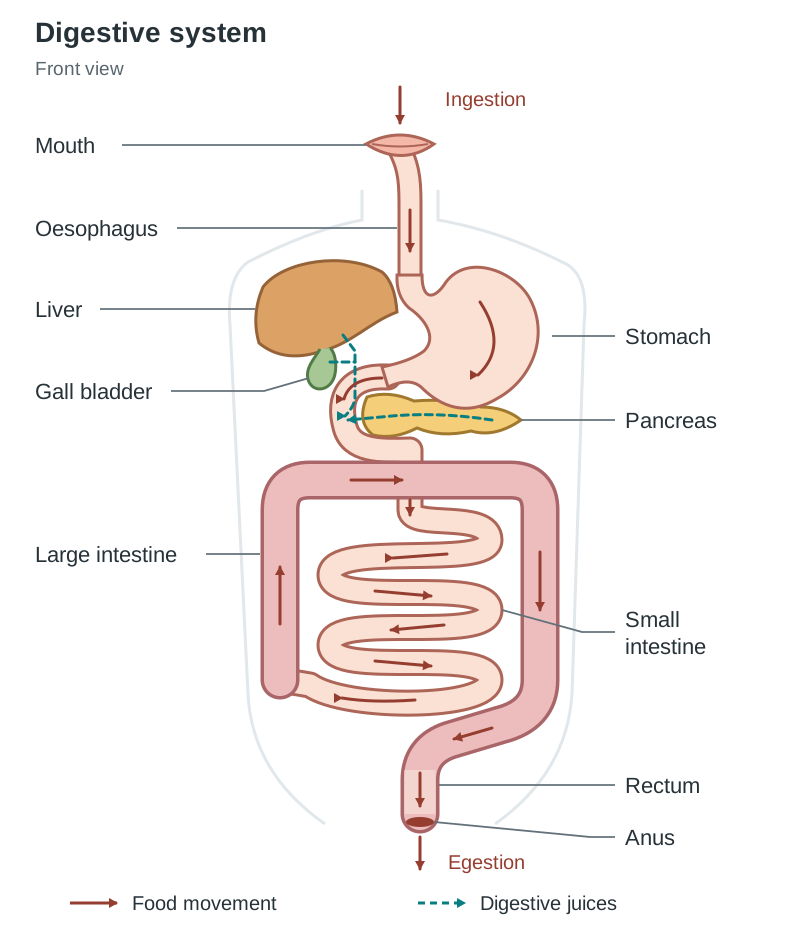
Food travels through the body inside a continuous muscular tube known as the digestive tract.
- Food moves through these organs in order: mouth, oesophagus, stomach, small intestine, large intestine, rectum, and anus.
- Ingestion means taking food in through the mouth, while egestion means expelling undigested waste through the anus.
- The liver, gall bladder, and pancreas act as accessory organs.
- Food never enters these accessory organs, but they supply vital digestive juices to the tract.
Physical versus Chemical Digestion
Your body uses two distinct methods to break down food before absorption can happen.
- Physical digestion breaks food into smaller pieces by chewing or muscular churning without changing any chemical structures.
- Chemical digestion uses biological chemicals called enzymes to break large food molecules into simple units.
- Each enzyme is specific and breaks down only one nutrient type.
| Nutrient | Simplest absorbable unit |
|---|---|
| Carbohydrates (starch) | Glucose (simple sugars) |
| Proteins | Amino acids |
| Fats | Fatty acids and glycerol |
Vitamins, minerals, and water are already small enough to pass into the blood without digestion. Fibre cannot be digested, but it provides bulk to keep waste moving.
The Upper Digestive Tract: Mouth to Stomach
Digestion starts straight away once you take a bite of food.
- In the mouth, teeth chew food into small pieces while saliva moistens the food.
- Saliva contains salivary amylase, an enzyme that starts breaking down cooked starch into simple sugars.
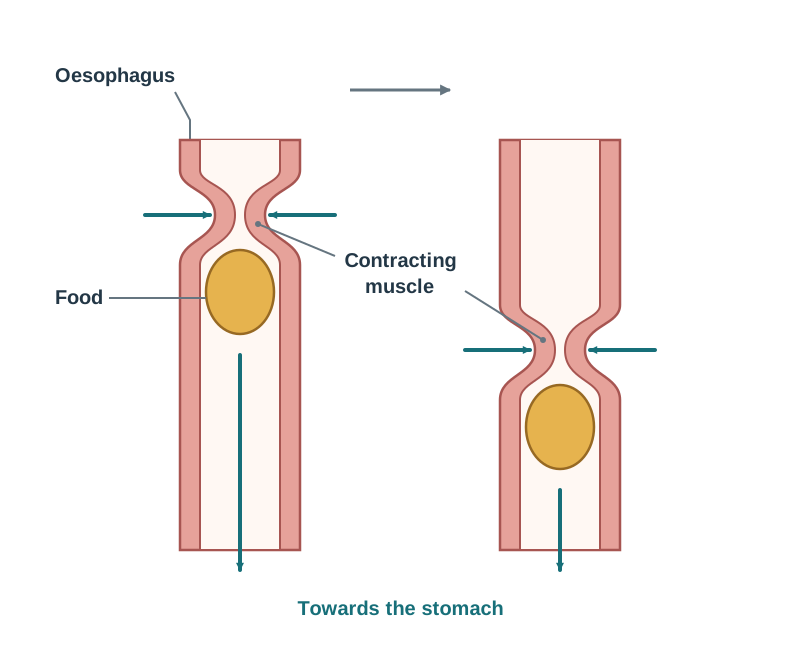
- The oesophagus is a muscular pipe that pushes food downward using wave-like muscular contractions called peristalsis.
- The stomach churns food with gastric juice for one to four hours.
- Gastric juice contains pepsin, an enzyme that begins splitting proteins into simpler units.
- Gastric juice also contains hydrochloric acid, which kills bacteria and provides the acid conditions pepsin requires.
- A thick layer of mucus lines the stomach wall so the acid cannot damage the organ.
The Lower Digestive Tract: Small and Large Intestines
Most chemical digestion and nearly all absorption take place in the small intestine.
- The liver makes bile, which is stored in the gall bladder and emulsifies fats into tiny droplets.
- The pancreas sends pancreatic juice into the small intestine to break down starches, proteins, and fats.
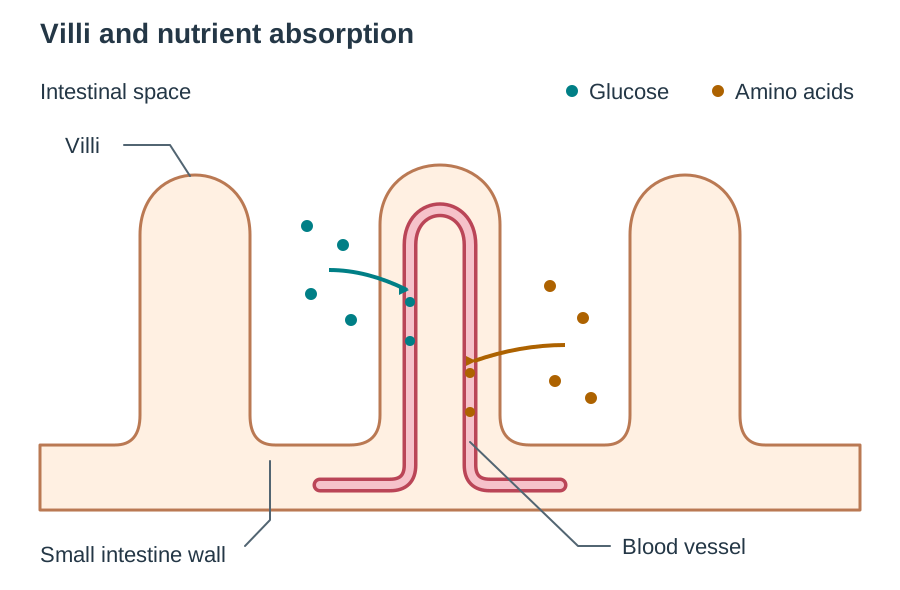
- Millions of tiny, finger-like projections called villi line the small intestine wall to absorb nutrients into the blood.
- The large intestine absorbs water and dissolved minerals from the remaining waste.
- Harmless gut bacteria in the large intestine produce vitamins B and K for the body.
- Semi-solid waste gathers in the rectum before leaving the body through the anus.
Key terms
- Digestion
- The breakdown of food into simple, soluble substances that can be absorbed into the bloodstream.
- Enzymes
- Biological chemicals that speed up the breakdown of specific nutrients into their simplest forms.
- Peristalsis
- The wave-like muscular contractions that push food along the digestive tract.
- Absorption
- The movement of digested nutrients through the wall of the small intestine into the bloodstream.
- Villi
- Tiny, finger-like projections lining the small intestine that create a large surface area for nutrient absorption.
- Bile
- A fluid made by the liver and stored in the gall bladder that breaks fats into small droplets.
- Salivary amylase
- An enzyme in saliva that begins the breakdown of starch into sugars in the mouth.
- Pepsin
- An enzyme in gastric juice that begins breaking down proteins in the stomach.
Check yourself
What is the correct order of organs through which food passes?
Mouth, oesophagus, stomach, small intestine, large intestine, rectum, and anus.
What muscular movement pushes food down the oesophagus?
Peristalsis.
Which enzyme starts breaking down starch in the mouth?
Salivary amylase.
Give two jobs done by hydrochloric acid in the stomach.
It kills harmful bacteria and provides an acid environment for pepsin to work.
What are the absorbable end products of fat digestion?
Fatty acids and glycerol.