

Food safety and hygiene involves handling, preparing, cooking, storing and serving food properly to prevent illness and spoilage. In the Junior Cycle written exam and practical food skills exam, you must explain safe kitchen practices, know critical temperatures, and prevent cross-contamination.
Food Spoilage and Bacterial Growth
Food spoilage is caused by natural food enzymes and micro-organisms (tiny living things) such as bacteria, yeasts and moulds. Bacteria are the main cause of food poisoning.
Bacteria need six conditions to grow and multiply:
- Food: High-risk foods rich in moisture and protein, like milk, meat and eggs.
- Warmth: Most multiply fastest between 30°C and 40°C.
- Moisture: Needed to absorb nutrients.
- Time: In warm conditions, one bacterium can divide in two every 20 minutes.
- Oxygen: Most bacteria need air, though some can multiply without it in sealed cans.
- Suitable pH: Bacteria prefer neutral or slightly acidic conditions; strong acids like vinegar slow them down.
Common food-poisoning bacteria include Salmonella (raw poultry, eggs), Campylobacter (raw poultry, unpasteurised milk), E. coli (undercooked minced beef), and Listeria (soft cheeses, pâté). Common symptoms include stomach cramps, nausea, vomiting, diarrhoea and fever.
Temperature Control and Safe Thawing
Controlling temperature stops bacteria from multiplying.
| Temperature Range | Food Environment | Effect on Bacteria |
|---|---|---|
| -18°C or colder | Domestic freezer | Bacteria become dormant (inactive); freezing does not kill them |
| 0°C to 5°C | Domestic refrigerator | Slows down bacterial growth and multiplication |
| 5°C to 63°C | The Danger Zone | Bacteria multiply rapidly; keep perishable food out of this zone |
| 75°C or higher | Centre (core) of cooked food | Kills most harmful bacteria — check the thickest part reaches 75°C |
Thaw frozen meat and poultry fully before cooking. Always thaw food in the fridge overnight on a plate, never on the worktop at room temperature. Never refreeze food once it has thawed. Cool cooked leftovers within two hours, store them in the fridge, and reheat them only once until piping hot.
Safe Food Storage and Refrigerator Care
Correct storage keeps food safe and prevents waste.
- Using a fridge: Keep temperatures between 0°C and 5°C. Never put hot food inside. Cover or wrap all foods. Do not over-pack shelves because cold air needs to circulate freely, and close the door promptly.
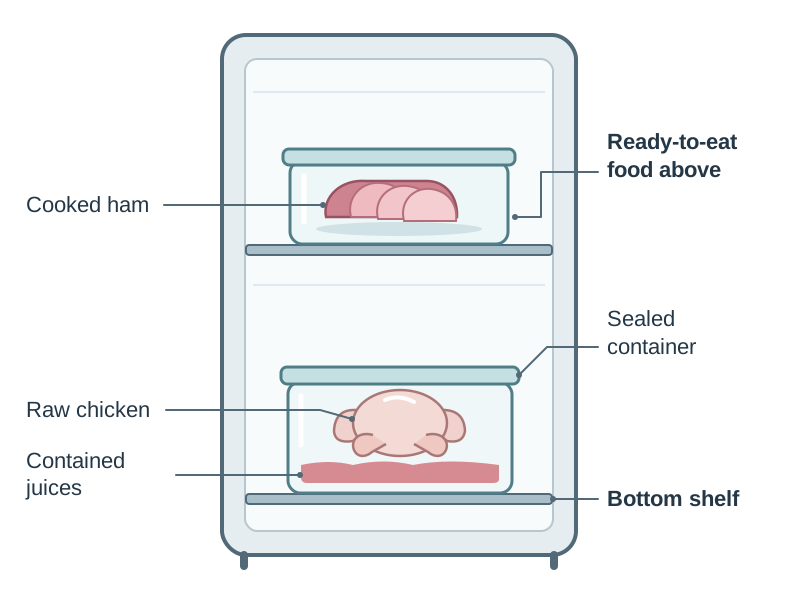
- Shelf placement: Store raw meat, poultry and fish in sealed containers on the bottom shelf. Place cooked and ready-to-eat foods on higher shelves. For example, keep cooked ham on the top shelf and raw chicken sealed on the bottom shelf so drips cannot land on the ham.
- Cleaning a fridge: Switch off and take out all food. Remove drawers and shelves to wash in warm, soapy water. Wipe the inside with warm water and bread soda, then dry with a clean cloth before restocking.
- Date marks: A use-by date is a legal safety deadline for perishable foods; never eat food past this date. A best-before date relates to quality and flavour rather than safety.
Preventing Cross-Contamination and Safe Serving
Cross-contamination is the transfer of harmful bacteria from raw food, dirty equipment, or food handlers onto cooked or ready-to-eat food.
To prevent it:
- Wash hands with warm water and soap before cooking, after using the toilet, and after touching raw meat.
- Tie back long hair, wear a clean apron, remove jewellery, and cover cuts with a waterproof plaster.
- Use colour-coded chopping boards: red for raw meat, blue for raw fish, yellow for cooked meat, and green for fruit and salad.
- Never wash raw chicken under the tap, as water droplets splash bacteria onto nearby surfaces.
Safe serving
Serve hot food piping hot (above 63°C) straight away. Keep cold dishes below 5°C until serving. Use clean serving spoons, never reuse plates that held raw meat, and cover food waiting to be served.
Key terms
- Cross-contamination
- The transfer of harmful bacteria from raw food, dirty surfaces, equipment, or hands onto cooked or ready-to-eat food.
- Danger Zone
- The temperature range between 5°C and 63°C where food-poisoning bacteria multiply most rapidly.
- Food poisoning
- An illness caused by eating food containing harmful bacteria, viruses, or the toxins they produce.
- High-risk food
- Moist, protein-rich food that bacteria multiply in quickly, such as cooked meat, poultry, dairy, eggs, and seafood.
- Use-by date
- A legal safety deadline found on perishable foods; food should never be eaten after this date.
- Best-before date
- A date mark indicating when food is at its best quality; the food is still safe to eat after this date.
Check yourself
What is the temperature range of the bacterial danger zone?
Between 5°C and 63°C.
What is the correct operating temperature range for a domestic refrigerator?
Between 0°C and 5°C.
Name one common food-poisoning bacterium and identify a common source of it.
Salmonella; found in raw poultry, raw eggs, or raw meat.
Why should frozen meat always be thawed in the fridge rather than on a kitchen worktop?
To keep the surface of the meat below 5°C so bacteria cannot enter the danger zone and multiply while the centre thaws.