
A polygon is a flat, closed 2D shape with straight sides, and a regular polygon has all sides equal in length and all interior angles equal in size. In the exam, you will name polygons in everyday objects, construct them accurately with drawing instruments, take measurements from drawings, and solve 3D spatial visualisation puzzles.
Regular Polygons and Angle Formulas
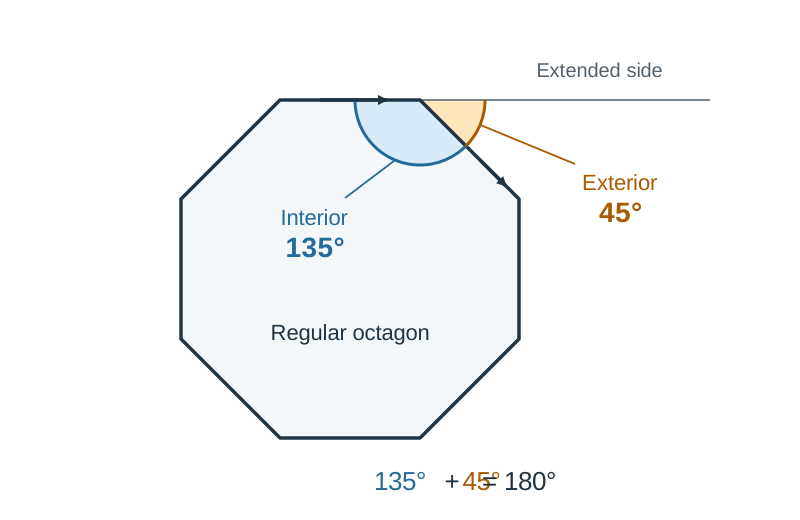
Two simple formulas connect the number of sides () to the angles of any regular polygon:
The exterior angle is the turn you make at each corner to complete a full circuit around the perimeter. Because the interior and exterior angles meet on a straight line, they always add up to . Turning a shape does not change it: a square standing on a corner is still a square with four angles.
| Sides () | Shape | Exterior Angle | Interior Angle | Everyday Example |
|---|---|---|---|---|
| 5 | Pentagon | |||
| 6 | Hexagon | Honeycomb cell, bolt nut | ||
| 7 | Heptagon | |||
| 8 | Octagon | Stop sign |
Constructing Polygons and Pitch Circles
Construct regular polygons and circular patterns using standard methods:
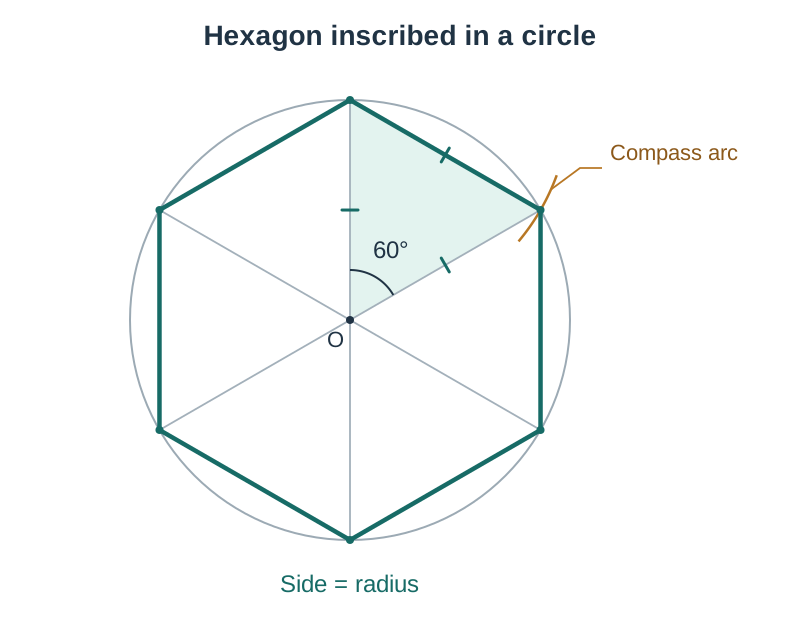
- Inscribed in a circle: Divide by the number of sides to get the central angle. Draw radii from the centre at that angle apart; where they hit the circle gives the corners. Join neighbouring corners. For a regular hexagon, the side length equals the radius, so step the radius six times around the circumference with your compass.
- Locating the centre: Bisect the interior angles at two adjacent corners; their intersection gives the centre.
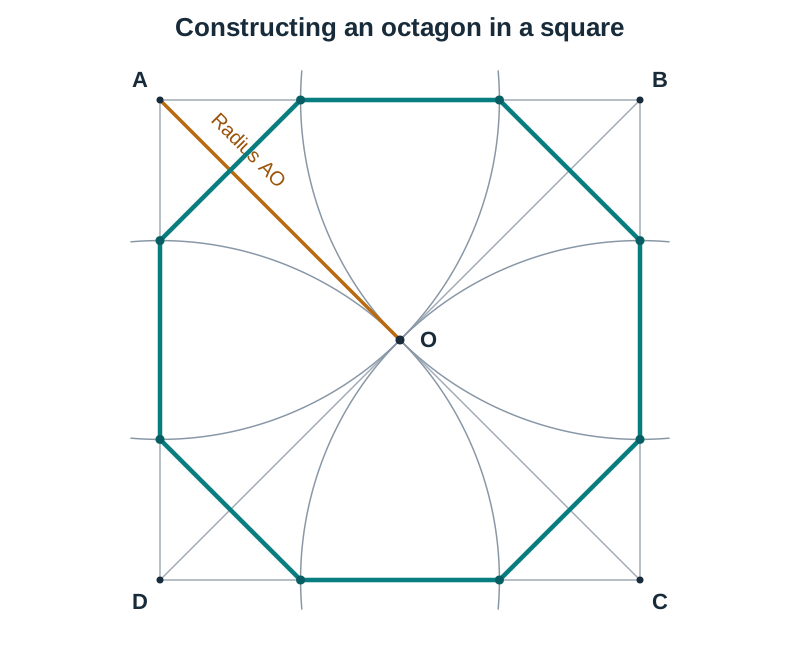
- Octagon in a square: Draw the square and diagonals to find centre . Set your compass to half the diagonal (corner to ) and swing arcs from each corner across the sides. Join the eight cut points in order.
- Pitch circle: Draw the circle through feature centres and divide by the number of features to space them equally.
Measuring from Printed Drawings
Exam papers often ask you to measure features from a given printed graphic before redrawing:
- Angles: Place the crosshairs of your protractor precisely over the vertex, line up the zero baseline with one arm, and read the angle off the correct scale.
- Side lengths: Measure straight lines with your ruler. Record measurements in the units and precision requested, normally millimetres (for example, ).
- Radius: Locate the centre point of the arc or circle first, then measure the straight distance from that centre to the curved edge (for example, ).
- Never guess or calculate an angle from polygon formulas if the question tells you to measure it directly from the drawing.
Spatial Reasoning and 3D Visualisation
Spatial reasoning means mentally picturing and rotating objects in 2D and 3D space:
- Counting blocks: Count by layers or columns, including hidden blocks established by the drawing or stated arrangement.
- Missing blocks: Count the empty spaces column by column. Only use minus the blocks present if the completed object forms a full solid box.
- Matching and rotating: Pick one distinct landmark corner or face and follow where it lands after a turn; rotating an object never alters its true lengths or angles.
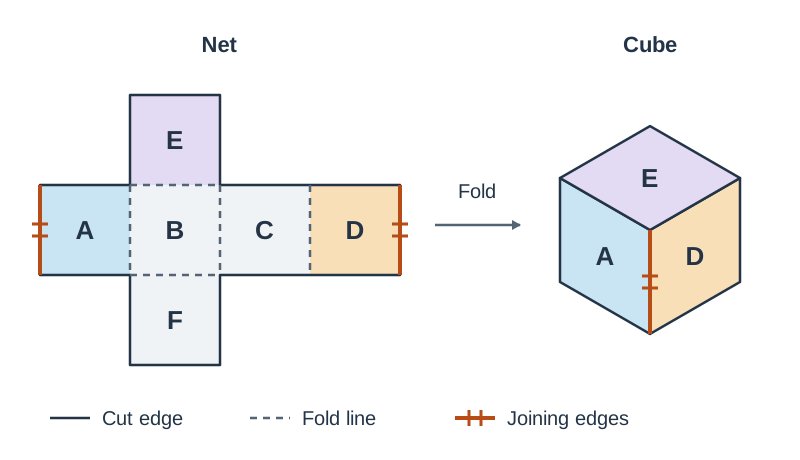
- Surface developments: When matching flat nets to 3D shapes, check the number and shape of faces first, then check which edges must fold together. Physical models or simulations help verify which edges stay hidden.
Key terms
- Regular Polygon
- A closed 2D shape with straight sides where all side lengths are equal and all interior angles are equal.
- Exterior Angle
- The angle between a side of a polygon and the extended adjacent side; for a regular polygon, it equals 360° ÷ n.
- Interior Angle
- The angle inside a polygon between two adjacent sides, equal to 180° minus the exterior angle.
- Inscribed
- Drawn completely inside a circle or shape so that every vertex touches the outer boundary.
- Pitch Circle
- A construction circle along which the centres of equally spaced features, such as holes or bolts, are positioned.
- Radius
- The straight-line distance from the exact geometric centre of a circle or arc to its circumference.
- Spatial Reasoning
- The ability to picture, manipulate, rotate, and mentally transform 2D shapes and 3D objects.
Check yourself
What is the exterior angle of a regular pentagon?
72° (calculated as 360° ÷ 5).
When a regular hexagon is inscribed in a circle of radius 35 mm, what is its side length?
35 mm, because an inscribed regular hexagon's side length always equals the circle's radius.
How do you find the exact centre of any regular polygon using geometric construction?
Bisect the interior angles at any two adjacent corners; their intersection point marks the centre.
You are asked to measure radius R from a printed drawing. What do you do first?
Find the centre point of the arc, then measure from the centre to the arc with your ruler and record the answer in mm.
A complete rectangular solid measures 4 blocks long, 2 blocks wide, and 3 blocks high. If an incomplete stack has 17 blocks, how many are missing?
7 blocks (total capacity is 4 × 2 × 3 = 24 blocks; 24 - 17 = 7).