
Enlargements and reductions change the size of a shape while keeping its proportions and internal angles identical. Practise using scale ratios, a pole and radial lines to construct resized figures accurately.
Scale ratios and similar figures
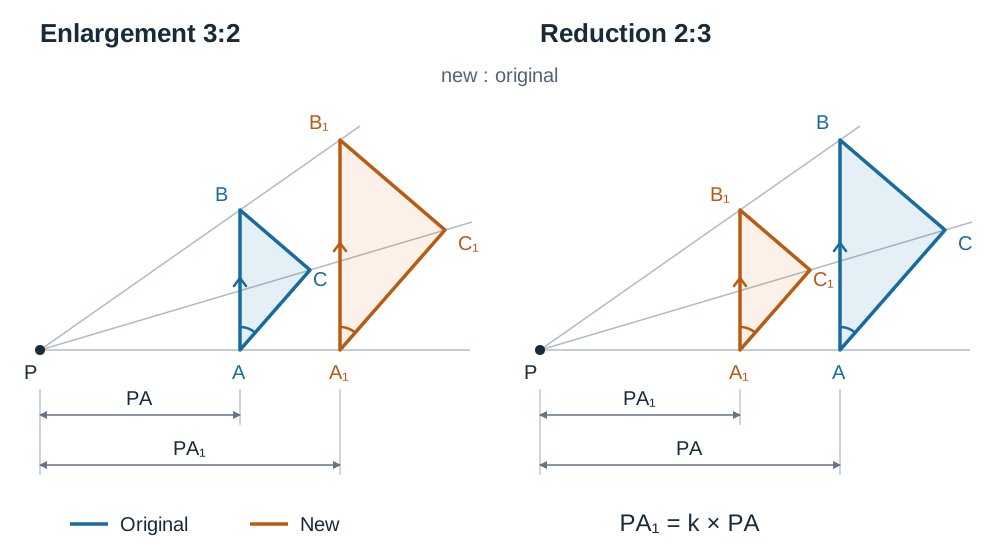
In this note, ratios mean new : original. Both figures end up mathematically similar, which means their sides stay in proportion and their angles never change.
- A ratio of 3:2 makes the drawing larger, while 2:3 makes it smaller.
- Matching sides on the original and resized drawings always stay parallel.
- Every corner angle remains identical after resizing.
- Use line division to locate the first new corner, then construct parallel sides with sliding set squares.
The radial line method
Every enlargement or reduction needs a fixed reference point called the pole, or centre of enlargement. The pole can sit outside the object, inside it, or directly on one of its corners.
- Draw light projection rays from the pole through every corner of the original figure.
- If a corner is chosen as the pole, that point stays fixed.
- In an enlargement, corners away from the pole sit further out along the rays past the original corners.
- In a reduction, corners away from the pole sit along the rays between the pole and the original corners.
- Scale factor k = new length ÷ original length. Choose A away from P; locate A1 on ray PA so PA1 = k × PA.
Completing shapes with sliding set squares
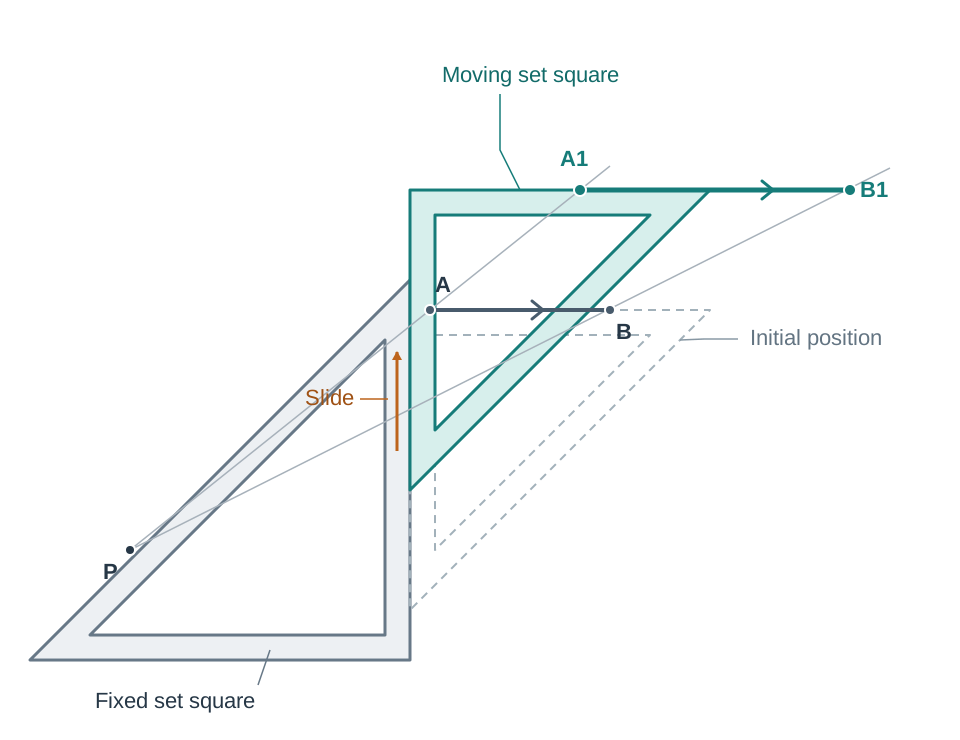
You do not need to divide every projection ray by hand. Once you find your first new corner, finish the outline using parallel lines.
- Align one set square along an original edge and support it with your second set square.
- Slide the set square until its edge reaches the new corner point.
- Draw a parallel line across to cut the next projection ray.
- Work your way around each edge until the boundary closes.
- For arcs and circles, project the centre point onto its own ray and multiply the radius by the same k.
Finding the pole and scale ratio
Given an original and resized figure, you can find the pole and scale ratio.
- Draw a straight line through a pair of matching corners, such as point A and point A1.
- Draw a second line through another matching pair until both lines cross.
- That crossing point is the pole.
- To find the ratio, measure matching sides and write the values as new length to original length.
- Simplify this fraction down to lowest whole numbers, such as 50:25 becoming 2:1.
Key terms
- Enlargement
- A transformation that increases the size of a shape by a set ratio without altering its angles.
- Reduction
- A transformation that decreases the size of a shape by a set ratio without altering its angles.
- Pole
- The fixed centre of enlargement where all radial projection rays meet.
- Scale ratio
- The relationship between drawing dimensions, written in this note as new : original.
- Radial lines
- Light construction lines drawn from the pole through each vertex of a figure.
- Similar figures
- Shapes that share identical angles and proportional side lengths, differing only in overall size.
Check yourself
What happens to the corner angles of a polygon when it is enlarged?
They remain unchanged because the resized shape is mathematically similar.
Is a drawing created in the ratio 2:5 an enlargement or a reduction?
It is a reduction because the new dimension is smaller than the original.
Where does a new corner away from the pole lie along a projection ray during an enlargement?
It sits further along the ray, beyond the original corner.
How do you locate the pole when given an original figure and a resized figure?
Draw projection lines through two or more pairs of matching corners until they intersect.