
A circle is a plane figure bounded by a curved line where every point is equidistant from the centre, containing 360°. In the Junior Cycle exam, you will be tested on circle terminology, constructing tangents, and drawing blending arcs and circles in contact with all points of contact clearly shown.
Circle Anatomy and Properties
Every point on the circumference is the same distance from the centre. A full turn around the centre measures 360°.
| Part | Geometric Definition |
|---|---|
| Radius () | A straight line from the centre to any point on the circumference. |
| Diameter (Ø) | A chord that passes through the centre; it is twice the length of the radius (Ø = ). |
| Chord | A straight line joining any two points on the circumference. |
| Arc | Any curved portion of the circumference. |
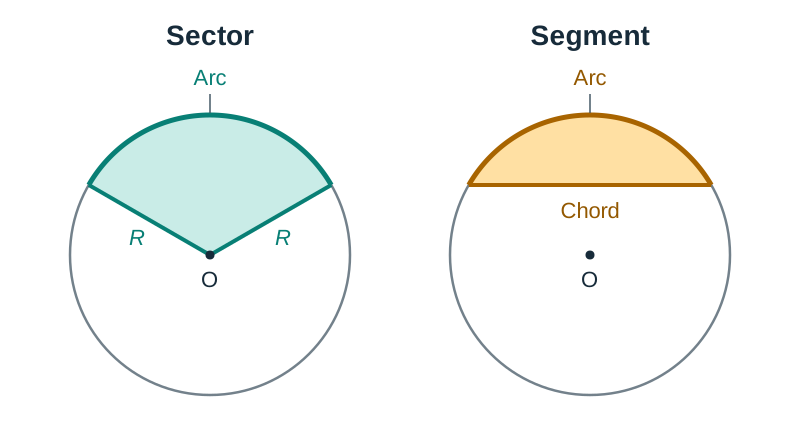
| Sector | The region enclosed by two radii and an arc (like a slice of pizza). |
| Segment | The region bounded by a straight chord and an arc. |
Circles that share the same centre point are concentric.
Locating Centres and Constructing Tangents
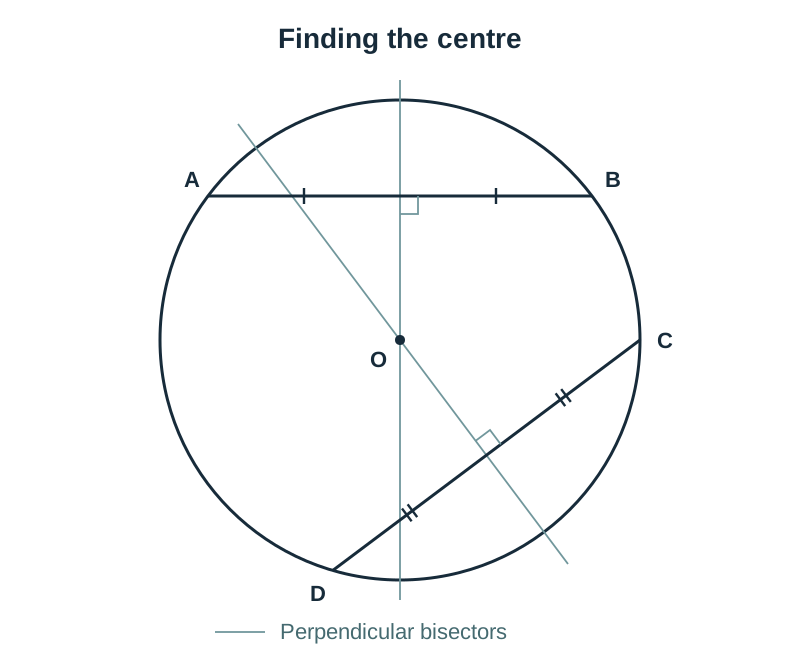
A perpendicular bisector cuts a chord in half at 90° and passes through the circle’s centre. Construct perpendicular bisectors of two non-parallel chords; their intersection is the centre.
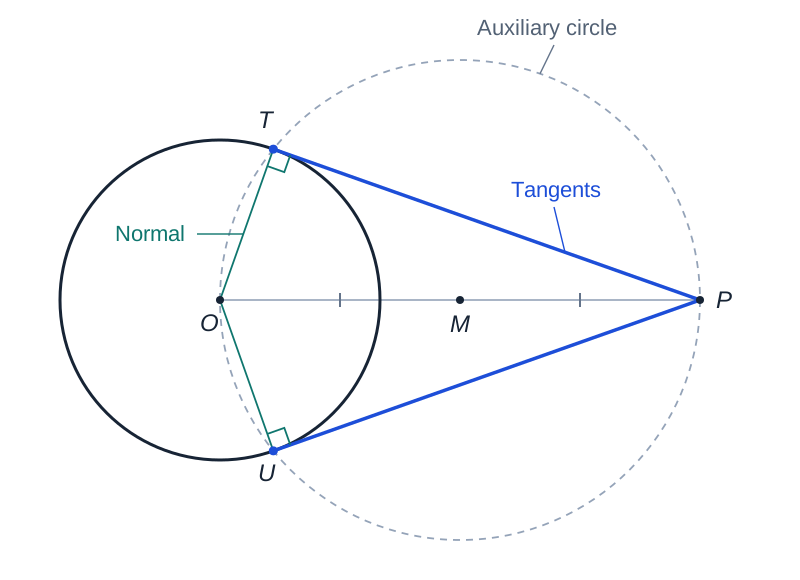
A tangent touches a circle at exactly one point. The normal is perpendicular to the tangent at this point of contact and points to the centre.
Tangent at a point on the circumference
Join the centre to the point on the circumference. Draw a perpendicular line at 90° through that point.
Tangents from an external point
Join external point to centre and bisect at midpoint . Draw an auxiliary circle with centre and radius . Its intersections with the circle mark points of contact and . Join and .
Circles in Contact and Tangent Lines
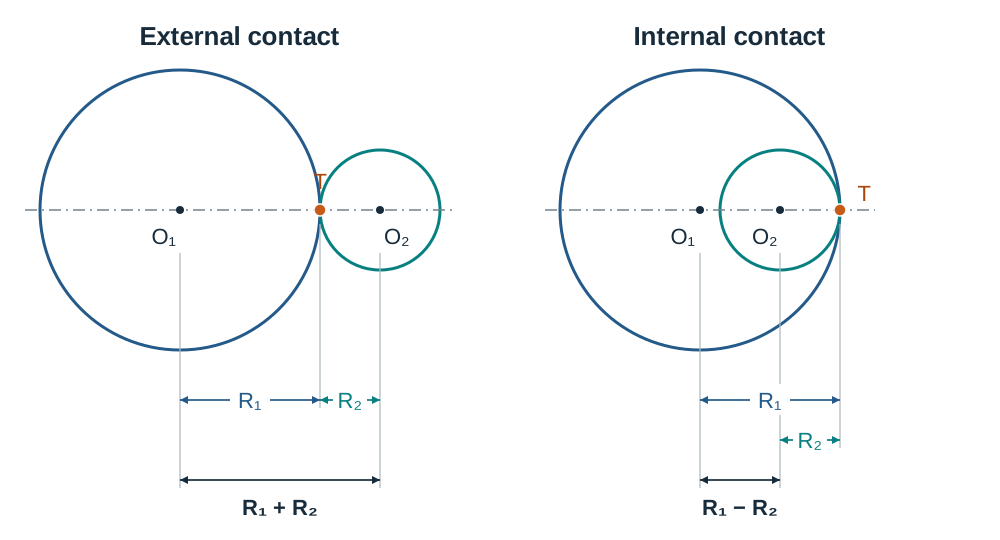
When two circles touch, their centres and the point of contact lie along one straight line.
- External contact: Circles touch outside each other. Distance between centres equals . The point of contact lies between the centres.
- Internal contact: One circle sits inside the other. Centre distance = larger radius − smaller radius. Extend the line through both centres to find the point of contact.
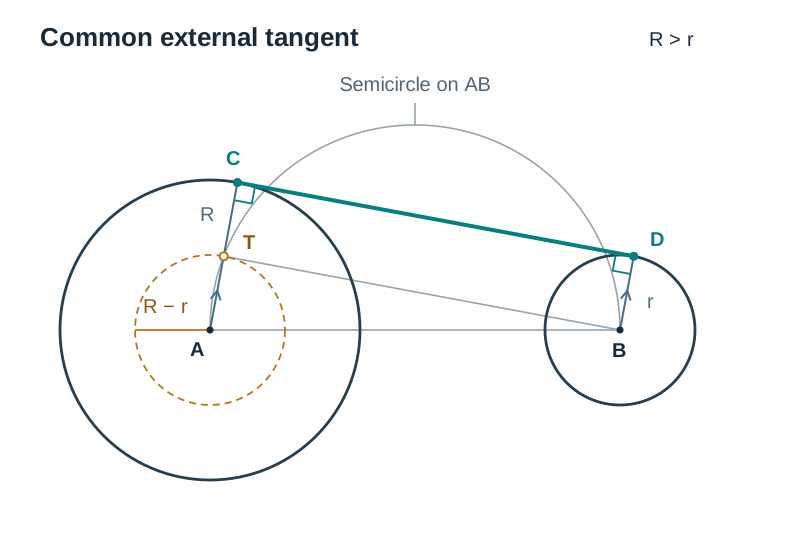
Common external tangent between two unequal circles
For two non-overlapping circles, let A and B be their centres, with radii R > r. Draw an auxiliary circle centred at A, radius R − r. Draw a semicircle with diameter AB, meeting it at T. Extend AT to the larger circle at C. From B, draw a parallel radius in the same direction to meet the smaller circle at D. Join C to D.
Constructing Blending Arcs
A blending arc smoothly joins circles or straight lines at exact points of contact.
Arc touching a straight line and a circle
Draw a line parallel to the straight line at distance . From the circle centre, swing a locating arc of radius (for external contact) to intersect the parallel line at the arc centre. Drop a perpendicular to the line to find the point of contact.
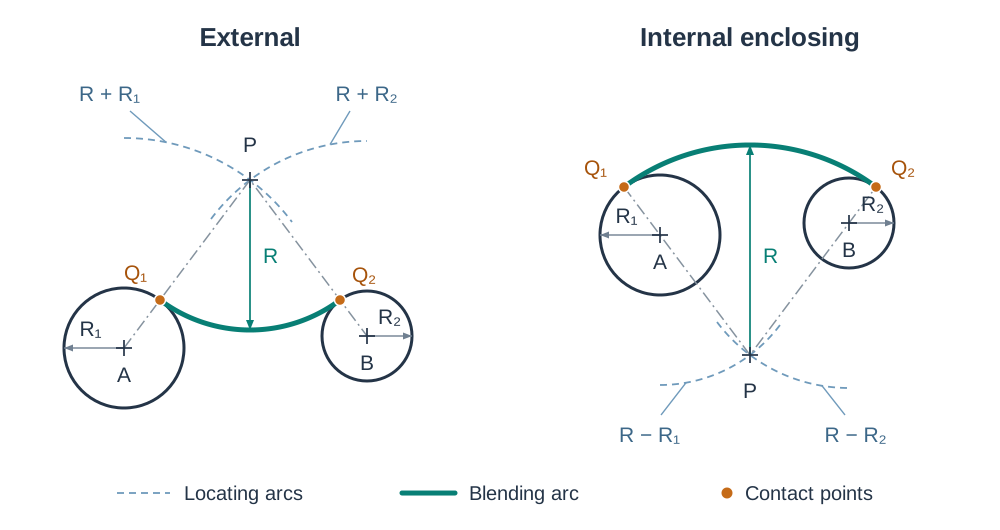
Blending arc between two circles
To locate the arc centre, swing locating arcs from both circle centres:
- External arc: Swing radii of and .
- Internal enclosing arc: Swing radii of and .
Their intersection gives the arc centre.
Key terms
- Circumference
- The boundary of a circle, and the total distance around that boundary.
- Point of Contact (POC)
- The single precise point where a tangent line or touching curve meets another geometric shape.
- Normal
- A line perpendicular to a tangent at the point of contact, passing through the centre of the circle.
- Concentric
- Two or more circles of different sizes that share the exact same centre point.
- External Contact
- Touching circles that remain entirely outside each other, with a centre distance of R₁ + R₂.
- Internal Contact
- Touching circles where one sits inside the other, with centre distance = larger radius − smaller radius.
- Tangent
- A straight line that touches the circumference of a circle at exactly one point without entering it.
Check yourself
What is the angle between a tangent line and the normal drawn to its point of contact?
Exactly 90° (a right angle).
How far from a straight line must you draw a parallel construction line to locate the centre of a touching R20 arc?
20 mm, measured perpendicularly from the straight line.
Where does the point of contact lie when two circles touch internally?
On the straight line joining both centres, extended past the smaller centre until it meets both circumferences.
What is the geometric difference between a sector and a segment?
A sector is bounded by two radii and an arc, whereas a segment is bounded by a straight chord and an arc.