
Conic sections are curves formed when a flat cutting plane slices through a cone at different angles. In the Junior Cycle examination, you must identify cone cuts, locate missing axes and focal points, and construct accurate ellipses and parabolas.
Conic Sections and Cone Cuts
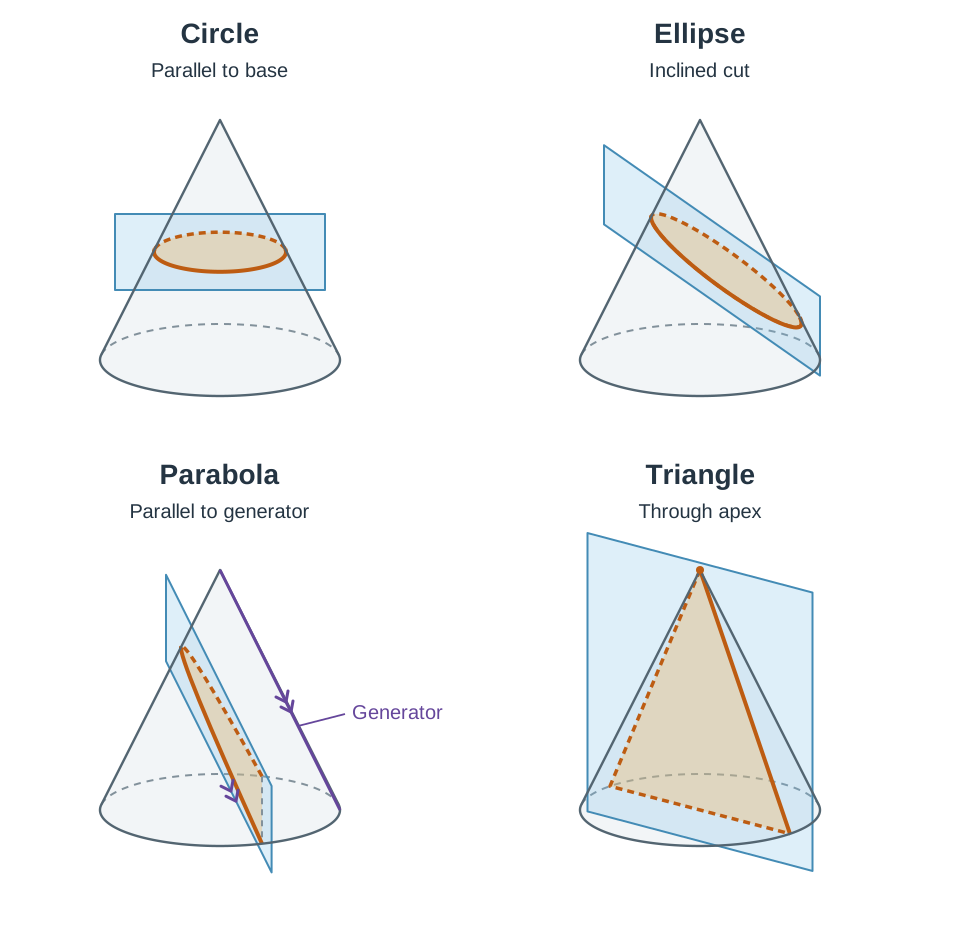
A right circular cone has a flat circular base, an apex, and a curved surface made of straight lines called generators running from apex to base. Slicing the cone with a cutting plane produces different cross-sections depending on the angle of the cut.
| Cutting plane position | Section produced |
|---|---|
| Parallel to the circular base | Circle |
| Inclined to the base and cutting every generator, without passing through the apex | Ellipse |
| Parallel to an extreme generator (slant edge) | Parabola |
| Passing through the apex and cutting across the base | Triangle |
Parts of the Ellipse
An ellipse is a closed, symmetrical curve defined by two perpendicular axes meeting at the centre.
- Major axis: the longest diameter across the ellipse, passing through both focal points. Half this length is the semi-major axis.
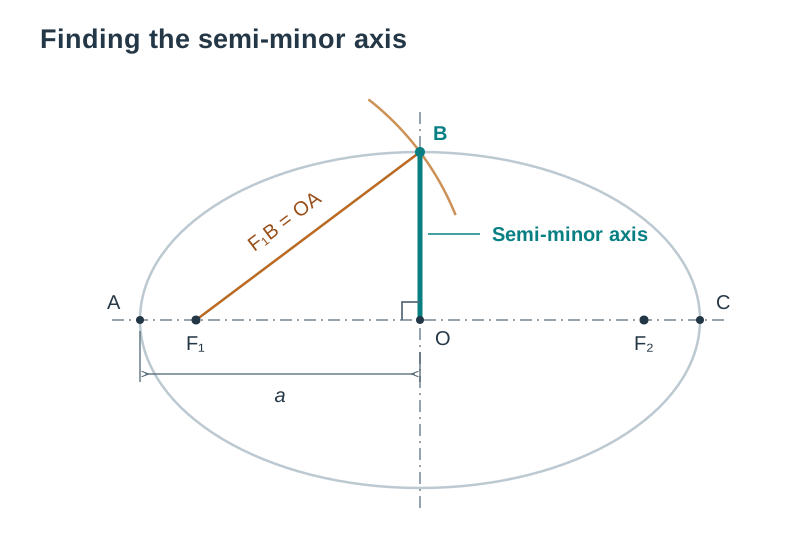
- Minor axis: the shortest diameter through the centre, perpendicular to the major axis. Half this length is the semi-minor axis.
- Focal points: two fixed points, and , lying on the major axis.
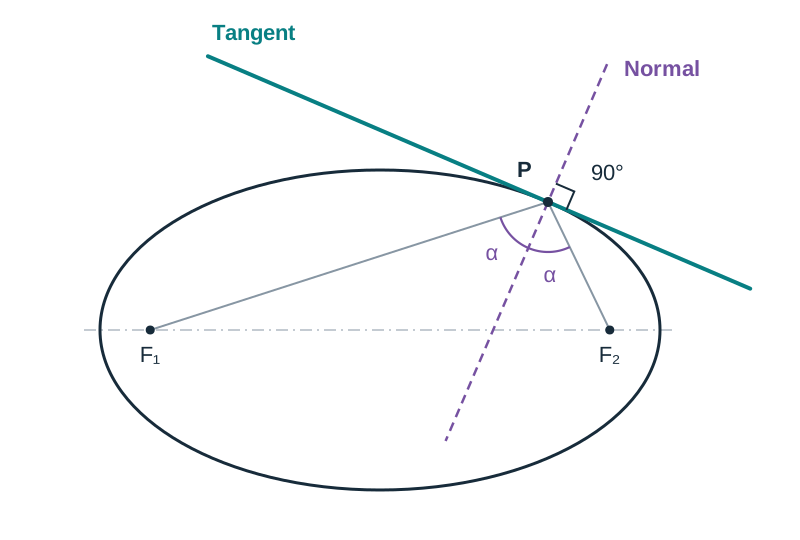
- Focal radii: the two lines and joining any point on the curve to the foci. Their sum always equals the major axis ().
- Minor-axis property: the distance from either end of the minor axis to either focal point equals half the major axis.
Constructing an Ellipse and Finding Axes
To find an unknown semi-minor axis, swing an arc of radius equal to half the major axis from a focal point to cut the minor axis line.
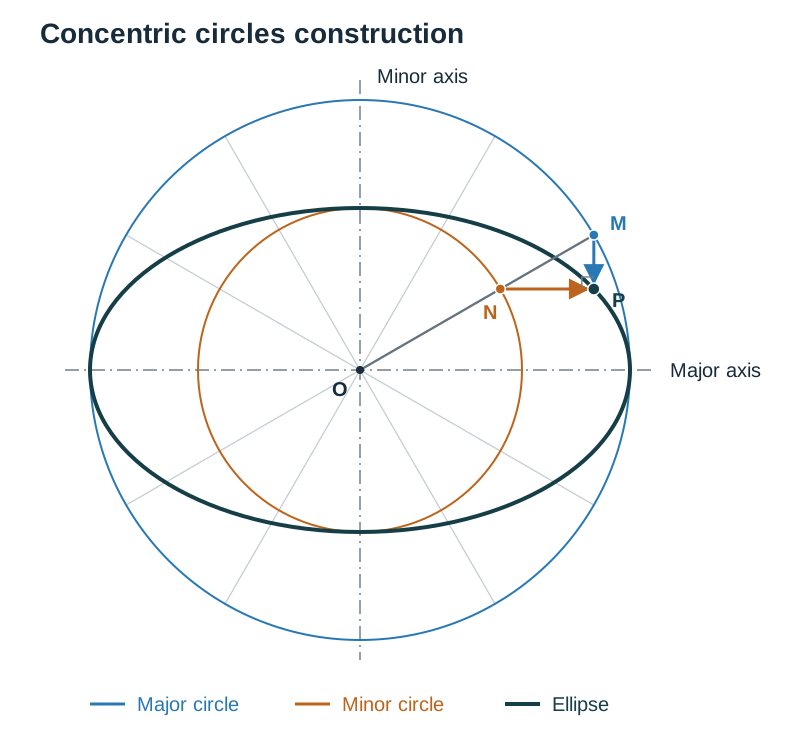
The concentric circles method constructs an ellipse using two auxiliary circles with radii equal to the semi-major and semi-minor axes:
Divide both circles into 12 sectors using a set square. Projecting parallel to the minor axis from the major circle and parallel to the major axis from the minor circle locates points on the curve.
To construct a tangent at point on the curve, join to and . Bisect angle to find the normal, then draw the tangent through at to that normal.
The Parabola and the Rectangle Method
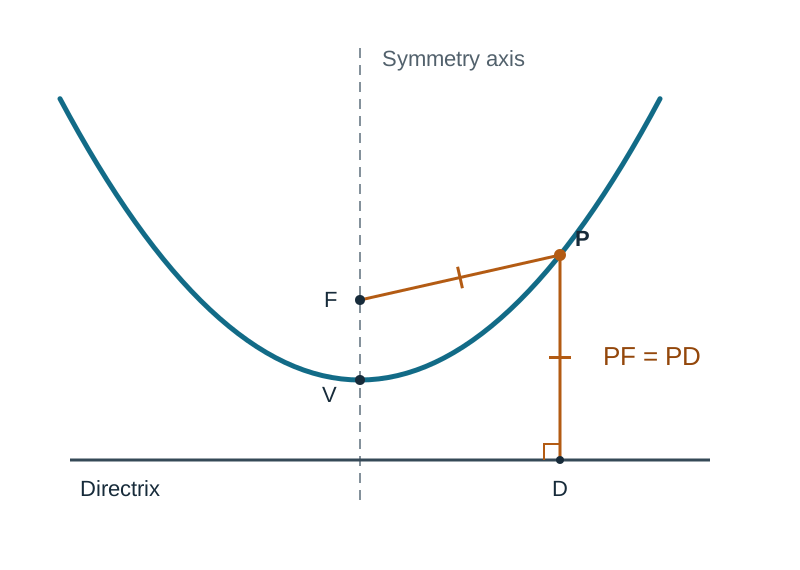
A parabola is an open, symmetrical curve. Every point on it maintains equal distance from a fixed point (the focus) and a fixed line (the directrix). Its vertex is the turning point where the curve meets its axis of symmetry.
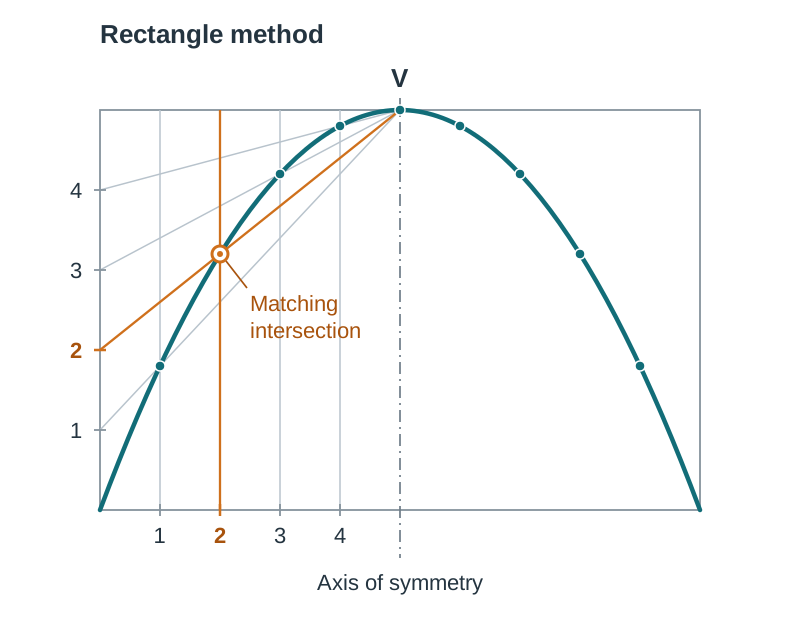
The rectangle method constructs a parabola within a rectangle centred on its axis of symmetry:
Divide the outer vertical side and half-base into the same number of equal parts. Radiate lines from vertex to the side points, and project lines parallel to the axis from the base points. Their matching intersections locate points on the curve.
Key terms
- Generator
- A straight line on the curved surface of a cone running from the apex to the edge of the base.
- Major Axis
- The longest diameter passing through the centre of an ellipse and containing both focal points.
- Minor Axis
- The shortest diameter passing through the centre of an ellipse, perpendicular to the major axis.
- Focal Radii
- The lines joining any point on an ellipse to both focal points; their combined length always equals the major axis.
- Auxiliary Circles
- Two concentric circles drawn from the centre of an ellipse with radii equal to the semi-major and semi-minor axes.
- Tangent
- A straight line that touches a curve at one point only without crossing it.
- Normal
- A straight line drawn perpendicular (90°) to the tangent at the point of contact.
- Vertex
- The point where a conic curve meets its axis of symmetry, such as the turning point of a parabola.
Check yourself
Which conic section is formed by a cutting plane parallel to an extreme generator of a cone?
A parabola.
What is the sum of the focal radii |PF1| + |PF2| for any point P on an ellipse?
It is always equal to the full length of the major axis.
How can you find the position of the focal points F1 and F2 when both axes are drawn?
Set a compass to half the major axis, place the point at an end of the minor axis, and swing arcs cutting the major axis.
What angle does the normal line make with the tangent at the point of contact?
Exactly 90° (they are perpendicular).