

Weathering is the breakdown of rock at or just below the Earth's surface, where it lies, without being carried away. Junior Cycle exam questions regularly ask you to explain freeze-thaw action with a diagram, describe carbonation in karst landscapes, and identify mass movement types.
Weathering, Erosion, and Mass Movement
Weathering and erosion are easy to mix up, so learn the difference. Together, they shape the landscape through denudation.
- Weathering breaks rock down in situ, meaning where it lies, without carrying it away.
- Erosion breaks rock down and moves it using water, ice, or wind.
Mass movement is the downhill movement of loose rock and soil (regolith) under gravity, after weathering has loosened it.
- Soil creep is a slow mass movement, moving a few centimetres a year and forming small ripples called terracettes.
- Landslides and mudflows are fast mass movements triggered by heavy rain on steep slopes, which can destroy houses and block roads.
People manage these processes using wire netting and rock bolts on steep road cuttings to prevent loose rock from tumbling onto traffic.
Mechanical Weathering: Freeze-Thaw Action
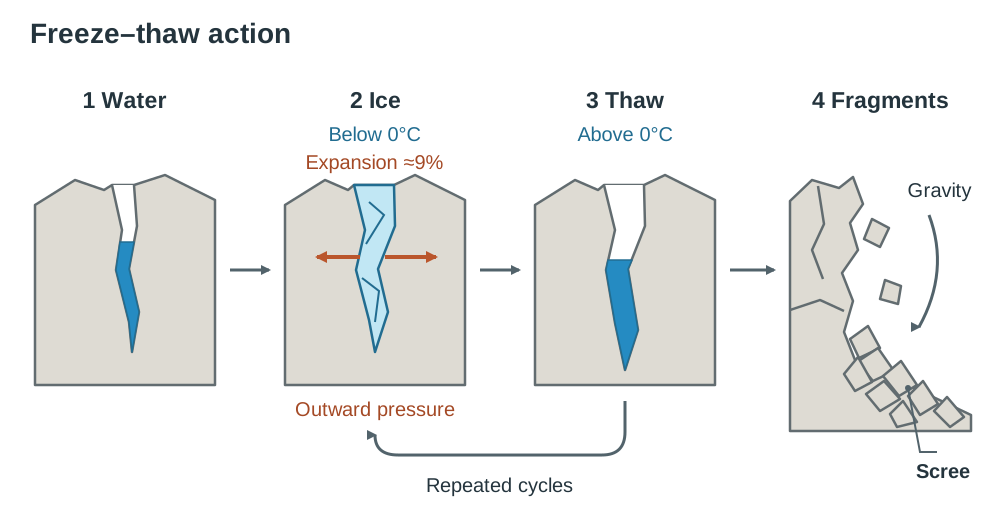
Mechanical weathering breaks rock physically without altering its chemical makeup. Freeze-thaw action is the most common mechanical process in bare upland areas like Croagh Patrick, Co. Mayo and the Great Sugarloaf, Co. Wicklow.
- Rainwater collects in natural cracks in exposed rock.
- Temperatures drop below 0°C and the water freezes.
- Freezing water expands in volume by about 9%, putting outward pressure on the crack walls.
- When the temperature rises, the ice thaws and water sinks deeper into the widened crack.
- Repeated freeze-thaw cycles shatter the rock completely.
The sharp, jagged fragments roll downhill under gravity to form slopes of scree at the base of cliffs.
Chemical Weathering: Carbonation
Chemical weathering changes the minerals inside rock. Carbonation happens when rain absorbs carbon dioxide from the air to form weak carbonic acid.
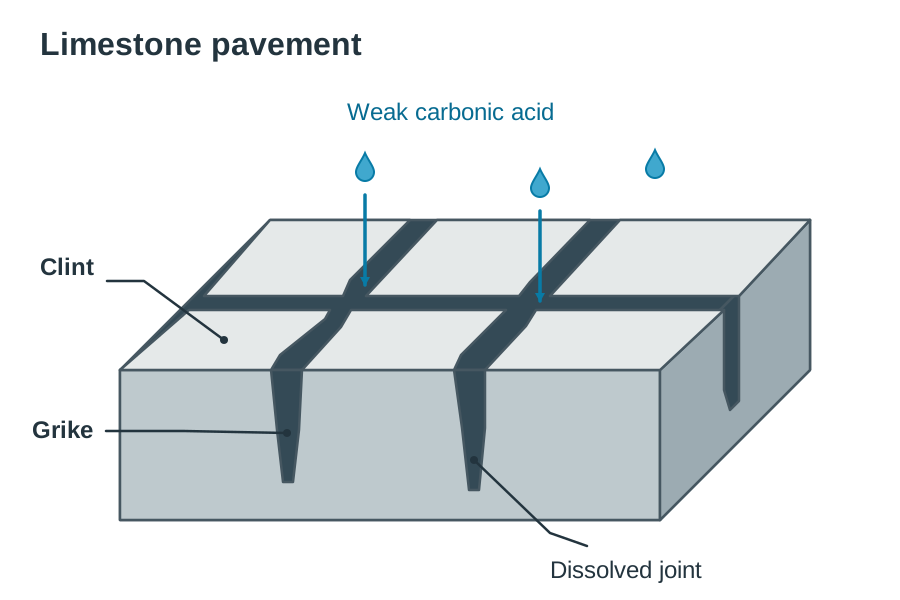
When acidic rain falls on limestone, it dissolves the calcium carbonate in the rock. This dissolves out joints to form a limestone pavement, as seen in the Burren, Co. Clare:
- Grikes are deep vertical slots dissolved along joints.
- Clints are the flat limestone slabs left standing between grikes.
Remember: clints are the chunks, grikes are the gaps.
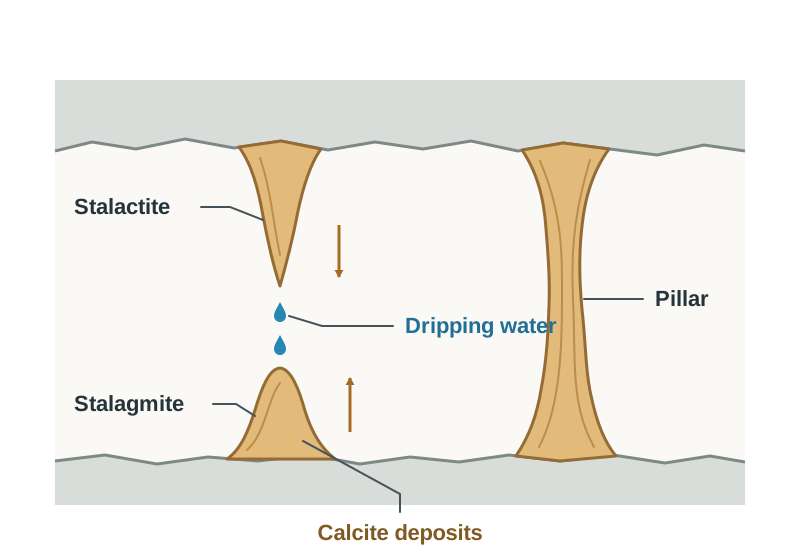
Underground, carbonation dissolves caves. Dripping water leaves calcite behind, building stalactites from the roof and stalagmites from the floor; where the two join they form a pillar.
Burning coal and oil releases sulphur dioxide, which makes rainwater more acidic. This acid rain speeds up carbonation, dissolving limestone buildings, statues, and gravestones.
Biological Weathering
Biological weathering occurs when living organisms break rock apart physically or chemically.
- Plant roots: Seeds settle into tiny cracks. As roots grow thicker, they exert pressure that wedges the joints open and levers the rock apart mechanically.
- Lichens and mosses: These grow on bare rock surfaces and release weak acids that slowly dissolve the minerals chemically.
Key terms
- Weathering
- The breakdown and decay of rock at or near the Earth's surface in situ, without being carried away.
- In situ
- In its original place, where the rock lies without being transported.
- Denudation
- The total wearing away of the Earth's surface by weathering and erosion combined.
- Freeze-thaw action
- Mechanical weathering where water trapped in cracks repeatedly freezes, expands by about 9%, and shatters rock.
- Scree
- A slope of loose, jagged rock fragments gathered at the foot of a cliff or mountain.
- Carbonation
- Chemical weathering where weak carbonic acid in rainwater dissolves calcium carbonate in limestone.
- Limestone pavement
- A bare, flat limestone surface divided into blocks (clints) separated by deep fissures (grikes).
- Mass movement
- The downhill movement of loose rock and soil (regolith) under the force of gravity.
Check yourself
What is the key difference between weathering and erosion?
Weathering breaks rock down in situ without moving it, while erosion breaks down rock and carries it away.
By what percentage does water expand when it freezes into ice?
It expands in volume by about 9%.
On a limestone pavement, which feature is the raised block and which is the deep crack?
Clints are the raised blocks and grikes are the deep vertical cracks.
Name one slow and one fast type of mass movement.
Soil creep is slow; landslides (or mudflows) are fast.
What underground karst feature is formed when a stalactite and a stalagmite join?
A pillar (or column).