

Mass movement is the downslope movement of loose soil and weathered rock (regolith) under the direct force of gravity. In the Junior Cycle exam, you need to say what makes a slope move, name slow and fast types, spot the signs in the landscape, and explain how people try to stop slopes collapsing.
What Drives Mass Movement?
Mass movement happens when gravity overcomes the friction holding loose material on a slope. The layer of loose, weathered rock and soil that rests on solid bedrock is called regolith.
Freeze-thaw weathering shatters rock on steep peaks, and gravity pulls these angular fragments downhill to collect as scree (scree is the evidence you point to in a photo, such as on the Great Sugar Loaf in Co. Wicklow).
Four main factors determine whether a slope will move:
- Slope gradient: gravity pulls far more strongly on steep slopes than on gentle ones.
- Water content: heavy rain adds weight to the regolith and lubricates soil particles, reducing friction.
- Vegetation: plant and tree roots bind soil together, while bare slopes wash away easily.
- Human activity: cutting into the base of a slope for roads or quarries removes support and triggers collapse.
Slow Mass Movement: Soil Creep
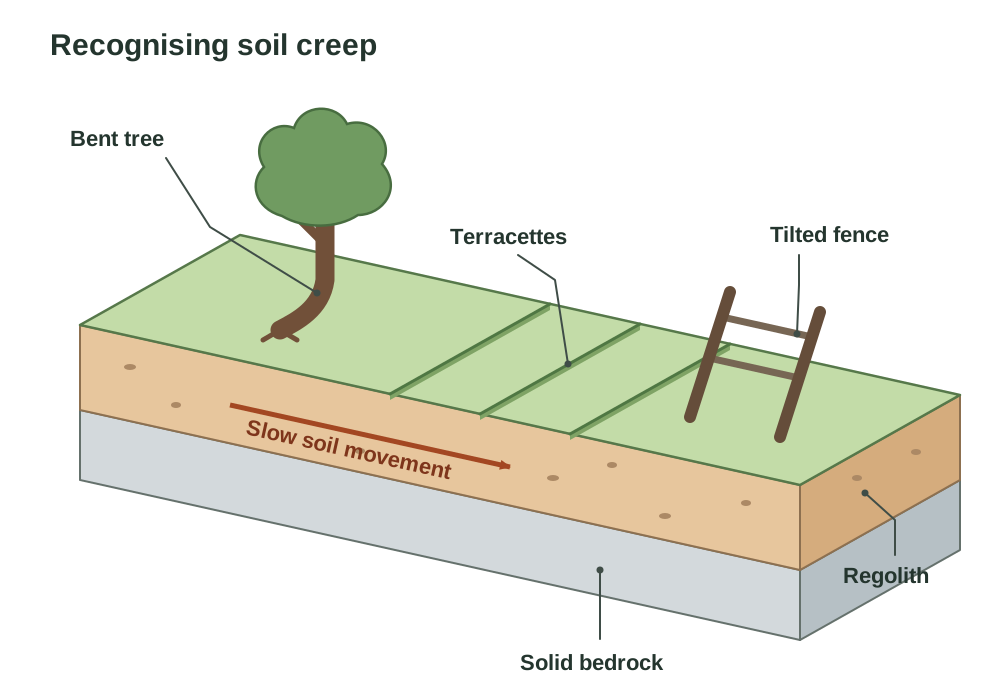
Soil creep is the slow downward movement of soil on gentle slopes, travelling at roughly 1 cm per year.
You cannot see it happening in real time. Instead, geographers spot it from clear clues left in the landscape:
- Terracettes: small, step-like ridges formed across grassy slopes as topsoil shifts.
- Bent trees: moving soil pushes the base of the trunk downslope, but the tree keeps growing straight up, leaving a curved trunk.
- Tilted fences and poles: fence posts and telegraph poles lean downhill.
- Bulging retaining walls: stone walls bow forward or break where soil piles up behind them.
- Cracked roads: tarmac buckles and cracks as soil shifts underneath road foundations.
Fast Mass Movement and Irish Case Study
Fast mass movement happens suddenly on steep or saturated slopes, causing severe destruction.
| Type | Speed | Moisture | Description |
|---|---|---|---|
| Landslide | Fast | Dry to wet | A block of rock and soil breaks away and slides rapidly downhill along a smooth surface of rock or clay, often after heavy rain or after the base of the slope is cut away. |
| Bog burst (bogburst) | Fast | Saturated | Waterlogged peat in upland bogs liquefies and rushes downhill after heavy rain. |
| Mudflow | Fast | Saturated | Soil mixes with heavy rain to form a slurry that flows quickly down a valley. |
| Avalanche | Fast | Frozen | A mass of snow and ice breaks loose and slides rapidly down a steep mountainside. |
In the exam, every type is classed as either slow (soil creep) or fast (landslide, bog burst, mudflow, avalanche).
Derrybrien Bog Burst (2003)
In October 2003, a bog burst at Derrybrien, Co. Galway, sent waterlogged peat rushing downhill after hillside wind farm construction. The moving peat blocked roads, damaged farmland, and washed into the Owendalulleegh river, killing thousands of fish.
Problems Caused by Mass Movement
When mass movement occurs, it creates serious social, economic, and environmental problems:
- Houses and farm buildings can be buried or destroyed, and people can be killed or injured.
- Roads, railways, and bridges are blocked or washed away, cutting off villages.
- Farmland is covered in rock, mud, or peat, so it can no longer be used for grazing.
- Peat and soil washed into rivers pollutes the water supply and kills fish.
- Repairs and clean-up cost local councils large sums of money.
Managing Slopes and Disaster Response
People actively manage surface processes to protect transport routes and homes from slope collapse.
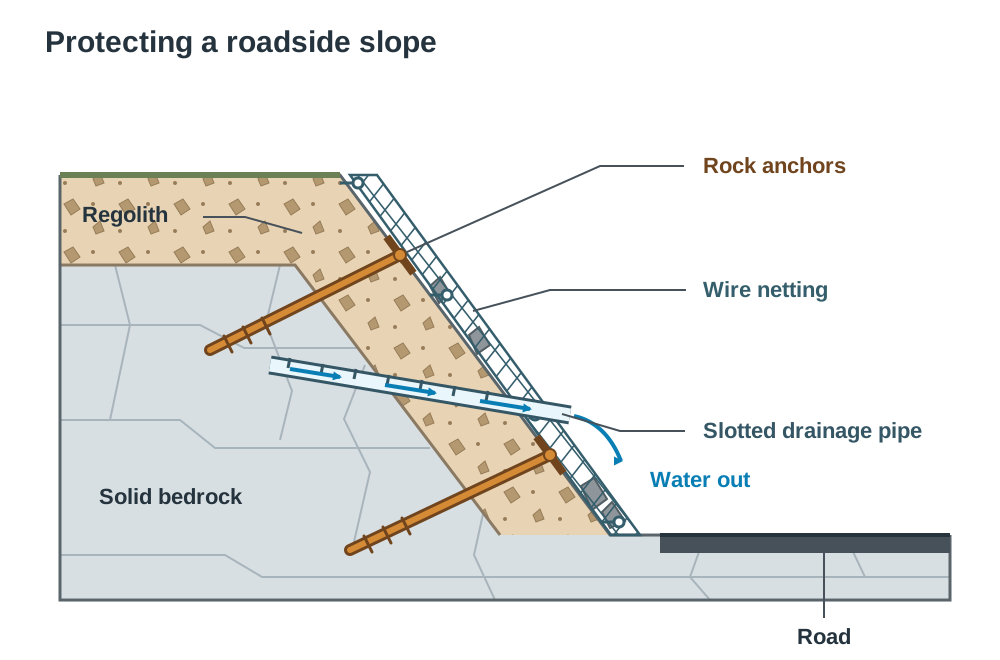
Civil engineers use three common methods to stabilise vulnerable slopes:
- Drainage pipes: slotted pipes channel rainwater away from hillsides to stop soil becoming heavy and waterlogged.
- Rock anchors: long steel rods are drilled deep through loose regolith into solid bedrock to pin rock faces in place.
- Wire netting: heavy steel mesh pinned over exposed rock cuttings catches falling stones before they hit roads.
Response to Natural Disasters
After a slope collapse, emergency services rescue trapped residents and clear roads, displaced families are rehoused, and local councils map hazard zones so that no new homes are built on unstable slopes.
Key terms
- Mass movement
- The downslope movement of loose rock and soil under the direct force of gravity.
- Regolith
- The layer of loose, weathered rock fragments and soil that covers solid bedrock.
- Scree
- Loose, angular rock pieces that break off cliffs through freeze-thaw weathering and pile up at the base of a slope.
- Soil creep
- The extremely slow downward movement of soil on a slope, travelling at about 1 cm per year.
- Terracettes
- Step-like ridges formed across a grassy hillside by the slow downslope shift of topsoil.
- Landslide
- The rapid downslope sliding of a large mass of rock and soil along a smooth surface of rock or clay.
- Bog burst
- A sudden, fast flow of waterlogged peat down an upland slope.
- Mudflow
- A fast-moving mixture of saturated soil and water that flows downhill.
Check yourself
What is the primary natural force driving all forms of mass movement?
Gravity.
Give two landscape clues that show soil creep is taking place on a hill.
Terracettes on grassy slopes and tilted poles or bent trees.
In what two ways does heavy rainfall trigger rapid mass movement?
It adds extra weight to the regolith and lubricates soil particles to reduce friction.
What type of material moves during a bog burst?
Waterlogged peat.
How do rock anchors stop a steep rock face along a road from collapsing?
They pin loose outer rock layers securely into solid bedrock underneath.