

Weather describes the day-to-day condition of the atmosphere at a particular time and place, while climate is the average weather pattern recorded over at least 30 years. The Junior Cycle exam tests your ability to read weather instruments and charts, explain rainfall processes, analyse factors shaping Ireland's climate, and evaluate significant storms.
Measuring Weather and the Water Cycle
| Weather Element | Instrument | Unit of Measurement |
|---|---|---|
| Temperature | Maximum-minimum thermometer | Degrees Celsius (°C) |
| Atmospheric pressure | Aneroid barometer | Millibars (mb) or hectopascals (hPa) |
| Precipitation | Rain gauge | Millimetres (mm) |
| Wind speed | Anemometer | Kilometres per hour (km/h) or knots |
| Wind direction | Wind vane | Compass points (e.g. SW) |
| Sunshine duration | Campbell-Stokes recorder | Hours per day |
Delicate instruments sit inside a Stevenson screen. This white wooden box reflects solar heat while slatted sides allow air to circulate freely. A wind vane points into the wind, showing the compass direction from which it blows.
The Water Cycle
Precipitation relies on three stages:
- Evaporation: the sun heats water in rivers, lakes, and oceans, turning it into invisible water vapour that rises.
- Condensation: rising water vapour cools and turns back into tiny water droplets, gathering to form clouds.
- Precipitation: water droplets grow too heavy to stay airborne and fall as rain, hail, sleet, or snow.
Factors Influencing Ireland's Climate
Ireland has a cool temperate oceanic climate with mild wet winters, cool wet summers, and rain all year.
- Prevailing winds: our prevailing winds are south-westerlies blowing across the warm North Atlantic Drift. They bring warm, moist air that keeps temperatures mild and supplies regular rainfall.
- Latitude: Ireland sits in mid-latitudes (51.5°N to 55.5°N), so the sun is never directly overhead and we avoid extremes of heat or cold.
- Distance from the sea: the ocean heats and cools slowly, moderating coastal temperatures so summers stay cooler and winters stay milder than inland regions.
- Altitude: temperature drops roughly 1 °C for every 150 m of elevation, making upland areas noticeably colder and wetter.
- Air masses: tropical maritime air brings mild, wet weather, whereas polar continental air brings cold, dry conditions.
Rain Formation: Three Types
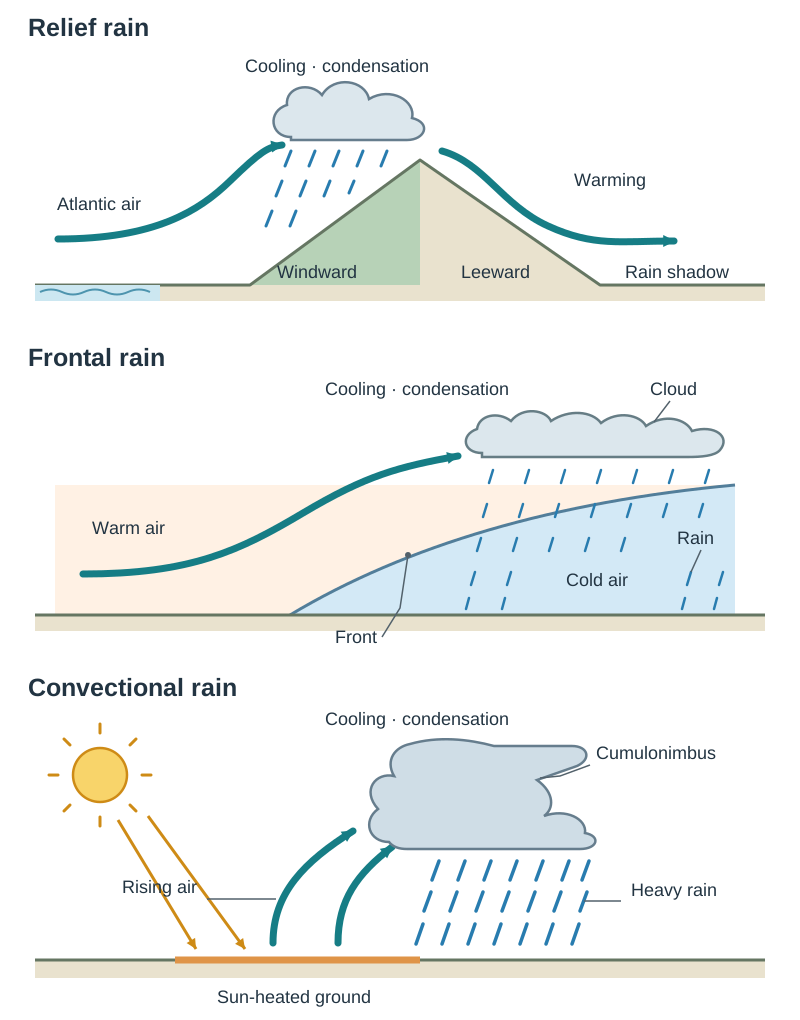
Every rainfall type begins when warm moist air rises, cools, and condenses into cloud droplets before falling as rain.
- Relief rain: moist Atlantic winds hit coastal mountains and are forced upward. The air cools and condenses, dropping heavy rain on the windward slopes. Descending air on the leeward side warms, leaving a dry rain shadow.
- Frontal rain: a warm, light air mass meets a cold, dense air mass at a front. The lighter warm air rises over the cold wedge, cooling to produce widespread, continuous rain.
- Convectional rain: strong sunshine heats the ground, warming the air above it. This heated air expands and rises rapidly, forming cumulonimbus clouds that unleash heavy downpours and thunder.
Pressure Systems and Synoptic Charts
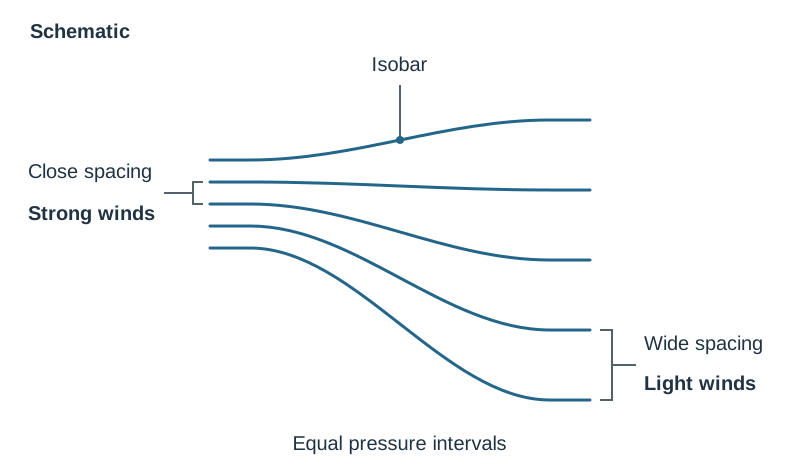
Air moves from high to low pressure. Synoptic weather charts use isobars (lines joining places of equal atmospheric pressure) to display these systems. Isobars close together mean pressure changes a lot over a short distance, so winds are strong. Isobars far apart mean light winds.
- Depressions (Lows): low-pressure systems where warm and cold air masses collide. Rising air cools to create cloudy skies, blustery winds, and rain.
- Anticyclones (Highs): high-pressure systems where cool air gently sinks. Sinking air warms and absorbs moisture, stopping clouds from forming. Summer anticyclones bring sunny, warm days. Winter anticyclones bring crisp, cold days and freezing, frosty nights because clear skies let ground heat escape into space.
Significant Weather Events and Weather Data
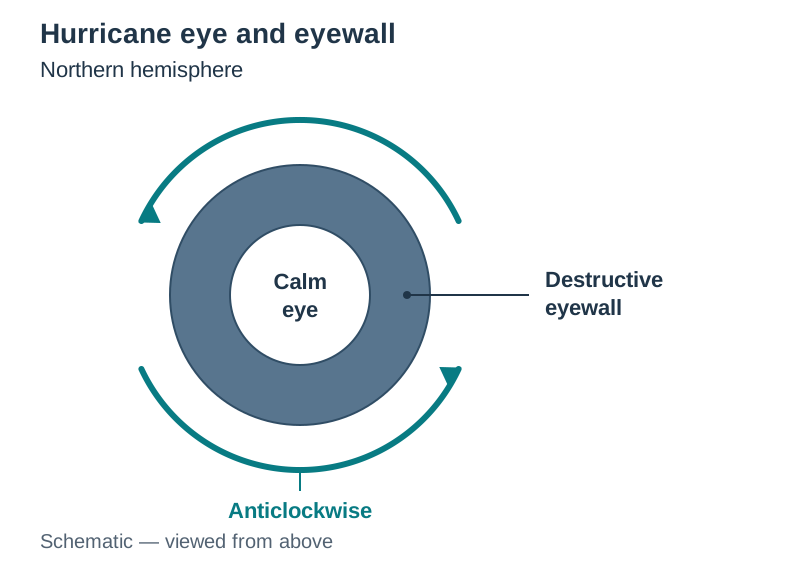
Hurricanes are severe tropical storms with winds over 119 km/h. They form between 5° and 20° north and south of the equator over ocean waters of at least 26 °C. Warm rising air condenses, releasing heat that drives the storm. The Earth's rotation makes the system spin anticlockwise in the northern hemisphere around a calm eye bordered by a destructive eyewall.
In October 2017, Hurricane Ophelia crossed the Atlantic. Over cooler waters it weakened into an extratropical storm before striking Ireland with gusts exceeding 150 km/h. Met Éireann issued a nationwide Status Red warning, schools closed, and three people were killed.
When investigating weather data, calculate mean daily rainfall by dividing total rainfall by the total number of days recorded. In climographs, rainfall bars read against the millimetre axis, while the temperature line reads against degrees Celsius.
Key terms
- Weather
- The day-to-day condition of the atmosphere at a specific time and place.
- Climate
- The average weather conditions of a place worked out over a long period of at least 30 years.
- Isobar
- A line drawn on a synoptic weather chart joining places of equal atmospheric pressure.
- Front
- The boundary where two air masses of different temperatures and densities meet.
- Stevenson screen
- A slatted, white wooden box that shields meteorological instruments from direct sunshine while allowing air to circulate.
- Rain shadow
- A dry area on the sheltered leeward side of a mountain that receives little precipitation.
- Depression
- A weather system of low atmospheric pressure that brings cloudy, wet, and windy conditions.
- Anticyclone
- A weather system of high atmospheric pressure that brings dry, settled weather with clear skies.
Check yourself
What is the single biggest factor influencing Ireland's mild, wet climate?
Prevailing south-westerly winds blowing across the warm North Atlantic Drift.
What line on a synoptic chart connects places of equal atmospheric pressure?
An isobar.
How can you identify a cold front on a weather chart without using colour?
By a line marked with solid triangles pointing in the direction the cold air is advancing.
Name the three key stages of the water cycle in order.
Evaporation, condensation, and precipitation.