

A volcano is an opening in the Earth's crust where molten rock, ash, and gases escape to the surface. Exam questions ask you to label the parts of a volcano, explain how one forms at a plate boundary, and give its good and bad effects on people.
Structure and Formation of a Volcano
The Earth is made up of three layers: the outer crust, the semi-molten mantle, and the dense core.
- Magma chamber: An underground pool storing molten rock beneath the crust.
- Vent: The pipe connecting the magma chamber to the surface.
- Crater: The bowl-shaped opening at the top of the volcano.
- Lava flow: The stream of molten rock running down the side of the volcano.
- Ash cloud: The cloud of ash, dust, and gas blown out above the crater.
Volcanoes form in three main stages:
- Magma collects in a magma chamber beneath the crust under pressure.
- Gas pressure forces magma up the vent and out of the crater as lava and ash.
- Repeated eruptions build alternating layers of lava and ash into a cone-shaped mountain.
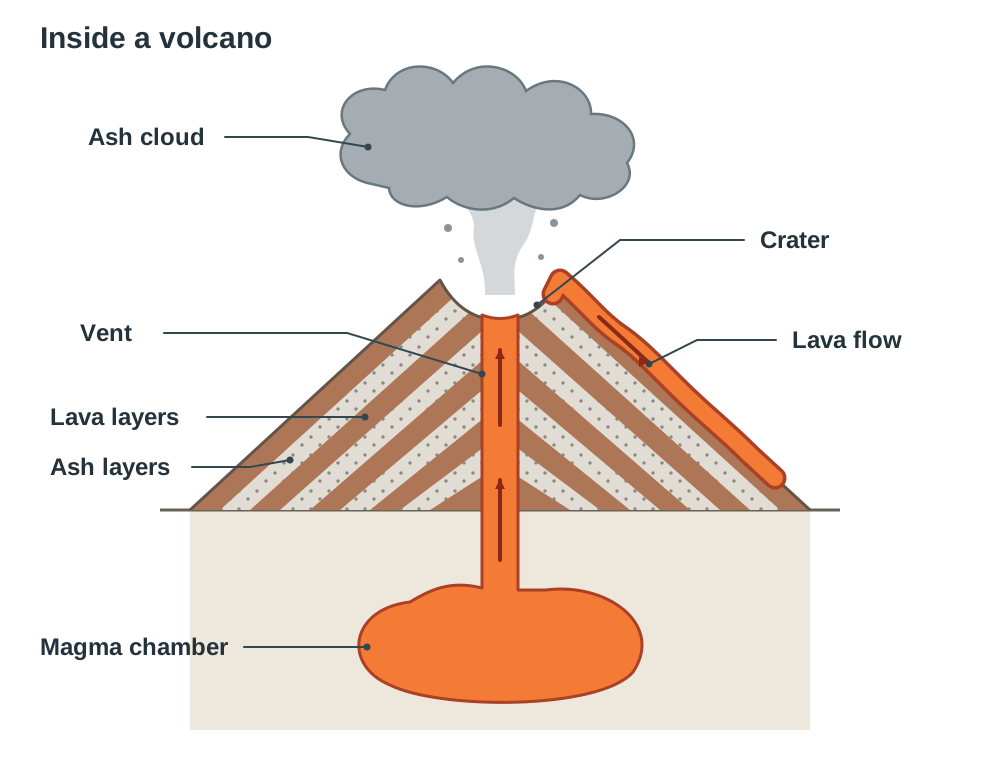
Remember: magma below, lava above.
Lava can also seep through long cracks called fissures. At the Giant's Causeway in County Antrim, basalt lava welled through fissures 65 million years ago; as the basalt lava cooled it contracted and cracked, forming hexagonal columns.
Stages of Activity
Volcanoes are classified into three stages based on their frequency of eruption:
| Stage | Definition | Example |
|---|---|---|
| Active | Erupts regularly or frequently | Mount Etna, Italy |
| Dormant | Has not erupted recently, but has erupted in recorded history and could erupt again | Mount Fuji, Japan |
| Extinct | Has not erupted in recorded history and is not expected to erupt again | Slemish, Co. Antrim |
Plate Boundaries and Global Distribution
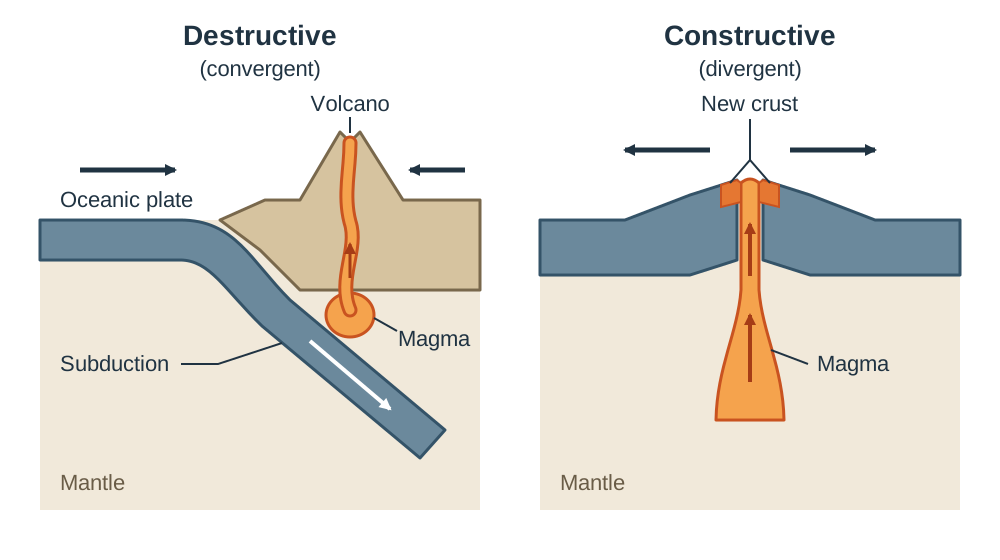
The Earth's crust is divided into tectonic plates moving on mantle convection currents. Most volcanoes are found along plate boundaries rather than scattered randomly.
- Destructive (convergent) boundaries: Two plates collide. The heavier oceanic plate sinks into the mantle during subduction, melting into magma that rises to form explosive volcanoes like Mount St Helens.
- Constructive (divergent) boundaries: Two plates separate. Magma rises to fill the gap, creating new crust. The Mid-Atlantic Ridge formed this way, rising above sea level to form Iceland.
- Pacific Ring of Fire: A horseshoe-shaped belt around the Pacific Ocean holding over 70% of active volcanoes where plates collide.
Reading a Distribution Map
- Volcanoes in long lines along ocean ridges show plates moving apart.
- Volcanoes in curved chains along coastlines or island arcs show plates moving together in subduction zones.
Economic and Social Impacts
Volcanoes bring benefits as well as damage. Keep economic effects (money, jobs, trade) separate from social effects (people, homes, health).
| Positive | Negative | |
|---|---|---|
| Economic | Magma heats underground water into steam for geothermal energy, heating 90% of homes in Iceland. Volcanic ash weathers into fertile soil. Tourist sites like the Blue Lagoon generate revenue and jobs. | The 2010 Eyjafjallajökull eruption in Iceland produced an ash cloud that grounded over 100,000 flights, costing the European economy €1.3 billion. Farmland can be buried and ruined. |
| Social | Geothermal energy reduces air pollution from burning coal and oil, which improves people's health. Geothermal tourism provides local employment for young people. | Lava and ash bury homes, force people to leave the area, and cause loss of life. Ash clouds cause respiratory illness and close local schools. |
Hazard Management: The 3 Ps
Volcanoes usually give warning signs before they erupt, so they are easier to predict than earthquakes. This gives governments time to reduce the risk using the 3 Ps:
- Prediction: Volcanologists monitor warning signs such as minor tremors using seismometers, ground swelling using tiltmeters, and rising sulfur gas levels.
- Planning: Authorities create hazard maps showing past lava paths and introduce zoning laws that ban housing in high-risk valleys.
- Preparation: Emergency services run community evacuation drills, establish escape routes, and stockpile emergency food, water, and tents.
Before Mount Pinatubo erupted in the Philippines in 1991, monitoring and timely evacuation orders saved thousands of lives.
Key terms
- Magma
- Molten rock located beneath the Earth's crust.
- Lava
- Molten rock that has reached the Earth's surface.
- Subduction
- The sinking of a heavier tectonic plate beneath a lighter plate into the mantle at a destructive boundary.
- Geothermal energy
- Renewable heat or electricity produced by harnessing water naturally heated underground by hot rocks and magma.
- Pacific Ring of Fire
- A horseshoe-shaped zone circling the Pacific Ocean with high concentrations of earthquakes and volcanic eruptions.
- Dormant volcano
- A volcano that is currently inactive but has erupted in recorded history and is capable of erupting again.
Check yourself
What is the channel connecting the magma chamber to the crater called?
The vent.
Name one active volcano and one extinct volcano.
Mount Etna, Italy (active); Slemish, Co. Antrim (extinct).
Which Irish landform formed when basalt lava cooled and cracked after flowing through fissures?
The Giant's Causeway, Co. Antrim.
What do the 3 Ps of hazard management stand for?
Prediction, Planning, and Preparation.