

Soil is a thin, fragile layer of loose material covering the Earth's surface where weathered rock, water, air, and living organisms interact. In the Junior Cycle examination, you must be able to describe soil profiles, explain how Irish soils form, assess local soils and vegetation, and evaluate sustainable soil management.
Soil Composition, Formation, and the Profile
A fertile soil is roughly 45% mineral matter (weathered rock), 25% water, 25% air, and 5% humus and living organisms. Water dissolves minerals so roots can absorb them, while air supplies oxygen for root growth.
Five main factors control how soil forms over centuries:
- Parent material: weathered bedrock that supplies the minerals.
- Climate: rainfall drives leaching; warmth speeds up the decay of litter.
- Living organisms: earthworms and micro-organisms break litter into humus and aerate the ground.
- Relief: steep slopes have thin, dry soils, while flat valley floors have deeper soils.
- Time: slow rock breakdown means forming just 1 cm of topsoil takes hundreds of years.
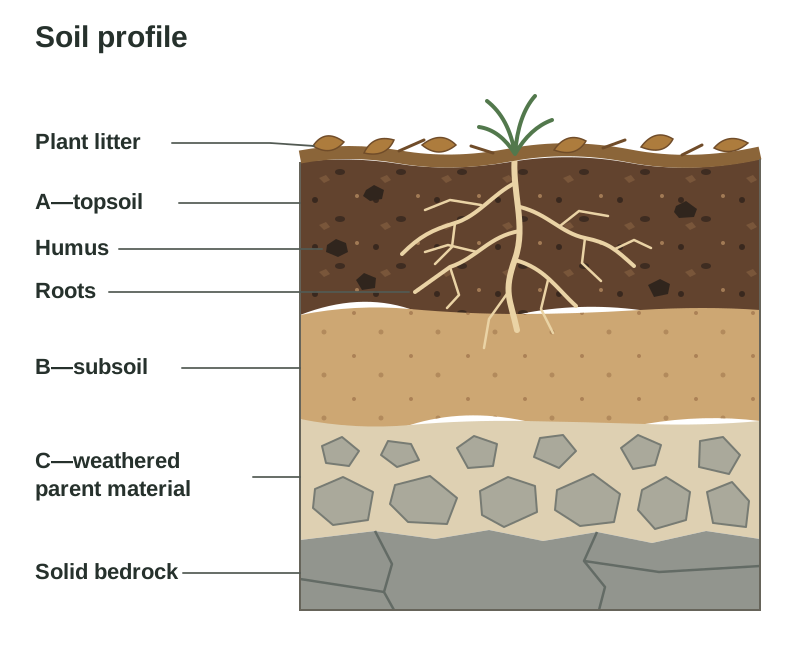
A soil profile is a slice straight down through the soil, showing its layers, called horizons:
- Surface: a layer of plant litter (dead leaves and twigs).
- A horizon (topsoil): dark, crumbly layer rich in humus and organisms; holds most plant roots.
- B horizon (subsoil): lighter layer where minerals washed down from the topsoil accumulate.
- C horizon: weathered parent material made of broken rock fragments resting on solid bedrock.
Irish Soil Types: Brown Earths and Podzols
Brown earths are Ireland's most common soil type. Different climates, relief, and natural vegetation produce contrasting soils across the country:
| Feature | Brown Earth Soils | Podzols |
|---|---|---|
| Natural vegetation | Deciduous broadleaf forest (oak, ash) | Coniferous forest (pine, spruce) and heath |
| Location | Drier, warmer lowlands (Midlands, South, East) | Wet, cold upland areas (Galway, Wicklow) |
| Humus and colour | High humus; dark brown, fertile topsoil | Low humus; pale grey, acidic topsoil |
| Leaching and drainage | Limited leaching; deep and well-drained | Severe leaching washes iron down, where it cements into a hardpan that blocks drainage |
| Primary land use | Arable crop farming and dairy grazing | Commercial forestry and rough sheep grazing |
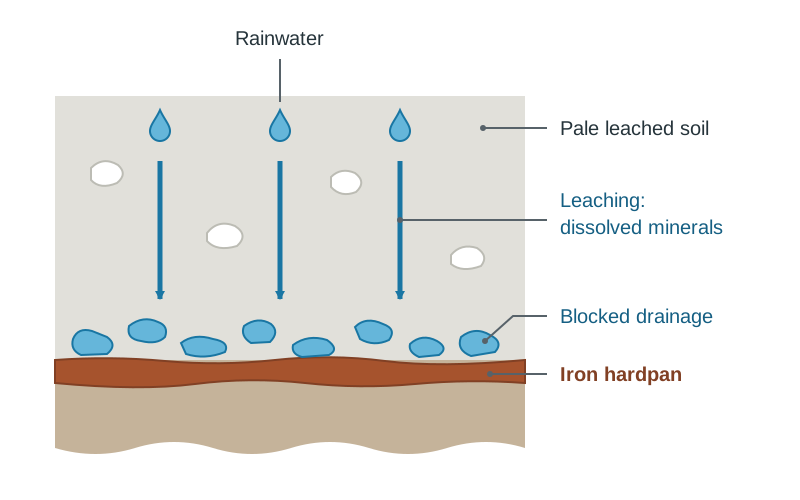
Deciduous trees drop broad leaves each autumn, supplying abundant litter that earthworms mix into fertile humus. Conifer needles are waxy and decay slowly in the cold, wet uplands, so little humus forms while heavy rain washes the minerals down.
Ireland also has gley soils (grey, waterlogged soils in poorly drained hollows where rushes grow) and peat soils (dark, acidic soils formed in wet bogs).
Assessing Soil in a Local Area
To assess a local soil you must look at the evidence and then give a judgement about it, linking what the soil is made of to the plants it supports:
- Note the location on an OS map, the slope, topsoil colour, texture (sand, silt, clay), and drainage after rain.
- Dig a shallow pit or inspect a ditch exposure to record horizon depths and observe root penetration.
- Test how acidic the soil is with a pH kit — very acidic soil holds fewer nutrients for plants.
- Record the dominant plant species to show the soil link. For example, rushes indicate poorly drained gley soils, whereas ryegrass and broadleaf trees point to fertile, well-drained brown earths.
Exploiting and Conserving Soil as a Resource
Soil forms extremely slowly — it can take hundreds of years to form just 1 cm of topsoil — so topsoil that is lost cannot be replaced in our lifetime. Modern land use creates serious pressures:
- Overgrazing: too many animals eat the grass down to the roots, leaving bare topsoil open to soil erosion by wind and rain.
- Compaction: heavy tractors crush soil pores, driving out air and causing waterlogging.
- Overcropping: repeatedly growing the same crop without rest exhausts nutrients and ruins soil structure.
Sustainable farming protects this resource through clear methods:
- Crop rotation: changing the crop planted in a field each year allows soil nutrients to recover.
- Winter cover crops: sowing temporary vegetation on bare fields prevents winter rains washing away loose topsoil.
- Hedgerow conservation: roots hold field borders together and shrubs act as windbreaks.
- Adding farmyard manure: restores organic matter, feeds earthworms, and builds good crumb structure.
Key terms
- Soil profile
- A vertical cross-section straight down through the soil that reveals its distinct layers.
- Horizons
- The horizontal layers within a soil profile (A, B, and C) that differ in colour, texture, and composition.
- Humus
- Dark, nutrient-rich organic matter formed from the decayed remains of plants and animals.
- Leaching
- The process where percolating rainwater dissolves and washes soluble minerals down through the soil.
- Hardpan
- A hard, waterproof layer of iron and minerals in the subsoil that blocks drainage and causes waterlogging.
- Brown earths
- Ireland's most common soil type; a dark, fertile lowland soil formed under broadleaf deciduous forest.
- Podzols
- Infertile, acidic, grey upland soils formed under coniferous trees and heavy rainfall.
- Soil erosion
- The physical removal and loss of topsoil by the action of wind or running water.
Check yourself
Name Ireland's most common soil type.
Brown earth.
What is the name for the washing of dissolved nutrients down through the soil?
Leaching.
Which soil horizon contains the highest concentration of humus and plant roots?
The A horizon (topsoil).
Why does an iron hardpan cause waterlogging in podzol soils?
It forms a cemented, waterproof crust in the subsoil that stops rainwater draining downwards.
State two farming practices that protect soil against erosion and nutrient loss.
Practising crop rotation and planting winter cover crops.