

A natural disaster happens when a natural event such as an earthquake, volcanic eruption or storm hits an area where people live, killing or injuring people and destroying property. The Junior Cycle exam tests how tectonic and weather hazards happen, how their social and economic impacts vary by national wealth, and how communities manage the risks.
Tectonic Hazards: Earthquakes and Volcanoes
Tectonic hazards occur along plate boundaries where crustal plates collide, pull apart, or slide past one another.
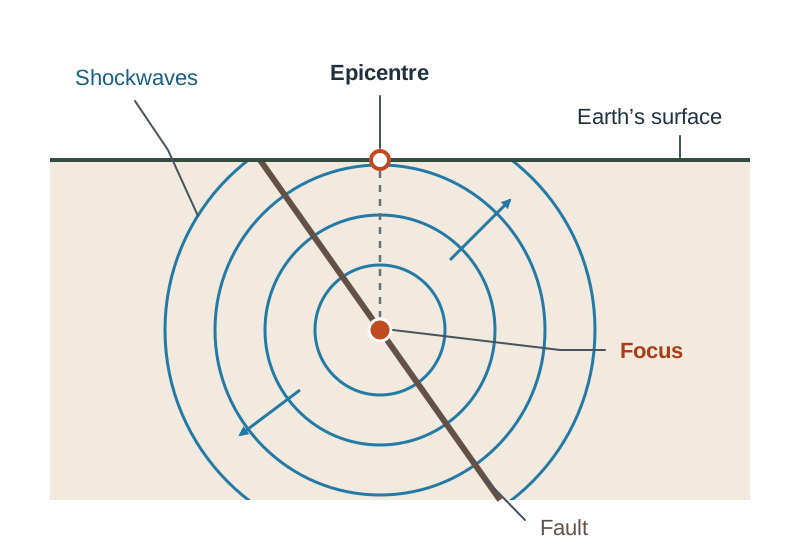
- Earthquakes happen when plates jam along a fault line, building pressure until rocks slip and release energy as shockwaves.
- The focus is the underground point where the rock slips and the earthquake rupture begins.
- The epicentre is the point on the Earth's surface directly above the focus, where ground shaking is strongest.
- Earthquake strength is called its magnitude, measured on the Richter scale using an instrument called a seismograph.
- An earthquake under the sea can suddenly lift or drop the seabed, sending huge waves called tsunamis racing towards the coast.
- Most volcanoes form where plates collide and one sinks beneath the other (the Pacific Ring of Fire) or where plates pull apart (Iceland).
- Volcanic eruptions bring both hazards and benefits. Lava and ash destroy homes and farmland, and ash clouds can ground aircraft, as seen when Eyjafjallajökull erupted in Iceland in 2010. However, volcanic activity also provides fertile soil, geothermal energy, and tourism.
Extreme Weather: Tropical Storms
Tropical storms are intense, rotating low-pressure systems that develop over warm tropical oceans.
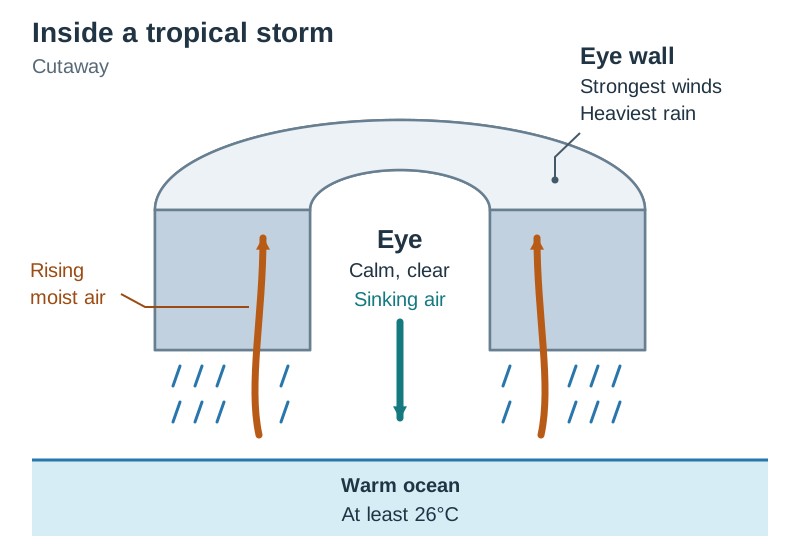
- They require ocean water temperatures of at least 26°C, causing rapid evaporation and strong rising air.
- The spin of the Earth makes the rising air start to rotate, and heat released as moist air condenses makes the winds stronger.
- A tropical storm is called a hurricane once its winds reach at least 119 km/h.
- The eye is the calm, clear centre of sinking air, while the surrounding eye wall contains the most violent winds and heaviest rainfall.
- Strong winds push seawater ashore, creating a destructive storm surge that floods coastal areas.
- In October 2017, ex-Hurricane Ophelia hit Ireland as a storm, triggering the first nationwide Status Red warning, closing all schools and causing three deaths.
Disaster Impacts and Economic Development
A country's wealth strongly affects its vulnerability to natural hazards.
| Factor | High-Income Countries (e.g. New Zealand, Japan) | Low-Income Countries (e.g. Haiti) |
|---|---|---|
| Building Quality | Strict building codes; reinforced steel frames and shock absorbers | Poorly built brick and block homes, which collapse easily |
| Emergency Response | Well-funded search-and-rescue teams, sirens and emergency text alerts | Damaged roads and ports delay aid; weak medical systems |
| Social Impacts | Far fewer deaths; rapid treatment of injuries | High death tolls; severe disease outbreaks such as cholera |
| Economic Impacts | High monetary repair bills, but covered by insurance and wealth | Less money lost in total, but rebuilding takes years and deepens poverty |
In 2010 two earthquakes of about magnitude 7 struck built-up areas: Haiti (January 2010) killed around 230,000 people and destroyed hospitals, while the Canterbury earthquake near Christchurch, New Zealand (September 2010) caused no direct deaths.
Managing Disasters: The Three Ps and Responses
Governments and communities reduce disaster damage through the Three Ps:
- Prediction: Monitoring warning signs such as gas leaks from volcanoes. Earthquakes cannot be predicted by exact date and time, making planning critical.
- Planning: Hazard mapping to prevent building on active fault lines or flood-prone coasts.
- Preparation: Conducting evacuation drills, such as Japan's 'duck, cover and hold', and keeping early-warning sirens and emergency text alerts working.
Disaster responses occur in two distinct stages:
- Short-term response: Immediate search and rescue, followed by emergency aid providing clean water, food rations, tents, and medical care. NGOs such as the Red Cross and MSF help distribute relief supplies.
- Long-term response: Rebuilding homes to stronger building codes, restoring transport and power networks, and providing development aid. Reconstruction can take years.
Key terms
- Focus
- The underground point where rock slips and an earthquake rupture begins.
- Epicentre
- The point on the Earth's surface directly above the focus, where shaking is strongest.
- Richter scale
- A scale from 1 to 10 used to measure the magnitude or energy released by an earthquake.
- Tsunami
- A series of massive ocean waves triggered when an undersea earthquake displaces the seabed.
- Storm surge
- A coastal rise in sea level caused by hurricane winds driving ocean water onto the land.
- Three Ps
- The hazard management framework consisting of prediction, planning, and preparation.
- Emergency aid
- Immediate short-term relief supplied to survivors, including clean water, food, shelter, and medical care.
Check yourself
What is the difference between an earthquake's focus and its epicentre?
The focus is the underground point where rock slips, while the epicentre is the surface point directly above it.
What minimum ocean water temperature is required for a hurricane to form?
A sea surface temperature of at least 26°C.
Name one negative effect and one positive effect of a volcanic eruption.
Negative: lava and ash bury homes and farmland. Positive: fertile volcanic soil or geothermal energy.
Name the instrument used to record the shockwaves of an earthquake.
A seismograph.
What is the difference between short-term and long-term disaster responses?
Short-term focuses on immediate survival (search and rescue, food, tents), while long-term focuses on rebuilding homes and infrastructure.