
This topic explores how inventors and engineers create practical solutions that shape everyday life, industry, and the environment. In the Junior Cycle examination, you will connect engineering disciplines to real-world applications, explain how innovations work, and evaluate their design factors and societal impacts.
Inventors, Engineers, and Design Factors
An inventor creates a new device, process, or method. An engineer applies scientific principles, mathematics, and materials to design, test, and manufacture practical solutions. The same person often does both.
- Engineering mindset: A systematic, cyclical approach to solving problems by testing prototypes and refining designs.
- Existing technologies: Solutions in widespread current use, such as LED lighting and diesel engines.
- Emerging technologies: New developments still being improved, such as self-driving vehicles and advanced robotics.
When developing products, engineers evaluate key factors that influence design:
- Function: what the product must do.
- Safety and cost: ensuring reliability within a set budget.
- Materials and manufacturing: choosing suitable, workable materials.
- Ergonomics: designing products for user comfort and safety, such as a shaped tool handle that reduces strain.
Engineering Disciplines and Everyday Applications
Engineering disciplines overlap, and major projects require different specialists working together.
| Discipline | Focus Area | Everyday Example |
|---|---|---|
| Civil (including structural) | Buildings, bridges, transport links, and water systems | Motorway flyovers and flood barriers |
| Mechanical | Moving machinery, mechanisms, and thermal systems | Car gearboxes, pumps, and wind turbines |
| Electrical and electronic | Power generation, circuits, and digital sensors | Solar inverters and microcontrollers |
| Biomedical | Devices and techniques that improve human or animal health | Artificial heart valves and prosthetic limbs |
| Environmental | Pollution control, recycling, and water treatment | Town water treatment plants |
| Agricultural | Food production, soil care, and crop handling | Automated milking machines and combine harvesters |
Irish Innovators and Their Impact
Irish innovators have developed technologies that solved major practical problems worldwide.
- John Philip Holland: Developed Holland VI, a practical submarine that entered US naval service in 1900.
- He combined an internal combustion engine for surface travel with electric battery power underwater.
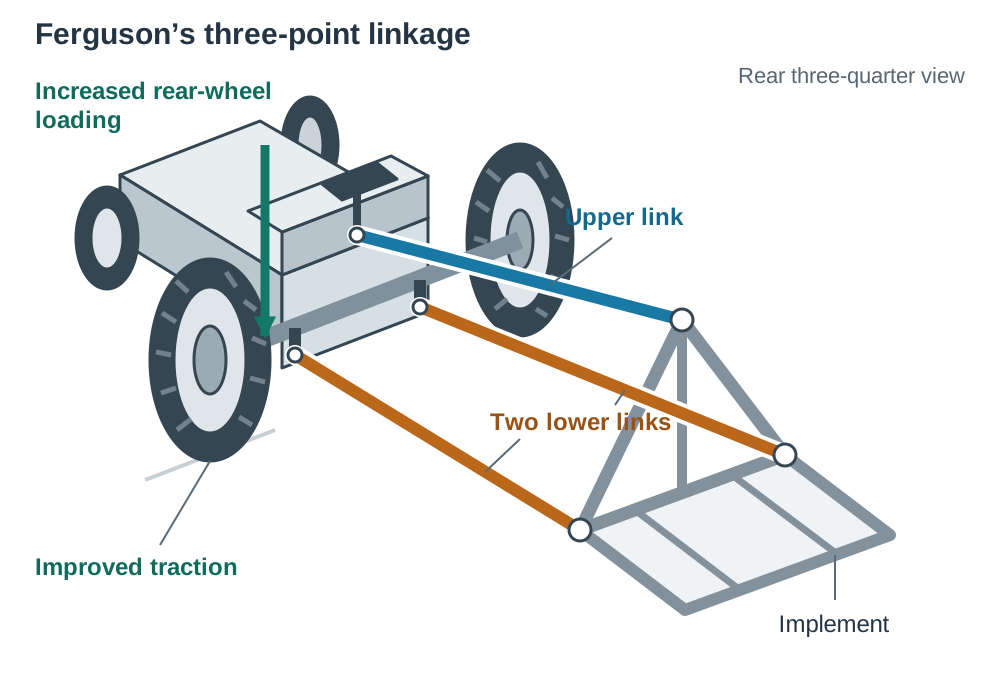
- Harry Ferguson: Invented the three-point linkage system for tractors.
- The linkage transferred weight to the tractor's rear wheels, improving traction and reducing the risk of rearing.
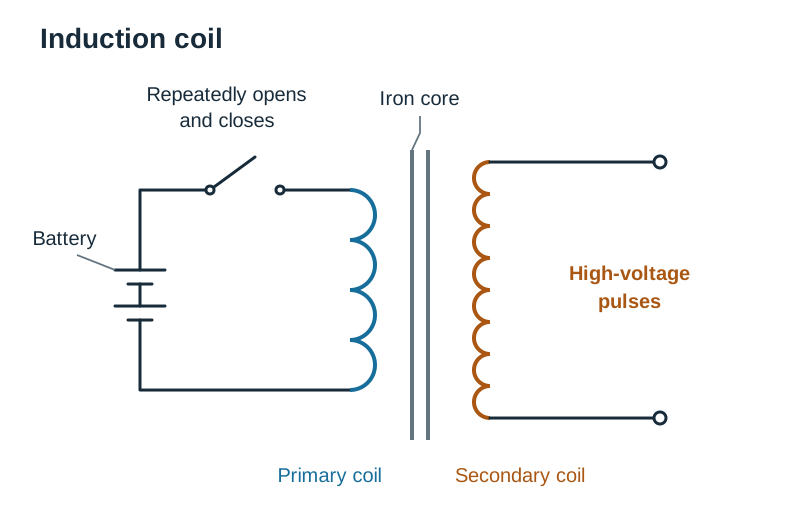
- Nicholas Callan: Invented the induction coil.
- Repeatedly interrupting current in one coil produces high-voltage pulses in a second coil.
- This principle is still used in car ignition coils and electrical transformers.
Mechatronics and Societal Impact
Mechatronics combines mechanical engineering, electronics, and computer software into automated systems. Every system uses an input, a process, and an output.
- In the home: a thermostat senses temperature (input), a controller processes it, and a switch activates the boiler (output).
- In the classroom: automatic doors use a motion sensor (input) and a controller (process) to drive an electric motor (output).
- In industry: automated factory robots carry out repetitive welding and assembly with high precision.
Every engineered product brings benefits and trade-offs:
- Positive impacts: Automation removes workers from hazardous jobs and increases manufacturing speed.
- Social trade-offs: Automation can replace manual jobs, requiring workers to retrain.
- Environmental trade-offs: Manufacturing electronics consumes scarce minerals and creates electronic waste.
- Sustainability: Meeting present needs while protecting resources for future generations by making products durable and recyclable.
Research Skills and the Learning Log
In Classroom-Based Assessment 1 (Engineering in action), you investigate an engineering application and record your progress in an individual learning log.
- Research may use primary methods, secondary methods, or both.
- Primary research gathers original data through surveys, measurements, or interviews.
- Secondary research uses existing information from books, reports, and websites.
- Record every source in your learning log so its reliability can be verified.
- Evaluate sources carefully by checking author credentials and looking for independent test results.
- Watch for commercial bias where a company promotes its own product rather than balanced facts.
- Reflect on what you learned, how your understanding changed, and how you completed the investigation.
Key terms
- Inventor
- A person who creates a new device, process, or method that did not exist before.
- Engineer
- A person who applies scientific principles, mathematics, and materials to design, build, test, and maintain practical solutions.
- Innovation
- Putting a new or improved product, process, or idea into practical use.
- Engineering Mindset
- A systematic, reflective approach to problem-solving based on cyclical designing, testing prototypes, and refining.
- Ergonomics
- Designing products, systems, and environments to fit the user's body, comfort, safety, and ease of use.
- Mechatronics
- The branch of engineering that combines mechanical components, electronics, and computer software into automated systems.
- Sustainability
- Meeting present needs while protecting resources and the natural environment for future generations.
Check yourself
Which engineering discipline is responsible for designing town water treatment systems and bridges?
Civil engineering.
What is ergonomics, and how does an adjustable tractor seat demonstrate it?
Designing products to suit the user's body and comfort; an adjustable seat adapts to different driver sizes to reduce strain and improve control.
Give one example of a control system in the home, naming its input and output.
A heating thermostat: the input is a temperature sensor, and the output is the boiler switching on or off.
How did Harry Ferguson's three-point linkage improve safety on farms?
It linked the tractor and plough into one unit, transferring implement weight forward to reduce the risk of the tractor rearing up.
Why must an engineering student look out for commercial bias when carrying out secondary research?
To ensure technical claims are factual and objective rather than promotional marketing designed to sell a product.