
Workshop health and safety covers the rules, protective gear, and habits that keep everyone safe while making projects, along with the features that make finished products safe to use. Practise recognising hazards and safety signs, stating suitable workshop precautions, and describing features that make products safe.
Hazards, Risks, and Workshop Rules
A hazard is anything with the potential to cause harm. A risk is the likelihood of that harm happening, combined with how severe the resulting injury might be. When you spot a hazard, you put a control measure in place to eliminate it or lower the risk.
General workshop rules protect everyone working in the room:
- Keep walkways and benches clear of schoolbags, offcuts, and trailing leads to prevent trips.
- Tie back long hair, secure loose clothing and drawstrings, and remove jewellery before using machinery.
- Walk at all times. Never run, rush, or distract someone operating a machine.
- Report all injuries, broken tools, spills, and near misses to your teacher immediately.
Safety Signs and PPE
Personal Protective Equipment (PPE) acts as a barrier against workshop hazards. Safety signs show what you must do, what is prohibited, and where emergency equipment sits.
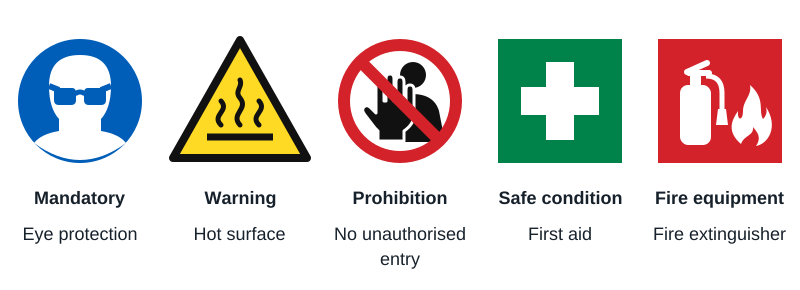
| Sign Category | Shape and Colour | Meaning and Example |
|---|---|---|
| Mandatory | Blue circle | Must do, such as wearing safety glasses |
| Warning | Yellow triangle | Danger warning, such as a hot surface |
| Prohibition | Red circle with diagonal crossbar | Not allowed, such as no unauthorised entry |
| Safe Condition | Green rectangle or square | Emergency aid, such as a first aid kit or fire exit |
| Fire Equipment | Red square | Firefighting gear, such as a fire blanket or extinguisher |
Always wear safety glasses when drilling, sawing, cutting, or using power tools. Do not wear gloves when using a pillar drill or scroll saw; they can catch in moving parts. Save gloves for handling hot acrylic or soldering work.
Safe Machine and Tool Practice
You should only operate workshop machinery with your teacher's permission and supervision.
| Machine or Tool | Key Safety Precautions |
|---|---|
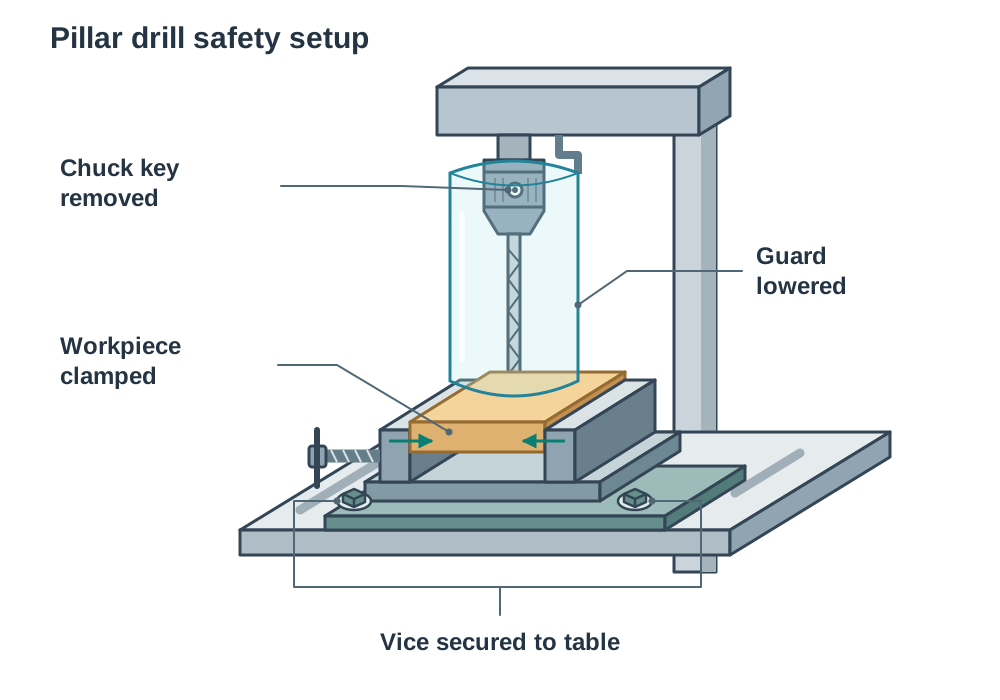
| Pillar drill | Clamp the workpiece in a vice secured to the drill table, remove the chuck key, and lower the guard. |
| Scroll saw | Set the hold-down foot flat against the workpiece and keep hands clear of the blade. |
| Power router | Clamp the material firmly to the bench and wait until the cutter stops before setting down. |
| Strip heater | Keep bare hands away from the hot element and wear heat-resistant gloves. |
| Soldering iron | Return the iron to its stand. Use the solder-fume extraction provided, keep your face out of the fumes, and wash your hands afterwards. |
Emergency Stops and Product Safety
An emergency stop stops machinery as quickly and safely as possible. Keep clear until all movement stops. Resetting permits a separate restart; it must not restart the machine.
Safety also applies to the artefacts you design and build for others:
- File away all rough burrs and round off sharp corners so edges cannot cut the user.
- On children's toys, avoid small detachable parts that could cause choking.
- Fasten battery covers with a small screw so young children cannot reach or swallow button cells.
- Apply only non-toxic, child-safe paints and finishes.
Key terms
- Hazard
- Anything in the workshop that has the potential to cause harm or injury.
- Risk
- The likelihood of a hazard causing harm combined with the severity of that injury.
- Control Measure
- A practical action taken to remove a hazard or reduce its risk, such as clamping material or wearing eye protection.
- Personal Protective Equipment (PPE)
- Gear worn by a worker, such as safety glasses or ear defenders, to guard against specific hazards.
- Emergency Stop
- An emergency stop stops machinery as quickly and safely as possible.
- Near Miss
- An unplanned event that did not result in an injury this time, but easily could have.
Check yourself
What is the difference between a hazard and a risk?
A hazard is anything that can cause harm, whereas risk is the chance of that harm happening and how severe it could be.
A power cable stretches across a workshop walkway. Identify the hazard and state one control measure.
The cable is a trip hazard; tape it down beneath a rubber cable bridge or re-route it along the wall.
What does a blue circular safety sign tell you to do?
It gives a mandatory instruction, such as an order to wear eye protection.
Why should you never hold a small workpiece in your bare hands while using a pillar drill?
The drill bit can snag the material and spin it violently, causing severe cuts or hand injuries.