
Transistors and microchips act as the switches and brains inside electronic circuits. For Junior Cycle Applied Technology, you need to understand how they process signals from sensors to control output devices like motors safely.
Transistors as Electronic Switches
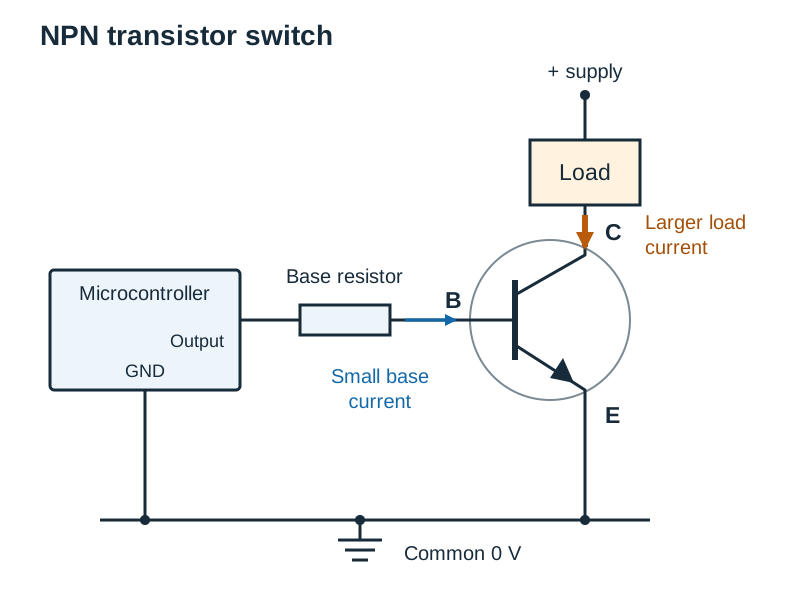
A transistor is an electronic component that switches power or amplifies weak electrical signals. In school projects, we mostly use NPN transistors as electronic switches.
- Base (B): Receives a small input current from a sensor or microcontroller.
- Collector (C): Connects to the positive supply through the load, such as a motor.
- Emitter (E): Connects to 0 V ground, with its circuit symbol arrow pointing outward.
A tiny current into the base opens the path between collector and emitter. This lets a much larger current flow to power an output device. We always put a base resistor in front of the base pin to protect the component from burning out.
Microchips and Microcontrollers
An integrated circuit (IC), or microchip, contains interconnected electronic components made on one small piece of semiconductor material.
- Fixed-function ICs: Built for one set job, such as 555 timers or audio chips.
- Microcontrollers: Programmable chips that store instructions to control whole systems.
- Printed Circuit Boards (PCBs): Copper tracks etched onto plastic boards to connect chips securely.
Microcontrollers carry out instructions in a step-by-step sequence. For example, the chip reads a sensor pin, checks a decision condition, and turns an output pin on or off. Testing your code in a digital simulation before building helps catch mistakes early.
Input, Process, and Output Flow
All automated technology systems work through three connected stages.
| Stage | Component | Job in the Circuit |
|---|---|---|
| Input | Sensor (e.g. LDR, thermistor) | A sensor circuit detects a change and provides an electrical signal. |
| Process | Microcontroller and transistor | The chip makes decisions; the transistor switches output power. |
| Output | Output device (e.g. motor, buzzer) | Produces the required effect, such as movement or sound. |
A microcontroller pin supplies limited current. A load needing more than its safe limit requires a suitable driver, such as a transistor. Direct connection can damage the pin.
Practical Uses and Environmental Impact
Solid-state electronics allow modern machines to be smaller, faster, and more efficient.
- In cars, microcontrollers process wheel speed signals to run anti-lock braking systems.
- In homes, automated heating controls save energy by shutting off radiators in empty rooms.
- Making silicon chips requires heavy amounts of energy, water, and rare raw minerals.
- Discarded gadgets create toxic electronic waste (e-waste) that harms soil and water unless recycled through specialist facilities.
Key terms
- Transistor
- A semiconductor component used as an electronic switch or an amplifier in circuits.
- Microchip (IC)
- An integrated circuit (IC), or microchip, contains interconnected electronic components made on one small piece of semiconductor material.
- Microcontroller
- A programmable microchip that reads sensor inputs and executes code to run outputs.
- Controlled System
- A system where components modify behaviour so that a machine works in a defined way.
- Simulation
- Imitating a situation or process using a mechanical, electrical or digital model.
- Actuator
- An output device that converts electrical energy into physical motion.
Check yourself
Which pin of an NPN transistor receives the small switching signal?
The base pin.
Why is a base resistor placed before the transistor base?
It limits the incoming current to protect the transistor and the microcontroller pin.
Which stage of a control system do microcontrollers and transistors belong to?
The process stage.
Why does a motor exceeding a pin’s current limit need a driver?
Direct connection can damage the pin.