

Topic 4.6 explores how energy is extracted from subatomic processes through Einstein's mass-energy equivalence, E = mc². You will learn how mass defect accounts for the energy released in nuclear fission, self-sustaining chain reactions, nuclear fusion, and positron–electron annihilation. You will also examine the engineering physics of fission reactors and learn how to critically evaluate secondary evidence regarding nuclear electrical generation, addressing sustainability, waste, and safety.
Mass-Energy Equivalence ($E = mc^2$)
Mass and energy are equivalent and interconvertible. Einstein showed that mass is a concentrated form of energy related by:
Here, is energy in joules (J), is mass in kilograms (kg), and is the speed of light in a vacuum (). Because is such a huge number (), even a tiny loss of mass gives an enormous amount of energy. Losing just one gram of mass would release about .
Chemical reactions involve mass changes too, but they are around a million million times smaller — of the order of for a whole mole of reactants — so no laboratory balance could ever detect them. In nuclear reactions the mass change is large enough to measure, and it reappears as kinetic energy of the products and as high-energy gamma photons.
In any nuclear reaction that releases energy, the total mass of the products is less than the total mass of the reactants. The difference is the mass defect ():
Nuclear masses are routinely stated in unified atomic mass units (u), where . To calculate energy in joules using , always convert atomic mass units into kilograms first. Alternatively, when working directly in mega-electronvolts, is equivalent to .
The same four steps — reactant mass, product mass, mass defect, and — apply to the Cockcroft and Walton proton-lithium reaction, radioactive decay, fission, and fusion. Learn this method once and it works for every nuclear energy calculation the paper can set.
Binding Energy per Nucleon: Why Fission and Fusion Release Energy
The binding energy of a nucleus is the minimum energy required to pull it completely apart into separate protons and neutrons. Dividing this value by the mass number gives the binding energy per nucleon, which measures how tightly bound and stable each nucleon is within that nucleus.
Plotting binding energy per nucleon against nucleon number reveals a distinctive curve:
- The curve rises sharply for very light nuclei ().
- It reaches a broad maximum near nucleon number 56 (iron, ), at roughly per nucleon. Iron-56 is the most stable nucleus.
- It slopes gently downwards for heavier nuclei, falling to around per nucleon for uranium-235.
Energy is released whenever a nuclear transformation produces daughter nuclei that are closer to the iron peak, because more tightly bound nucleons have less mass per nucleon:
- Nuclear fission: A very heavy, less stable nucleus splits into two medium-sized fragments closer to the peak. The nucleons become more tightly bound, mass is lost, and energy is released.
- Nuclear fusion: Two light nuclei combine to form a heavier nucleus closer to the peak. The nucleons become more tightly bound, mass is lost, and energy is released.
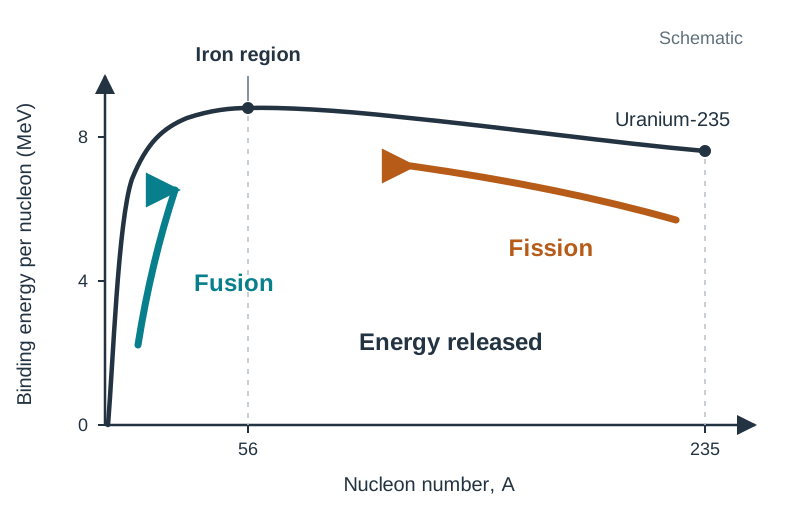
Moving away from the peak requires energy to be supplied. You cannot extract energy by fusing iron or by splitting carbon.
Nuclear Fission and Balancing Equations
Nuclear fission is the splitting of a large, heavy nucleus into two smaller nuclei of roughly equal size, accompanied by the release of neutrons and energy.
Finding Missing Neutrons
Exam questions regularly name the fissile target and fragments, stating that 'some neutrons' are released. You must balance the nucleon numbers (top) and atomic numbers (bottom) to find the unknown coefficient before calculating any mass defect.
Suppose uranium-235 captures a slow neutron and splits into barium-139 and krypton-94:
- Balance nucleon number (top): .
- Verify atomic number (bottom): . This balances.
The complete balanced equation is:
Conserving nucleon number does not mean mass is conserved. The three emitted neutrons must be included on the product side when calculating the total mass defect.
Chain Reactions and Fission Reactors
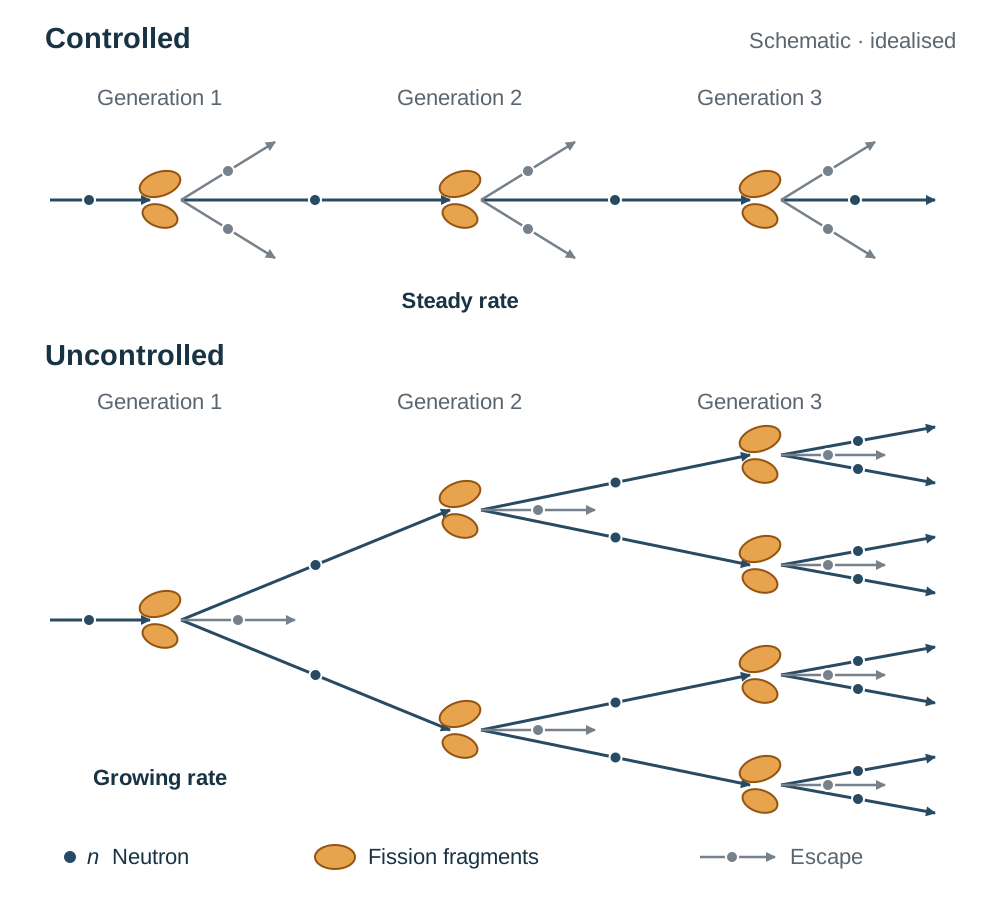
Because each fission event liberates two or three fast neutrons, these can strike neighbouring fissile nuclei and cause further fissions, creating a chain reaction.
- Critical mass: The minimum mass of fissile material required to sustain a self-maintaining chain reaction. Below this mass, too many neutrons escape through the surface without colliding with nuclei.
- Controlled chain reaction: Exactly one neutron from each fission event triggers a subsequent fission. Energy output remains steady, which is the operational principle of commercial nuclear power stations.
- Uncontrolled chain reaction: More than one neutron per fission triggers further events. The reaction rate grows exponentially in microseconds, releasing catastrophic energy, as in nuclear weapons.
Core Reactor Components
A commercial reactor converts nuclear fission energy into heat to raise steam for an electrical turbine.
- Fuel rods: Contain enriched uranium (3–5% , with the rest ).
- Moderator: A material made of light nuclei — graphite or heavy water () — placed around the fuel rods. Fast neutrons collide with these light nuclei and lose kinetic energy, slowing down to 'thermal' speeds where they are far more likely to cause further fission in uranium-235.
- Control rods: Rods of a neutron-absorbing material such as boron or cadmium steel. Lowering them into the core absorbs more neutrons and slows the reaction; raising them lets the fission rate increase; dropping them fully in shuts the reactor down.
- Coolant: Fluid (such as pressurised water or carbon dioxide gas) pumped through the core to extract thermal energy and carry it to an external heat exchanger.
- Shielding: Thick internal steel lining and external high-density reinforced concrete walls to absorb stray neutrons and penetrating gamma rays.
Exam distinction: the moderator slows fast neutrons down by collisions so that they can cause further fission. The control rods absorb neutrons to control or stop the rate of reaction. Mixing up these two jobs is the commonest way marks are lost here.
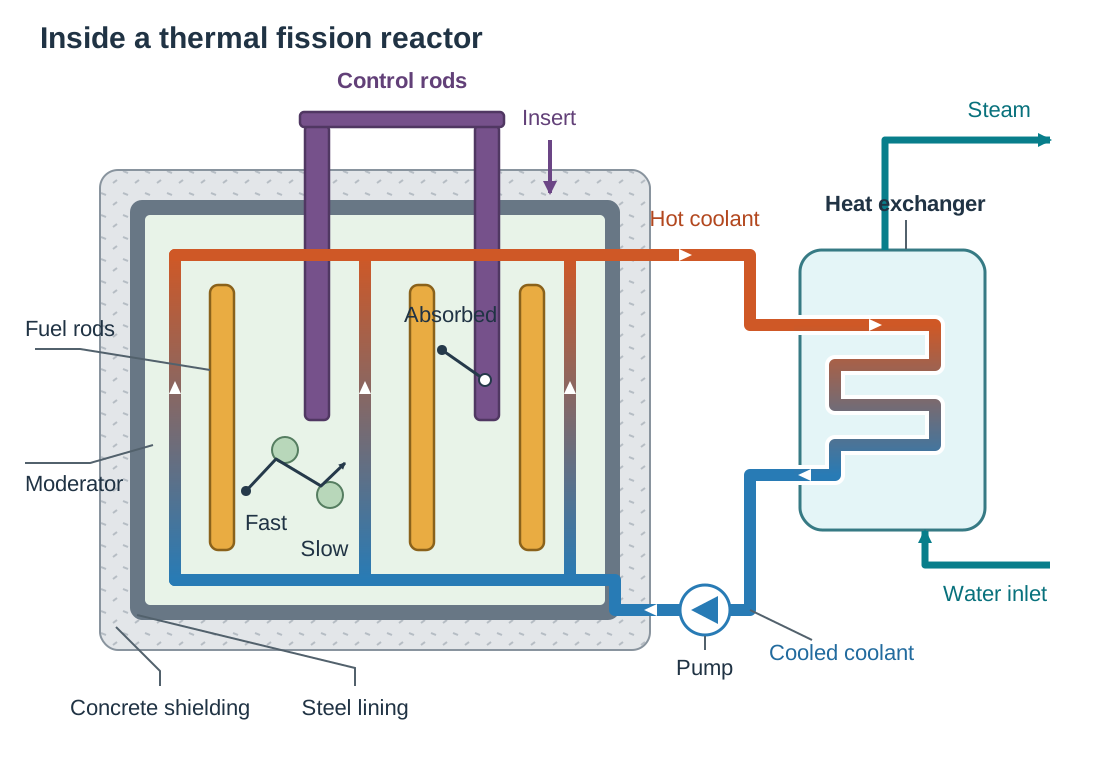
Even after control rods are fully dropped in and the chain reaction ceases, radioactive fission fragments continue to release decay heat, so coolant pumps must keep operating. A loss of emergency coolant power was the direct cause of the core meltdowns at Fukushima in 2011.
Nuclear Fusion and the Coulomb Barrier
Nuclear fusion is the joining together of two light atomic nuclei to form a single, heavier nucleus, accompanied by the release of energy.
Fusion powers the Sun. On Earth, experimental reactors use the hydrogen isotopes deuterium () and tritium ():
Because both nuclei carry positive proton charges, they experience powerful electrostatic repulsion (Coulomb barrier). For the short-range attractive strong nuclear force () to take over, the nuclei must collide at tremendous velocities.
To get nuclei moving fast enough, the fuel has to be heated to over 100 million kelvin (). At that temperature the atoms are completely stripped of their electrons, forming a plasma — a hot gas of bare nuclei and free electrons. Magnetic confinement facilities, such as tokamaks, use powerful magnetic fields to keep the plasma away from physical walls. While net energy output has been demonstrated in brief experimental pulses, sustained commercial electrical delivery to the grid has not yet been achieved.
Fission vs Fusion at a Glance
| Feature | Nuclear Fission | Nuclear Fusion |
|---|---|---|
| What happens | A heavy nucleus splits into two smaller nuclei | Two light nuclei join to form one heavier nucleus |
| Typical fuel | Uranium-235, plutonium-239 | Deuterium and tritium (hydrogen isotopes) |
| Trigger condition | Absorption of a slow (thermal) neutron | Temperature to overcome Coulomb repulsion |
| By-products | 2–3 neutrons, radioactive fission fragments | Helium nucleus, 1 neutron |
| Energy yield | per event | per event (far higher energy per kg of fuel) |
| Status | Mature commercial technology in power grids | Experimental; zero commercial power plants operational |
Particle–Antiparticle Interactions
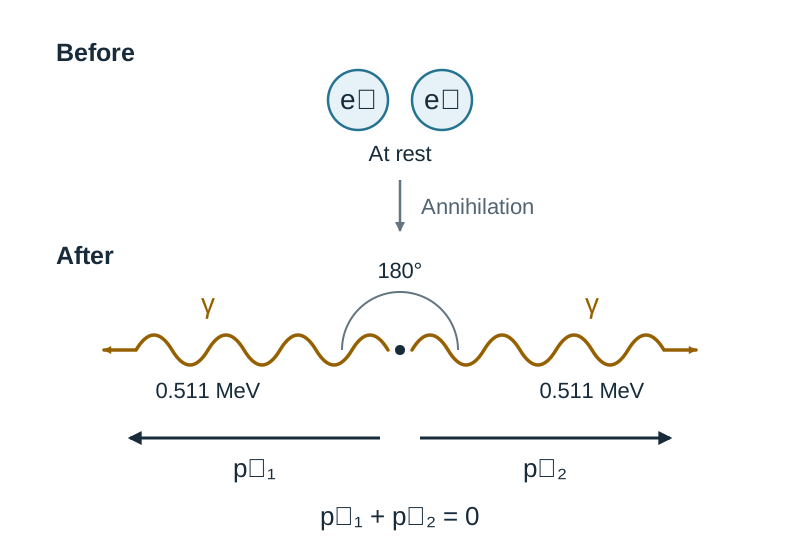
Every fundamental matter particle has an antiparticle with identical mass but opposite charge. When they meet, annihilation occurs: both particles disappear, converting their combined rest mass entirely into high-energy photons.
For positron–electron annihilation:
Two gamma photons must be produced rather than one because of conservation laws:
- Conservation of charge: Initial charge is , matching two neutral photons.
- Conservation of linear momentum: When an electron and positron annihilate at rest, the total initial momentum is zero. Because a photon always carries momentum (), a single emitted photon could never have zero momentum. Therefore, two identical photons must be emitted in opposite directions ( apart) so their momentum vectors cancel.
Each photon receives the rest energy of one electron (). This reaction is applied in medicine in Positron Emission Tomography (PET) scanning.
The Reverse Process: Pair Production
In pair production, a single high-energy gamma-ray photon interacts near a heavy atomic nucleus, disappears, and creates a particle–antiparticle pair:
The incoming photon must supply at least the rest energy of both particles:
Any photon energy exceeding becomes kinetic energy shared by the electron and positron.
Evaluating Nuclear Power in Electrical Generation
You are expected to weigh up evidence about using nuclear fission and fusion to generate electricity, drawing on information gathered by others (secondary sources). In physics, 'evaluate' means setting out the evidence on both sides, identifying potential source bias, and finishing with a justified conclusion.
Energy Density: Why Fission Uses So Little Fuel
One kilogram of uranium-235 contains approximately nuclei. At () per fission:
Burning of coal releases roughly . Thus, of uranium-235 releases about the same energy as 2,700 tonnes of coal. This immense energy density is the central physics reason nuclear plants require so little fuel volume.
Evidence for and Against Fission Power
When writing an evaluation answer, lift specific evidence points:
- Evidence for fission:
- Zero direct emissions during generation, aiding greenhouse gas reduction.
- Immense energy density (), requiring minimal fuel transport.
- Provides steady, predictable baseload power independent of weather conditions.
- Evidence against fission:
- Spent fuel rods constitute high-level radioactive waste that requires deep geological storage for thousands of years.
- Fission plants carry multi-billion euro capital construction costs and take over a decade to build.
- Severe cooling failures can contaminate large geographical regions (e.g. Chernobyl 1986, Fukushima 2011).
- Evidence on fusion:
Deuterium is abundant in seawater and fusion cannot melt down (loss of confinement halts the plasma instantly). However, tritium must be bred from lithium and is radioactive, structural reactor walls undergo neutron activation, and commercial viability remains decades away.
- Evaluating sources for bias:
Check whether reports originate from nuclear industry bodies, fossil-fuel lobbies, anti-nuclear campaign groups, or independent peer-reviewed scientific journals. In Ireland, commercial nuclear fission electricity generation is prohibited under the Electricity Regulation Act 1999.
Key terms
- Nuclear fission
- The splitting of a large, heavy atomic nucleus into two smaller nuclei of roughly equal size, accompanied by the release of neutrons and energy.
- Nuclear fusion
- The joining together of two light atomic nuclei to form a single, heavier nucleus, accompanied by the release of energy.
- Mass defect
- The difference between the total rest mass of the reactants and the total rest mass of the products in a nuclear reaction.
- Binding energy per nucleon
- The total binding energy of a nucleus divided by its number of nucleons; a measure of how tightly bound and stable the nucleus is.
- Chain reaction
- A self-sustaining process in which neutrons released by one fission event trigger further fission reactions in neighbouring nuclei.
- Critical mass
- The minimum mass of fissile material required to sustain a self-maintaining chain reaction.
- Moderator
- A material in a nuclear reactor (such as graphite or heavy water) that slows down fast neutrons to thermal speeds without absorbing them.
- Control rods
- Rods of neutron-absorbing material (such as boron or cadmium) that are inserted into or withdrawn from a reactor core to regulate the reaction rate.
- Plasma
- A state of matter consisting of a high-temperature gas of bare atomic nuclei and free electrons.
- Annihilation
- The process in which a particle collides with its antiparticle, resulting in the destruction of both and the conversion of their mass into electromagnetic radiation.
Check yourself
A fission reaction is written as ²³⁹₉₄Pu + ¹₀n → ¹³⁴₅₄Xe + ¹⁰³₄₀Zr + x ¹₀n. Find x.
Balance the nucleon numbers: 239 + 1 = 134 + 103 + x, so 240 = 237 + x, giving x = 3. Check atomic numbers: 94 + 0 = 54 + 40 + 3(0) = 94.
Distinguish between the role of the moderator and the role of the control rods in a nuclear reactor.
The moderator (graphite or heavy water) slows down fast neutrons produced by fission so that they are more likely to cause further fission. The control rods (boron or cadmium) absorb neutrons to control the rate of the chain reaction.
An electron and a positron at rest annihilate. State the energy of each gamma photon produced in MeV, and explain why they travel in opposite directions.
0.511 MeV each. The pair was at rest so initial momentum was zero; the two photons must carry equal and opposite momentum, meaning they travel 180° apart.
Explain using the binding energy curve why both nuclear fission and nuclear fusion release energy.
The binding energy per nucleon curve peaks at iron-56. Fusion joins light nuclei and fission splits heavy nuclei; both reactions move the resulting nucleons towards the iron peak, increasing binding energy per nucleon and releasing the mass difference as energy.
Calculate the energy released in joules when a mass defect of 2.50 × 10⁻²⁹ kg occurs in a nuclear reaction. (c = 3.00 × 10⁸ m s⁻¹)
E = (Δm)c² = (2.50 × 10⁻²⁹ kg) × (3.00 × 10⁸ m s⁻¹)² = 2.25 × 10⁻¹² J.