

From Plum Pudding to Rutherford's Nuclear Atom
In 1897, J.J. Thomson discovered the electron. Because matter is electrically neutral in ordinary conditions, Thomson proposed the plum pudding model: an atom was imagined as a sphere of uniform positive charge with negatively charged electrons embedded throughout it like raisins in a pudding.
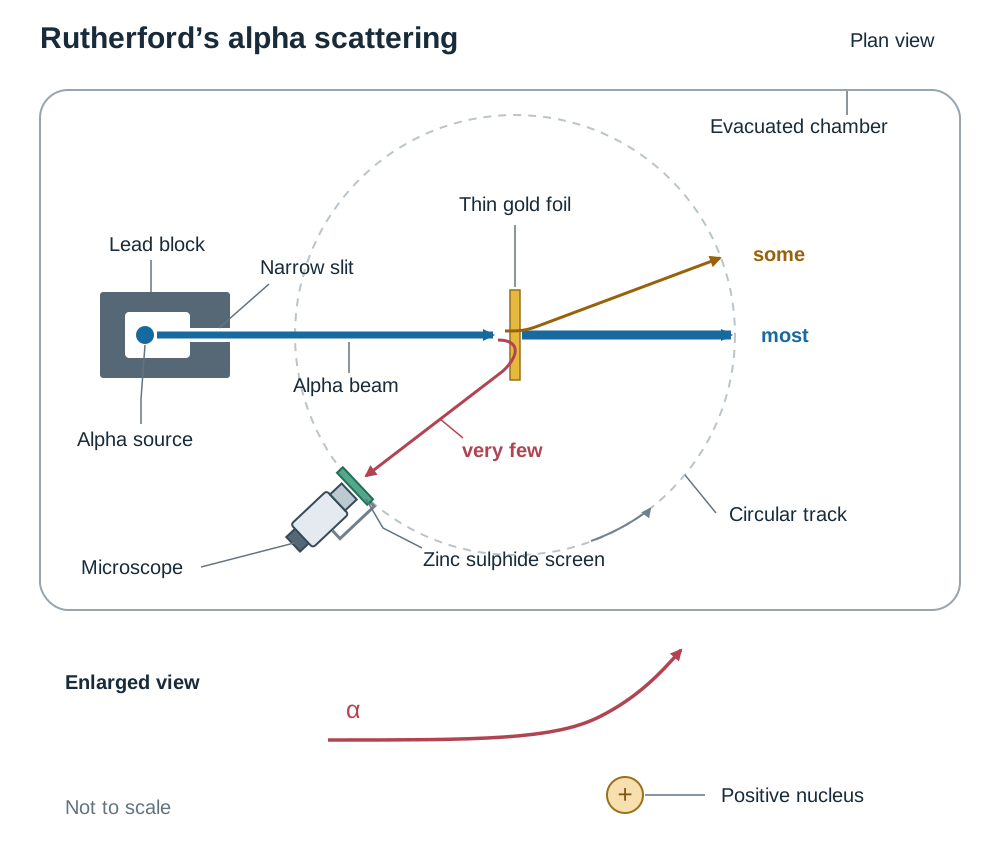
Between 1909 and 1911, Hans Geiger and Ernest Marsden, carrying out experiments directed by Ernest Rutherford, tested this model by firing high-speed alpha particles ( nuclei) at an extremely thin sheet of gold foil (around 2,000 atoms thick) inside an evacuated chamber.
Experimental Setup and Diagram
To draw the Geiger-Marsden apparatus:
- A radioactive alpha source is placed inside a heavy lead block with a narrow exit slit to produce a thin, straight beam.
- A thin sheet of gold foil stands at the centre of the chamber.
- A zinc sulphide screen attached to a microscope acts as the detector. It can be rotated on a circular track all the way around the gold foil.
- The entire apparatus is enclosed in an evacuated container so that air molecules do not absorb or deflect the alpha particles.
- Label arrows show: most alpha particles passing straight through, some deflecting through small angles, and a tiny number bouncing backwards.
Observations and Conclusions
Thomson's model predicted that positive charge was spread thinly throughout each atom, meaning the alpha particles would feel negligible electrostatic force and pass straight through with deflections of less than a degree. The experimental findings contradicted this:
- Most alpha particles passed straight through undeflected: This demonstrated that the atom is mostly empty space.
- Some alpha particles were deflected through small angles: This showed that an electrostatic repulsive force acts on alpha particles when they pass near a concentration of positive charge.
- A tiny fraction (roughly 1 in 8,000) was deflected through angles greater than , with some rebounding almost backwards: This showed that the positive charge and nearly all the mass of the atom are concentrated in a small, dense, positively charged nucleus.
Rutherford published his nuclear model in 1911. His calculations established that the nucleus has a radius of roughly , whereas the whole atom has a radius of about . The nucleus is tens of thousands of times smaller than the atom itself.
The Bohr Model, Line Spectra, and the Universe
Rutherford's planetary model had a severe limitation under classical physics: an orbiting electron accelerates continuously, which means it should continuously radiate electromagnetic energy, spiral inward, and collapse into the nucleus within a fraction of a microsecond. Furthermore, glowing low-pressure gases emit discrete lines of colour rather than a continuous rainbow.
In 1913, Niels Bohr resolved this by introducing quantum rules:
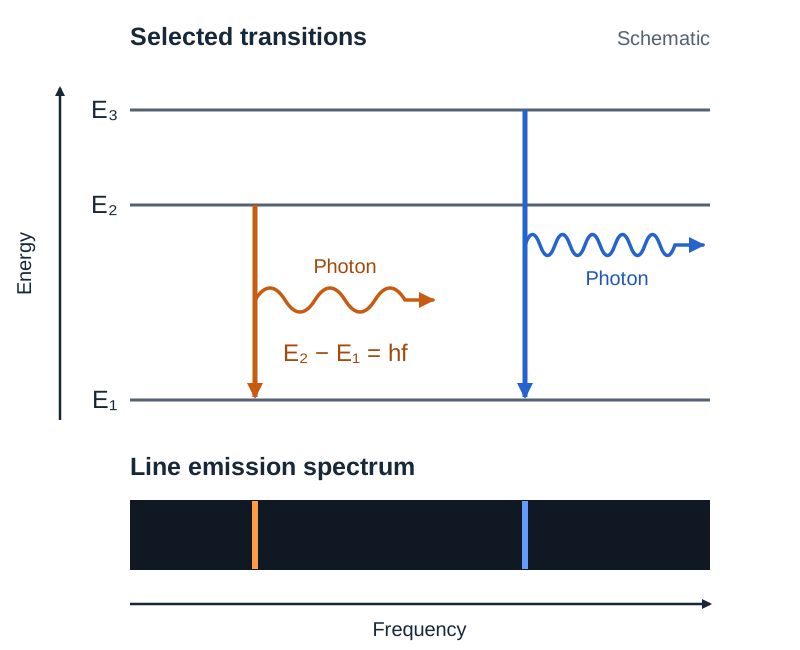
- Electrons can only occupy certain stable, non-radiating circular orbits known as energy levels.
- An electron in an allowed orbit has a fixed, discrete energy. The lowest level is the ground state (); higher levels () are excited states.
- An electron can absorb a photon to jump to a higher excited state. When an excited electron falls from a higher level to a lower level , it emits a single photon whose energy equals the difference between the two states:
Using , the wavelength of the emitted light is:
Where is Planck's constant () and is the speed of light in a vacuum ().
Because each chemical element has a unique nuclear charge and arrangement of electrons, each element possesses a unique set of allowed energy levels. Therefore, excited atoms of a gaseous element produce a characteristic line emission spectrum (sharp, coloured lines on a dark background). Dense, glowing solids or liquids produce a continuous spectrum containing an unbroken band of wavelengths.
Spectra and the Universe
Every element produces its own set of spectral lines, acting like a chemical fingerprint. Astronomers split starlight into a spectrum using spectrometers (spectroscopy) and match the lines to laboratory measurements:
- Composition of stars: Identifying specific emission and absorption lines reveals which elements make up the star (principally hydrogen and helium).
- Discovery of helium: In 1868, an unknown bright yellow line was observed in the Sun's spectrum. The element was named helium (from the Greek helios, Sun) decades before it was discovered on Earth.
- Absorption lines: Cooler gases in a star's outer atmosphere absorb the exact photon frequencies that their atoms would emit when excited, leaving dark lines across the continuous spectrum.
- Motion of galaxies: When a star or galaxy moves away from Earth, its observed spectral lines shift toward longer wavelengths (red shift). Distant galaxies exhibit large red shifts, providing key evidence that the universe is expanding.